
This page is about Lina’s Family Class 1 — NCERT Class 1 Maths Chapter 7 in the Joyful Mathematics textbook. It introduces measurement: tallest and shortest people, longest and thickest things, measuring with handspan and footspan, heavier and lighter, and how much water different containers hold.
The official Lina’s Family Class 1 chapter PDF is below, followed by a plain walkthrough of every scene and activity in the chapter.
Download Lina’s Family Class 1 NCERT Chapter PDF
Open the official Lina’s Family Class 1 chapter PDF on the NCERT textbooks portal to read the chapter exactly as it is printed in the Joyful Mathematics book, with every picture scene and activity included. NCERT publishes the file free of cost, so this is the version a student should read.
Chapter at a Glance: What Is Inside the PDF
The table below lists what the chapter holds at a glance. This is a picture-led, activity-led chapter: it teaches through scenes to look at, answers to tick, circle and colour, and measuring tasks the child does with their own hands and feet.
| What the chapter holds | Count | Where it is used |
|---|---|---|
| Printed pages | 12 | |
| Figures with NCERT captions | 8 | |
| Tables | 4 | |
| Activities | 4 | |
| Official NCERT PDF | Download the chapter PDF | the chapter exactly as NCERT publishes it |
What Lina’s Family Class 1 Actually Teaches
Children of this age cannot yet read a ruler, so the book builds measurement the way children naturally compare things: first sizes, then positions, then measuring with body parts, and finally connecting measurement to real choices such as saving water.
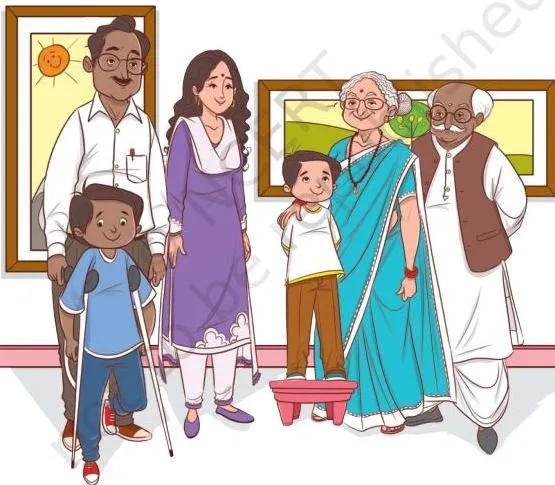
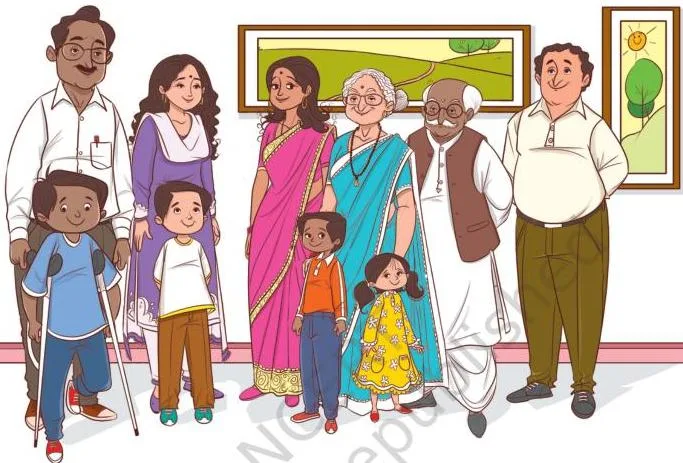
- The chapter opens with Lina’s family get-together. The child finds the tallest member, ticks the tallest, draws a cap on the shortest, and answers who is taller than Lina’s mother but shorter than Lina’s father.
- A village scene follows, with Lina’s hut-shaped house in a hilly area. The child locates her house, then decides what is nearest to and farthest from the shop, the school and the school bus.
- An Amazing Facts box introduces the Statue of Unity, the tallest statue in the world, so “tallest” connects to a real landmark.
- Comparison rows ask the child to tick the longest, shortest, thickest and thinnest object in each pair.
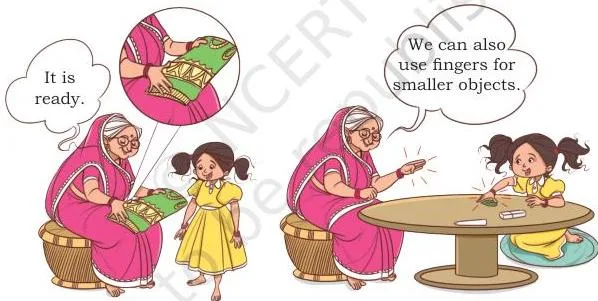
- The handspan section begins with Dadi checking the length of Chitra’s sweater. The child then measures tables, bags, blackboards and arms in handspans, switches to fingers for tiny objects and footspan for floor distances, and records a guess before every finding.
- Heavier and lighter picture pairs follow, with a classroom talk about how two weights can be compared.
- Water activities close the chapter: filling a bucket with jugs, glasses and bowls, finding which bottle holds more, and choosing the right amount of water for each daily job.
The order matters: comparison comes before measuring, and measuring before real-world decisions such as how much water a job needs.
Key Concepts in Lina’s Family Class 1
Non-standard measurement means measuring with a body unit such as a handspan or footspan instead of a ruler. Class 1 starts here because every child always carries these tools with them, and because counting “how many handspans” teaches the idea of a unit before centimetres are ever named.
Tallest and Shortest: Comparing People
Lina lives with her grandparents, parents and brother Shanbor, and her uncles, aunts and cousins live near, so the family scene has plenty of people to compare. Tallest means the person whose head is highest; shortest means the person whose head is lowest. The child circles the tallest member, ticks the tallest, and draws a cap on the shortest.
The talking questions push further: who is taller than Lina’s mother but shorter than Lina’s father, and who is the tallest child in the class? These force the child to compare two people at a time instead of guessing.
Nearest and Farthest: Comparing Positions
Nearest to means the smallest distance away; farthest from means the biggest distance away. In the village scene the child locates Lina’s hut-shaped house and decides whether it is nearest to or farthest from the shop and the school. The same choices repeat for the school bus and the red-roofed house, giving position words plenty of practice.
Long, Short, Thick and Thin: Comparing Things
Long and short describe how far something stretches; thick and thin describe how much space it takes across. The tick tasks present pairs of pictures — the child chooses the longest, shortest, thickest and thinnest. The drawing tasks turn the same idea around: draw a stick longer than the one shown, and a rope shorter than the one shown.
Measuring with Handspan, Fingers and Footspan
A handspan is the distance from thumb tip to little-finger tip with the hand stretched flat. To measure, the child places the hand at one end, marks where the thumb reaches, moves the hand so the little finger starts at that mark, and counts. This is the chapter’s measuring method, and it works before a child can read a ruler.
A worked handspan comparison shows how to read the answer. Suppose the dining table takes six handspans and the school bag takes two — six is more than two, so the table is longer than the bag. If the last span falls short of the end, the honest answer is “about six handspans and a bit”.
The chapter then asks a sharp question: can a handspan measure everything? A pencil, a key or a friend’s nose is shorter than one handspan, so fingers give the better answer there.
For floor distances, such as the gap between a seat and the classroom door, the footspan is the matching tool — one foot placed heel-to-toe ahead of the other, with the child counting how many feet the distance takes.
Heavier and Lighter: Comparing Weight
Heavier and lighter compare how much an object weighs. The picture tasks ask the child to tick the heavier object and the lighter object, then colour the heavier and lighter ones in four more pairs.
The discussion prompt makes the method explicit: hold one object in each hand and feel which pulls down more, or check on a weighing machine — which is where weight is usually measured at home or at a clinic.
The Project Work extends the same idea by asking which things are easy to carry and which are difficult to carry; the difficulty usually comes from weight.
Holds More, Holds Less: Comparing Capacity
Holds more and holds less compare how much water a container can take — its capacity. The water tasks keep the comparison fair by using the same cup for both bottles: count the cups, and the bottle that takes more cups holds more.
Filling one bucket first with jugs, then with glasses, then with bowls shows the same idea from the other side — bigger containers take fewer fills.
Water for Daily Jobs, and Saving Water
The closing picture activity asks the child to choose how much water a job really needs. The rule the chapter is teaching: the smallest container that does the job is the right one.
- Brushing teeth takes a mug, not a bucket full of water.
- Bathing takes a bucket, not a shower or running tap.
- Two glasses of lemon water take a jug, not a bucket.
- Watering a plant takes a mug, not a bucket.
- Water left in a glass can be given to the plants instead of thrown away.
- Save water by closing the tap when it is not in use and by reusing water.
Picture Walkthrough: Reading the Chapter’s Scenes

The chapter teaches through pictures rather than written definitions, so the value is in what the child notices. Here is what to look for in each scene, in the order the book uses it.
- Family get-together. A crowd of relatives, with Lina standing on a stool because she likes to be tall. Find the tallest member and circle them.
- Village scene. A hut-shaped house in a hilly area. Locate Lina’s house, then decide what is nearest to and farthest from the shop, the school, the school bus and the red-roofed house.
- Amazing Facts. The Statue of Unity, the world’s tallest statue, in Gujarat — a real-life example of “tallest”.
- Comparison rows. Pairs of objects where the child ticks the longest, shortest, thickest and thinnest.
- Handspan scene. Dadi measuring Chitra’s sweater with a handspan, beside tasks to draw a stick longer and a rope shorter than the samples.
- Handspan measures. Finding how many handspans long the table, bag, blackboard, Maths book and arms are, and circling the things shorter than a handspan.
- Guess-then-measure table. Choosing handspan or fingers for a bottle, spoon, pencil, friend’s nose, leg and key — guess first, measure second — then footspan for four floor distances.
- Heavier and lighter pairs. Ticking the heavier object, then the lighter one, then colouring the heavier and lighter objects in four more pairs.
- Water pictures. A bucket being filled with jugs, glasses and bowls, two bottles compared with the same cup, and the mug-versus-bucket choices for daily jobs.
- Project Work. Paper strips pasted short and long, lists of things easy and difficult to carry, and the talk about bathing with a bucket instead of a shower or running tap.
Measurement Words in Lina’s Family, Explained
The chapter never prints written definitions — the pictures do the teaching. This table puts each word into plain language for the adult helping at home.
| Word | What it compares | Plain meaning |
|---|---|---|
| Tallest | Height of people and standing things | The one whose top is highest — circle the tallest member in Lina’s family. |
| Shortest | Height | The one whose top is lowest — draw a cap on the shortest family member. |
| Longest | Length of things that stretch out | The one that stretches the most — tick the longest stick or rope. |
| Thickest | Thickness across an object | The one that is broad or bulky — tick the thickest in the pair. |
| Thinnest | Thickness across an object | The one that is slim — tick the thinnest in the pair. |
| Nearest to | Distance and position | The closest thing to a place — is Lina’s house nearest to the shop or the school? |
| Farthest from | Distance and position | The thing with the biggest gap between it and another place — is the school farthest from the shop? |
| Heavier | Weight | The one that presses down more — tick the heavier object in each pair. |
| Lighter | Weight | The one that weighs less — colour the lighter object. |
| Handspan | Length, measured with the hand | The distance from thumb tip to little-finger tip with the hand stretched — check a table’s length in handspans. |
| Footspan | Length, measured with the foot | The length of one foot, used heel-to-toe for distances on the floor. |
| Holds more / holds less | Capacity (how much water fits) | Which container takes more or fewer cups of water — count with the same cup. |
Common Mistakes Students Make with Lina’s Family Activities
These mistakes are not about wrong answers; they are about measuring in a way the child cannot check. The chapter is designed so these errors surface — the guess column exists precisely so a child can see the difference between predicting and measuring.
| Mistake | Correct rule | How to check your answer |
|---|---|---|
| Guessing without measuring | The guess is a prediction; the finding is the answer. The chapter prints both columns side by side. | Look at the “My findings” column — were hands or fingers actually laid along the object and counted? |
| Using handspan for tiny objects | Handspan suits tables, bags and books; fingers suit a pencil, key or friend’s nose. | If the object fits inside one stretched hand, switch to fingers. |
| Mixing taller with longer | Taller belongs to height — people and standing things; longer belongs to length — sticks, ropes, tables. | Ask: does it stand up (height) or stretch out (length)? |
| Choosing a bucket for brushing teeth | A mug of water is enough for brushing; a bucket would waste the rest. | Tick the smallest container that completes the job. |
| Judging capacity by how a container looks | A tall thin bottle can hold less than a short wide one; only pouring tells. | Fill both bottles with the same cup and count the fills. |
How Class 1 Checks the Ideas in Lina’s Family
This chapter has no formal exercise block with numbered questions, so the check is the doing. Can the child compare honestly, measure with the right body unit, explain the choice, and say how much water each job needs?
- Observation tasks: the child ticks, circles and colours the correct object in the picture tasks.
- Measuring tasks: the child places hand or foot without gaps and counts the spans correctly.
- Reasoning: the child can say why fingers beat a handspan for a pencil, and why a mug beats a bucket for brushing.
- Discussion: the Let us Talk and Project Work prompts are for classroom talk; the teacher listens for the reason, not just the word.
Textbook contents and the examinable syllabus are not always identical — for Class 1, check the current official syllabus on the CBSE website to see how skills like these are recorded in your school year.
Quick Revision Map for Lina’s Family Class 1
This is a one-glance map of the chapter’s ideas, in the order the book builds them: from comparing sizes in a picture to saving water as a daily habit.
| Step | Idea | What the child does |
|---|---|---|
| 1 | Compare sizes in a group | Circle the tallest; draw a cap on the shortest. |
| 2 | Describe positions in a scene | Decide what is nearest to and farthest from the shop, school and bus. |
| 3 | Order things | Tick longest, shortest, thickest and thinnest. |
| 4 | Measure with body units | Handspans for tables and bags; fingers for small things; footspans for floor distances. |
| 5 | Compare weight | Tick and colour heavier and lighter objects. |
| 6 | Compare capacity | Fill a bucket with jugs, glasses and bowls; find which bottle holds more. |
| 7 | Save water | Mug for teeth, bucket for bathing, jug for lemon water, mug for the plant. |
Related NCERT Class 1 Mathematics Pages
Moving through the whole book? The chapter before this one is the Vegetable Farm chapter, and the chapter after it is the Fun with Numbers chapter.
- Class 1 Mathematics book page — notes and chapter pages for the whole book.
- Class 1 hub — every Class 1 subject this site covers.
- CBSE notes home — all classes and subjects.
Sources and Data Verification
This listing is maintained for the 2026-27 academic session using the NCERT textbook information available to us. NCERT remains the authority for confirming the latest edition.
This page describes NCERT Class 1 Mathematics (Joyful Mathematics), Chapter 7, “Lina’s Family”, in the official edition published on ncert.nic.in. It covers this one chapter of this one book — not other Class 1 subjects, and not other editions of the book.
The listing is maintained for the current academic session against the official NCERT publication. NCERT settles textbooks, editions and PDFs; CBSE settles curriculum, syllabus and examinations.
Reference: NCERT Class 1 Mathematics textbook, chapter 7, official edition on ncert.nic.in.
Frequently Asked Questions About Lina’s Family Class 1
What does the Lina’s Family Class 1 chapter teach?
It teaches early measurement: comparing heights (tallest, shortest), positions (nearest, farthest), lengths and thicknesses, measuring with handspan, fingers and footspan, comparing heavier and lighter, comparing how much water containers hold, and choosing water carefully for daily jobs.
Why does Lina’s Family use handspan and footspan instead of a ruler?
Six-year-olds cannot yet read the markings on a ruler, but every child carries a handspan and a footspan with them. The chapter goes one step further and asks when a handspan is too big: a pencil or a key is shorter than a handspan, so fingers are the better tool.
The idea that the unit must fit the thing being measured prepares children for centimetres and metres in later classes.
Does the Lina’s Family chapter have exercise questions like later classes?
No. There is no numbered exercise block. The work is observation and doing: tick and circle the right object, colour the heavier one, guess then measure in handspans and footspans, and record the findings.
How can my child practise Lina’s Family at home?
Repeat the chapter’s own activities with real objects: count how many handspans long the dining table and school bag are, compare who is taller, fill a bottle with the same cup and count, and choose between mug and bucket for real jobs like brushing and watering. Keep the guess-first habit: predict, then measure, then compare the two.
Is water conservation part of Lina’s Family Class 1?
Yes, the closing part of the chapter is built around water. The child chooses a mug for brushing teeth rather than a bucket, and the Project Work discusses why a bucket bath is better than a shower or running tap, closing taps when not in use, reusing water, and giving leftover water to plants.
Explore Class 1 Mathematics Books
- Previous: Vegetable Farm
- Next: Fun with Numbers
Related chapters:
- Finding the Furry Cat!
- What is Long?
- Mango Treat