
What is Long? Class 1 Maths Chapter 2 is the shape-and-motion chapter of NCERT’s Joyful Mathematics textbook for Class 1 — a play-and-activity chapter of 8 printed pages built from picture tasks, a rolling-dholak story, a motion experiment and craft projects.
The official Chapter 2 PDF is right here on this page, and the walkthrough below shows what each activity asks a six-year-old to do. This page is maintained for the 2026-27 NCERT edition.
Download the What is Long? Class 1 Chapter PDF
The What is Long? Class 1 Maths Chapter 2 PDF is the official NCERT chapter file published on ncert.nic.in — open it to read the chapter exactly as it appears in the Joyful Mathematics book your child uses in school, with the pictures, the story and every activity in place.
It is the official NCERT file from ncert.nic.in — the same chapter that is printed in the child’s book, with no changes and no extra material.
Chapter at a Glance
This chapter is a play session rather than a lesson of sums: a warm-up naming game, picture tasks, a make-things activity, a story about a rolling dholak, a roll-versus-slide experiment and project ideas. The sections run: Look Around, Think and Do, Let us Do, Wise Grandmother, Let us Slide, a second Think and Do, and Project Work.
To see where this chapter sits in the book, open the Joyful Mathematics Class 1 page. The table below gives the chapter’s content at a glance — its sections and tasks.
| What the chapter holds | Count | Where it is used |
|---|---|---|
| Printed pages | 8 | |
| Figures with NCERT captions | 6 | |
| Tables | 1 | |
| Activities | 1 | |
| Official NCERT PDF | Download the chapter PDF | the chapter exactly as NCERT publishes it |
Every section is an activity, a picture task or a discussion — there are no written sums anywhere in the chapter. Use this list to find the section you want to revisit.
What This Chapter Covers: From a Shape Game to a Rolling Dholak
The chapter has one job: help six-year-olds notice shape and connect shape to how things move. Here is the flow, section by section.
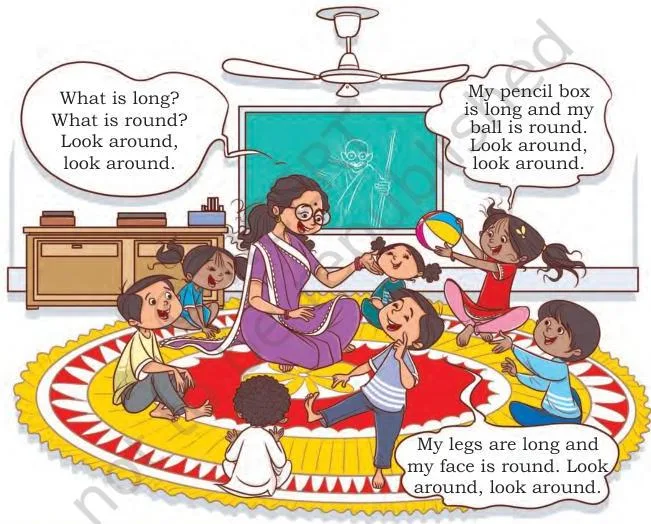
- Look Around — children sit in a circle and each child names one long and one round thing, without repeating what others have said.
- Think and Do — six picture tasks (A to F) that sort, match and tick shapes.
- Let us Do — children build a house, toy, tower, robot or bus from objects around the classroom.
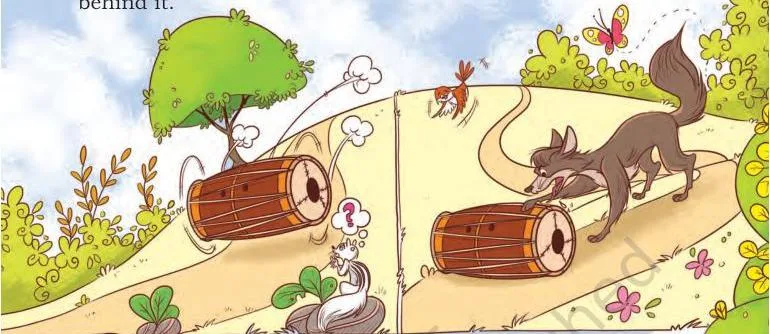
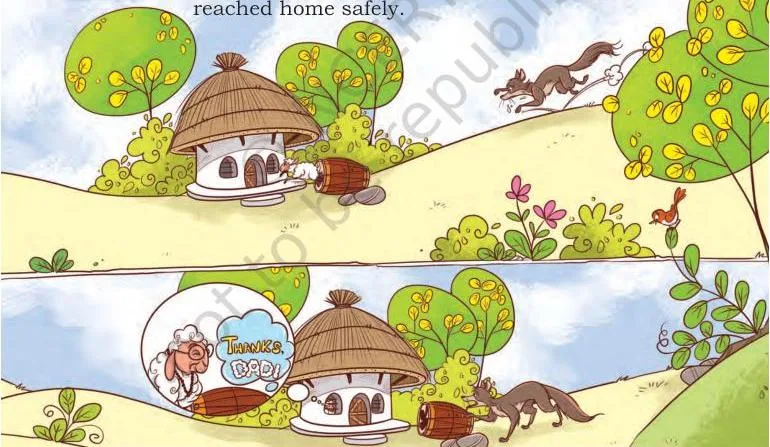
- Wise Grandmother — a story in which a dholak rolls home with a lamb hidden inside it.
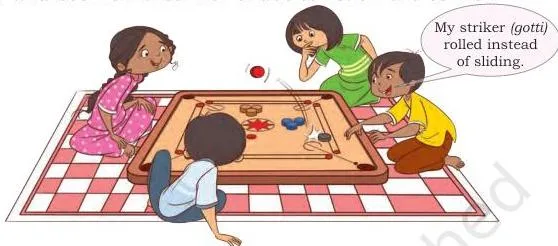
- Let us Slide — children watch a carrom striker slide, then label objects in a picture R for roll or S for slide.
- Think and Do — a table to fill in: does each object roll, slide, or do both?
- Project Work — cardboard-box puppets, towers from different objects, and shapes made from clay.
The order is deliberate: children first sort objects by shape, then use that shape vocabulary to predict how the same kinds of objects move. Understanding the shape is what makes the motion predictable.
Round or Long? Why the Same Object Can Be Both
This is the chapter’s first and simplest idea: look at any object and decide whether it is round or long.
Long means stretched out in one direction — the object can be tall, wide or long. Round means curved, with no flat edges, like a ball.
The Look Around game makes a subtle point: the same object can be both. In the chapter’s own example, one child calls a tumbler long while another calls it round, and the book says both views need to be considered.
The answer depends on which way you look at it — the tumbler’s height makes it long, and its curved shape makes it round.
Task A of Think and Do turns this into a paper task: draw round objects in a circle (○) and long objects in a square (□). When two children disagree, ask why rather than who is right — a child who can explain the thinking has understood the lesson.
Why the Dholak Rolled: Rolling and Sliding
This section is the chapter’s second big idea — shape decides how an object moves — and the story is what carries it.
In the Wise Grandmother story, a little lamb going to her grandmother is seen by a wolf who wants to catch her. The lamb asks to visit her grandmother first, and once there the grandmother hides her inside a dholak and rolls the dholak back toward home.
The dholak rolls very fast, the wolf cannot catch it, and the lamb reaches home safely.
The chapter does not hand out the reason — it asks children to reason it out. The dholak rolls because its shape is round, with a curved side that turns over and over, and because the path from the jungle to the house is a sloping, inclined surface, which lets it roll on its own.
Rolling means the object turns over and over as it moves along. Sliding means it moves along without turning over.
In Let us Slide, the carrom striker slides because its face is flat; children write R for objects that roll and S for objects that slide, and the second Think and Do adds a third column for objects that roll as well as slide.
Roll or Slide? A Home Test With Everyday Objects
This is an original five-minute test you can run at home. It asks the same question as the chapter’s Think and Do table, but with objects you already have, and the child guesses before testing.
| Object | Rolls | Slides | Does both |
|---|---|---|---|
| Ball | Yes | No | No |
| Book | No | Yes | No |
| Pencil | Yes | No | No |
| Eraser | No | Yes | No |
| Coin | Yes | Yes | Yes — on its edge it rolls, lying flat it slides |
| Water bottle | Yes | Yes | Yes — on its side it rolls, standing upright it slides |
Treat the table as a forecast, not a list to memorise: let the child guess first, then test each object on the floor or on a book held at a slope. The reason behind the answers is simple — a round face helps an object roll, and a flat face makes it slide.
The Picture Tasks: What Each One Asks Your Child to Do
The second section of the chapter, Think and Do, is six small picture tasks. Each one trains a slightly different shape skill. The book supplies all the pictures, so keep the chapter open while working through them.
A. Draw round objects in circles and long objects in squares
Sorting by one property: the child decides, for each picture, which of the two groups it belongs to.
B. Match the objects that are similar in shape
Seeing the same outline in different objects — the skill behind recognising shapes in real life.
C. Tick the shape similar to a ball
Spotting a round shape (like a sphere) among other outlines.
D. Tick the shape similar to a cap
Spotting a cone-like shape with a pointed top and a wider base.
E. Tick the shape similar to a glass
Spotting a cylinder — a shape with straight sides and round ends, like the glasses in the picture.
F. Tick the shape similar to a matchbox
Spotting a cuboid — the box-like shape with flat faces that a matchbox has.
Let us Do and Project Work: Activities That Need Only Household Things
These two sections are the hands-on heart of the chapter. Both need only objects already lying around at home or school.
Let us Do — build something from classroom objects
Children make a house, toy, tower, robot, bus or anything else using notebooks, books, a pencil box, a water bottle, waste or old boxes, birthday caps and funnels. In the group version, four groups each get one shape, bring two used or waste objects of that shape, and explain to the class why they chose them.
Project Work — puppets, towers and clay
- Puppets: collect cardboard boxes such as shoe boxes or empty food boxes, cut a slit in the front, draw eyes, a mouth and a nose, and turn the box into a puppet for a classroom show.
- Towers: build towers with different objects and find out which shapes make taller and more stable towers.
- Clay: create different shapes and objects by hand using clay.
One honest hint: flat-bottomed shapes make steadier towers than round ones — and the child should discover that by building, not by being told. These activities matter because they make the chapter’s words — round, long, roll, slide, stable — physical, so the vocabulary sticks.
Key Terms: Round, Long, Roll and Slide
These four words carry the whole chapter. Read them aloud with the child, each with an example from the chapter.
| Term | What it means | Example |
|---|---|---|
| Round | Curved all over, with no flat edges | A ball |
| Long | Stretched out in one direction; it can also be tall or wide | A tall tumbler |
| Roll | The object turns over and over as it moves along | The dholak rolling home |
| Slide | The object moves along without turning over | The carrom striker |
| Sloping surface | A surface that tilts, like a ramp | The path to the lamb’s house |
Common Mistakes Children Make With Round and Long Shapes
These five slips come up again and again, and the chapter is built to catch them. Name the mistake before the child makes it, then use the check to confirm.
| Mistake | Correct rule | How to check your answer |
|---|---|---|
| Treating round vs long as having only one correct answer | Both answers can be right; the reason is what matters | After the child answers, ask “why do you say that?” |
| Saying only balls roll | Anything with a round face rolls — a pencil or a bottle on its side rolls too | Try rolling a pencil and a bottle along the floor |
| Saying flat objects roll | A book, eraser or matchbox cannot roll because it has no round face | Try rolling a book; it slides instead |
| Missing the objects that do both | A coin stands on edge and rolls, or lies flat and slides | Test the same coin both ways |
| Guessing the motion without testing | Decide by trying the object, not by looking at it | Push each object, watch it move, then fill in the table |
All five sit inside the chapter’s own design: the book repeatedly asks children to explain their thinking, collect objects, try them out and discuss what they see.
Skills This Chapter Builds, and How to Check Them
There is no CBSE board examination in Class 1, so this chapter is about early reasoning, not marks. What matters is the child’s ability to look, sort and explain.
- Name one round thing and one long thing from the world around them.
- Sort objects by shape — round in one group, long in another.
- Match objects that share the same shape.
- Predict whether an object will roll, slide, or do both.
- Explain the choice in a sentence, such as “the ball rolls because it is round.”
- Build a model from objects and describe what they made.
Five-minute check: can the child name one round and one long thing, say whether a ball rolls or slides, and say why the dholak rolled? If yes, the chapter has landed.
Textbook contents and what a school actually assesses are not always identical, so check the current official syllabus — but this chapter’s goals are the skills above, nothing to memorise and no written sums.
What Your Child Should Remember From This Chapter
In the order the chapter teaches them, these are the five ideas the activities add up to.
- An object can be round or long.
- The same object can look both — and both answers are accepted when the child explains their thinking.
- Round things roll.
- Flat things slide.
- Some things do both, and a sloping surface lets things move on their own.
Each idea connects to at least one activity in the chapter, so a child who has played through the sections has met every one of them.
Related Chapters and Resources
Continue with the book around this chapter:
- Joyful Mathematics Class 1 book page — the whole textbook, chapter by chapter.
- Class 1 hub — notes and resources for every Class 1 subject.
- CBSE notes index — find notes by class and subject.
- Class 1 Maths Chapter 1, Finding the Furry Cat — the previous chapter in this book.
- Class 1 Maths Chapter 3, Mango Treat — the next chapter in this book.
The official textbook, its editions and its PDFs are published by NCERT (ncert.nic.in) — the source of the official chapter file and the authority for this book.
Reference: NCERT Class 1 Mathematics textbook, chapter 2, official edition on ncert.nic.in.
Sources and Data Verification
- The activities and picture tasks described on this page come from the NCERT Joyful Mathematics textbook for Class 1, Chapter 2 (“What is Long?”), as published in the official PDF on ncert.nic.in.
- This page covers Chapter 2 only, not the whole book.
- NCERT is the authority for the textbook, its editions and its PDFs; CBSE is the authority for the syllabus and examinations.
- The page is maintained against the current NCERT edition of the book.
Frequently Asked Questions
Why does the dholak roll in the Wise Grandmother story?
The dholak rolls because of its round shape and the sloping path. A round, curved side lets the dholak turn over and over as it moves, and the inclined surface from the jungle to the house lets it roll on its own. The chapter asks children to work this out themselves through discussion rather than telling them the answer.
What is the difference between rolling and sliding?
Rolling means the object turns over and over as it travels, like a ball or the dholak. Sliding means the object moves along without turning over, like a carrom striker or a book pushed across a table. A coin can do both — on its edge it rolls, and lying flat it slides.
Why can the same object be both long and round?
Because it depends on which dimension you look at. In the Look Around game, a tumbler is long when you notice its height and round when you notice its curved shape. The chapter says both views need to be considered — the important part is that the child can explain the reasoning.
Which shapes make taller and more stable towers in Project Work?
Flat-bottomed shapes make steadier towers, because they sit without rolling away. Round objects tend to roll off the stack, and the child should find this out by building the towers. The chapter asks which shapes make taller and stable towers, so the test — not the answer — is the activity.
Does this chapter have any written sums to solve?
No. Every task in the chapter is a hands-on activity, a picture task or a discussion — there are no written sums anywhere in it. The only marking is ticking or crossing the boxes in the rolls-and-slides table.
Explore Class 1 Mathematics Books
- Previous: Finding the Furry Cat!
- Next: Mango Treat
Related chapters:
- Making 10
- How Many?
- Vegetable Farm