
Finding the Furry Cat! Class 1 is Chapter 1 of NCERT’s Joyful Mathematics textbook — a short, play-based chapter that builds a child’s first positional words (on, under, inside, outside, above, below, top, bottom) and simple sorting through songs and games.
This page gives you the official NCERT PDF of the chapter right below, with a plain-language walkthrough underneath so you know what each page teaches.
The official Finding the Furry Cat! Class 1 PDF is the NCERT file on ncert.nic.in — open it to read the poem, the games and the activities exactly as printed in the textbook.
What’s inside Finding the Furry Cat!
The table below lists how the chapter is organised — its sections, activities and illustrations — so you can see the whole file at a glance before reading further.
| What the chapter holds | Count | Where it is used |
|---|---|---|
| Printed pages | 9 | |
| Figures with NCERT captions | 8 | |
| Activities | 3 | |
| Official NCERT PDF | Download the chapter PDF | the chapter exactly as NCERT publishes it |
Finding the Furry Cat! Class 1: what the chapter teaches
This chapter is about language before numbers. It builds the words a child needs to say where things are — on, under, inside, outside, above, below, top, bottom, before, after, near, far — because geometry and measurement later assume a child can describe position.
The book teaches those words the way young children learn best: through a poem they act out, a train rhyme they sing, and games where the child moves, speaks and sorts.
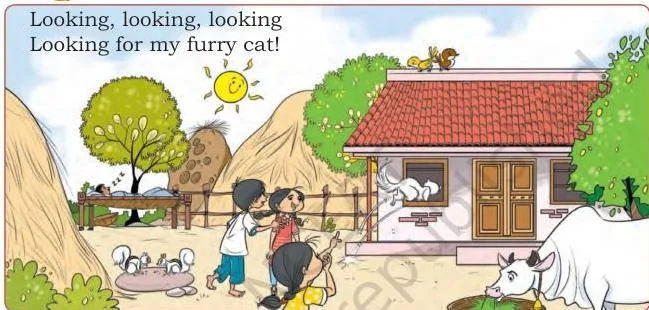
- The cat poem. Four short verses, each built around one or two position words. The book asks children to read the poem aloud, recite it and act it out, then look at the pictures and talk about which things are above, below, on or under other things — and about the animals they see around them, like cats, dogs and cows. After the poem, children circle the correct word in four small questions: a red ball above/under/on the bed, a cat inside/outside/on the car, a man lying under/inside/on the tree, and a cow inside/top of/outside the house.
- Think and Answer. Two real-life talk questions with no writing: where do you put your shoes, and where do you throw the garbage — each answered as inside or outside.
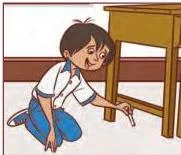
- Let us Play – Find the Things. A hide-and-seek game in two teams. One team hides a few things and gives the other team spoken clues built from inside/outside, far/near and above/below — for example, a white thing hidden near the board and under the table, or a red thing outside the classroom and under the tree.
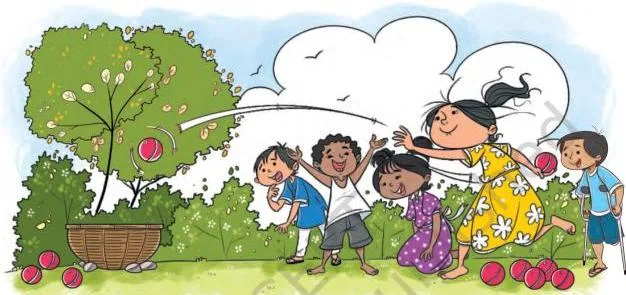
- Let us Play – Throw the Ball! Each child aims and throws the ball into a basket. When the ball lands inside, the class says IN; when it misses, they say OUT.
- Let us Do. The practice page: ticking the things that are inside, ticking the things that are outside, choosing on or under for a boy and birds near a tree, drawing a smile below the nose and eyebrows above the eyes, and answering four questions about the tiranga, the National Flag. The page closes with a class discussion on when, where and why we hoist the flag; children then make their own tiranga and sing the National Anthem in standing position, facing it.
- Chhuk Chhuk goes our Train! A train rhyme that brings in before and after: bogies before my bogie, bogies after my bogie. Four tasks follow — count the bogies after the engine, count the bogies before the red bogie, colour the bogies after the red bogie orange, and colour the bogies before it blue. The class also discusses train journeys, children who have never travelled by train are encouraged to ask questions, and everyone draws a train or builds one from waste materials like boxes and cans.
- Let us Play – sorting. Children form a train by holding each other’s shoulders and sing, and every child names who is before and after them. Then Suwali and Rohit sort objects: pebbles together, leaves in one group, chalk pieces in another. The book suggests similar sorting with seeds, leaves and beads.
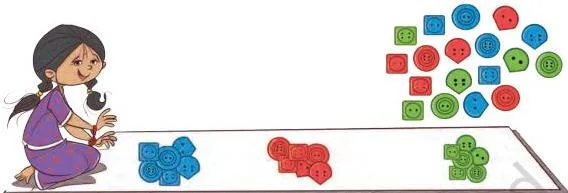
- Let us Do – Suwali’s buttons. Suwali has placed all her buttons in three groups. Children are asked why she made such groups, then asked to help her sort the buttons in other ways by drawing them.
- Project Work. The chapter ends with a classroom job: arrange the cupboard and describe the work using positional vocabulary — for example, two objects in the bottom rack and one object in the top rack.
The positional words: what each activity practises
Children understand a word like ‘above’ only after they have felt it — reached up high, crouched down low. The chapter gives each word pair a physical activity, so the vocabulary lands in the body before it lands on the page.
| Word pair | Activity that uses it | Example from the book |
|---|---|---|
| inside / outside | Think and Answer; Throw the Ball!; Find the Things | ‘Are you inside the backpack? Are you outside the red rack?’ — and the class shouting IN and OUT with every throw |
| on / under | The cat poem; the tree picture task | The cat sits on the window shed and sleeps under the bed; a boy and birds are on or under the tree |
| above / below | The cat poem; Find the Things; the drawing task | The cat hops above the hat and hides below the mat; eyebrows go above the eyes, a smile below the nose |
| top / bottom | The cat poem; the tiranga task; Project Work | The cat plays at the top of the car and scratches the bottom of the jar; the top colour of the tiranga; the bottom rack of the cupboard |
| before / after | Chhuk Chhuk goes our Train!; the human-train game | ‘Bogies before my bogie, bogies after my bogie’ — and each child naming who stands before and after them |
| near / far | Find the Things | The clues guide the search, as in ‘near the board and under the table’ |
Walking through the pictures: what to point at




The pictures in this chapter carry no printed captions — the child is meant to name what each picture shows, and the adult’s job is to point and ask. The sequences worth pointing at are the ones the text itself establishes.
- The poem’s eight pictures. Each verse shows the cat in one position: sitting on the window shed, sleeping under the bed, inside the backpack, outside the red rack, scratching the bottom of the jar, playing at the top of the car, hopping above the hat, hiding below the mat. Point at the cat and ask the verse’s own question — ‘Are you under the bed?’ — and let the picture answer it.
- The tree picture. The Let us Do page shows a boy and some birds with a tree, and the child ticks on or under for each. Ask ‘is the boy touching the tree?’ — touching means on; not touching means under.
- The train picture. An engine is followed by a chain of bogies, with one bogie red. Question A counts the bogies after the engine, and question B counts the bogies before the red bogie; then the child colours the after-bogies orange and the before-bogies blue. The numbers live in the book’s picture, so work out the direction here and let the child count there.
Positional words, defined simply
Definitions are for the grown-up reading aloud: if you say the same word the same way every time, the child picks it up faster. Here is each positional word the chapter uses, with the book’s own example.
- Inside — in the space enclosed by something: the cat is inside the backpack, the ball is inside the basket.
- Outside — not in that space: the cat is outside the red rack, the ball is outside the basket.
- On — touching a surface and resting on it: the cat sits on the window shed.
- Under — below something, with that thing above it: the cat sleeps under the bed.
- Above — higher than something, not touching it: the cat hops above the hat.
- Below — lower than something, not touching it: the cat hides below the mat.
- Top — the highest part: the cat plays at the top of the car; the top colour of the tiranga.
- Bottom — the lowest part: the cat scratches the bottom of the jar; the bottom rack of the cupboard.
- Before / after — earlier and later in a line: the bogies before and after the red bogie; the child before or after Meera in the train.
- Near / far — close and distant: the hide-and-seek clues use near and far to guide the search.
Tiranga questions answered
The book asks four questions about the National Flag, and the answers follow from the flag itself.
| Tiranga question | Correct option |
|---|---|
| Which colour is at the top of the tiranga? | saffron |
| Which colour is below the white colour? | green |
| Which colour is above the green colour? | white |
| Where is the Ashoka Chakra on the tiranga? | in the middle |
These match any classroom tiranga: saffron at the top, white below it, green below that, with the Ashoka Chakra in the middle.
Where Class 1 children get confused (and how the book handles it)
Young children learn spatial words by doing, and the book’s games are built around exactly the places they slip. These four confusions are the ones to watch for, with the book’s own fix for each.
| Mistake | Correct rule | How to check your answer |
|---|---|---|
| ‘On’ said instead of ‘above’ | On means touching the surface; above means higher up but not touching. | Compare the poem’s two pictures: the cat sits on the window shed but hops above the hat. |
| ‘Before’ and ‘after’ swapped | Before means ahead in the line, after means behind it — and the direction depends on where you stand. | The human-train game: every child names who is before and after them from their own place. |
| ‘Inside’ and ‘outside’ blurred | Inside means in the space; outside means not in it. | The basket game: the class shouts IN and OUT as the ball lands or misses, tying each word to a seen event. |
| No second way to sort found | Any group can be regrouped by a different shared feature. | Suwali’s buttons: after asking why she made such groups, the book asks children to sort them in other ways. |
Running the two games at home
The two core games need nothing but household objects, which is why they are the best practice a parent can give.
- Find the Things. Hide two or three small objects and give clues in the book’s pattern — ‘look for a white thing which is hidden near the board and under the table’ — using near/far, above/below and inside/outside. Then swap roles so the child gives the clues.
- Throw the Ball. Use a basket or bucket and a soft ball. Every throw, call IN when the ball lands inside and OUT when it misses. The book suggests attaching a ghungroo to the ball so children get a sound cue for in and out.
The book adds that the ball activity should be run so that every child stays engaged, whatever their ability — the sound cue exists so a child who cannot follow the basket with their eyes can still tell in from out.
The button question is about the act of grouping, not about the groups themselves. Children answer why Suwali made such groups — because each group shares a feature — and then sort them in other ways, which means choosing a different shared feature. That is the chapter’s quiet introduction to classification.
Exam and readiness notes for Class 1 mathematics
Class 1 has no CBSE board examination. Learning is assessed by the school, through observation of activities very like the ones in this chapter — reciting, moving, answering and sorting. Textbook contents and the examinable syllabus are not always identical, so check the current official syllabus for what a session actually requires.
What this chapter is really preparing is readiness. The positional words are the vocabulary of geometry and measurement — describing where one thing sits relative to another — and the sorting tasks are the first step of data handling.
A child who can say ‘the ball is inside the basket’ and can regroup Suwali’s buttons has the language those later topics assume.
Finding the Furry Cat! in one screen
Finding the Furry Cat! closes with Project Work rather than a summary, so this recap is the chapter in one screen, in our words.
- Eight positions, one cat. The poem moves through on, under, inside, outside, bottom, top, above and below as the child hunts for the cat.
- IN or OUT. The basket game turns the two words into a shout every time the ball lands or misses.
- Before and after. The train rhyme and the human-train game make the two order words physical — each child says who stands before and after them.
- Tiranga positions. The flag questions practise top, below and above, finishing with the Ashoka Chakra in the middle.
- Sorting. Pebbles, leaves and chalk pieces first, then Suwali’s buttons — grouped, and regrouped in other ways.
- Project Work. The chapter ends with the class cupboard being arranged using bottom rack and top rack.
For the pictures, the poem and each game’s exact instructions, keep the official PDF above open while you read.
Related chapters and book pages
Finding the Furry Cat! opens the Joyful Mathematics book for Class 1. The pages below help you move to the next chapter or check that this is the right book.
- Class 1 Joyful Mathematics book page — the chapter list for this book.
- Next chapter: What is Long?
- Class 1 hub — the starting point for Class 1 material.
- CBSE notes home
Sources and data verification
This listing is maintained for the 2026-27 academic session using the NCERT textbook information available to us. NCERT remains the authority for confirming the latest edition.
Where this page’s information comes from, and what it covers, stated plainly.
- This description is based on the NCERT Class 1 Joyful Mathematics textbook (English), official edition hosted on ncert.nic.in.
- This page covers Chapter 1, Finding the Furry Cat!, only — not other editions, translations, or the older Class 1 mathematics book.
- The listing is maintained for the current academic session using the NCERT information available to us.
- NCERT settles textbooks, editions and PDFs; CBSE settles curriculum, syllabus and examinations.
Reference: NCERT Class 1 Mathematics (Joyful Mathematics) textbook, chapter 1, official edition on ncert.nic.in.
Finding the Furry Cat!: common questions
What does Chapter 1 of Joyful Mathematics Class 1 teach?
Finding the Furry Cat! Class 1 teaches positional words — inside, outside, on, under, above, below, top, bottom, before, after, near and far — through a poem about a lost cat, a train rhyme and three games.
It also introduces sorting: children group pebbles, leaves, chalk pieces and buttons, then regroup them in other ways. There are no computation sums in the chapter; the work is looking, moving, speaking and sorting.
How can I help my child practise inside, outside, above and below at home?
Play the book’s own games with household objects. For inside and outside, take a basket and a soft ball and call IN when the ball lands, OUT when it misses — the book suggests attaching a ghungroo to the ball so the sound changes.
For above and below, hide two or three small objects and give clues in the book’s pattern — ‘a white thing hidden near the board and under the table’ — then let your child give the clues.
Does Class 1 have a CBSE maths exam?
No. Class 1 is assessed by the school through observation and activities, not through a CBSE board exam. Textbook contents and the examinable syllabus are not always identical, so check the current official syllabus to see what your school must cover.
What are the answers to the tiranga questions in Finding the Furry Cat?
The top colour is saffron, the colour below white is green, the colour above green is white, and the Ashoka Chakra is in the middle. These answers follow from the flag itself, so your child can check them against any tiranga.
Where can I download the official Finding the Furry Cat! Class 1 PDF?
NCERT publishes the official chapter file on ncert.nic.in. The link near the top of this page — Finding the Furry Cat! Class 1 PDF — opens the poem, games and activities exactly as printed in the textbook.
Explore Class 1 Mathematics Books
- Next: What is Long?
Related chapters:
- Mango Treat
- Making 10
- How Many?