
Surface Areas and Volumes is Chapter 12 of the NCERT Class 10 Mathematics textbook, spanning about ten printed pages (pages 160–169). It teaches one skill: how to find the surface area and volume of an object made by joining two basic solids, such as a cone on a hemisphere or a cylinder with a hemisphere scooped out.
The official NCERT chapter PDF is one click away, in the download section below.
Download the Official NCERT Chapter PDF
The official rationalised NCERT edition of the NCERT Class 10 Mathematics Chapter 12 Surface Areas and Volumes PDF is free, needs no login, and is the exact text that appears in the printed textbook — open it to read the introduction, both exercises and the closing summary as published.
Chapter 12 at a Glance
The table below lists what Chapter 12 contains: its sections, figures, worked examples and exercise questions.
The sections of the chapter, in order, are:
- 12.1 Introduction (printed pages 161–162): opens with the basic solids from Class IX — cuboid, cone, cylinder and sphere — and real objects made from combinations of them: a truck container, a test tube, monuments.
- 12.2 Surface Area of a Combination of Solids (printed pages 162–166): develops the surface-area rule through the lattu, the decorative block, the rocket and the bird-bath, then closes with Exercise 12.1 (printed pages 166–167).
- 12.3 Volume of a Combination of Solids (printed pages 167–169): develops the volume rule through the shed, the juice glass and the toy inside a cylinder, then closes with Exercise 12.2, which runs to the end of the chapter.
- 12.4 Summary (the closing page): restates the chapter’s two rules.
What This Chapter Covers: One Idea, Two Rules
Every problem in this chapter is one idea: a combined solid, which is simply two basic solids joined flat face to flat face. The chapter then teaches exactly two rules for handling it — one for surface area, one for volume.
The surface-area rule (NCERT, p. 162): the total surface area of the new solid is the sum of the curved surface areas of the parts that remain visible. The faces where the parts touch disappear into the join and are not counted.
The volume rule (NCERT, p. 167): the volume of the solid formed by joining two basic solids is the sum of the volumes of its parts. Nothing is subtracted at the join.
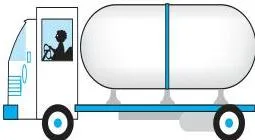
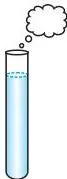
The chapter’s everyday objects make the point (NCERT, p. 161): a truck’s container is a cylinder with a hemisphere at each end, and a test tube is a cylinder with one hemispherical end. Neither is a single basic solid, which is exactly why a new method is needed.
Surface Area of a Combination of Solids: Add Only What You Can See
When two solids are joined, the face where they touch is hidden inside the object. Paint, canvas and colour never reach it, so it must never be counted.
That gives the pattern the whole section follows, and the lattu of Example 1 (pp. 163–164) is the simplest case: a cone on a hemisphere with equal base radii. Its total surface area is the hemisphere’s curved surface (\(2\pi r^2\)) plus the cone’s curved surface (\(\pi r l\)). The cone’s own height is the top’s total height minus the hemisphere’s radius.
The book warns right here (p. 164): the total surface area of the top is not the sum of the total surface areas of the cone and hemisphere. Their flat faces coincide at the join, so adding both double-counts a face that no longer exists.
The decorative block of Example 2 (p. 164) is a cube with a hemisphere on top. Start from the cube’s total surface area (\(6a^2\)), subtract the hemisphere’s base circle (\(\pi r^2\)) that the hemisphere hides, then add the hemisphere’s curved surface (\(2\pi r^2\)).
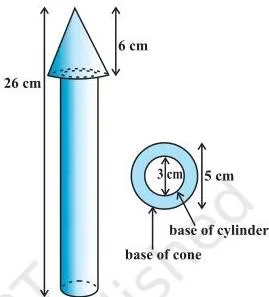
The rocket of Example 3 (p. 165) shows the one place an area is subtracted: the cone’s base radius is larger than the cylinder’s, so a ring of the cone’s base stays visible. The orange area is the cone’s curved surface plus the full cone base minus the cylinder’s base circle: \(\pi r l + \pi r^2 – \pi (r’)^2\).
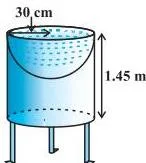
The bird-bath of Example 4 (p. 166) turns subtraction around. A hemispherical depression is cut into the cylinder, so the hemisphere’s curved surface is exposed and gets added to the cylinder’s curved surface: \(2\pi r h + 2\pi r^2\).
Volume of a Combination of Solids: Add Everything
For surface area you skip the join; for volume you do not. NCERT states it directly (p. 167): the volume of the solid formed by joining two basic solids is the sum of the volumes of the constituents.
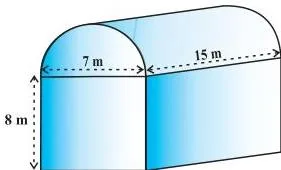
The shed of Example 5 (pp. 167–168) is a cuboid with a half cylinder on top. Its volume is the cuboid’s volume plus half the cylinder’s volume. The twist comes next: to find the air inside, subtract the machinery’s space (\(300\ \text{m}^3\)) and the workers’ space (\(20 \times 0.08\ \text{m}^3\)) — what gets subtracted can itself be a combination.
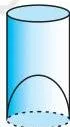
The juice glass of Example 6 (p. 168) introduces capacity. The glass looks like a plain cylinder, but a raised hemisphere at the bottom takes up space juice cannot fill. So apparent capacity = \(\pi r^2 h\) of the full cylinder, and actual capacity = apparent capacity minus the hemisphere’s volume \(\frac{2}{3}\pi r^3\).
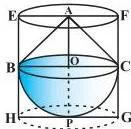
The toy of Example 7 (p. 169) sits inside a right circular cylinder that just circumscribes it. The cylinder’s radius equals the toy’s radius, and its height is the cone’s height plus the hemisphere’s radius. The required difference is the cylinder’s volume minus the toy’s volume.
Worked Example: A Cone on a Hemisphere, Solved Step by Step
Here is a fresh problem with original numbers, so you can watch the whole method of surface areas and volumes class 10 in one place. A toy is made by mounting a cone on a hemisphere: the cone’s base radius is 3 cm, its height is 4 cm, and the hemisphere has the same radius, 3 cm.
Step 1 — split the toy.
The toy is two solids joined flat face to flat face: a cone of radius \(r = 3\) cm and height \(h = 4\) cm, and a hemisphere of the same radius \(r = 3\) cm.
Equal base radii mean the join is a clean circle and the surface is smooth.
Step 2 — find the slant height of the cone.
The slant height runs along the cone’s sloping face, found with \(l = \sqrt{r^2 + h^2}\):
\[ l = \sqrt{3^2 + 4^2} = \sqrt{9 + 16} = \sqrt{25} = 5\ \text{cm} \]
Step 3 — surface area.
The joining faces are hidden, so add the curved surface of the hemisphere and the curved surface of the cone:
\[ \text{TSA} = 2\pi r^2 + \pi r l = 2\pi(3)^2 + \pi(3)(5) = 18\pi + 15\pi = 33\pi\ \text{cm}^2 \]
\[ 33\pi \approx 33 \times 3.14 = 103.62 \approx 103.6\ \text{cm}^2 \]
Step 4 — volume.
Nothing vanishes at the join, so add the two full volumes:
\[ V = \frac{2}{3}\pi r^3 + \frac{1}{3}\pi r^2 h = \frac{2}{3}\pi(27) + \frac{1}{3}\pi(9)(4) = 18\pi + 12\pi = 30\pi\ \text{cm}^3 \]
\[ 30\pi \approx 30 \times 3.14 = 94.2\ \text{cm}^3 \]
Step 5 — the wrong route, and why it fails.
If you added the full total surface areas — \(3\pi r^2 = 27\pi\) for the hemisphere and \(\pi r^2 + \pi r l = 9\pi + 15\pi = 24\pi\) for the cone — you would get \(51\pi\).
The difference from \(33\pi\) is \(18\pi\), exactly the two coincident base circles counted twice.
Final answers: surface area \( \approx 103.6\ \text{cm}^2 \), volume \( \approx 94.2\ \text{cm}^3 \). Surface area ignores the hidden join; volume does not.
The Formulas This Chapter Uses, with Page References
None of these formulas is new — every one comes from Class IX, and the circle formulas arrive via the previous chapter, Areas Related to Circles. This chapter only applies them to objects made of two solids.
| Solid / part | Formula | What each symbol means | Where the chapter uses it |
|---|---|---|---|
| Hemisphere — curved surface area | \(2\pi r^2\) | \(r\) = radius | The lattu’s hemisphere, Example 1 (p. 163) |
| Cone — curved surface area | \(\pi r l\) | \(r\) = base radius, \(l\) = slant height | The lattu’s cone, Example 1 (p. 164) |
| Cone — slant height | \(l = \sqrt{r^2 + h^2}\) | \(h\) = height of the cone | The rocket, Example 3 (p. 165); also the lattu (p. 164) |
| Cube — total surface area | \(6a^2\) | \(a\) = edge of the cube | The decorative block, Example 2 (p. 164) |
| Cylinder — curved surface area | \(2\pi r h\) | \(r\) = radius, \(h\) = height | The bird-bath, Example 4 (p. 166) |
| Hemisphere — volume | \(\frac{2}{3}\pi r^3\) | \(r\) = radius | The toy, Example 7 (p. 169); the juice glass (p. 168) |
| Cone — volume | \(\frac{1}{3}\pi r^2 h\) | \(r\) = base radius, \(h\) = height | The toy, Example 7 (p. 169) |
| Cylinder — volume | \(\pi r^2 h\) | \(r\) = radius, \(h\) = height | Apparent capacity of the juice glass, Example 6 (p. 168) |
| Cuboid — volume | \(l \times b \times h\) | \(l, b, h\) = length, breadth, height | The shed, Example 5 (pp. 167–168) |
| Combined solid — surface area | sum of the curved surface areas of the visible parts | the hidden joining face is skipped | The rule itself (p. 162) |
| Combined solid — volume | sum of the volumes of all the parts | nothing is subtracted at the join | The rule itself (p. 167) |
Reading the Figures: What Each Diagram Is Teaching

Most figures in this chapter show a single object made of two basic solids. The job of each diagram is to teach you to see the two parts — and that split is the whole method.
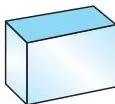
Fig. 12.1 is the chapter’s starting point: the four basic solids from Class IX — cuboid, cone, cylinder and sphere. Recognise their shapes here, because every object later in the chapter is two of these joined together.
Fig. 12.2 is the truck with a container fitted on its back, the chapter’s opening example of a combined solid. The container is not a cylinder or a sphere — it is a cylinder with a hemisphere stuck at each end. Naming the parts is step one of every problem in this chapter.
Fig. 12.4 shows the same container pulled apart into a cylinder and two hemispheres. This is the key move of the whole chapter: break the object into basic solids. Seen this way, only the two hemisphere curved surfaces and the cylinder’s curved surface face the outside.
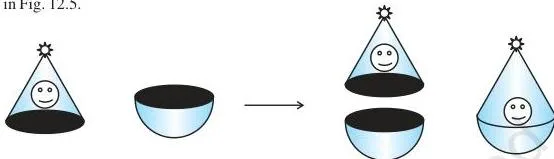
Fig. 12.5 shows a cone and a hemisphere brought together flat face to flat face. The base radius of the cone is taken equal to the radius of the hemisphere so the toy has a smooth surface. The two flat faces coincide at the join and disappear from the surface area.
Fig. 12.8 is the wooden toy rocket: a cone mounted on a cylinder. Its lesson is the unequal radii. The cone’s base is larger than the cylinder’s, so a ring of the cone’s base stays visible and must be painted — the orange area is the cone’s CSA plus the full cone base minus the cylinder’s base.
Fig. 12.9 is the bird-bath: a cylinder with a hemispherical depression at one end. The hollow half-sphere opens its curved surface to the outside, so the total surface area is the cylinder’s curved surface plus the hemisphere’s curved surface.
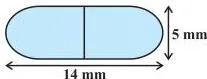
Fig. 12.10 is the medicine capsule: a cylinder with two hemispheres stuck to its ends. To use it you must find the cylinder’s own height first — subtract the radii of both hemispheres from the capsule’s total length of 14 mm.
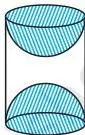
Fig. 12.11 is the wooden article made by scooping a hemisphere out of each end of a solid cylinder. Each scoop exposes a hemisphere’s curved surface and removes the flat circular end of the cylinder. Both curved surfaces are added; the flat ends are gone.
Fig. 12.12 is the shed: a cuboid surmounted by a half cylinder. The air the shed holds is the cuboid’s volume plus half the cylinder’s volume. Then machinery and workers take up space, and that space is subtracted.
Fig. 12.13 is the juice glass: a cylinder with a raised hemisphere at the bottom. The hemisphere takes up space juice cannot fill, so the glass’s actual capacity is less than its apparent capacity by the hemisphere’s volume.
Fig. 12.14 is the solid toy — a hemisphere surmounted by a right circular cone — inside a right circular cylinder that just circumscribes it. The cylinder’s radius equals the toy’s radius, and its height is the cone’s height plus the hemisphere’s radius. The difference of the two volumes is the problem.
Key Terms and Definitions
The chapter uses a handful of technical terms, and each one appears in almost every question of both exercises.
| Term | Meaning | NCERT page |
|---|---|---|
| Curved surface area (CSA) | the area of only the curved surfaces of a solid — for a hemisphere, \(2\pi r^2\) | pp. 162–163 |
| Total surface area (TSA) | the area of every surface that faces the outside of the solid | pp. 162–163 |
| Combination of solids | an object made by joining two or more of the basic solids: cuboid, cone, cylinder, sphere, hemisphere | p. 162 |
| Slant height | the distance along a cone’s sloping face from the vertex to the rim of its base, \(l = \sqrt{r^2 + h^2}\) | pp. 164–165 |
| Capacity | the inner volume of a container — the amount it can actually hold | p. 168 |
| Apparent capacity | the volume the container would hold if nothing were raised inside it — for the glass, the full cylinder’s \(\pi r^2 h\) | p. 168 |
| Actual capacity | apparent capacity minus the volume of any raised part inside, such as the hemisphere in the juice glass | p. 168 |
| Hemispherical depression | a half-sphere hollow cut into a solid, as in the bird-bath of Example 4 | p. 166 |
Common Mistakes in This Chapter, and How to Avoid Them
The book warns about its own pitfalls, and each warning sits right where the mistake would happen.
| Mistake | Correct rule | How to check your answer |
|---|---|---|
| Adding the full total surface areas of the two parts | Add only the surfaces that stay visible; the joining face disappears (Example 1 warning, p. 164) | List every face paint can reach — the hidden join is not on the list |
| Counting the hemisphere’s base when it sits on a cube | Cube TSA − base circle + hemisphere CSA, that is \(6a^2 + \pi r^2\) (Example 2, p. 164) | The cube’s top face and the hemisphere’s base circle are the same hidden face — count it once |
| Using the whole height of the object as the cone’s height | Cone height = total height − hemisphere’s radius (Example 1, p. 164) | Slant height uses the cone’s own height: \(l = \sqrt{r^2 + h^2}\) |
| Missing the ring when the cone and cylinder have different base radii | Cone CSA + cone base − cylinder base: \(\pi r l + \pi r^2 – \pi (r’)^2\) (Example 3, p. 165) | Compare the two base radii; if they differ, a ring of the larger base stays visible |
| Carrying the surface-area habit into volume | For volume you always add the volumes of the parts (p. 167) | If the question asks about air, water or space inside, nothing is subtracted at the join |
| Quoting apparent capacity as the real capacity | Actual capacity = apparent capacity − volume of the raised part (Example 6, p. 168) | Ask what liquid can physically occupy; the raised hemisphere is not available |
Exam Preparation Notes for Chapter 12
This chapter rewards a fixed method more than memorised questions. The same three steps solve almost every problem in it.
- Split. Sketch or name the combined solid, then break it into basic solids.
- Mark. Write down every radius and height, converting units so they all match before you calculate.
- Decide. Ask what the question wants: surface area when it talks about paint, canvas, paper or colour; volume or capacity when it talks about air, water, syrup or mass. Apply the matching rule.
Watch the \(\pi\) instruction. Both exercises print “Unless stated otherwise, take \(\pi = \frac{22}{7}\)” at their head (pp. 166 and 169), yet several solved examples work with \(\pi = 3.14\) (Examples 3, 6 and 7). Read the instruction in the question every time; the final answer depends on the choice.
Convert mixed units first. The bird-bath mixes centimetres and metres, and the answer is finally converted to \(3.3\ \text{m}^2\) (p. 166). Substituting mixed units is the fastest way to lose a question.
What you subtract can be a combination too. In the shed example, the air left in is the shed’s volume minus the machinery (\(300\ \text{m}^3\)) plus the workers (\(20 \times 0.08\ \text{m}^3\)), both together (p. 168).
One honest note: textbook contents and the examinable syllabus are not always identical. Check the current official CBSE syllabus before deciding what to focus on.
Revision Summary: The Two Rules of Chapter 12
The book closes the chapter with a two-point summary (p. 169), and both points are really one idea: surface area skips the hidden join; volume does not.
- Surface area of an object formed by combining any two basic solids: add the surface areas of the parts that remain visible.
- Volume of the same object: add the volumes of all the parts, and subtract nothing at the join.
The contrast, side by side:
| Surface area | Volume | |
|---|---|---|
| What gets added | curved surfaces and exposed flat faces | every part’s full volume |
| What gets skipped | the hidden joining face | nothing at the join |
| Fresh worked example | \(33\pi\ \text{cm}^2 \approx 103.6\ \text{cm}^2\) | \(30\pi\ \text{cm}^3 \approx 94.2\ \text{cm}^3\) |
A four-item final checklist:
- Name the basic solids in the object.
- Mark every radius and height, and convert units so they match.
- Check which faces are exposed before adding areas.
- Check whether the question wants capacity (the inner volume a container holds), not just volume.
Related Chapters and Resources
This listing is maintained for the 2026-27 academic session using the NCERT textbook information available to us. NCERT remains the authority for confirming the latest edition.
- Previous chapter: Areas Related to Circles — where the circle formulas and \(\pi\) conventions this chapter relies on are taught.
- Next chapter: Statistics.
- All chapters: Class 10 Mathematics notes and the Class 10 hub.
- Official files: the Chapter 12 PDF and the NCERT textbook portal, where the current Class 10 Mathematics edition and all its chapters are listed.
Sources and Data Verification
- This page describes the NCERT Class 10 Mathematics textbook (English edition), Chapter 12 “Surface Areas and Volumes”, as published by NCERT.
- It covers this single chapter, not the whole CBSE scheme of subjects or the complete textbook.
- It is maintained against the NCERT edition currently listed on ncert.nic.in; check the official site for the latest printing.
- NCERT settles textbooks, editions and PDFs; CBSE settles the curriculum, syllabus and examinations.
| What the chapter holds | Count | Where it is used |
|---|---|---|
| Printed pages | 10 | |
| Sections in the chapter | 4 | |
| Figures with NCERT captions | 12 | |
| Exercise questions | 17 | answered in our NCERT Solutions |
| Official NCERT PDF | Download the chapter PDF | the chapter exactly as NCERT publishes it |
Reference: NCERT Class 10 Mathematics textbook, chapter 12, official edition on ncert.nic.in.
Frequently Asked Questions
Why is the total surface area of a combined solid not the sum of the total surface areas of its parts?
Because the faces where the parts meet stop facing the outside. When a cone is mounted on a hemisphere, the cone’s base and the hemisphere’s flat face coincide — neither can be painted or covered, so counting both double-counts one hidden face. That is exactly the warning the book gives beside Example 1 (p. 164).
When do I subtract a base area in this chapter?
Whenever a flat face of one part is hidden by another, or the question excludes it. The three places in the chapter: the hemisphere’s base hidden on the cube (Example 2, p. 164), the cylinder’s base subtracted below the larger cone base on the rocket (Example 3, p. 165), and the tent base, which is not covered with canvas (Exercise 12.1, Question 7).
One more subtraction is of a volume, not an area: when a hemisphere is raised inside a glass, its volume is removed from the capacity (Example 6, p. 168).
Should I use \(\pi = \frac{22}{7}\) or 3.14 in Chapter 12?
Use the value the question gives you. Both exercises print “Unless stated otherwise, take \(\pi = \frac{22}{7}\)” (pp. 166 and 169), while several solved examples work with \(\pi = 3.14\). When a question states a value, that value settles the answer.
What is the difference between apparent capacity and actual capacity?
Apparent capacity is what the container would hold if nothing were raised inside it — for the juice glass, the full cylinder’s \(\pi r^2 h\). Actual capacity is what it really holds: apparent capacity minus the volume of the raised hemisphere \(\frac{2}{3}\pi r^3\), because the liquid cannot occupy that space (p. 168).
How do I find the slant height of a cone in a combined solid?
Use \(l = \sqrt{r^2 + h^2}\), where \(r\) is the cone’s base radius and \(h\) is the cone’s own height. In a combined solid the cone’s height is rarely the whole height — first subtract the radius of the hemispherical part from the total height (Example 1, p. 164).
Is the whole chapter in the CBSE Class 10 syllabus?
Textbook contents and the examinable syllabus are not always identical — CBSE occasionally rationalises what is examinable. Check the current official CBSE Class 10 Mathematics syllabus for the latest chapter list.
Explore Class 10 Mathematics Books
Related chapters: