
This is the official NCERT Class 10 Mathematics textbook, Chapter 3, Pair of Linear Equations in Two Variables — a short chapter of about 14 pages that opens at textbook page 23 in the current official NCERT edition. The official PDF is linked below, and the rest of this page explains what the chapter teaches and how each method works.
To study from the chapter exactly as printed, download the NCERT Class 10 Mathematics Chapter 3 Pair of Linear Equations in Two Variables PDF — it is the same file NCERT publishes free on its official website, so you are always working from the current edition.
Pair of Linear Equations in Two Variables at a Glance
The table below lists what is inside the official PDF of this chapter — its length, sections, figures and questions — so you can see at a glance what opening the file will give you.
| What the chapter file contains | Count |
|---|---|
| Printed pages (opens at textbook page 23) | 14 |
| Numbered sections | 6 |
| Figures | 2 |
| Worked examples | 10 |
| Exercise questions (Exercise 3.1 to Exercise 3.3) | 12 |
| Question parts in total | 41 |
This table describes the chapter file itself. It is not the CBSE syllabus — the examinable portions are fixed separately in the current official syllabus.
What This Chapter Contains: From Akhila’s Fair to the Algebraic Shortcuts
The chapter opens with a puzzle, solves it by drawing lines, then replaces the drawing with algebra. The order of sections matters because each method fixes a weakness of the one before it.
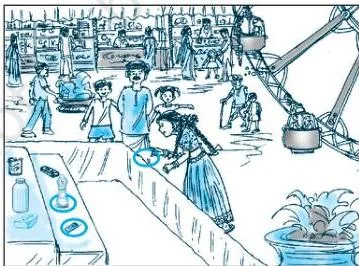
The picture above is the scene of the chapter’s first problem. Akhila went to a fair, rode the Giant Wheel and played Hoopla, a game where a ring must cover an object completely to win it (NCERT p. 25).
Let \(x\) be the number of rides and \(y\) the number of Hoopla games. She played Hoopla half as many times as she rode, which is \(y = \frac{1}{2}x\). Each ride cost ₹3 and each game ₹4, and she spent ₹20, which gives \(3x + 4y = 20\).
The caption’s hint — try different cases — is the trial-and-error route: one ride? two rides? The chapter replaces that guessing with a systematic pair of equations and two ways to solve them.
The chapter then moves in this order:
- Section 3.1 (pages 24–25): the fair problem becomes a pair of linear equations in two variables.
- Section 3.2 (pages 25–30): the graphical method, worked through Examples 1 to 3 including Champa’s sale, then Exercise 3.1.
- Section 3.3 (from page 30): the algebraic methods, introduced because graphs are unreliable when the solution has awkward coordinates.
- Section 3.3.1 (pages 30–33): the substitution method, Examples 4 to 7, then Exercise 3.2.
- Section 3.3.2 (pages 34–36): the elimination method, Examples 8 to 10, then Exercise 3.3.
- Section 3.4 (pages 36–37): the chapter’s closing Summary.
Key Terms: Consistent, Inconsistent and Dependent Pairs of Equations
These five labels appear in nearly every question of the chapter. Learn what each means before attempting the exercises.
- Pair of linear equations in two variables — two equations in the general form \(a_1x + b_1y + c_1 = 0\) and \(a_2x + b_2y + c_2 = 0\), sharing the same two variables \(x\) and \(y\) (NCERT p. 26).
- Solution — values of \(x\) and \(y\) that satisfy both equations at the same time.
- Consistent pair — a pair that has a solution (NCERT p. 25).
- Inconsistent pair — a pair that has no solution; its lines are parallel (NCERT p. 25).
- Dependent pair — the two equations are equivalent, so they share infinitely many common solutions; a dependent pair is always consistent (NCERT p. 25).
The names come from the three things two straight lines can do (NCERT p. 25): intersect in one point → unique solution, consistent; run parallel → no solution, inconsistent; coincide completely → infinitely many solutions, dependent (consistent). Keep that picture and the definitions stay memorable.
The Ratio Test: Classifying a Pair of Lines Without Drawing Them
The ratio test decides which of the three behaviours a pair of lines has without drawing them. It is the single most reused idea in the chapter, so check your mastery of it before the exercises.
Put both equations into the general form \(a_1x + b_1y + c_1 = 0\) and \(a_2x + b_2y + c_2 = 0\), then compute the three ratios \( \frac{a_1}{a_2} \), \( \frac{b_1}{b_2} \) and \( \frac{c_1}{c_2} \) (NCERT p. 26, Table 3.1).
| Condition on the ratios | Lines | Solutions | Classification |
|---|---|---|---|
| \( \frac{a_1}{a_2} \neq \frac{b_1}{b_2} \) | Intersecting | Exactly one | Consistent |
| \( \frac{a_1}{a_2} = \frac{b_1}{b_2} \neq \frac{c_1}{c_2} \) | Parallel | None | Inconsistent |
| \( \frac{a_1}{a_2} = \frac{b_1}{b_2} = \frac{c_1}{c_2} \) | Coincident | Infinitely many | Dependent (consistent) |
Why this works: the ratio \( \frac{a_1}{a_2} \) compared with \( \frac{b_1}{b_2} \) tells you whether the two slopes are equal — the slope of \(ax + by + c = 0\) is \(-\frac{a}{b}\). Unequal ratios mean different slopes, so the lines must cross once.
Equal ratios mean equal slopes, so the lines never cross — they are either parallel or actually the same line, and the \( \frac{c_1}{c_2} \) comparison is what separates the two. The converse is also true for any pair of lines (NCERT p. 26).
Apply the test to the book’s three sample pairs (NCERT p. 26) and the pattern is clear:
- \(x – 2y = 0\) with \(3x + 4y – 20 = 0\): \( \frac{a_1}{a_2} = \frac{1}{3} \), \( \frac{b_1}{b_2} = -\frac{1}{2} \) — unequal, so the lines intersect.
- \(2x + 3y – 9 = 0\) with \(4x + 6y – 18 = 0\): all three ratios equal \( \frac{1}{2} \), including \( \frac{-9}{-18} = \frac{1}{2} \) — coincident lines.
- \(x + 2y – 4 = 0\) with \(2x + 4y – 12 = 0\): \( \frac{a_1}{a_2} = \frac{b_1}{b_2} = \frac{1}{2} \) but \( \frac{c_1}{c_2} = \frac{1}{3} \) — parallel lines.
Mnemonic: compare \( \frac{a_1}{a_2} \) with \( \frac{b_1}{b_2} \) first. If they differ, the lines meet and you are done. If they are equal, check \( \frac{c_1}{c_2} \): equal means the same line (coincident), unequal means parallel twins. In short — a and b decide whether they meet; c decides whether they are twins or the same line.
Reading Fig 3.1: Where the Graphical Solution Comes From
The graph is the ratio test made visible. This walkthrough of Example 1 shows the exact recipe the exercises expect.
Example 1 checks the pair \(x + 3y = 6\) and \(2x – 3y = 12\) graphically (NCERT pp. 26–27). Find two solutions of each equation, as in Table 3.2 (p. 27):
- For \(x + 3y = 6\): the points A(0, 2) and B(6, 0).
- For \(2x – 3y = 12\): the points P(0, -4) and Q(3, -2).
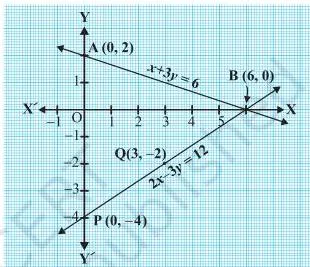
As Fig 3.1 shows, the line through A and B and the line through P and Q share one point, B(6, 0). A point on both lines satisfies both equations, so \(x = 6\), \(y = 0\) is the solution. Verify by substitution: \(6 + 3(0) = 6\) and \(2(6) – 3(0) = 12\), both true.
Two points are enough per line because a straight line is fixed by two points; the intersection is then the unique solution of a consistent pair.
Example 2 (p. 27) shows the other face of the same idea: for \(5x – 8y + 1 = 0\) and \(3x – \frac{24}{5}y + \frac{3}{5} = 0\), multiplying the second equation by \( \frac{5}{3} \) reproduces the first exactly. The lines coincide, so there are infinitely many solutions.
The Substitution Method: Three Steps and a Full Worked Example
Substitution hides one variable inside another: express one variable in terms of the other, and the pair collapses into a single equation in one variable. The chapter gives three steps (NCERT pp. 30–31):
- From either equation, write one variable in terms of the other — choose whichever equation makes this easiest.
- Substitute that expression into the other equation. This gives one equation in one variable; solve it.
- Put that value back into the expression from Step 1 to get the second variable, then verify in both original equations.
Here is the method on an original pair, \(6x + 5y = 32\) and \(2x + y = 8\):
- Step 1: From \(2x + y = 8\), write \(y = 8 – 2x\).
- Step 2: Substitute into \(6x + 5y = 32\):
\[ 6x + 5(8 – 2x) = 32 \]
\[ 6x + 40 – 10x = 32 \Rightarrow -4x = -8 \Rightarrow x = 2 \]
Step 3: Back-substitute: \(y = 8 – 2(2) = 4\).
Verification: \(6(2) + 5(4) = 32\) and \(2(2) + 4 = 8\), both satisfied.
Final answer: \(x = 2\), \(y = 4\).
Sometimes the substitution removes the variable altogether. The leftover statement is the method’s verdict, as in Example 6 and Example 7 (pp. 32–33):
| Statement with no variable | Example in the chapter | Meaning |
|---|---|---|
| True, e.g. \(18 = 18\) | Example 6: pencils and erasers (p. 32) | Both equations are the same line → infinitely many solutions |
| False, e.g. \(-4 = 0\) | Example 7: two railway lines (pp. 32–33) | The lines are parallel → no solution, pair is inconsistent |
In Example 6 the equations \(2x + 3y = 9\) and \(4x + 6y = 18\) are the same equation doubled, which is why every value works; in Example 7 the rails \(x + 2y – 4 = 0\) and \(2x + 4y – 12 = 0\) are the parallel pair from the ratio table, so the rails never cross.
The Elimination Method: Four Steps, and the Same Pair Solved Again
Elimination does the opposite trick: instead of substituting one variable, it cancels a variable by making the coefficients match and subtracting. The chapter’s four steps (NCERT p. 35):
- Multiply the equations by suitable non-zero constants so the coefficients of one variable become numerically equal.
- Add or subtract to eliminate that variable. A true statement with no variable → infinitely many solutions; a false one → no solution.
- Solve the one-variable equation.
- Substitute the value into either original equation to find the other variable.
The same original pair, \(6x + 5y = 32\) and \(2x + y = 8\), by elimination:
Step 1: Match the \(y\)-coefficients (5 and 1) by multiplying the second equation by 5:
\[ 10x + 5y = 40 \]
Step 2: Subtract the second from the first to eliminate \(y\):
\[ (6x + 5y) – (10x + 5y) = 32 – 40 \Rightarrow -4x = -8 \Rightarrow x = 2 \]
Step 3: Substitute \(x = 2\) into \(2x + y = 8\): \(2(2) + y = 8\), so \(y = 4\).
Verification: identical to the substitution check — both equations hold.
Final answer: \(x = 2\), \(y = 4\), exactly as substitution gave.
One multiplication was enough here, which is why the book calls elimination sometimes more convenient than substitution.
Example 8 (pp. 34–35) shows the classic set-up: incomes in the ratio 9 : 7 and expenditures in the ratio 4 : 3, with savings of ₹2000 each. Writing incomes as \(9x\) and \(7x\) and expenditures as \(4y\) and \(3y\) gives \(9x – 4y = 2000\) and \(7x – 3y = 2000\).
Multiplying the first equation by 3 and the second by 4 makes the \(y\)-coefficients both 12; subtracting gives \(x = 2000\), then \(y = 4000\).
Example 9 (p. 35) is the false-statement case: \(2x + 3y = 8\) and \(4x + 6y = 7\). After making the \(x\)-coefficients equal, subtracting yields \(0 = 9\), which is false — so the pair has no solution.
The book’s remark after Example 8 (p. 35) is worth remembering: you could also have eliminated \(x\), or used substitution or graphs — try it and use whichever feels more convenient.
Which Method Should You Use? A Decision Guide
With three methods available, the choice is practical, not mathematical — all three give the same answer. The book itself flags the deciding clue on page 30: the graphical method is not convenient when the solution has coordinates like \((\sqrt{3}, 2\sqrt{7})\), \((-1.75, 3.3)\) or \((\frac{4}{13}, \frac{1}{19})\), because reading such points invites mistakes.
The quick guide below comes from that warning and from the book’s remark on page 35 that several methods work and you should pick the convenient one.
| Method | Reach for it when | Why it wins |
|---|---|---|
| Graphical | Coefficients are small and the solution looks like whole numbers, with graph paper at hand | The intersection is read directly off the figure |
| Substitution | One variable already stands alone with coefficient 1, as in \(x + 2y = 3\) | The rewrite costs one line, no multiplying needed |
| Elimination | Most other pairs, especially word problems like Example 10’s two-digit number (p. 36) | Coefficients stay small and fractions wait until the end |
Rule of thumb: elimination for most pairs, substitution when a variable stands alone, graphs only for easy integer solutions.
The Word Problems in This Chapter: Situations That Keep Repeating
The exercises reuse a small set of situations, so the translation step becomes pattern recognition. The repeated categories across Exercises 3.1 to 3.3 are:
- Counting: the quiz with 10 students, girls 4 more than boys (Exercise 3.1, Q1).
- Costs of items: pencils and pens (3.1 Q1), bats and balls (3.2 Q3), taxi charges (3.2 Q3), bank notes (3.3 Q2), library charges (3.3 Q2).
- Ages: Aftab and his daughter (Example 5), Jacob and his son (3.2 Q3), Nuri and Sonu (3.3 Q2).
- Digits: a two-digit number and the number formed by reversing its digits (Example 10; 3.3 Q2).
- Fractions: a fraction that changes when the same number is added to numerator and denominator (3.2 Q3; 3.3 Q2).
- Geometry: the rectangular garden whose length is 4 m more than its width (3.1 Q5).
The translation skill that decides success is keeping the sentence’s subject on the left. Champa’s sale is the model (Example 3, p. 28): “The number of skirts is two less than twice the number of pants.” With \(x\) = pants and \(y\) = skirts, that is \(y = 2x – 2\).
Her second clue, “four less than four times”, gives \(y = 4x – 4\). Writing \(x = 2y – 2\) instead is the classic error; the final answer (1 pant, 0 skirts) satisfies both clues.
A fresh micro-example with the same habit: let \(x\) = pens and \(y\) = notebooks. “Notebooks are 3 more than twice the pens” gives \(y = 2x + 3\); “18 items in all” gives \(x + y = 18\).
Substitution gives \(x + (2x + 3) = 18\), so \(3x = 15\), \(x = 5\) and \(y = 13\). Check \(13 = 2(5) + 3\) and \(5 + 13 = 18\). The routine to copy: define the variables first, translate each sentence into an equation second, solve third.
Common Mistakes in This Chapter and How to Avoid Them
Most errors in this chapter are reading errors rather than arithmetic errors — wrong form, wrong sign, wrong clause order. Each row below names the mistake before you make it.
| Mistake | Correct rule | How to check your answer |
|---|---|---|
| Comparing ratios before the equations are in the form \(ax + by + c = 0\) | Rearrange every equation to standard form first; a moved term changes the sign of \(c\) | Rewrite both equations as \(= 0\) and recompute the ratios |
| Sign error in the c-ratio, e.g. reading \(\frac{-9}{-18}\) as \(-\frac{1}{2}\) | A negative divided by a negative is positive: \(\frac{-9}{-18} = \frac{1}{2}\) (Table 3.1, p. 26) | Write both signs down before simplifying |
| Stopping after \(\frac{a_1}{a_2} = \frac{b_1}{b_2}\) without checking \(\frac{c_1}{c_2}\) | Equal a- and b-ratios mean parallel or coincident; only c separates them | Compare \(\frac{c_1}{c_2}\): equal → coincident, unequal → parallel |
| Reversing the clause in a word problem | “Two less than twice” gives \(y = 2x – 2\), not \(x = 2y – 2\) (Example 3, p. 28) | Read your equation back as an English sentence |
| Writing a two-digit number as \(x + y\) | The number with tens digit \(x\) and units digit \(y\) is \(10x + y\) (Example 10, p. 36) | Test with 56 = 10(5) + 6 |
| Misreading a no-variable result | True, e.g. \(18 = 18\), means infinitely many; false, e.g. \(0 = 9\), means none (pp. 32–35) | Ask: is the statement true? |
| On a graph, taking one line’s intercept as the answer | The solution is the point where the two lines cross, not where one meets an axis (Fig 3.1, p. 27) | Substitute the point into both equations |
How the Exercises Are Shaped: A Question-Type Map
The three exercises each train one skill and then mix it with word problems. One question from each row below covers every shape the chapter teaches.
| Exercise | Questions | What the questions train |
|---|---|---|
| Exercise 3.1 (seven questions) | 1–7 | Forming equations from a story and solving graphically (Q1); classifying lines by ratios (Q2); deciding consistency by ratios (Q3); testing consistency and solving graphically (Q4); the garden word problem (Q5); writing a second equation to force intersecting, parallel or coincident lines (Q6); drawing lines to find a shaded triangle with the x-axis (Q7) |
| Exercise 3.2 (three questions, Q1 and Q3 with parts) | 1–3 | Substitution on plain, decimal, fractional and surd pairs (Q1); solving a pair and using the solution to find \(m\) in \(y = mx + 3\) (Q2); word problems — numbers, angles, bats and balls, taxi fares, a fraction, ages (Q3) |
| Exercise 3.3 (two questions, with parts) | 1–2 | Both methods on the same pairs, with fractional coefficients (Q1); elimination word problems — a fraction, ages, a two-digit number, bank notes, library charges (Q2) |
Two practice pointers: Q6 of Exercise 3.1 is the strongest test of the ratio conditions because you must engineer all three line relationships yourself, and the two-digit and fraction problems of Exercise 3.3 test forming equations from symbolic wording. Textbook contents and the examinable syllabus are not always identical — check the current official CBSE syllabus.
The Chapter in One Page: What NCERT’s Own Summary Emphasises
The chapter closes with a six-point summary (Section 3.4, pp. 36–37). Distilled for last-minute revision, it says:
- A pair of linear equations in two variables can be solved by the graphical method or by an algebraic method.
- Graphically, two lines that intersect give a unique solution (consistent pair); coincident lines give infinitely many solutions (dependent and consistent); parallel lines give no solution (inconsistent pair).
- Algebraically, the two methods are substitution and elimination.
- For the general pair, the ratios decide: \(\frac{a_1}{a_2} \neq \frac{b_1}{b_2}\) → consistent; \(\frac{a_1}{a_2} = \frac{b_1}{b_2} \neq \frac{c_1}{c_2}\) → inconsistent; all three equal → dependent and consistent.
- Some problems begin as equations that are not linear but can be rearranged into a pair of linear equations.
Rebuild these five lines from memory before attempting any full-length practice set — they are the chapter in one page.
Related Chapters and Resources on This Site
This listing is maintained for the 2026-27 academic session using the NCERT textbook information available to us. NCERT remains the authority for confirming the latest edition.
The equation-handling habits this chapter builds — naming variables, forming equations, solving them — are the spine of the rest of the book.
The Class 10 Mathematics book page lists every chapter in order, and the Class 10 hub gathers all subjects. The CBSE notes section holds revision material for every class.
In the book itself, the previous chapter, Polynomials, leads into this one, and the next chapter, Quadratic Equations, builds on the solving habits you practise here.
Sources and Data Verification
This page describes the NCERT Class 10 Mathematics textbook, official NCERT edition, Chapter 3, Pair of Linear Equations in Two Variables, which opens at textbook page 23 and runs about 14 pages in the official PDF. It covers this one chapter — not the full book, and not the CBSE syllabus.
The page is maintained for the current academic session using the NCERT information available to this site.
NCERT settles the textbooks, editions and PDFs; CBSE settles the curriculum and examinations for Classes 9 to 12. The official chapter PDF is published on the NCERT website.
| What the chapter holds | Count | Where it is used |
|---|---|---|
| Printed pages | 14 | |
| Sections in the chapter | 6 | |
| Figures with NCERT captions | 2 | |
| Tables | 4 | |
| Worked examples | 2 | solved step by step in our NCERT Solutions |
| Exercise questions | 12 | answered in our NCERT Solutions |
| Official NCERT PDF | Download the chapter PDF | the chapter exactly as NCERT publishes it |
Chapter-wise notes for this subject are not published yet. The unit-wise syllabus on this page is complete and verified against the official CBSE curriculum document.
Frequently Asked Questions
When does a pair of linear equations have no solution?
A pair has no solution when the two lines are parallel. The ratios show this as \( \frac{a_1}{a_2} = \frac{b_1}{b_2} \neq \frac{c_1}{c_2} \) (NCERT p. 26), and algebra confirms it when a method ends in a false statement with no variable, such as \(-4 = 0\) in Example 7 (p. 33) or \(0 = 9\) in Example 9 (p. 35).
What is the difference between consistent, inconsistent and dependent pairs of linear equations?
Consistent means a solution exists; inconsistent means no solution exists, so the lines are parallel; dependent means the two equations are equivalent and share infinitely many solutions. A dependent pair is always consistent (NCERT p. 25), because infinitely many solutions still counts as having solutions.
What does it mean when my working gives 18 = 18 or 0 = 9?
A statement with no variable left is the method’s verdict on the whole pair. A true one, like \(18 = 18\) from Example 6 (p. 32), means the two equations are the same line, so there are infinitely many solutions. A false one, like \(0 = 9\) from Example 9 (p. 35), means the lines are parallel and the pair has no solution.
Should I use substitution or elimination to solve a pair of linear equations?
Use substitution when one variable already stands alone with coefficient 1, because the rewrite costs one line. Use elimination for most other pairs, since it postpones fractions and handles the chapter’s word problems cleanly. The book itself notes after Example 8 that several methods work — see which is more convenient (p. 35).
How do I turn a word problem into a pair of linear equations?
Name the unknown quantities with variables first, then translate each sentence into an equation, watching the order of the wording — “two less than twice” means \(y = 2x – 2\), not the reverse (Example 3, p. 28). Finish by substituting your answer back into the original sentences to confirm it.
Is the whole of this chapter part of the CBSE syllabus for Class 10?
Textbook contents and the examinable syllabus are not always identical. This page describes the NCERT textbook chapter; for what is examinable this session, check the current official CBSE syllabus.
Reference: NCERT Class 10 Mathematics textbook, chapter 3, official edition on ncert.nic.in.
Explore Class 10 Mathematics Books
Related chapters: