
This page is about Chapter 4, Quadratic Equations, of the NCERT Class 10 Mathematics textbook — in the NCERT edition in use this academic session, the chapter runs from textbook pages 37 to 47 (11 printed pages).
The official chapter PDF is offered right here in the download section, and below it you get a section-by-section map, the chapter’s diagrams read step by step, and the key ideas explained in plainer words.
Download the NCERT Class 10 Quadratic Equations Chapter 4 PDF
Open the official quadratic equations class 10 NCERT chapter 4 PDF on ncert.nic.in when you want the chapter exactly as printed — it is the same file schools follow, with the textbook’s own examples, exercises and figures on pages 37 to 47, and it is free to download.
The sections below then walk you through what is inside that file.
Chapter 4 at a Glance
The chapter’s size and shape — its sections, figures, worked examples and exercise questions — sit in the table below, so you can see what the PDF holds before you decide what to read.
What This Chapter Covers: A Walk Through Sections 4.1 to 4.5
This walkthrough names each numbered section and each exercise, the textbook page where it starts, and what it asks a student to do. Skim it once to see the chapter’s shape, then jump to the part you need.
4.1 Introduction — pages 37 to 39
The chapter opens with a problem you can picture: a trust wants a prayer hall with carpet area \(300\ \text{m}^2\), and the hall’s length is one metre more than twice its breadth. Calling the breadth \(x\) turns that sentence into the quadratic equation \(2x^2 + x – 300 = 0\) (NCERT p. 38).
A short historical note follows: Babylonians solved the “two numbers with a given sum and product” problem, Euclid used geometry, and Indian mathematicians Brahmagupta and Sridharacharya gave early formulas — Sridharacharya’s is the ancestor of today’s quadratic formula (NCERT pp. 38–39).
4.2 Quadratic Equations — pages 38 to 41
This section fixes the definition: a quadratic equation in \(x\) has the standard form \(ax^2 + bx + c = 0\), with \(a, b, c\) real and \(a \neq 0\) (NCERT p. 38). Two examples then show how real situations become equations — a story about marbles shared by two friends, and a cottage industry counting toys and production cost (NCERT pp. 39–40).
Example 2 teaches the checking skill: expand and simplify before you decide whether an equation is quadratic. The Remark after it warns that an equation can look quadratic yet reduce to linear, while one that looks cubic can turn out quadratic (NCERT p. 41).
Exercise 4.1 — pages 40 to 42
The first exercise has two tasks: checking whether a given equation is quadratic, and representing a situation as a quadratic equation. The situations cover a rectangular plot, consecutive integers, ages and a train’s speed (NCERT pp. 41–42).
4.3 Solution of a Quadratic Equation by Factorisation — pages 41 to 44
Here the chapter defines a root: a real number \(\alpha\) is a root of \(ax^2 + bx + c = 0\) when \(a\alpha^2 + b\alpha + c = 0\) (NCERT p. 42). It then solves equations by splitting the middle term, working through Examples 3 to 6 — the last of which finishes the prayer hall problem of Section 4.1 (NCERT pp. 42–44).
When factorisation gives \(x = 12\) or \(x = -12.5\), the chapter keeps 12 because a breadth cannot be negative (NCERT p. 44).
Exercise 4.2 — pages 43 to 45
Practice for the factorisation method, starting with bare equations and moving to word problems: two numbers with a given sum and product, consecutive integers whose squares sum to a given value, a right triangle, and a cottage industry’s production cost (NCERT pp. 44–45).
4.4 Nature of Roots — pages 44 to 47
The section introduces the quadratic formula \(x = \frac{-b \pm \sqrt{b^2 – 4ac}}{2a}\) (NCERT p. 44) and names its deciding part, the discriminant \(b^2 – 4ac\) (NCERT p. 45). Examples 7 to 9 use it — including the circular park problem, where the discriminant alone answers whether the task is possible at all (NCERT pp. 45–46).
Exercise 4.3 — pages 46 to 47
The last exercise asks “is it possible” design questions: a rectangular mango grove, the present ages of two friends, and a rectangular park. Each is answered by checking whether real roots exist, then solving for the dimensions (NCERT pp. 46–47).
4.5 Summary — page 47
The chapter closes with five summary points restating the standard form, the meaning of a root, the factorisation method, the quadratic formula and the discriminant’s three cases (NCERT p. 47).
Key Concepts: Standard Form, Roots, Factorisation and the Quadratic Formula
A quadratic equation is a degree-2 polynomial set equal to zero. The chapter gives you two ways to solve it — factorisation and the quadratic formula — and one way to predict the nature of the roots before solving: the discriminant.
Standard form: why a cannot be zero
The standard form is \(ax^2 + bx + c = 0\), where \(a, b, c\) are real numbers and \(a \neq 0\) (NCERT p. 38). The condition \(a \neq 0\) is not decoration: the \(x^2\) term is what makes the equation quadratic. If \(a\) were 0, the equation would collapse to \(bx + c = 0\), a linear equation with at most one solution.
The book’s own example \(1 – x^2 + 300 = 0\) shows \(b\) can be zero — there is no \(x\) term — and the equation is still quadratic.
Roots and solutions: the same as the zeroes
A real number \(\alpha\) is a root of \(ax^2 + bx + c = 0\) if substituting it gives \(a\alpha^2 + b\alpha + c = 0\) (NCERT p. 42). The book also calls \(x = \alpha\) a solution of the equation.
The roots of the equation are exactly the zeroes of the polynomial \(ax^2 + bx + c\), and since a quadratic polynomial has at most two zeroes, a quadratic equation has at most two roots (NCERT p. 42).
The factorisation method, with a worked example
When the polynomial splits into two linear factors, factorise and set each factor to zero. A product of two real numbers is zero only when one of them is zero, so each factor gives one root.
Worked example with new numbers: solve \(4x^2 – 11x + 6 = 0\) by splitting the middle term.
- Step 1: Identify \(a = 4\), \(b = -11\), \(c = 6\).
- Step 2: Find two numbers whose product is \(ac = 4 \times 6 = 24\) and whose sum is \(b = -11\).
They are \(-8\) and \(-3\).
Step 3: Split the middle term and group:
\[ 4x^2 – 11x + 6 = 4x^2 – 8x – 3x + 6 = 4x(x – 2) – 3(x – 2) = (4x – 3)(x – 2) \]
Step 4: Set each factor to zero: \(4x – 3 = 0\) or \(x – 2 = 0\).
\[ x = \frac{3}{4} \quad \text{or} \quad x = 2 \]
Step 5: Verify by substitution.
For \(x = \frac{3}{4}\): \(4\left(\frac{3}{4}\right)^2 – 11\left(\frac{3}{4}\right) + 6 = \frac{9}{4} – \frac{33}{4} + \frac{24}{4} = 0\).
For \(x = 2\): \(4(4) – 22 + 6 = 0\).
Final answer: \(x = \frac{3}{4}\) and \(x = 2\).
This is the same method NCERT applies in Example 3 (NCERT p. 42): pick two numbers whose product is \(ac\) and whose sum is \(b\), rewrite the middle term, group, and factor out the common binomial.
The quadratic formula, with a worked example
When factorisation is not obvious, the formula gives the roots directly (NCERT p. 44): \(x = \frac{-b \pm \sqrt{b^2 – 4ac}}{2a}\). Here \(a, b, c\) are the coefficients of \(ax^2 + bx + c = 0\), and the \(\pm\) sign is shorthand for two separate values — one with a plus, one with a minus.
Worked example with new numbers: solve \(3x^2 + 5x – 2 = 0\) using the quadratic formula.
Step 1: The equation is already in standard form.
Read off \(a = 3\), \(b = 5\), \(c = -2\).
Step 2: Compute the discriminant: \(b^2 – 4ac = 5^2 – 4(3)(-2) = 25 + 24 = 49\).
Since \(49 \gt 0\), two distinct real roots exist.
Step 3: Substitute into the formula:
\[ x = \frac{-5 \pm \sqrt{49}}{2(3)} = \frac{-5 \pm 7}{6} \]
- Step 1: The \(\pm\) sign produces the two roots: \(x = \frac{-5 + 7}{6} = \frac{2}{6} = \frac{1}{3}\) and \(x = \frac{-5 – 7}{6} = \frac{-12}{6} = -2\).
- Step 2: Verify: \(3\left(\frac{1}{3}\right)^2 + 5\left(\frac{1}{3}\right) – 2 = \frac{1}{3} + \frac{5}{3} – 2 = 0\), and \(3(-2)^2 + 5(-2) – 2 = 12 – 10 – 2 = 0\).
Final answer: \(x = \frac{1}{3}\) and \(x = -2\).
The formula is valid whenever \(b^2 – 4ac \geq 0\). When the discriminant is negative, the square root has no real value, so the equation has no real roots (NCERT p. 45).
Discriminant quick-reference table
Because \(b^2 – 4ac\) decides the nature of the roots, it is called the discriminant (NCERT p. 45). The three cases:
| Sign of discriminant \(b^2 – 4ac\) | Nature of roots | Example equation |
|---|---|---|
| \(b^2 – 4ac \gt 0\) | Two distinct real roots | \(x^2 – 5x + 6 = 0\), discriminant \(= 1\) |
| \(b^2 – 4ac = 0\) | Two equal (coincident) roots | \(x^2 – 6x + 9 = 0\), discriminant \(= 0\) |
| \(b^2 – 4ac \lt 0\) | No real roots | \(x^2 + x + 1 = 0\), discriminant \(= -3\) |
The Chapter’s Figures, Read Step by Step
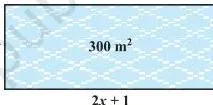
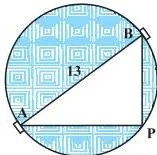
The diagrams in this chapter each carry a word problem into geometry: labelled lengths you can turn straight into an equation. Read the label, write the relation the problem gives, expand — and the quadratic equation appears.
Figure 4.1: the prayer hall (NCERT p. 38)
The figure is a rectangle with the two labels that matter: breadth \(x\), length \(2x + 1\). The problem states that the area is \(300\ \text{m}^2\), and area is length times breadth, so \(x(2x + 1) = 300\). Expanding gives \(2x^2 + x – 300 = 0\), the equation the whole chapter starts from (NCERT p. 38).
The sides of the picture are the equation’s building blocks: if you can label a rectangle, you can set up the equation yourself.
Figure 4.2: the circular park and the pole (NCERT p. 45)
The diameter AB is \(13\ \text{m}\), P lies on the boundary, and the difference of the distances, \(AP – BP\), is \(7\ \text{m}\). With \(BP = x\), that gives \(AP = x + 7\).
Because AB is a diameter, angle APB is \(90^\circ\) — the angle in a semicircle is a right angle — so Pythagoras applies: \((x + 7)^2 + x^2 = 13^2\) (NCERT p. 46).
Expanding and simplifying gives \(x^2 + 7x – 60 = 0\), whose discriminant \(7^2 – 4(1)(-60) = 289\) is positive — so the pole is possible, and \(x = 5\) or \(x = -12\). The value \(-12\) is discarded because \(x\) measures a distance; a distance cannot be negative, just as \(x = -12.5\) was discarded earlier because a breadth cannot be negative (NCERT p. 46).
The pole stands \(5\ \text{m}\) from gate B and \(12\ \text{m}\) from gate A.
Definitions to Remember: Standard Form, Root, Discriminant
These are the terms the chapter defines formally, and questions use their exact meanings. Each is restated in one clear line, with the NCERT page where it is defined.
| Term | Meaning in this chapter | NCERT page |
|---|---|---|
| Standard form of a quadratic equation | \(ax^2 + bx + c = 0\), with \(a, b, c\) real and \(a \neq 0\) | 38 |
| Root (or solution) | A real number \(\alpha\) such that \(a\alpha^2 + b\alpha + c = 0\) | 42 |
| Zeroes of the quadratic polynomial | The same numbers as the roots of \(ax^2 + bx + c = 0\) | 42 |
| Discriminant | \(b^2 – 4ac\), which decides the nature of the roots | 45 |
| Equal (coincident) roots | Both roots equal \(-\frac{b}{2a}\), occurring when the discriminant is 0 | 45 |
Common Mistakes in Quadratic Equations, and How to Avoid Them
NCERT flags most of these traps inside its own examples. Recognise the mistake before you make it — each row gives the correction and a self-check.
| Mistake | Correct rule | How to check your answer |
|---|---|---|
| Calling an equation quadratic before simplifying it (NCERT p. 41) | Expand both sides, collect terms, then decide — an equation can look quadratic and reduce to linear | After simplifying, does an \(x^2\) term with a non-zero coefficient remain? |
| Forgetting the \(a \neq 0\) condition in the standard form (NCERT p. 38) | If \(a = 0\) the \(x^2\) term vanishes and the equation is linear | Name \(a, b, c\) first; if \(a = 0\), it is not a quadratic equation |
| Sign errors while tidying a negative \(x^2\) term (NCERT pp. 39–40) | Multiply the whole equation by \(-1\), e.g. \(-x^2 + 45x – 324 = 0\) becomes \(x^2 – 45x + 324 = 0\) | Substitute each root into the original equation, not your tidy version |
| Accepting a negative root that the situation rejects (NCERT pp. 44, 46) | Breadth, length, distance, age and speed cannot be negative; drop such roots with a reason | Ask what the variable measures before writing the final answer |
| Saying “no roots” when the discriminant is negative (NCERT p. 45) | The equation has no real roots | State the sign of the discriminant and use the exact phrase “no real roots” |
How to Practise This Chapter for Exams
The three exercises are arranged so each one builds the skill the next one needs. Practise in order, and use this map to target a weak spot.
| Exercise | Pages | Skill it trains |
|---|---|---|
| Exercise 4.1 | 40–42 | Recognising a quadratic equation; translating a situation into an equation |
| Exercise 4.2 | 43–45 | Solving by factorisation: bare equations first, then word problems on numbers, consecutive integers, right triangles and production cost |
| Exercise 4.3 | 46–47 | Using the discriminant; “is it possible” design questions decided by whether real roots exist |
Two practice habits from the book’s own method: verify every root by substituting it back into the equation, and reject any root that makes the quantity impossible — a breadth, distance, age or speed cannot be negative. A full-marks answer to a word problem shows the equation, the working, the rejected root with a reason, and the final values with units.
The chapter builds directly on Chapter 2, where the zeroes of a quadratic polynomial become the roots of a quadratic equation here (NCERT p. 42). Note that textbook contents and the examinable syllabus are not always identical — check the current official syllabus before deciding what to revise.
Chapter 4 Revision Summary: What to Remember
NCERT closes the chapter with five summary points (NCERT p. 47); here they are in plainer words, with one line on how to spot each idea in a question.
- Standard form: a quadratic equation in \(x\) is \(ax^2 + bx + c = 0\) with real \(a, b, c\) and \(a \neq 0\). Spot it: the highest power of \(x\) is exactly 2, with a non-zero coefficient.
- Root: a real number \(\alpha\) is a root when \(a\alpha^2 + b\alpha + c = 0\); the roots are the zeroes of the polynomial, so there are at most two. Spot it: “verify that … is a root” means substitute and show the result is 0.
- Factorisation: when the polynomial splits into two linear factors, set each factor to zero. Spot it: the coefficients are small enough to split the middle term by inspection.
- Quadratic formula: \(x = \frac{-b \pm \sqrt{b^2 – 4ac}}{2a}\), valid whenever \(b^2 – 4ac \geq 0\). Spot it: factorisation is not obvious, or the roots contain surds.
- Discriminant: \(b^2 – 4ac\) positive means two distinct real roots, zero means two equal roots, negative means no real roots. Spot it: the question says “find the nature of the roots”.
Related Chapters and Resources
This listing is maintained for the 2026-27 academic session using the NCERT textbook information available to us. NCERT remains the authority for confirming the latest edition.
Quadratic equations reuse Chapter 2’s idea of zeroes: the zeroes of \(ax^2 + bx + c\) become the roots of \(ax^2 + bx + c = 0\) (NCERT p. 42). For revision around this chapter, work through the Class 10 Mathematics notes, and link the chapter to its neighbours — pair of linear equations in two variables before it, and arithmetic progressions after it.
If you are revising the whole year, start from the Class 10 hub. The chapter described here is the NCERT Class 10 Mathematics edition published at ncert.nic.in, which is also where NCERT settles all textbook editions and PDFs.
Sources and Data Verification
- This page describes Chapter 4, Quadratic Equations, of the NCERT Mathematics textbook for Class 10, English medium, official edition published on ncert.nic.in.
- It covers this one chapter only — not other Class 10 chapters, subjects or textbooks.
- The listing is maintained for the current academic session using the NCERT information available. NCERT settles textbook editions and PDFs; CBSE settles the curriculum, syllabus and examinations.
- In that edition the chapter runs from textbook pages 37 to 47.
| What the chapter holds | Count | Where it is used |
|---|---|---|
| Printed pages | 11 | |
| Sections in the chapter | 5 | |
| Figures with NCERT captions | 2 | |
| Tables | 1 | |
| Worked examples | 2 | solved step by step in our NCERT Solutions |
| Exercise questions | 13 | answered in our NCERT Solutions |
| Official NCERT PDF | Download the chapter PDF | the chapter exactly as NCERT publishes it |
Reference: NCERT Class 10 Mathematics textbook, chapter 4, official edition on ncert.nic.in.
Frequently Asked Questions About Quadratic Equations, Class 10
What is the standard form of a quadratic equation, and why must a not be zero?
The standard form is \(ax^2 + bx + c = 0\), where \(a, b, c\) are real numbers and \(a \neq 0\) (NCERT p. 38). If \(a\) were zero, the \(x^2\) term would disappear and the equation would become the linear equation \(bx + c = 0\). The non-zero \(a\) is what makes the equation quadratic at all.
Are the roots of a quadratic equation the same as the zeroes of a quadratic polynomial?
Yes — exactly the same numbers (NCERT p. 42). A real number \(\alpha\) is a root of \(ax^2 + bx + c = 0\) precisely when \(a\alpha^2 + b\alpha + c = 0\), which is the same condition as \(\alpha\) being a zero of the polynomial. Since a quadratic polynomial has at most two zeroes, the equation has at most two roots.
How do I decide between factorisation and the quadratic formula?
Factorise when the polynomial splits cleanly into linear factors with small coefficients, using the middle-term splitting method (NCERT p. 42). Use the quadratic formula when factorisation is not obvious or the roots contain surds (NCERT p. 44). Both methods give the same roots whenever \(b^2 – 4ac \geq 0\).
What does the discriminant tell me about the roots?
The discriminant \(b^2 – 4ac\) decides the nature of the roots (NCERT p. 45): positive means two distinct real roots, zero means two equal real roots, negative means no real roots. It also settles “is it possible” questions — if no real roots exist, the described design cannot have real dimensions.
Why are negative roots rejected in word problems?
Because the variable stands for a physical quantity that cannot be negative. In Example 6, \(x = -12.5\) is dropped because \(x\) is the breadth of a hall (NCERT p. 44); in Example 8, \(x = -12\) is dropped because \(x\) is a distance from a gate (NCERT p. 46). The algebra is correct either way — the meaning of the quantity decides which root survives.
Is every equation that contains x² a quadratic equation?
No — simplify first, then decide. The Remark after Example 2 shows \(x(x + 1) + 8 = (x + 2)(x – 2)\) looks quadratic but reduces to \(x + 12 = 0\), a linear equation; while \((x + 2)^3 = x^3 – 4\) looks cubic but simplifies to \(x^2 + 2x + 2 = 0\), which is quadratic (NCERT p. 41).
Explore Class 10 Mathematics Books
Related chapters: