
Areas Related to Circles is Chapter 11 of the NCERT Class 10 Mathematics textbook, printed on pages 153–160. The official PDF of the chapter is right here, and below it you will find the formulas, the reasoning behind them, a map of every Exercise 11.1 question and the mistakes that cost marks.
Download the Official Chapter 11 PDF
This is the chapter file NCERT publishes on its website — the same pages, figures and exercise you get in the printed book, in one PDF. Download the official Areas Related to Circles Class 10 NCERT PDF (Chapter 11 of Mathematics) and keep it open while you work through the notes below.
Want the whole book instead? The official Class 10 Mathematics textbook page on ncert.nic.in offers the complete book and chapter-wise downloads of every chapter.
Chapter 11 at a Glance
The table below shows the size and shape of the chapter — what sits inside the PDF before you start reading.
| What the chapter holds | Count |
|---|---|
| Sections | 3 — Section 11.1, Exercise 11.1 and Section 11.2 Summary |
| Worked examples | 2 — a sector (Example 1) and a segment (Example 2) |
| Figures | 11 — Figures 11.1 to 11.11 |
| Exercise questions | 14 — all in Exercise 11.1 |
What This Chapter Covers: Section 11.1, Exercise 11.1 and the Summary
Every question in Exercise 11.1 draws on the same small set of ideas, so a quick map of where those ideas live saves you from reading the chapter out of order.
- Section 11.1, pages 153–158 — defines the sector and the segment, derives the sector-area and arc-length formulas by the unitary method, and works two examples: a sector of radius 4 cm with angle \(30^\circ\) (pages 156–157) and a segment of radius 21 cm with angle \(120^\circ\) solved by dropping a perpendicular and using sine and cosine (pages 157–158).
- Exercise 11.1, pages 158–160 — the exercise questions. The exercise opens by stating that \(\pi = \frac{22}{7}\) unless otherwise stated, and several questions print their own values of \(\pi\) and \(\sqrt{3}\).
- Section 11.2 Summary, page 160 — the three final results of the chapter: the arc length, the sector area and the segment area.
Read Section 11.1 for the reasoning, attempt the exercise, then confirm yourself against the summary on page 160.
Key Concepts: Sector, Segment, and Why the Fraction of the Angle Appears
A sector of a circle is the part of the circular region enclosed by two radii and the arc between them; a segment is the part enclosed between a chord and its arc (NCERT, p. 154). These are the only two shapes in the chapter — every formula and every exercise question measures one of them.
NCERT adds a convention that catches students out: when the book writes “sector” or “segment” without “major” or “minor”, it means the minor one (NCERT, p. 154). The major sector or major segment is whatever remains of the circle once the minor part is removed.
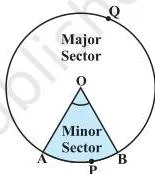
Figure 11.1 shows both sectors of the same circle at once. The two radii OA and OB, together with the arc APB, enclose the shaded minor sector OAPB; the rest of the circle, OAQB, is the major sector. The angle \(\angle AOB\) is called the angle of the sector, and the major sector’s angle is \(360^\circ – \angle AOB\) (NCERT, p. 154).
Why the fraction \(\frac{\theta}{360}\) appears. The whole circle is itself a sector of angle \(360^\circ\), and its area is \(\pi r^2\). By the unitary method, one degree of angle covers \(\frac{\pi r^2}{360}\) of the area, so \(\theta\) degrees cover \(\theta \times \frac{\pi r^2}{360} = \frac{\theta}{360} \times \pi r^2\) (NCERT, p. 155).
Apply the same reasoning to the circumference \(2\pi r\) and you get the arc length \(\frac{\theta}{360} \times 2\pi r\).
Because the full circle has area \(\pi r^2\), the complements follow at once (NCERT, p. 156):
- major sector area = \(\pi r^2 – \text{minor sector area}\)
- major segment area = \(\pi r^2 – \text{minor segment area}\)
Definitions: Sector, Segment, Minor and Major
These are the exact terms the chapter’s questions assume. Learn them once and every problem reads more clearly.
| Term | Plain definition | Where it appears |
|---|---|---|
| Sector | The part of the circular region enclosed by two radii and the arc between them | NCERT p. 154 |
| Angle of the sector | The angle at the centre between the two radii, such as \(\angle AOB\) | NCERT p. 154 |
| Minor and major sector | The smaller part (OAPB) and the rest of the circle (OAQB) | NCERT p. 154 |
| Segment | The part of the circular region enclosed between a chord and its arc | NCERT p. 154 |
| Minor and major segment | The smaller part cut off by a chord, and the rest of the circle | NCERT p. 154 |
| Arc of a sector | The curved boundary of the sector — \(\frac{\theta}{360}\) of the circumference \(2\pi r\) | NCERT pp. 154–155 |
Unless the question says otherwise, “sector” means the minor sector and “segment” means the minor segment (NCERT, p. 154).
The Formulas: Area of a Sector, Arc Length, Area of a Segment
The chapter produces exactly three results. Section 11.2 pulls them together on page 160, and every exercise question is one of these three applied to an everyday object.
| Formula (NCERT p. 160) | What it gives | Symbols, meaning and unit |
|---|---|---|
| \(\frac{\theta}{360} \times \pi r^2\) | Area of a sector | \(\theta\) = angle of the sector in degrees; \(r\) = radius of the circle in cm (or any length unit); result in square units such as \(\text{cm}^2\); \(\pi = \frac{22}{7}\) or 3.14 (no unit) |
| \(\frac{\theta}{360} \times 2\pi r\) | Length of the arc of a sector | \(\theta\) and \(r\) as above; result in length units such as cm |
| \(\frac{\theta}{360}\pi r^2 – \text{area of } \triangle OAB\) | Area of a segment | The triangle is the one formed by the two radii and the chord; result in square units |
Worked example 1: a sector of radius 10 cm with angle 72 degrees
Step 1: Write down what the question gives: radius \(r = 10\) cm and angle of the sector \(\theta = 72^\circ\).
The sector’s fraction of the circle is \(\frac{\theta}{360}\), which simplifies: \(\frac{72}{360} = \frac{1}{5}\).
Use \(\pi = 3.14\).
\[ \text{Area of sector} = \frac{\theta}{360} \times \pi r^2 = \frac{1}{5} \times 3.14 \times 10^2 = \frac{1}{5} \times 314 = 62.8\ \text{cm}^2 \]
Step 2: The arc length uses the same fraction of the circumference \(2\pi r\):
\[ \text{Arc length} = \frac{\theta}{360} \times 2\pi r = \frac{1}{5} \times 2 \times 3.14 \times 10 = 12.56\ \text{cm} \]
Final answer: sector area \(62.8\ \text{cm}^2\) (exactly \(20\pi\ \text{cm}^2\)) and arc length \(12.56\ \text{cm}\) (exactly \(4\pi\ \text{cm}\)).
Worked example 2: a segment of radius 14 cm whose chord subtends 90 degrees at the centre
Step 1: Here \(r = 14\) cm and \(\theta = 90^\circ\).
Use \(\pi = \frac{22}{7}\).
The sector of angle \(90^\circ\) is one quarter of the circle, so its area is \[ \frac{90}{360} \times \frac{22}{7} \times 14^2 = \frac{1}{4} \times \frac{22}{7} \times 196 = \frac{1}{4} \times 616 = 154\ \text{cm}^2 \]
Step 2: The corresponding triangle OAB has OA = OB = 14 cm and \(\angle AOB = 90^\circ\), so it is right isosceles.
Its area is half the product of the two perpendicular radii:
\[ \text{Area of } \triangle OAB = \frac{1}{2} \times 14 \times 14 = 98\ \text{cm}^2 \]
Step 3: Subtract the triangle from the sector:
\[ \text{Area of segment} = 154 – 98 = 56\ \text{cm}^2 \]
Final answer: the minor segment has area \(56\ \text{cm}^2\). Its major counterpart is \(616 – 56 = 560\ \text{cm}^2\), since the whole circle has area \(\frac{22}{7} \times 196 = 616\ \text{cm}^2\).
Two special triangles save time in segment questions (NCERT, pp. 157–158):
- \(\theta = 90^\circ\) — the triangle is right isosceles, so its area is \(\frac{1}{2}r^2\).
- \(\theta = 60^\circ\) — the triangle is equilateral, so its area is \(\frac{\sqrt{3}}{4}r^2\).
- Any other angle — draw the perpendicular OM from the centre to the chord. Then \(OM = r\cos\frac{\theta}{2}\) and \(AM = r\sin\frac{\theta}{2}\), exactly as Example 2 does for \(120^\circ\).
Figure Walkthrough: Reading the NCERT Diagrams
The diagrams are not decoration — each sector or segment question in the exercise is a word problem wrapped around one of these pictures. Once you can name the sector, the chord and the angle in a picture, the question is only a substitution away.
(a) Fig 11.1 — the sector definition. This figure is shown with the Key Concepts section above. Shaded OAPB is the minor sector, unshaded OAQB is the major sector, and \(\angle AOB\) is the angle of the sector. Name all three from the picture before attempting any question (NCERT, p. 154).
(b) Fig 11.3 — the derivation diagram.
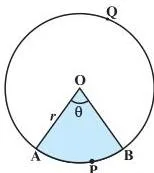
Fig 11.3 is the working figure for both derivations. Tracing the arc APB shows what the arc-length formula measures — \(\frac{\theta}{360}\) of the full circumference \(2\pi r\) (NCERT, p. 155).
(c) Fig 11.8 — the horse and the field.
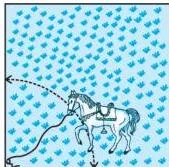
Fig 11.8 turns a farm problem into a clean sector. The square field’s side of 15 m only fixes where the peg sits; the grazing region is the quarter of a circle cut out by the 5 m rope. The angle is \(90^\circ\) because the peg is at a corner of the square (NCERT, p. 158).
(d) Fig 11.9 — the brooch.
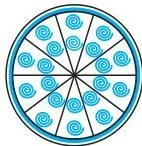
Fig 11.9 shows the silver brooch: a circle of diameter 35 mm with five diameters drawn through the centre. Five diameters give ten radii, which divide the circle into ten equal sectors, each of angle \(\frac{360^\circ}{10} = 36^\circ\) (NCERT, p. 159).
Common Mistakes in Sector and Segment Problems
These are the slips the chapter’s own examples and questions are built to catch. Fix them before they cost marks.
| Mistake | Correct rule | How to check your answer |
|---|---|---|
| Taking the diameter as the radius — the brooch question gives a diameter of 35 mm | Halve it first: \(r = 17.5\) mm | Look for the word “diameter”; if given, divide by 2 before any formula |
| Treating a segment as a sector | A segment has a chord on one side, so its area = sector area − triangle area (NCERT, p. 156) | Does the region touch the chord? Then subtract the triangle of the two radii |
| Forgetting that “sector” and “segment” alone mean minor | The major region is \(\pi r^2\) minus the minor one (NCERT, pp. 154, 156) | If the angle is greater than \(180^\circ\), you are finding the major part |
| Using the wrong value of \(\pi\) | Exercise 11.1 says use \(\frac{22}{7}\) unless stated otherwise; questions that want 3.14 (or \(\sqrt{3}\)) print it (NCERT, pp. 158–160) | Read the bracket after every question before substituting |
| Getting the clock angle wrong | 5 minutes on the minute hand = \(30^\circ\), because \(360^\circ\) in 60 minutes means 1 minute = \(6^\circ\) | Angle = minutes \(\times 6^\circ\); \(5 \times 6^\circ = 30^\circ\) |
| Choosing the wrong triangle inside a segment | It is the isosceles triangle of the two radii and the chord; its height comes from the perpendicular to the chord using sine and cosine (NCERT, pp. 157–158) | Both equal sides must be radii; \(OM = r\cos(\theta/2)\), \(AM = r\sin(\theta/2)\) |
| Missing the word “increase” in Q8 | Increase = new grazing area − old grazing area (NCERT, p. 159) | Underline “increase” or “decrease” — the final step is a difference |
What Exercise 11.1 Tests: A Question Map
Every question in Exercise 11.1 is the same three formulas wrapped in a different object — a clock, a horse, an umbrella, a lighthouse. The table below maps each question to the concept it tests, with a one-line way in.
| Question | What it tests | How to start |
|---|---|---|
| 1 — sector, radius 6 cm, angle \(60^\circ\) | Direct sector formula | Put \(r = 6\) and \(\theta = 60^\circ\) into \(\frac{\theta}{360}\pi r^2\); the fraction \(\frac{1}{6}\) simplifies the work |
| 2 — quadrant, circumference 22 cm | Quadrant = sector of \(90^\circ\) | Find \(r\) from \(2\pi r = 22\) first, then take \(\frac{1}{4}\) of \(\pi r^2\) |
| 3 — minute hand, 14 cm, 5 minutes | Sector swept by a clock hand | 5 minutes = \(30^\circ\), so area = \(\frac{30}{360}\pi(14)^2\) |
| 4 — chord of radius 10 cm, right angle | Minor segment and major sector | The triangle is right isosceles: \(\frac{1}{2} \times 10 \times 10\); major sector = \(\pi r^2\) − minor sector |
| 5 — radius 21 cm, angle \(60^\circ\) | All three formulas on one figure | Run arc length, then sector area, then segment = sector − equilateral triangle |
| 6 — radius 15 cm, angle \(60^\circ\) | Minor and major segment | The triangle is equilateral with side 15; major segment = \(\pi r^2\) − minor segment |
| 7 — radius 12 cm, angle \(120^\circ\) | Segment via sine and cosine | Drop the perpendicular OM; \(OM = 12\cos 60^\circ\), \(AM = 12\sin 60^\circ\), as in Example 2 (NCERT, p. 157) |
| 8 — horse tied at a corner (Fig 11.8) | Quarter-circle grazing sector | The rope of 5 m is the radius and the corner of the square makes the angle \(90^\circ\), so the grazing region is \(\frac{90}{360}\pi(5)^2\). Part (ii): area with the 10 m rope minus the area with the 5 m rope
|
| 9 — silver brooch (Fig 11.9) | Circumference plus diameters, equal sectors | Total wire = circumference \(2\pi(17.5)\) + five diameters \(5 \times 35\) mm; the diameters make 10 equal sectors, each \(\frac{1}{10}\) of the circle
|
| 10 — umbrella with 8 ribs | Sector between consecutive ribs | 8 equal ribs give \(\theta = \frac{360^\circ}{8} = 45^\circ\); area = \(\frac{45}{360}\pi(45)^2\) |
| 11 — two car wipers, \(115^\circ\) each | Two non-overlapping sectors | Each wiper cleans \(\frac{115}{360}\pi(25)^2\); add the two equal areas |
| 12 — lighthouse beam over \(80^\circ\) | Sector of a lighthouse beam | Area = \(\frac{80}{360} \times 3.14 \times (16.5)^2\); the answer keeps the unit \(\text{km}^2\) |
| 13 — round table cover, six designs | Six segments, then cost | Each design is a \(60^\circ\) sector minus its equilateral triangle; one segment × 6 × ₹0.35 |
| 14 — tick the correct option | Recognising the sector formula | Option (D), \(\frac{p}{720} \times 2\pi R^2 = \frac{p}{360}\pi R^2\), matches the formula exactly |
Textbook contents and the examinable syllabus are not always identical — check the current official CBSE syllabus for the portion that applies to your board exam.
Revision Summary: The Chapter Condensed
Night-before recap — the chapter’s own summary (NCERT, p. 160) in the fewest possible words.
- Arc length of a sector of angle \(\theta\): \(\frac{\theta}{360} \times 2\pi r\).
- Area of a sector of angle \(\theta\): \(\frac{\theta}{360} \times \pi r^2\).
- Area of a segment: area of the corresponding sector − area of the corresponding triangle.
- Complements (NCERT, p. 156): major sector = \(\pi r^2\) − minor sector; major segment = \(\pi r^2\) − minor segment.
Working sequence for any segment problem: draw the two radii and the chord → find the sector area → find the triangle area using the perpendicular to the chord → subtract.
Related Resources
This listing is maintained for the 2026-27 academic session using the NCERT textbook information available to us. NCERT remains the authority for confirming the latest edition.
Chapter 11 sits between two chapters that reuse its ideas. Chapter 10: Circles supplies the vocabulary this chapter assumes — chords, radii, arcs and the area \(\pi r^2\) — while Chapter 12: Surface Areas and Volumes carries the same circular-area reasoning into three dimensions.
- Circles Class 10 notes — the previous chapter’s circle facts
- Surface Areas and Volumes Class 10 notes — the next chapter
- Class 10 Mathematics notes hub
- All Class 10 notes
The official files live on ncert.nic.in — the Chapter 11 PDF gives you this chapter alone, while the full Class 10 Mathematics textbook page offers chapter-wise downloads of the whole book.
One study tip: the segment method in this chapter leans on trigonometric ratios. Example 2 uses \(\cos 60^\circ = \frac{1}{2}\) and \(\sin 60^\circ = \frac{\sqrt{3}}{2}\) to find the triangle inside the segment (NCERT, p. 157).
Sources and Data Verification
Where the information on this page comes from, plainly stated.
- The figures on this page describe NCERT Class 10 Mathematics, Chapter 11 “Areas Related to Circles”, printed pages 153–160 of the current edition, as published on ncert.nic.in.
- This page covers only this chapter of the book.
- The listing is maintained for the current academic session using the NCERT textbook information available to us.
- NCERT settles textbooks, editions and official PDFs; CBSE settles curriculum, syllabus and examinations.
| What the chapter holds | Count | Where it is used |
|---|---|---|
| Printed pages | 7 | |
| Sections in the chapter | 2 | |
| Figures with NCERT captions | 4 | |
| Exercise questions | 14 | answered in our NCERT Solutions |
| Official NCERT PDF | Download the chapter PDF | the chapter exactly as NCERT publishes it |
Reference: NCERT Class 10 Mathematics textbook, chapter 11, official edition on ncert.nic.in.
Frequently Asked Questions
Quick answers to the questions students most often search about this chapter.
What is the difference between a sector and a segment of a circle?
A sector is the part of the circular region enclosed by two radii and the arc between them; a segment is the part enclosed between a chord and its arc (NCERT, p. 154). The sector’s boundary always runs through the centre, while the segment sits between the chord and the circumference.
How do you find the area of a segment of a circle?
Subtract the area of the triangle formed by the two radii and the chord from the area of the sector: segment = \(\frac{\theta}{360}\pi r^2\) − triangle area (NCERT, p. 156).
For \(\theta = 90^\circ\) the triangle is right isosceles (\(\frac{1}{2}r^2\)); for \(\theta = 60^\circ\) it is equilateral (\(\frac{\sqrt{3}}{4}r^2\)); for other angles, drop a perpendicular from the centre to the chord and use sine and cosine (NCERT, pp. 157–158).
Why does the area of a sector formula contain theta over 360?
Because the whole circle is a sector of angle \(360^\circ\) with area \(\pi r^2\), one degree of angle covers \(\frac{\pi r^2}{360}\) of that area. \(\theta\) degrees therefore cover \(\theta \times \frac{\pi r^2}{360} = \frac{\theta}{360}\pi r^2\) (NCERT, p. 155). The same unitary method applied to the circumference gives the arc length.
When should I use pi = 22/7 instead of pi = 3.14 in this chapter?
Use \(\frac{22}{7}\) whenever the question does not print a value, because Exercise 11.1 opens with exactly that instruction. When a question brackets “Use \(\pi = 3.14\)” (often with a value of \(\sqrt{3}\) as well), use the printed numbers — the question’s answers are computed with them (NCERT, pp. 158–160).
How do I find the area swept by the minute hand of a clock in 5 minutes?
The minute hand turns \(360^\circ\) in 60 minutes, so in 5 minutes it sweeps \(30^\circ\). The swept region is a sector of radius equal to the hand’s length: area = \(\frac{30}{360}\pi r^2\). For the 14 cm hand in Question 3, that is \(\frac{1}{12}\pi(14)^2\ \text{cm}^2\) (NCERT, p. 158).
Where can I download the official NCERT Class 10 Maths Chapter 11 PDF?
From NCERT’s own website. Download the official Areas Related to Circles Class 10 NCERT PDF directly, or open the Class 10 Mathematics textbook page and pick Chapter 11 from the chapter list.
Explore Class 10 Mathematics Books
Related chapters: