
This page is about the NCERT Class 10 Mathematics textbook, Chapter 7: Coordinate Geometry — the chapter that teaches the distance formula and the section formula and applies them to triangles, quadrilaterals, collinearity and midpoints. The chapter runs 14 printed pages in the English edition, and the official NCERT PDF is linked right below.
Below the download you will find a section-by-section map of the chapter, both formulas explained step by step with worked examples, a walkthrough of the key figures, the common mistakes students make, and an exercise-by-exercise practice guide.
Download the NCERT Class 10 Maths Chapter 7 Coordinate Geometry PDF
For the official chapter file, open the NCERT Class 10 Maths Chapter 7 Coordinate Geometry PDF on ncert.nic.in — this is the file NCERT publishes for the chapter, containing the introduction, both derivations, all ten worked examples and both exercises exactly as printed.
Chapter 7 at a glance
Chapter 7 builds two tools: the distance formula, which tells you how far apart two points are, and the section formula, which tells you where a point sits on a line segment. Everything else in the chapter — triangle types, square and parallelogram checks, collinearity, trisection — is one of those two formulas applied.
The table on this page lists the chapter’s sections, figures and exercise questions at a glance.
What Chapter 7 covers, section by section
Use this map to jump to the exact part of the book you need. Page numbers are the printed NCERT page numbers, matching the PDF above.
| Section | NCERT pages | What it contains |
|---|---|---|
| 7.1 Introduction | p.100 | Coordinate axes and the terms abscissa and ordinate; a point-plotting activity; the aims of the chapter |
| 7.2 Distance Formula | pp.100-105 | The town distance problem, the Pythagoras-based derivation and the distance formula; Exercise 7.1 on pp.105-106 |
| 7.3 Section Formula | pp.106-111 | The relay tower problem, the similar-triangle derivation, the section formula and the midpoint; Exercise 7.2 on pp.111-112 |
| 7.4 Summary | p.112 | The four key results of the chapter in one list |
| A Note to the Reader | p.112 | Internal division (this chapter) versus external division (higher classes) |
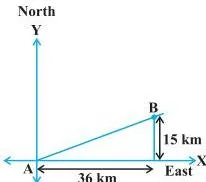
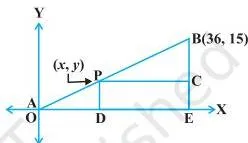
The chapter opens with a plotting activity — joining points such as A(4, 8) and B(3, 9) in order draws a picture. It then enters the formulas through two real-life problems: a town 36 km east and 15 km north of another town (p.100), and the relay tower that must sit on AB so its distance from B is twice its distance from A (p.106).
Distance formula: what it is and how it works
The distance formula is Pythagoras’ theorem rewritten with coordinates: if you can draw a right triangle between two points, the distance between them is its hypotenuse.
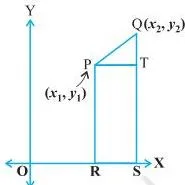
Here is the construction the book builds on pp.100-102. From P(x1, y1) and Q(x2, y2), draw perpendiculars to the x-axis.
The horizontal leg of the triangle has length \(x_2 – x_1\), the vertical leg has length \(y_2 – y_1\), and the distance is the hypotenuse:
\[ PQ = \sqrt{(x_2 – x_1)^2 + (y_2 – y_1)^2} \]
This is the distance formula (p.102). Three things to keep in mind:
- Only the positive root is used. Distance is always non-negative, so \(\sqrt{169} = 13\), never -13 (p.102).
- The order inside the brackets does not matter. \((x_1 – x_2)^2 = (x_2 – x_1)^2\), so either order gives the same distance.
- Distance from the origin is a special case. For a point P(x, y) and O(0, 0), the formula becomes \(OP = \sqrt{x^2 + y^2}\) (p.102).
If both points lie on the x-axis, the distance is simply the difference of their x-coordinates — for A(4, 0) and B(6, 0) it is \(6 – 4 = 2\) units — and similarly on the y-axis.
Worked example: distance between A(-2, 4) and B(3, -8)
Step 1: Label the coordinates.
Here \(x_1 = -2\), \(y_1 = 4\), \(x_2 = 3\), \(y_2 = -8\).
Step 2: Substitute into the formula, keeping the signs of both coordinates.
\[ AB = \sqrt{(x_2 – x_1)^2 + (y_2 – y_1)^2} = \sqrt{(3 – (-2))^2 + (-8 – 4)^2} \]
\[ = \sqrt{5^2 + (-12)^2} = \sqrt{25 + 144} = \sqrt{169} \]
Step 3: Take the positive square root, because distance is non-negative.
\[ AB = 13\ \text{units} \]
Final answer: The distance between A(-2, 4) and B(3, -8) is 13 units.
Notice what happened to the signs: \(3 – (-2) = 5\) and \(-8 – 4 = -12\). The square of -12 is still 144, so the answer is positive — but the differences must be substituted correctly before squaring.
Section formula: dividing a line segment in a given ratio
The section formula answers a different question: where on a line segment does a point sit if it divides the segment in a given ratio? The chapter enters this through the relay tower problem (p.106): a tower at P must sit between A and B so that its distance from B is twice its distance from A, written OP : PB = 1 : 2.
Similar triangles — the AA criterion from Chapter 6 Triangles — lead to the general result.
If P(x, y) divides AB internally in the ratio PA : PB = m1 : m2, where A is (x1, y1) and B is (x2, y2), then P has the coordinates below. This is the section formula (p.107):
\[ x = \frac{m_1 x_2 + m_2 x_1}{m_1 + m_2}, \quad y = \frac{m_1 y_2 + m_2 y_1}{m_1 + m_2} \]
The one detail that decides everything:
- m1 multiplies the coordinates of B, not A. The ratio PA : PB = m1 : m2 is read in that order, and m1 rides with (x2, y2).
- The k : 1 form. If the ratio is written as k : 1, the formula simplifies to \(\left(\frac{kx_2 + x_1}{k + 1}, \frac{ky_2 + y_1}{k + 1}\right)\) (p.107).
- The midpoint is the 1 : 1 special case. Putting m1 = m2 = 1 gives \(\left(\frac{x_1 + x_2}{2}, \frac{y_1 + y_2}{2}\right)\) (p.107).
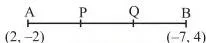
- Trisection means applying the formula twice. To cut a segment into three equal parts, P divides AB in 1 : 2 and Q divides it in 2 : 1 (Example 8, p.109).
The same formula also answers the reverse question — in what ratio does a given point divide AB? Example 7 (p.108) sets the given point equal to the formula and solves for m1 : m2, and Example 9 (p.110) fixes a point on the y-axis by setting its abscissa to zero.
Worked example: divide A(2, 3) and B(8, 9) in the ratio 1 : 2
Step 1: Read the ratio.
PA : PB = 1 : 2, so m1 = 1 and m2 = 2, with A(x1, y1) = (2, 3) and B(x2, y2) = (8, 9).
Step 2: Apply the section formula.
Note that m1 = 1 multiplies the coordinates of B.
\[ x = \frac{m_1 x_2 + m_2 x_1}{m_1 + m_2} = \frac{1(8) + 2(2)}{1 + 2} = \frac{8 + 4}{3} = 4 \]
\[ y = \frac{m_1 y_2 + m_2 y_1}{m_1 + m_2} = \frac{1(9) + 2(3)}{1 + 2} = \frac{9 + 6}{3} = 5 \]
Step 3: Verify with the distance formula.
If the ratio of the two pieces matches the given ratio, the point is correct.
\[ AP = \sqrt{(4 – 2)^2 + (5 – 3)^2} = \sqrt{4 + 4} = 2\sqrt{2} \]
\[ PB = \sqrt{(8 – 4)^2 + (9 – 5)^2} = \sqrt{16 + 16} = 4\sqrt{2} \]
\[ AP : PB = 2\sqrt{2} : 4\sqrt{2} = 1 : 2 \]
Final answer: P(4, 5) divides the segment from A(2, 3) to B(8, 9) in the ratio 1 : 2. The point is closer to A, exactly as the ratio 1 : 2 requires.
Reading the chapter’s key figures
The six figures below are the constructions NCERT uses to derive and apply the two formulas. Each one turns a coordinate problem into a right-triangle or similar-triangle problem; the page number shows where the figure sits in the book.
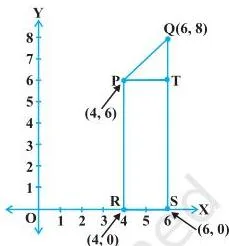
This is the first construction that produces the distance formula (p.100). Perpendiculars from P and Q to the x-axis meet it at R(4, 0) and S(6, 0), and a horizontal line from P meets QS at T. Triangle PTQ has legs \(PT = 2\) and \(QT = 2\), so \(PQ^2 = 2^2 + 2^2 = 8\) and \(PQ = 2\sqrt{2}\). The distance you want is always the hypotenuse of such a triangle.
The same triangle idea works when the points lie in different quadrants (p.101). For P(6, 4) and Q(-5, -3), the horizontal separation is 11 units and the vertical separation is 7 units, giving \(PQ = \sqrt{11^2 + 7^2} = \sqrt{170}\). Negative coordinates change nothing once the differences are squared.
Example 1 uses distances alone to decide what shape three points make (p.102). The three sides come out as \(\sqrt{50} \approx 7.07\), \(\sqrt{52} \approx 7.21\) and \(\sqrt{2} \approx 1.41\). Because the sum of any two is greater than the third, the points form a triangle; and because \(PQ^2 + PR^2 = QR^2\), the converse of Pythagoras makes it right-angled at P.
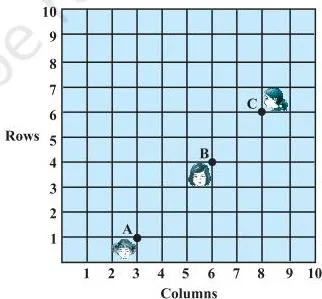
Example 3 checks whether three students at A(3, 1), B(6, 4) and C(8, 6) are seated in a line (p.103). The distances are \(AB = 3\sqrt{2}\), \(BC = 2\sqrt{2}\) and \(AC = 5\sqrt{2}\). Since \(AB + BC = AC\), the points are collinear — the students are indeed in a line.
This is the standard collinearity test: three points are collinear when the largest distance equals the sum of the other two.
The relay tower figure opens the section formula (p.106). The tower at P must satisfy OP : PB = 1 : 2. Perpendiculars from P and B to the x-axis create similar triangles, and the AA criterion from Chapter 6 gives the equal ratios \(\frac{x}{36 – x} = \frac{1}{2}\) and \(\frac{y}{15 – y} = \frac{1}{2}\), so x = 12 and y = 5. The tower’s coordinates are P(12, 5).
Example 8 finds the two trisection points of a segment (p.109). P divides AB internally in the ratio 1 : 2 and Q divides it in the ratio 2 : 1; applying the section formula twice, for A(2, -2) and B(-7, 4), gives P(-1, 0) and Q(-4, 2).
Definitions you must know for Chapter 7
These are the terms the chapter uses; written answers should use them in exactly these senses.
| Term | Meaning in this chapter | NCERT page |
|---|---|---|
| Coordinate axes | The pair of perpendicular number lines used to fix the position of a point on a plane | p.100 |
| Abscissa (x-coordinate) | Distance of a point from the y-axis | p.100 |
| Ordinate (y-coordinate) | Distance of a point from the x-axis | p.100 |
| Point on the x-axis / y-axis | Of the form (x, 0) / (0, y) | p.100 |
| Distance formula | \(PQ = \sqrt{(x_2 – x_1)^2 + (y_2 – y_1)^2}\) | p.102 |
| Equidistant | At the same distance from two given points | p.104 |
| Collinear | Lying on the same straight line; checked by the largest distance = sum of the other two | p.104 |
| Section formula | Coordinates of the point dividing a segment internally in the ratio m1 : m2 | p.107 |
| Midpoint | The dividing point when the ratio is 1 : 1 | p.107 |
Common mistakes in coordinate geometry (and how to fix them)
The five errors below are the ones students actually make in this chapter. Each row gives the wrong version, the correct rule, and a quick check.
| Mistake | Correct rule | How to check your answer |
|---|---|---|
| Reversing the ratio in the section formula — treating PA : PB = 1 : 2 as if m1 = 2 | The ratio is read PA : PB = m1 : m2, and m1 multiplies the coordinates of B | Compute PA and PB with the distance formula; their ratio must equal the given ratio |
| Forgetting that a point on the y-axis has x-coordinate 0 | A point on the y-axis is (0, y); Example 9 (p.110) sets the abscissa equal to 0 and solves | Substitute your point back; its first coordinate must be 0 |
| Losing negative signs inside the distance formula, e.g. writing \(y_2 – y_1\) as \(4 – (-8)\) instead of \(-8 – 4\) | Substitute both coordinates exactly as given: \(y_2 – y_1 = -8 – 4 = -12\); squaring removes the sign only after a correct difference | Recompute with the order reversed, \((x_1 – x_2)^2 + (y_1 – y_2)^2\); the answer must be the same |
| Taking the negative square root | Distance is always non-negative, so only the positive root is used (p.102) | Ask: can a length be negative? If your answer is negative, it is wrong |
| Using the midpoint formula when the ratio is not 1 : 1 | The midpoint is only the 1 : 1 special case; use the full section formula or the k : 1 form otherwise | Read the ratio in the question before writing any formula |
One boundary from the end of the chapter: the Note to the Reader (p.112) explains that the section formula here is for internal division only — P lies between A and B. If P lies outside the segment on the line AB, that is external division, and it is not done in Class 10.
How to use Chapter 7 for exam practice
Both exercises in Chapter 7 are straight practice of the two formulas. This map tells you which skill each question tests, so you can drill exactly what you need.
| Exercise | Questions | Skill being tested |
|---|---|---|
| 7.1 | Q1-Q2 | Distance between two points; Q2 adds distance from the origin and the town problem |
| 7.1 | Q3 | Collinearity of three points |
| 7.1 | Q4 | Isosceles triangle check |
| 7.1 | Q5 | Square, using equal sides and equal diagonals |
| 7.1 | Q6 | Type of quadrilateral, with reasons |
| 7.1 | Q7 | Point on the x-axis equidistant from two points |
| 7.1 | Q8 | Distance given, find the unknown coordinate |
| 7.1 | Q9-Q10 | Equidistant point with an unknown; relation between x and y |
| 7.2 | Q1 | Section formula in a given ratio |
| 7.2 | Q2, Q9 | Trisection and division into four equal parts |
| 7.2 | Q3 | Fraction of a segment and midpoint (flags on a school ground) |
| 7.2 | Q4-Q5 | Ratio in which a point or the x-axis divides a segment |
| 7.2 | Q6 | Parallelogram vertices — diagonals bisect each other |
| 7.2 | Q7-Q8 | Midpoint (diameter of a circle; fraction \(AP = \frac{3}{7}AB\)) |
| 7.2 | Q10 | Rhombus area from its diagonals |
A full-marks answer to these questions needs three things: the formula written out, the substitution shown with the correct signs, and the conclusion stated in words — “the points are collinear”, “the quadrilateral is a square”, “the ratio is 2 : 7”.
One syllabus note: textbook contents and the examinable syllabus are not always identical — check the current official CBSE syllabus for what is examinable this session.
Formula sheet: the results to remember before a test
One screen of results before a test. These are exactly the results the chapter’s Summary collects on p.112.
| Result | Formula | NCERT page |
|---|---|---|
| Distance between P(x1, y1) and Q(x2, y2) | \(PQ = \sqrt{(x_2 – x_1)^2 + (y_2 – y_1)^2}\) | p.102 |
| Distance of P(x, y) from the origin | \(OP = \sqrt{x^2 + y^2}\) | p.102 |
| Section formula for ratio m1 : m2 | \(\left( \frac{m_1 x_2 + m_2 x_1}{m_1 + m_2}, \frac{m_1 y_2 + m_2 y_1}{m_1 + m_2} \right)\) | p.107 |
| Section formula in k : 1 form | \(\left( \frac{kx_2 + x_1}{k + 1}, \frac{ky_2 + y_1}{k + 1} \right)\) | p.107 |
| Midpoint (ratio 1 : 1) | \(\left( \frac{x_1 + x_2}{2}, \frac{y_1 + y_2}{2} \right)\) | p.107 |
Memory aid: “m1 rides with x2” — the first number of the ratio multiplies the coordinates of the second point B.
The chapter’s final list: four results to remember
The chapter’s own Summary (p.112) closes with four results. In plainer words:
- The distance formula — Pythagoras’ theorem written with coordinates.
- The distance from the origin — the formula with the second point at (0, 0).
- The section formula — the coordinates of the point dividing a segment internally in the ratio m1 : m2.
- The midpoint formula — the section formula with the ratio 1 : 1.
The Note to the Reader after the Summary adds the boundary: the section formula in this chapter is for internal division only. External division — P outside the segment — is left for higher classes.
Related resources
This listing is maintained for the 2026-27 academic session using the NCERT textbook information available to us. NCERT remains the authority for confirming the latest edition.
Continue with the chapters that sit around this one:
- Class 10 Mathematics notes — all chapters of the book
- Chapter 6 Triangles notes — the similarity criteria used in the section formula derivation
- Chapter 8 Introduction to Trigonometry notes — the chapter that follows coordinate geometry
- Class 10 study hub
- All CBSE notes
Sources and textbook edition
This page describes the NCERT Class 10 Mathematics textbook, Chapter 7: Coordinate Geometry, English edition, as published on ncert.nic.in. NCERT settles textbook editions and official PDFs; CBSE settles the examinable syllabus. This listing is maintained for the current academic session from NCERT’s official PDF.
| What the chapter holds | Count | Where it is used |
|---|---|---|
| Printed pages | 14 | |
| Sections in the chapter | 4 | |
| Figures with NCERT captions | 6 | |
| Exercise questions | 20 | answered in our NCERT Solutions |
| Official NCERT PDF | Download the chapter PDF | the chapter exactly as NCERT publishes it |
Reference: NCERT Class 10 Mathematics textbook, chapter 7, official edition on ncert.nic.in.
Frequently asked questions about Coordinate Geometry Class 10
Where can I download the NCERT Class 10 Maths Chapter 7 Coordinate Geometry PDF?
The official PDF is on ncert.nic.in — the NCERT Class 10 Maths Chapter 7 Coordinate Geometry PDF is linked in the download section at the top of this page, and it is the chapter exactly as printed in the book.
What is the distance formula in Class 10 coordinate geometry?
For two points P(x1, y1) and Q(x2, y2), the distance is \(PQ = \sqrt{(x_2 – x_1)^2 + (y_2 – y_1)^2}\). It is Pythagoras’ theorem written with coordinates, and distance from the origin is the special case \(OP = \sqrt{x^2 + y^2}\) (p.102).
What is the section formula in Class 10 coordinate geometry?
If P divides AB internally in the ratio PA : PB = m1 : m2, where A is (x1, y1) and B is (x2, y2), then \(P = \left( \frac{m_1 x_2 + m_2 x_1}{m_1 + m_2}, \frac{m_1 y_2 + m_2 y_1}{m_1 + m_2} \right)\) (p.107).
What is the midpoint formula in Class 10 coordinate geometry?
The midpoint of the join of (x1, y1) and (x2, y2) is \(\left( \frac{x_1 + x_2}{2}, \frac{y_1 + y_2}{2} \right)\) — the section formula with the ratio 1 : 1 (p.107).
Does the section formula in Chapter 7 work for external division too?
No. The chapter’s Note to the Reader (p.112) states that the section formula in this chapter is for internal division only; external division is studied in higher classes.
What is the Note to the Reader at the end of Chapter 7 about?
It clarifies the boundary of Section 7.3. The formula covers P lying between A and B (internal division). If P lies on the line AB but outside the segment and PA : PB = m1 : m2, that is external division, which Class 10 does not cover.
Explore Class 10 Mathematics Books
Related chapters: