
This is the official NCERT Class 10 Mathematics textbook, Chapter 2 — Polynomials, in the English edition. It runs from printed page 11 to page 23.
The chapter covers the degree and zeroes of a polynomial, what the zeroes look like on a graph, and how the zeroes connect to the coefficients. The official NCERT PDF of the chapter is right below.
Download the Polynomials Class 10 NCERT Chapter PDF
Download the Polynomials Class 10 NCERT chapter PDF — the official NCERT scan of Chapter 2, printed pages 11–23 of the Class 10 Mathematics textbook, published on ncert.nic.in. Every page reference on this page uses the same edition, so you can follow the citations below in the printed book or in the file.
Chapter 2 at a Glance
The table below lists how much Chapter 2 holds — its sections, figures, worked examples and exercise questions, each counted from the official text. What each of those parts teaches is explained from the next section down.
What This Chapter Covers, Section by Section
Use this as a map: find the section you are stuck on and jump to its printed page. The sections build on one another — Section 2.1 ends by asking whether the zeroes of a quadratic are related to its coefficients, and Section 2.3 answers that question.
- 2.1 Introduction (NCERT, p. 11). It reopens Class IX work: the degree of a polynomial, the names linear, quadratic and cubic, and the general forms of each. It defines the value \( p(k) \) and a zero of a polynomial, and finds the zero of \( ax + b \) as \( -\frac{b}{a} \). It closes by asking whether a quadratic’s zeroes relate to its coefficients — the question Section 2.3 answers.
- 2.2 Geometrical Meaning of the Zeroes (NCERT, pp. 12–17). Zeroes are shown as the x-coordinates of the points where the graph of \( y = p(x) \) meets the x-axis: one crossing for a line, three possibilities for a parabola, then cubics with up to three crossings. This gives the rule that a polynomial of degree \( n \) has at most \( n \) zeroes. Example 1 and Exercise 2.1, both on counting zeroes from graphs, close the section (NCERT, p. 18).
- 2.3 Relationship between Zeroes and Coefficients (NCERT, pp. 19–22). By writing a quadratic as \( k(x – \alpha)(x – \beta) \) and comparing coefficients, the book derives \( \alpha + \beta = -\frac{b}{a} \) and \( \alpha\beta = \frac{c}{a} \), then applies them in Examples 2–4. It then states the three cubic relations and verifies them in Example 5. Exercise 2.2 ends the section.
- 2.4 Summary (NCERT, p. 23). Six points collect the chapter — the names by degree, the quadratic form, the graph meaning of zeroes, the at-most rule, and the two sets of zero–coefficient relations. The revision summary at the end of this page rewrites them in plainer words.
Key Concepts: Degrees, Zeroes and the Zero–Coefficient Relationships
A polynomial is an expression built from whole-number powers of a variable. The chapter’s central idea is the zero — a number that makes the whole polynomial evaluate to 0 — because zeroes appear where the graph crosses the x-axis, and their sums and products are fixed by the coefficients.
What counts as a polynomial
Only whole-number powers of the variable are allowed. Expressions like \( \frac{1}{x-1} \), \( \sqrt{x} + 2 \) and \( \frac{1}{x^2 + 2x + 3} \) are not polynomials, because a variable appears in a denominator or under a root (NCERT, p. 11).
Degree and the three names
The degree of a polynomial is the highest power of the variable in it (NCERT, p. 11). Degree 1 is called linear, form \( ax + b \); degree 2 is quadratic, form \( ax^2 + bx + c \); degree 3 is cubic, form \( ax^3 + bx^2 + cx + d \). In the last two forms \( a \neq 0 \), so the highest power actually appears.
For example, \( 2y^2 – 3y + 4 \) is quadratic even though its variable is \( y \).
Value at x = k versus a zero
Putting \( x = k \) into \( p(x) \) gives the value \( p(k) \). A zero is the special case where that value is 0: a real number \( k \) is a zero of \( p(x) \) if \( p(k) = 0 \) (NCERT, p. 11). For \( p(x) = x^2 – 9 \), the zeroes are 3 and −3, while \( p(0) = -9 \) — so 0 is not a zero.
For a linear polynomial \( ax + b \), solving \( ax + b = 0 \) gives the single zero \( k = -\frac{b}{a} \), which is the negative of the constant term divided by the coefficient of \( x \) (NCERT, p. 11).
Zeroes as x-axis crossings
If \( k \) is a zero, then \( p(k) = 0 \), so the point \( (k, 0) \) lies both on the graph of \( y = p(x) \) and on the x-axis. That is exactly what an intersection point is (NCERT, p. 12).
And since a graph of degree \( n \) can cross the x-axis at at most \( n \) points, a polynomial of degree \( n \) has at most \( n \) zeroes (NCERT, p. 17).
Quadratic: the sum and product of zeroes
For \( p(x) = ax^2 + bx + c \) with zeroes \( \alpha \) and \( \beta \), the factors are \( x – \alpha \) and \( x – \beta \). Expanding and comparing coefficients gives (NCERT, pp. 19–20):
\[ ax^2 + bx + c = k(x – \alpha)(x – \beta) = k[x^2 – (\alpha + \beta)x + \alpha\beta] \]
\[ \alpha + \beta = -\frac{b}{a}, \qquad \alpha\beta = \frac{c}{a} \]
- \( a \) is the coefficient of \( x^2 \), \( b \) the coefficient of \( x \), \( c \) the constant term.
- \( \alpha \) and \( \beta \) are Greek letters, pronounced “alpha” and “beta”; the book also uses \( \gamma \) (“gamma”) for cubics (NCERT, p. 19).
Cubic: three relationships
For \( ax^3 + bx^2 + cx + d \) with zeroes \( \alpha, \beta, \gamma \), three relations hold (NCERT, p. 22):
\[ \alpha + \beta + \gamma = -\frac{b}{a}, \qquad \alpha\beta + \beta\gamma + \gamma\alpha = \frac{c}{a}, \qquad \alpha\beta\gamma = -\frac{d}{a} \]
The signs alternate: minus on the sum and the product, plus on the pairwise sum.
Worked example — quadratic with original numbers
Find the zeroes of \( p(x) = 2x^2 + 7x – 4 \) and verify the relationships.
- Step 1: Read the coefficients: \( a = 2 \), \( b = 7 \), \( c = -4 \).
- Step 2: Split the middle term.
We need two numbers whose product is \( a \times c = 2 \times (-4) = -8 \) and whose sum is 7: the numbers are 8 and −1.
\[ 2x^2 + 7x – 4 = 2x^2 + 8x – x – 4 = 2x(x + 4) – 1(x + 4) = (2x – 1)(x + 4) \]
- Step 1: The zeroes make each factor 0: \( 2x – 1 = 0 \) gives \( x = \frac{1}{2} \), and \( x + 4 = 0 \) gives \( x = -4 \).
- Step 2: Verify the sum.
Here \( b = 7 \), so \( -\frac{b}{a} = -\frac{7}{2} \), and \( \frac{1}{2} + (-4) = -\frac{7}{2} \).
Matches.
Step 5: Verify the product.
\( \frac{c}{a} = \frac{-4}{2} = -2 \), and \( \frac{1}{2} \times (-4) = -2 \).
Matches.
Final answer: the zeroes are \( \frac{1}{2} \) and \( -4 \); sum \( -\frac{7}{2} \), product \( -2 \).
Worked example — cubic with original numbers
Verify all three relationships for \( p(x) = 2x^3 – 3x^2 – 5x + 6 \).
- Step 1: Read the coefficients: \( a = 2 \), \( b = -3 \), \( c = -5 \), \( d = 6 \).
- Step 2: Try \( x = 1 \): \( 2 – 3 – 5 + 6 = 0 \), so \( x – 1 \) is a factor.
Dividing it out:
\[ 2x^3 – 3x^2 – 5x + 6 = (x – 1)(2x^2 – x – 6) \]
Step 3: Split \( -x \) in \( 2x^2 – x – 6 \) as \( 3x – 4x \):
\[ 2x^2 – x – 6 = 2x^2 + 3x – 4x – 6 = x(2x + 3) – 2(2x + 3) = (x – 2)(2x + 3) \]
Step 4: The zeroes are \( 1 \), \( 2 \) and \( -\frac{3}{2} \).
Since \( b = -3 \), the minus sign “flips” it: \( -\frac{b}{a} = \frac{3}{2} \).
And \( 1 + 2 – \frac{3}{2} = \frac{3}{2} \).
Matches.
Step 5: Pairwise sum: \( 1 \times 2 + 2 \times (-\frac{3}{2}) + (-\frac{3}{2}) \times 1 = 2 – 3 – \frac{3}{2} = -\frac{5}{2} \), equal to \( \frac{c}{a} = \frac{-5}{2} \).
Matches.
Step 6: Product: \( 1 \times 2 \times (-\frac{3}{2}) = -3 \), equal to \( -\frac{d}{a} = -\frac{6}{2} = -3 \).
Matches.
Final answer: the zeroes are \( 1, 2, -\frac{3}{2} \), and all three relations hold.
Constructing a quadratic from a given sum and product
This is the reverse job: build the polynomial when the sum and product of its zeroes are known. Because \( ax^2 + bx + c = k(x – \alpha)(x – \beta) \), the zeroes fix the polynomial up to a constant multiple. The method follows Example 4 (NCERT, p. 21):
- Write the factor form \( k[x^2 – (\alpha + \beta)x + \alpha\beta] \), with \( k \) any non-zero real number.
- Substitute the given sum and product.
- Choose \( k = 1 \) when no other condition is given — you get \( x^2 – (\text{sum})x + \text{product} \).
For example, sum 4 and product 3 give \( x^2 – 4x + 3 \); multiplying by any constant, say 3, gives \( 3x^2 – 12x + 9 \), which has the same zeroes. The book’s Example 4 makes this same constant-multiple point (NCERT, p. 21).
Reading the Graphs in This Chapter
Every graph in the chapter answers one question: how many zeroes does this polynomial have? The answer is always the same counting rule — the number of times the curve meets the x-axis (NCERT, p. 17).
Figure 2.1 — a linear polynomial has one zero
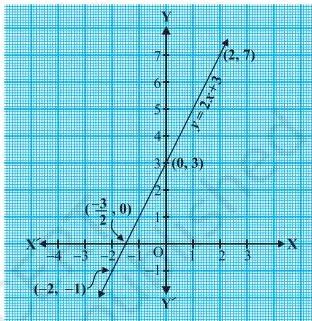
Fig 2.1 is the graph of \( y = 2x + 3 \), a straight line. It crosses the x-axis mid-way between \( x = -1 \) and \( x = -2 \), at \( (-\frac{3}{2}, 0) \) — exactly the value you get by solving \( 2x + 3 = 0 \). Since a line can meet the x-axis only once, a linear polynomial has exactly one zero (NCERT, p. 12).
Figure 2.2 — a quadratic that cuts the axis twice
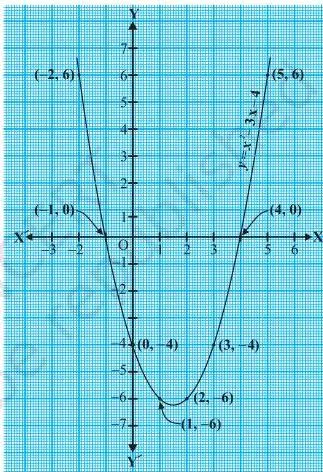
Fig 2.2 is the graph of \( y = x^2 – 3x – 4 \). Because \( a = 1 \gt 0 \), the parabola opens upward. It cuts the x-axis at \( x = -1 \) and \( x = 4 \), the same values found by evaluating: \( p(-1) = 0 \) and \( p(4) = 0 \). So the zeroes are precisely the x-coordinates of the cutting points (NCERT, p. 13).
Any quadratic \( ax^2 + bx + c \) has this \( \bigcup \) or \( \bigcap \) shape, which the book names a parabola.
Figures 2.3–2.5 — the three cases for a parabola
A parabola and the x-axis can meet in exactly three ways, and the book draws all three (NCERT, pp. 14–15).
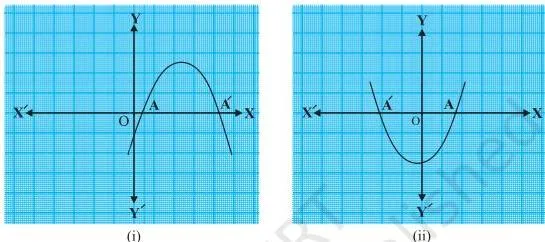
Case (i), Fig 2.3: two distinct cutting points A and A’. Their x-coordinates are the two distinct zeroes of the polynomial.
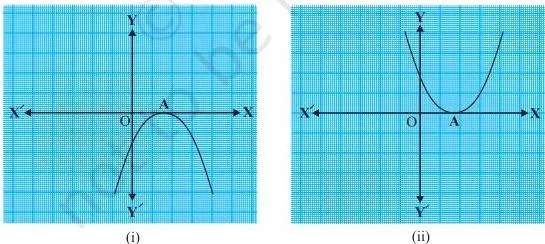
Case (ii), Fig 2.4: the graph cuts the axis at exactly one place, because the two intersections of Case (i) have coincided into one point A. The book calls this “two equal zeroes”, which is still one distinct zero.
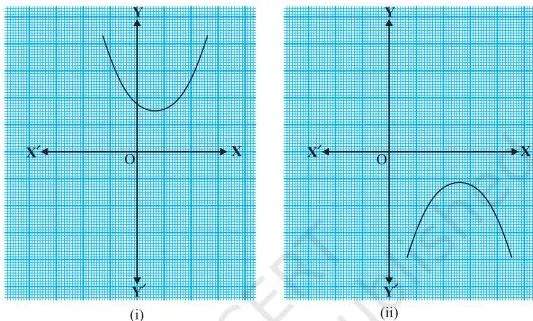
Case (iii), Fig 2.5: the curve is wholly above or wholly below the axis and cuts it nowhere, so the polynomial has no real zero.
Read the three figures as one continuous slide: in Fig 2.3 the axis cuts two points; Fig 2.4 is the instant they touch; Fig 2.5 is the moment after, when they have disappeared. That is why a quadratic has at most two zeroes (NCERT, p. 15).
| Case | What the parabola does | Number of zeroes |
|---|---|---|
| (i) | cuts the x-axis at two distinct points | two distinct zeroes |
| (ii) | touches the axis at one point (two coincident points) | one zero (two equal zeroes) |
| (iii) | lies completely above or below the axis | no real zero |
Figure 2.6 — a cubic with three zeroes
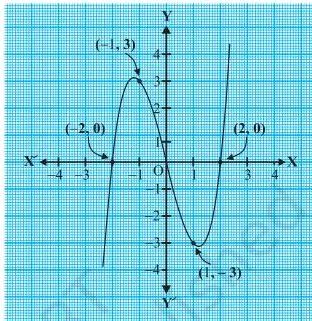
Fig 2.6 shows \( y = x^3 – 4x \), whose value table gives zeroes at \( -2, 0, 2 \). The curve meets the x-axis at exactly those three points, so those are its only zeroes (NCERT, p. 16). The book also draws \( y = x^3 \) (only zero 0) and \( y = x^3 – x^2 = x^2(x – 1) \) (zeroes 0 and 1) so you can see a cubic need not have three distinct zeroes.
Together these graphs justify the rule: a cubic has at most three zeroes, and in general a polynomial of degree \( n \) has at most \( n \) zeroes (NCERT, p. 17).
Figure 2.9 — Example 1: count the intersections
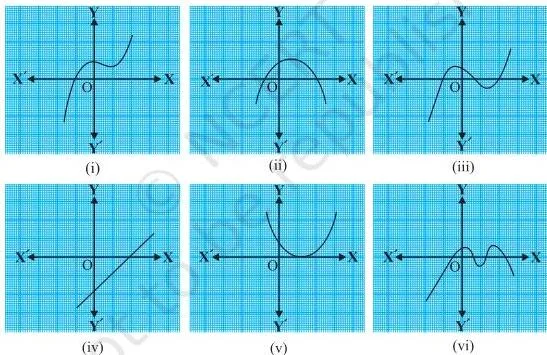
Example 1 (NCERT, p. 17) puts six graphs of \( y = p(x) \) side by side. The only task is counting: the x-axis intersections are 1, 2, 3, 1, 1 and 4 respectively, and those are the numbers of zeroes. The book writes “Why?” after some answers to force you to do that counting yourself.
Figure 2.10 — Exercise 2.1: same question, your turn
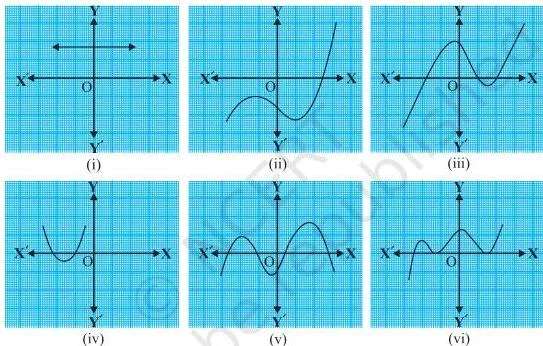
Exercise 2.1 asks the same question for the graphs in Fig 2.10 (NCERT, p. 18): find the number of zeroes in each case.
This is a reading skill, not a drawing skill — the book’s footnote at the start of Section 2.2 says plotting graphs of quadratic or cubic polynomials is not meant to be done by students, nor is it to be evaluated (NCERT, p. 12). For each graph you only count how many times the curve crosses the x-axis.
Definitions at a Glance: Polynomials Vocabulary
A quick-reference table for the chapter’s terms, with the page where NCERT states each one.
| Term | Meaning | NCERT page |
|---|---|---|
| Polynomial in one variable | an expression made of whole-number powers of one variable with real coefficients, e.g. \( 4x + 2 \), \( 2y^2 – 3y + 4 \) | p. 11 |
| Degree of a polynomial | the highest power of the variable in the polynomial | p. 11 |
| Linear polynomial | degree 1; general form \( ax + b \) | p. 11 |
| Quadratic polynomial | degree 2; general form \( ax^2 + bx + c \), \( a \neq 0 \) | p. 11 |
| Cubic polynomial | degree 3; general form \( ax^3 + bx^2 + cx + d \), \( a \neq 0 \) | p. 11 |
| Value of \( p(x) \) at \( x = k \), written \( p(k) \) | the number obtained by replacing \( x \) by \( k \) in the polynomial | p. 11 |
| Zero of a polynomial | a real number \( k \) such that \( p(k) = 0 \) | p. 11 |
| Parabola | the \( \bigcup \)- or \( \bigcap \)-shaped curve that is the graph of \( y = ax^2 + bx + c \) | p. 13 |
| At most \( n \) zeroes | a polynomial of degree \( n \) can meet the x-axis at at most \( n \) points, so it has at most \( n \) zeroes | p. 17 |
Common Mistakes in Polynomials — and the Fix
These are the errors the chapter’s own examples and remarks are built to prevent — one wrong sign here loses a whole verification.
| Mistake | Correct rule | How to check your answer |
|---|---|---|
| Writing the sum of zeroes as \( \frac{b}{a} \) instead of \( -\frac{b}{a} \) | \( \alpha + \beta = -\frac{b}{a} \). The minus appears when you compare coefficients in \( k(x – \alpha)(x – \beta) \): the coefficient of \( x \) is \( -k(\alpha + \beta) \) (NCERT, pp. 19–20). | Re-read \( b \) with its sign and recompute \( -\frac{b}{a} \); then add your zeroes again. The two numbers must match. |
| Assuming every quadratic has two distinct zeroes | A quadratic has at most two: two distinct (Case i), one coincident zero (Case ii), or no real zero (Case iii) (NCERT, pp. 14–15). | Look at your factorisation: a perfect square like \( (2s – 1)^2 \) means one zero; if it will not split into real linear factors, check whether the graph really cuts the axis. |
| Confusing a zero with the value at \( x = 0 \) | \( p(0) \) is just the value at 0. A number \( k \) is a zero only when \( p(k) = 0 \) (NCERT, p. 11). | Test \( p(x) = x^2 – 9 \): the zeroes are 3 and −3, but \( p(0) = -9 \). Substitute your candidate back into the polynomial. |
| Forgetting the constant multiple when constructing a polynomial | Given sum and product, every fitting polynomial is \( k(x^2 – (\text{sum})x + \text{product}) \), \( k \neq 0 \) (NCERT, p. 21). | Multiply your answer by any number, say 2, and substitute a zero — the value is still 0. |
| For cubics, checking only sum and product | All three relations must hold, including the middle one \( \alpha\beta + \beta\gamma + \gamma\alpha = \frac{c}{a} \) (NCERT, p. 22). | Compute the pairwise products \( \alpha\beta + \beta\gamma + \gamma\alpha \) separately — it is the one students skip. |
| Saying a polynomial of degree \( n \) has exactly \( n \) zeroes | The chapter’s Remark proves at most \( n \) zeroes — the graph can meet the x-axis in fewer points (NCERT, p. 17). | Count the crossings on the graph before you write the number of zeroes. |
Exam Notes: What the Book Itself Says
Everything here is printed in the NCERT text itself — what it expects you to master, and what it explicitly steps out of the examination frame.
- Graph plotting is not evaluated. The footnote at the start of Section 2.2 says plotting graphs of quadratic or cubic polynomials is not meant to be done by students, nor is it to be evaluated (NCERT, p. 12). What the chapter does test is reading a finished graph and counting zeroes — that is Exercise 2.1, Question 1 with Fig 2.10 (NCERT, p. 18).
- Example 5 is starred “not from the examination point of view”. The star on Example 5 (NCERT, p. 22) applies to the long verification that \( 3, -1, -\frac{1}{3} \) are zeroes of \( 3x^3 – 5x^2 – 11x – 3 \). The cubic relations themselves are not starred — they are Summary point 6 (NCERT, p. 23) — so learn the three formulas; the mechanical drill is the part the book steps out of the exam frame.
Exercise 2.2 sets the two standard patterns of this chapter. The table maps them; it does not promise that any particular question will appear in an exam.
| Exercise 2.2 | Pattern it trains | What a full answer must include |
|---|---|---|
| Question 1 | Find the zeroes of six quadratics, then verify the zero–coefficient relationships. It mixes the split-the-middle-term cases with a perfect square (\( 4s^2 – 4s + 1 \)) and a difference of squares (\( t^2 – 15 \)). | the factorisation; the zeroes written explicitly; then \( \alpha + \beta = -\frac{b}{a} \) and \( \alpha\beta = \frac{c}{a} \) with the numbers substituted, not just stated. |
| Question 2 | Construct a quadratic from a given sum and product, six parts including edge cases like sum 0 with product \( \sqrt{5} \), or sum 1 with product 1. | the polynomial \( x^2 – (\text{sum})x + \text{product} \) written out, plus one line noting that any non-zero constant multiple \( k \) also works. |
Two factorisation tools carry the whole chapter: splitting the middle term for cases like \( x^2 + 7x + 10 \) (Example 2, NCERT, p. 20), and the identity \( x^2 – 3 = (x – \sqrt{3})(x + \sqrt{3}) \) for a difference of squares (Example 3, NCERT, p. 20). Note that textbook contents and the examinable syllabus are not always identical — check the current official CBSE syllabus alongside the book.
Revision Summary: The Chapter in Six Points
The chapter closes with a Summary (NCERT, p. 23); these are its six points in plainer words — the fastest pass the night before.
- Names by degree: degree 1 → linear, degree 2 → quadratic, degree 3 → cubic.
- Quadratic form: \( ax^2 + bx + c \) with real \( a, b, c \) and \( a \neq 0 \).
- Zeroes on the graph: the zeroes of \( p(x) \) are exactly the x-coordinates of the points where \( y = p(x) \) meets the x-axis.
- At most, not exactly: a quadratic has at most 2 zeroes, a cubic at most 3; in general, degree \( n \) gives at most \( n \) zeroes.
- Quadratic relations: \( \alpha + \beta = -\frac{b}{a} \) and \( \alpha\beta = \frac{c}{a} \).
- Cubic relations: \( \alpha + \beta + \gamma = -\frac{b}{a} \), \( \alpha\beta + \beta\gamma + \gamma\alpha = \frac{c}{a} \), \( \alpha\beta\gamma = -\frac{d}{a} \).
Memory aid for the pair that matters most: the sum keeps the minus sign, the product does not.
Related Resources
This listing is maintained for the 2026-27 academic session using the NCERT textbook information available to us. NCERT remains the authority for confirming the latest edition.
Where to go next, from the same book and from this site:
- The Class 10 Mathematics book page lists every chapter of this textbook, so you can open Chapter 1 or jump ahead without another search.
- The previous chapter, Real Numbers, supplies the arithmetic that factorisation here leans on; the next chapter, Pair of Linear Equations in Two Variables, builds its expressions from the polynomials you studied here.
- For a different format, the Class 10 Mathematics revision notes and the Real Numbers notes cover the same ground; the Class 10 study hub and the CBSE notes index organise everything by subject.
- To verify the edition you are using against the official site, open the NCERT Class 10 Mathematics textbook page on ncert.nic.in.
Sources and Data Verification
- The figures and page references on this page describe the NCERT Class 10 Mathematics textbook, English edition, Chapter 2 — Polynomials, printed pages 11–23.
- This page covers only that chapter of that book. It does not cover the Hindi medium edition, other chapters, or any other subject’s textbook.
- The page is maintained for the current academic session against the NCERT edition published on ncert.nic.in.
- NCERT settles textbooks, editions and PDFs; CBSE settles the curriculum, syllabus and examinations. Textbook contents and the examinable syllabus are not always identical — check the current official CBSE syllabus alongside this page.
| What the chapter holds | Count | Where it is used |
|---|---|---|
| Printed pages | 14 | |
| Sections in the chapter | 4 | |
| Figures with NCERT captions | 8 | |
| Tables | 3 | |
| Worked examples | 1 | solved step by step in our NCERT Solutions |
| Exercise questions | 3 | answered in our NCERT Solutions |
| Official NCERT PDF | Download the chapter PDF | the chapter exactly as NCERT publishes it |
Reference: NCERT Class 10 Mathematics textbook, chapter 2, official edition on ncert.nic.in.
Frequently Asked Questions
What are linear, quadratic and cubic polynomials?
They are the names of polynomials of degree 1, 2 and 3. A linear polynomial has the form \( ax + b \), a quadratic \( ax^2 + bx + c \) with \( a \neq 0 \), and a cubic \( ax^3 + bx^2 + cx + d \) with \( a \neq 0 \) (NCERT, p. 11).
What is the difference between the value of a polynomial and a zero of the polynomial?
The value \( p(k) \) is whatever number you get by putting \( x = k \) in. A zero is the special case where that number is 0: \( k \) is a zero of \( p(x) \) if and only if \( p(k) = 0 \) (NCERT, p. 11). For \( p(x) = x^2 – 9 \), the zeroes are 3 and −3, while \( p(0) = -9 \).
How many zeroes can a quadratic polynomial have?
At most two. The graph can cut the x-axis at two distinct points (two zeroes), touch it at one point (two equal zeroes, i.e. one zero), or miss it entirely (no real zero) — the three Cases (i)–(iii) of NCERT pages 14–15.
How do I find a quadratic polynomial when the sum and product of its zeroes are given?
Start from the factor form \( x^2 – (\alpha + \beta)x + \alpha\beta \), substitute the given sum and product, and take \( k = 1 \) unless a question fixes a coefficient. With sum \( S \) and product \( P \), the answer is \( x^2 – Sx + P \); every non-zero constant multiple also works (Example 4, NCERT, p. 21).
Why are the zeroes of a polynomial the points where its graph cuts the x-axis?
If \( k \) is a zero, then \( p(k) = 0 \), so the point \( (k, 0) \) lies on the graph of \( y = p(x) \). But \( y = 0 \) is exactly the x-axis, so the point sits on both the curve and the axis — that is the intersection (NCERT, pp. 12–13).
Does Class 10 Maths cover the relationship between zeroes and coefficients of a cubic polynomial?
Yes. The three relations \( \alpha + \beta + \gamma = -\frac{b}{a} \), \( \alpha\beta + \beta\gamma + \gamma\alpha = \frac{c}{a} \) and \( \alpha\beta\gamma = -\frac{d}{a} \) are stated on page 22 and repeated in the Summary on page 23.
The long worked verification in Example 5 carries the book’s star “not from examination point of view”, but the formulas themselves are part of the chapter.
Explore Class 10 Mathematics Books
Related chapters: