
Introduction to Trigonometry Class 10 is NCERT Mathematics Chapter 8 — a 20-page chapter on the six trigonometric ratios, their exact values for standard angles, and the three identities built on Pythagoras’ theorem.
The official NCERT PDF of the chapter is right here. Below it, every section of the chapter is explained in plain language, using the book’s own figures. Use the PDF when you want the textbook text; use this page when you want it explained.
The authorised file lives on the NCERT website. Download Introduction to Trigonometry Class 10 NCERT PDF to read the full chapter text, all NCERT figures, Table 8.1 and the three exercises offline, or to print them for practice.
Chapter 8 at a glance
Here is the map of the file, section by section, with the printed NCERT page numbers.
- 8.1 Introduction (NCERT p.114) — three real-life situations that hide right triangles.
- 8.2 Trigonometric Ratios (NCERT p.115) — the six ratios, their names and notation.
- Exercise 8.1 (NCERT pp.121–122) — eleven questions on definitions, one-given-ratio problems and true-or-false traps.
- 8.3 Trigonometric Ratios of Some Specific Angles (NCERT p.122) — values for 45°, 30°/60° and 0°/90°.
- Table 8.1 (NCERT p.125) — the standard values in one table.
- Exercise 8.2 (NCERT pp.127–128) — evaluating expressions and true-or-false questions on the values.
- 8.4 Trigonometric Identities (NCERT p.128) — three identities derived from Pythagoras’ theorem.
- Exercise 8.3 (NCERT pp.131–132) — expressing ratios and proving identities.
- 8.5 Summary (NCERT p.132) — the chapter’s key points.
The exercises are named Exercise 8.1, Exercise 8.2 and Exercise 8.3. NCERT’s own Table 8.1 of standard values sits on p.125.
How the chapter is organised: from real life to identities
This is a map of the chapter’s argument, not a summary; each section exists to teach one skill.
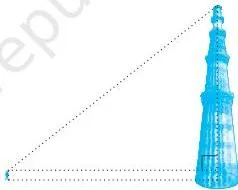
Section 8.1 opens with three situations — a student looking up at Qutub Minar, a girl on a balcony across a river, and a family watching a hot-air balloon. In each one, the distances make a right triangle in your imagination (NCERT, p.114). The skill to take away: see the right triangle that a real situation hides.
Section 8.2 defines the six trigonometric ratios for an acute angle of a right triangle. The skill: label the opposite side, adjacent side and hypotenuse before you write any ratio (NCERT, p.115).
Section 8.3 fixes the exact values for \(0^\circ\), \(30^\circ\), \(45^\circ\), \(60^\circ\) and \(90^\circ\). The skill: recall these values instantly, because the rest of this chapter and Chapter 9 lean on them.
Section 8.4 changes the focus from numbers to identities — equations true for every angle. The skill: prove an identity by rewriting it in sine and cosine and simplifying.
The six trigonometric ratios: definitions first
Ratios connect an acute angle to the sides of a right triangle: once you fix the angle, the side lengths stay in the same proportion.
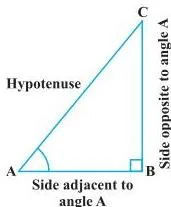
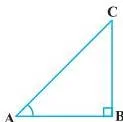
For angle A in Figure 8.4, side BC faces the angle, so it is the side opposite to A. Side AB is part of angle A, so it is the side adjacent to A. AC is the hypotenuse, always the side across from the right angle (NCERT, p.115).
- \(\sin A = \frac{\text{side opposite}}{\text{hypotenuse}}\)
- \(\cos A = \frac{\text{side adjacent}}{\text{hypotenuse}}\)
- \(\tan A = \frac{\text{side opposite}}{\text{side adjacent}}\)
- \(\cosec A = \frac{1}{\sin A}\)
- \(\sec A = \frac{1}{\cos A}\)
- \(\cot A = \frac{1}{\tan A}\)
Note the pattern: sine, cosine and tangent are the three basic comparisons; cosecant, secant and cotangent are their reciprocals (NCERT, p.115). Two more relations follow directly: \(\tan A = \frac{\sin A}{\cos A}\) and \(\cot A = \frac{\cos A}{\sin A}\).
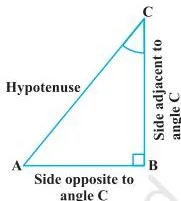
Figure 8.5 shows why the labels swap when the angle changes. If you choose angle C, side AB now faces angle C, so AB is opposite and BC is adjacent. Always name the sides from the angle you are using.
The symbols are abbreviations, not products. \(\sin A\) means “the sine of angle A” — sin separated from A has no meaning (NCERT, p.116). Also, \(\sin^2 A\) is short for \((\sin A)^2\), and \(\cosec A = (\sin A)^{-1}\) is not the same as \(\sin^{-1} A\), which is a different idea from higher classes (NCERT, p.117).
How to find all six ratios when only one ratio is given
One ratio fixes the shape of the triangle but not its size. In Figure 8.7, \(\sin A = \frac{1}{3}\) means BC and AC are in the ratio 1 : 3, so we can write \(BC = k\) and \(AC = 3k\), with \(k\) any positive number (NCERT, p.117).
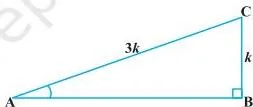
The same idea works for any given ratio, as this original example shows.
Worked example: from tan A = 7/24 to all six ratios
Step 1: \(\tan A = \frac{\text{opposite}}{\text{adjacent}} = \frac{7}{24}\).
In a right triangle ABC right-angled at B, take \(BC = 7k\) and \(AB = 24k\).
Step 2: Find the hypotenuse using Pythagoras: \(AC^2 = AB^2 + BC^2 = (24k)^2 + (7k)^2 = 576k^2 + 49k^2 = 625k^2\), so \(AC = 25k\).
\[ \sin A = \frac{BC}{AC} = \frac{7k}{25k} = \frac{7}{25}, \quad \cos A = \frac{AB}{AC} = \frac{24k}{25k} = \frac{24}{25} \]
Step 3: Take reciprocals: \(\cot A = \frac{24}{7}\), \(\sec A = \frac{25}{24}\), \(\cosec A = \frac{25}{7}\).
Final answer: \(\sin A = \frac{7}{25}\), \(\cos A = \frac{24}{25}\), \(\tan A = \frac{7}{24}\), \(\cot A = \frac{24}{7}\), \(\sec A = \frac{25}{24}\), \(\cosec A = \frac{25}{7}\).
Why is \(AC = 25k\) and not \(-25k\)? A side length is positive, so the negative square root is rejected (NCERT, p.117). Because the hypotenuse is the longest side, \(\sin A\) and \(\cos A\) are never greater than 1, while \(\sec A\) and \(\cosec A\) are never less than 1 (NCERT, p.118).
Standard angle values: 0, 30, 45, 60 and 90 degrees
These five values are the chapter’s memory load; once you know them, every evaluation and proof in the rest of the chapter works.
Where 45 degrees comes from
In a right triangle with one angle \(45^\circ\), the other acute angle is also \(45^\circ\), so the legs are equal. If each leg is \(a\), Pythagoras gives hypotenuse \(a\sqrt{2}\), hence \(\sin 45^\circ = \cos 45^\circ = \frac{1}{\sqrt{2}}\) and \(\tan 45^\circ = 1\) (NCERT, p.122).
Where 30 and 60 degrees come from
Drop the perpendicular from a vertex of an equilateral triangle to the base. Half of the triangle is a right triangle with angles \(30^\circ\), \(60^\circ\) and \(90^\circ\). If the side of the equilateral triangle is \(2a\), the short leg is \(a\) and the perpendicular is \(a\sqrt{3}\), giving all the 30° and 60° values (NCERT, p.123).
The figure shows that half-triangle ABD with \(\angle BAD = 30^\circ\) and \(\angle ABD = 60^\circ\); every 30° and 60° value below is read from its three sides.
Where 0 and 90 degrees come from
Let angle A shrink toward \(0^\circ\). Side BC gets closer to zero while AC nearly equals AB, so \(\sin 0^\circ = 0\) and \(\cos 0^\circ = 1\) (NCERT, p.124).

Now let angle A grow toward \(90^\circ\). Side AB nearly vanishes while AC almost coincides with BC, so \(\sin 90^\circ = 1\) and \(\cos 90^\circ = 0\) (NCERT, p.124).

Table 8.1 on NCERT p.125 collects the values; the table below is the same set in a compact layout.
| Angle \(A\) | \(\sin A\) | \(\cos A\) | \(\tan A\) | \(\cosec A\) | \(\sec A\) | \(\cot A\) |
|---|---|---|---|---|---|---|
| \(0^\circ\) | 0 | 1 | 0 | Not defined | 1 | Not defined |
| \(30^\circ\) | \(\frac{1}{2}\) | \(\frac{\sqrt{3}}{2}\) | \(\frac{1}{\sqrt{3}}\) | 2 | \(\frac{2}{\sqrt{3}}\) | \(\sqrt{3}\) |
| \(45^\circ\) | \(\frac{1}{\sqrt{2}}\) | \(\frac{1}{\sqrt{2}}\) | 1 | \(\sqrt{2}\) | \(\sqrt{2}\) | 1 |
| \(60^\circ\) | \(\frac{\sqrt{3}}{2}\) | \(\frac{1}{2}\) | \(\sqrt{3}\) | \(\frac{2}{\sqrt{3}}\) | 2 | \(\frac{1}{\sqrt{3}}\) |
| \(90^\circ\) | 1 | 0 | Not defined | 1 | Not defined | 0 |
Two patterns matter. As A rises from \(0^\circ\) to \(90^\circ\), \(\sin A\) rises from 0 to 1 and \(\cos A\) falls from 1 to 0 (NCERT, p.125). Four entries are undefined: \(\tan 90^\circ\), \(\cosec 0^\circ\), \(\sec 90^\circ\) and \(\cot 0^\circ\). Each is a division by zero, for example \(\tan 90^\circ = \frac{\sin 90^\circ}{\cos 90^\circ} = \frac{1}{0}\).
Figure walkthrough: sides, angles and the identity triangle
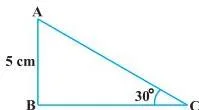
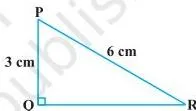
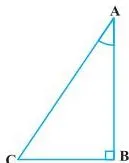
These figures are the bridge between definitions and problems; each one shows a small decision that keeps a whole question simple.
Fig 8.19 (Example 6): choosing the right ratio
The triangle is right-angled at B with \(AB = 5\) cm and \(\angle ACB = 30^\circ\). We want BC. Since AB is opposite to angle C and BC is adjacent to it, \(\frac{AB}{BC} = \tan C = \tan 30^\circ = \frac{1}{\sqrt{3}}\), so \(BC = 5\sqrt{3}\) cm; then \(\sin 30^\circ = \frac{5}{AC}\) gives \(AC = 10\) cm (NCERT, p.125).
Fig 8.20 (Example 7): reading a ratio backwards
Triangle PQR is right-angled at Q with \(PQ = 3\) cm and \(PR = 6\) cm. Then \(\sin R = \frac{PQ}{PR} = \frac{3}{6} = \frac{1}{2}\), so \(\angle PRQ = 30^\circ\) and \(\angle QPR = 60^\circ\) (NCERT, p.126). The standard table works in both directions: from angle to value, and from value back to angle.
Fig 8.21: the identity triangle
The third figure is the right triangle ABC right-angled at B whose Pythagoras relation \(AB^2 + BC^2 = AC^2\) becomes the three identities. The next section reads this single equation three ways.
Trigonometric identities: the three statements and how to prove them
An identity is an equation that is true for every value for which the expressions are defined. A trigonometric identity is the same idea applied to ratios of an angle (NCERT, p.128).
- \(\sin^2 A + \cos^2 A = 1\), for \(0^\circ \leq A \leq 90^\circ\) (NCERT, p.128)
- \(\sec^2 A = 1 + \tan^2 A\), for \(0^\circ \leq A \lt 90^\circ\) (NCERT, p.128)
- \(\cosec^2 A = 1 + \cot^2 A\), for \(0^\circ \lt A \leq 90^\circ\) (NCERT, p.129)
All three are the same Pythagoras equation read differently. Dividing \(AB^2 + BC^2 = AC^2\) by \(AC^2\), \(AB^2\) and \(BC^2\) gives them in that order (NCERT, pp.128–129).
Proof strategy that works
- Start from the harder side, usually the LHS.
- Convert every ratio to sine and cosine using the definitions.
- Apply an identity wherever a \(\sin^2 A + \cos^2 A\) pair appears.
- Simplify until the expression matches the other side; if both sides are messy, simplify LHS and RHS separately.
The chapter’s own exercises hint at exactly this — write in terms of sine and cosine, and simplify LHS and RHS separately when needed (NCERT, p.132).
Worked proof: sec A − tan A = cos A / (1 + sin A)
Step 1: Rewrite secant and tangent over a common denominator.
\[ \sec A – \tan A = \frac{1}{\cos A} – \frac{\sin A}{\cos A} = \frac{1 – \sin A}{\cos A} \]
Step 2: Multiply numerator and denominator by \(1 + \sin A\).
\[ \frac{1 – \sin A}{\cos A} \cdot \frac{1 + \sin A}{1 + \sin A} = \frac{1 – \sin^2 A}{\cos A(1 + \sin A)} \]
Step 3: Use \(\sin^2 A + \cos^2 A = 1\) and cancel \(\cos A\).
\[ \frac{\cos^2 A}{\cos A(1 + \sin A)} = \frac{\cos A}{1 + \sin A} \]
Final answer: LHS simplifies to RHS, so the identity holds.
Key terms: a quick glossary
When a question leaves you stuck on a word, find it here in one line.
| Term | Quick meaning | NCERT page |
|---|---|---|
| Trigonometry | The study of relationships between the sides and angles of a triangle | p.114 |
| Hypotenuse | The side opposite the right angle; the longest side of a right triangle | p.115 |
| Side opposite to angle A | The side of the triangle that faces angle A | p.115 |
| Side adjacent to angle A | The side that is part of angle A, besides the hypotenuse | p.115 |
| Trigonometric ratio | A ratio of two sides of a right triangle taken with respect to one acute angle | p.115 |
| Reciprocal | The fraction 1 divided by a ratio; cosec, sec and cot are reciprocals of sin, cos and tan | p.115 |
| Trigonometric identity | An equation involving trigonometric ratios that is true for every angle for which it is defined | p.128 |
Common mistakes in Chapter 8 and how to avoid them
Most ratio errors come from treating symbols as products and from forgetting what each ratio can and cannot equal. NCERT’s own true-or-false questions are built on these traps.
| Mistake | Correct rule | How to check your answer |
|---|---|---|
| \(\sin A\) means \(\sin \times A\) | \(\sin A\) is one symbol for “sine of angle A”; sin alone has no meaning (NCERT, p.116) | Read it aloud as “sine of A”; if it sounds like a product, it is wrong |
| \(\cosec A = \sin^{-1} A\) | \(\cosec A = \frac{1}{\sin A}\); \(\sin^{-1} A\) is the inverse sine, a different idea (NCERT, p.117) | Check that your answer is a reciprocal, not an inverse function |
| \(\sin \theta = \frac{4}{3}\) is possible | \(\sin A\) and \(\cos A\) never exceed 1 because the hypotenuse is the longest side (NCERT, p.118) | If sin or cos comes out greater than 1, recheck the sides |
| \(\tan A\) is always less than 1 | \(\tan A\) can be greater than 1; \(\tan 60^\circ = \sqrt{3}\) (NCERT, p.125) | Remember \(\tan 45^\circ = 1\), so values above 1 exist |
| \(\tan 90^\circ\) and \(\cot 0^\circ\) have values | Both are not defined; each is a division by zero (NCERT, p.124) | A zero in the denominator means the ratio is undefined |
| \(\sin (A+B) = \sin A + \sin B\) | Sines do not distribute over addition (Exercise 8.2 Q4) | Test \(A = B = 30^\circ\): \(\sin 60^\circ = \frac{\sqrt{3}}{2}\), not 1 |
Also remember the direction of change: as \(\theta\) goes from \(0^\circ\) to \(90^\circ\), \(\sin \theta\) increases from 0 to 1 and \(\cos \theta\) decreases from 1 to 0 (NCERT, p.125).
How to practise this chapter
The three exercises form a natural ladder; do them in order, and each one prepares the next.
| Exercise | What it practises | What a full-marks answer needs |
|---|---|---|
| Exercise 8.1 (pp.121–122) | Labelling sides, finding ratios from a figure, and computing all ratios when one ratio is given | Name opposite, adjacent and hypotenuse; show the \(k\) step; reject negative roots as lengths |
| Exercise 8.2 (pp.127–128) | Evaluating expressions using the standard values and judging true-or-false statements | Substitute exact values from Table 8.1 and justify every true/false answer with a reason |
| Exercise 8.3 (pp.131–132) | Expressing one ratio in terms of another and proving identities | Start with LHS, apply definitions, simplify step by step, and arrive exactly at RHS |
A full-marks answer shows the definitions you used: name the opposite, adjacent and hypotenuse sides, write \(k\) for the unknown scale, and state why the negative root is rejected. For identity proofs, begin with LHS and end exactly at RHS.
- Definitions first: label sides for both angle A and angle C.
- Table 8.1 drill: run through all six ratios at 0°, 30°, 45°, 60° and 90° until the values are instant.
- One-ratio problems: Exercise 8.1 Q3–Q5, Q7, Q8.
- Proof questions: Exercise 8.3 Q4; keep the strategy list open while you work.
One honest syllabus note: textbook contents and the examinable syllabus are not always identical — check the current official syllabus. This page makes no promise about which questions will appear.
Chapter 8 summary: what NCERT wants you to remember
These are the chapter’s own Summary points on NCERT p.132, put into shorter words.
- The six ratios are \(\sin A\), \(\cos A\), \(\tan A\), \(\cosec A\), \(\sec A\), \(\cot A\), defined as the three basic ratios and their reciprocals.
- \(\tan A = \frac{\sin A}{\cos A}\) and \(\cot A = \frac{\cos A}{\sin A}\).
- If one ratio of an acute angle is known, the remaining ratios can be found using Pythagoras’ theorem.
- Memorise the standard values for \(0^\circ\), \(30^\circ\), \(45^\circ\), \(60^\circ\), \(90^\circ\) from Table 8.1.
- \(\sin A\) and \(\cos A\) never exceed 1; \(\sec A\) and \(\cosec A\) are always at least 1 within their defined ranges.
- The three identities: \(\sin^2 A + \cos^2 A = 1\), \(\sec^2 A = 1 + \tan^2 A\), \(\cosec^2 A = 1 + \cot^2 A\).
To recall the first three ratios, use the initials Pandit Badri Prasad Har Har Bole.
Write the P, B, P of “Pandit Badri Prasad” over the H, H, B of “Har Har Bole”: \(\sin A = \frac{P}{H}\), \(\cos A = \frac{B}{H}\), \(\tan A = \frac{P}{B}\), where P is the side opposite (perpendicular), B the side adjacent (base) and H the hypotenuse. Their reciprocals reverse each pair.
Related NCERT chapters and resources
This listing is maintained for the 2026-27 academic session using the NCERT textbook information available to us. NCERT remains the authority for confirming the latest edition.
This chapter is one step in a chain; Chapter 9 spends a whole chapter using these exact ratios.
- Chapter 7 (Coordinate Geometry) — the previous chapter of the book.
- Chapter 9 (Some Applications of Trigonometry) — heights and distances using these ratios.
- Class 10 Mathematics book page — every chapter of this book in one place.
- Class 10 hub — subject pages for the whole class.
- All CBSE notes — the starting point for every class.
For the file itself, Download Introduction to Trigonometry Class 10 NCERT PDF again, so you can keep the chapter text beside you while you work.
Sources and data verification
Where the facts on this page come from, plainly stated:
- The page describes the NCERT Class 10 Mathematics textbook, Chapter 8, Introduction to Trigonometry, in its official NCERT edition, with page numbers following the NCERT file jemh108.
- It covers the NCERT textbook chapter only; textbook contents and the examinable syllabus are not always identical, so the CBSE syllabus remains the final authority for examinations.
- It is maintained for the current academic session using the NCERT information available to us.
- NCERT settles textbook editions, contents and PDFs; CBSE settles the curriculum, syllabus and examinations.
| What the chapter holds | Count | Where it is used |
|---|---|---|
| Printed pages | 20 | |
| Sections in the chapter | 5 | |
| Figures with NCERT captions | 11 | |
| Tables | 1 | |
| Worked examples | 1 | solved step by step in our NCERT Solutions |
| Exercise questions | 19 | answered in our NCERT Solutions |
| Official NCERT PDF | Download the chapter PDF | the chapter exactly as NCERT publishes it |
Reference: NCERT Class 10 Mathematics textbook, chapter 8, official edition on ncert.nic.in.
Frequently asked questions
Why is tan 90° not defined while sin 90° is 1?
Because \(\tan 90^\circ = \frac{\sin 90^\circ}{\cos 90^\circ} = \frac{1}{0}\), and dividing by zero gives no number. \(\sin 90^\circ\) itself is defined: the side opposite the angle approaches the hypotenuse, so the ratio approaches 1 (NCERT, p.124).
How can I find all the trigonometric ratios when only one ratio is given?
Use the ratio as a proportion. If \(\tan A = \frac{7}{24}\), write opposite and adjacent as \(7k\) and \(24k\), use Pythagoras to get hypotenuse \(25k\), then divide: \(\sin A = \frac{7}{25}\), \(\cos A = \frac{24}{25}\), and the other three are reciprocals.
What is the difference between cosec A and sin⁻¹ A?
\(\cosec A\) is the reciprocal \(\frac{1}{\sin A}\). \(\sin^{-1} A\) is the inverse sine function, a completely different idea studied in higher classes (NCERT, p.117).
Why is the value of sin A or cos A never greater than 1?
Because the hypotenuse is the longest side of a right triangle, \(\sin A = \frac{\text{opposite}}{\text{hypotenuse}}\) and \(\cos A = \frac{\text{adjacent}}{\text{hypotenuse}}\) can never exceed 1 (NCERT, p.118).
What are the three trigonometric identities in Class 10 Chapter 8?
\(\sin^2 A + \cos^2 A = 1\) for \(0^\circ \leq A \leq 90^\circ\); \(\sec^2 A = 1 + \tan^2 A\) for \(0^\circ \leq A \lt 90^\circ\); and \(\cosec^2 A = 1 + \cot^2 A\) for \(0^\circ \lt A \leq 90^\circ\) (NCERT, pp.128–129).
Does cos θ increase or decrease as θ goes from 0° to 90°?
\(\cos \theta\) decreases from 1 to 0 as \(\theta\) goes from \(0^\circ\) to \(90^\circ\), while \(\sin \theta\) increases from 0 to 1 (NCERT, p.125).
Explore Class 10 Mathematics Books
Related chapters: