
This page gives you the official PDF of Some Applications of Trigonometry Class 10, Chapter 9 of the NCERT Class 10 Mathematics textbook. It is the chapter that applies the trigonometric ratios of Chapter 8 to find heights and distances — a tower’s height, a river’s width — without climbing or crossing anything.
The chapter runs about 11 pages of the printed book, starting at page 132, and the official PDF link is directly below.
Download the official chapter PDF
The file below is the same PDF that NCERT publishes on its own website, covering the chapter as printed from page 132 onward.
This is the official file — download the Some Applications of Trigonometry Class 10 chapter PDF when you want the exact NCERT text, figures and Exercise 9.1 questions on your own screen for reading, printing or offline revision.
Chapter 9 at a glance
Chapter 9 has one teaching section, 9.1 Heights and Distances, followed by Exercise 9.1 and a short closing summary (9.2 Summary, page 143). Use the chapter table below to check the chapter’s size before you start — it lists the section, figure and question counts for the file above.
What Chapter 9 is about: measuring heights you cannot reach
This chapter answers a single question: how do you find the height of something you cannot climb, or a distance you cannot walk across, using the trigonometric ratios from Chapter 8?
Section 9.1 opens by redrawing Chapter 8’s Fig. 8.1 as Fig. 9.1 — a student looking at the top of a minar (NCERT p. 133). The same picture gives the chapter its two core ideas.
The line of sight is the line from the student’s eye to the top of the minar, and the angle of elevation is the angle that line makes with the horizontal. A girl on a balcony introduces the angle of depression (NCERT p. 134) — the same kind of angle measured below the horizontal when she looks down.
On page 135 the book asks what information you need to find the minar’s height without measuring it. You need three things:
- the distance of the student from the foot of the minar;
- the angle of elevation of the top of the minar;
- the height of the student.
Because the full height is \( CD = CB + BD \), once you find CB from the angle you add BD — the eye height — and the answer follows.
The chapter then works a series of examples, each adding one new difficulty, sets one exercise, and closes with a short summary (9.2, page 143).
Key concepts: line of sight, angle of elevation, angle of depression
The entire chapter runs on one line and two angles. Master these three ideas before touching any formula.
- Line of sight — the straight line from the observer’s eye to the point on the object being viewed (NCERT p. 133). In every diagram, this line is the hypotenuse of the working right triangle.
- Angle of elevation — the angle the line of sight makes with the horizontal when the object is above eye level, the case when you raise your head (NCERT pp. 133-134). It sits at the observer’s position, between the horizontal and the line of sight.
- Angle of depression — the same kind of angle below the horizontal when the object is below eye level, the case when you lower your head (NCERT p. 134). It also sits at the observer’s eye, never at the object.
The raise-your-head / lower-your-head test is the fastest way to tell the two angles apart. Ask which way the observer’s eye moved.
Every problem hides the same right triangle: the vertical side is the height, the horizontal side is the ground distance, and the given angle is at the observer’s position.
Choose the ratio that involves the side you know and the side you want (NCERT p. 135): use tan or cot when those two sides are the legs, and sin when the hypotenuse is involved, as in Example 2 (NCERT p. 136). The figure walkthrough below makes both angles concrete before any formula appears.
How the chapter’s worked examples build the skill, one step at a time
The worked examples are not different topics: each one adds a single new difficulty to the same method. When an Exercise 9.1 question feels hard, find its family in the table below and reread that example.
The table maps each example to its situation, the ratio it uses, and the new difficulty it introduces.
| Example | NCERT page | Situation | Ratio used | The new difficulty |
|---|---|---|---|---|
| Example 1 | p. 135 | Tower, point 15 m away, angle of elevation \( 60^\circ \) | \( \tan 60^\circ \) | The basic direct case — everything later builds on it |
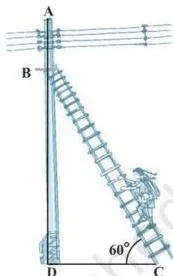
| Example 2 | p. 136 | Electrician on a 5 m pole, ladder inclined at \( 60^\circ \) | \( \sin 60^\circ \), then \( \cot 60^\circ \) | First use of the hypotenuse: the ladder length |
| Example 3 | p. 137 | Observer 1.5 m tall, 28.5 m from a chimney, angle \( 45^\circ \) | \( \tan 45^\circ \) | Add the observer’s height to the result |
| Example 4 | p. 138 | 10 m building plus a flagstaff, angles \( 30^\circ \) and \( 45^\circ \) from one point | \( \tan \) in two triangles | Two right triangles that share the side AP |
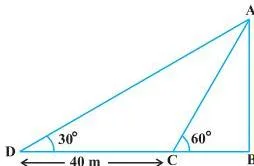
| Example 5 | pp. 138-139 | Shadow 40 m longer at sun’s altitude \( 30^\circ \) than at \( 60^\circ \) | \( \tan 30^\circ \) and \( \tan 60^\circ \), then substitute | Two equations from two positions of the same object |
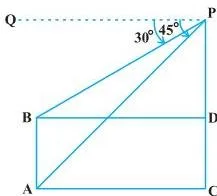
| Example 6 | pp. 139-140 | Angles of depression of the top and bottom of an 8 m building | \( \tan 30^\circ \), \( \tan 45^\circ \) | Depression angles, the alternate-angle transfer, and rationalising \( \frac{8}{\sqrt{3} – 1} \) |
| Example 7 | pp. 140-141 | Bridge 3 m above a river, depressions \( 30^\circ \) and \( 45^\circ \) to the two banks | \( \tan \) | Adding two horizontal distances for a total width |
The flagstaff diagram — NCERT Fig. 9.7, page 138 — shows what “two triangles from one point” means.
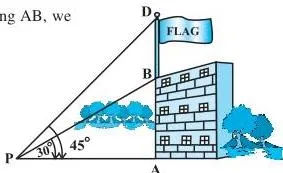
In Example 4, the side AP belongs to both right triangles. In triangle PAB it is the base for finding the distance of the building from P; in triangle PAD it is the base for finding the height to the top of the flag.
Keep every angle with its own triangle: the \( 30^\circ \) angle belongs to triangle PAB and the \( 45^\circ \) angle belongs to triangle PAD, and the two equations solve cleanly.
Reading NCERT’s diagrams: a figure walkthrough
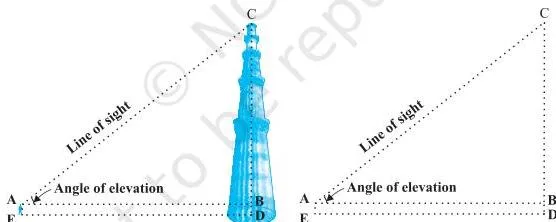
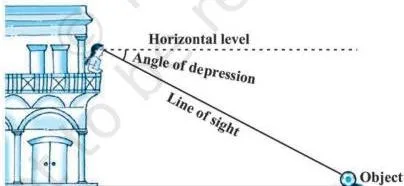
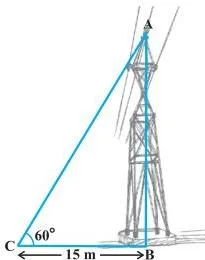
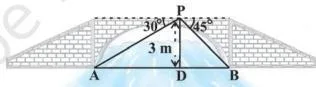
Whenever a heights-and-distances question feels impossible, draw the diagram first — NCERT’s Example 1 opens with “First let us draw a simple diagram” (p. 135). Reading the figures correctly is the whole skill, so here is what each key diagram means.
Fig 9.1: the founding picture of the minar
In Fig. 9.1 (NCERT p. 133) the student’s eye is at A and the top of the minar is at C. The line of sight is AC; the horizontal from the eye is AB; and the angle of elevation \( \angle BAC \) sits at A, between the horizontal and the line of sight.
Later the book shows the full height as \( CD = CB + BD \), where BD is the observer’s height (NCERT p. 135). The working triangle alone gives only the part of the height above eye level.
Fig 9.3: the depression picture
Fig. 9.3 (NCERT p. 134) shows the girl on the balcony looking down at a flower pot. Her line of sight runs below the horizontal drawn through her eye, and the angle of depression is the angle between that horizontal and the line of sight.
The angle lives at the observer’s eye — never at the flower pot. That is the point students most often misplace.
Fig 9.8: why shadow problems need two equations
Fig. 9.8 (NCERT p. 138) shows the same tower AB of height h casting two shadows: BC when the sun’s altitude is \( 60^\circ \), and the longer shadow DB when it is \( 30^\circ \).
The problem states that DB is 40 m longer than BC, so write \( DB = 40 + x \). Then \( \tan 60^\circ = h/x \) in triangle ABC and \( \tan 30^\circ = h/(x + 40) \) in triangle ABD — two equations in h and x, solved by substitution.
Fig 9.9: the alternate-angle key to depression problems
Fig. 9.9 (NCERT pp. 139-140) is the figure that unlocks most depression questions. PC is the multi-storeyed building and AB is the 8 m building.
The line of sight PB crosses the parallel lines PQ and BD, so \( \angle QPB \) and \( \angle PBD \) are alternate angles and are equal — the \( 30^\circ \) depression angle transfers into the triangle as \( \angle PBD = 30^\circ \). Similarly \( \angle PAC = 45^\circ \).
Because \( \tan 45^\circ = 1 \), the working ends with \( PC = AC \): height and distance come out equal, exactly as Example 6 concludes.
Definitions you should be able to write
The chapter’s own summary (9.2, page 143) lists exactly three definitions, and you may be asked to state any of them. Here they are in plain words, with a way to spot each one in a diagram.
| Term | What it means | How to spot it in a diagram |
|---|---|---|
| Line of sight | The straight line from the observer’s eye to the point on the object viewed | Always the hypotenuse of the working triangle — it joins the eye to the object |
| Angle of elevation | The angle the line of sight makes with the horizontal when the object is above eye level — you raise your head | An angle at the eye that opens upwards, between the horizontal and the line of sight |
| Angle of depression | The angle the line of sight makes with the horizontal when the object is below eye level — you lower your head | An angle at the eye that opens downwards, between the horizontal and the line of sight |
One equality turns depression problems into elevation problems. When the line of sight crosses two parallel lines — the horizontal through the observer’s eye and the horizontal through the object — the angle of depression at the observer equals the angle of elevation at the object.
Example 6 proves it with alternate angles: \( \angle QPB = \angle PBD \) (NCERT p. 140).
Worked example: the observer height step, solved with original numbers
Here is the full method on a fresh problem, with original numbers, so you can watch every step — including the last step that is usually missed — without already knowing the answer.
Problem. An observer 1.6 m tall stands \( 8\sqrt{3} \) m from the foot of a tower. From the observer’s eye, the angle of elevation of the top of the tower is \( 60^\circ \). Find the height of the tower.
Step 1: Draw the right triangle.
The vertical tower, the horizontal ground distance \( 8\sqrt{3} \) m, and the \( 60^\circ \) angle at the observer’s eye.
The eye is 1.6 m above the ground, so this triangle sits above eye level.
Step 2: Let h be the height of the tower above the observer’s eye.
The side opposite the \( 60^\circ \) angle is h and the side adjacent to it is \( 8\sqrt{3} \) m, so tan is the ratio that links them.
\[ \tan 60^\circ = \frac{h}{8\sqrt{3}} \]
Step 3: Substitute \( \tan 60^\circ = \sqrt{3} \) and solve for h.
\[ \sqrt{3} = \frac{h}{8\sqrt{3}} \Rightarrow h = 8\sqrt{3} \times \sqrt{3} = 8 \times 3 = 24\ \text{m} \]
Step 4: Add the observer’s eye height, because the angle was measured from the eye and not from the ground.
\[ \text{Height of the tower} = 24 + 1.6 = 25.6\ \text{m} \]
Final answer: The height of the tower is \( 25.6\ \text{m} \).
The most common wrong answer is 24 m — it forgets that the angle of elevation is measured from the eye, not from the ground. NCERT Example 3 (p. 137) is built around exactly this trap: the chimney height is \( AE + 1.5 \), not AE alone.
The fresh problem has the same shape as NCERT Fig. 9.4 (p. 135): a vertical side, a horizontal side, and the angle at the ground point. Only the numbers differ.
In the figure, AB is the tower and CB the ground distance. Triangle ABC is right-angled at B, with the angle of elevation \( 60^\circ \) at C — the same setup as the fresh problem, except that this observer’s eye is on the ground, so nothing needs adding.
Common mistakes in heights and distances problems, with corrections
Most errors in this chapter are reading errors, not calculation errors. Each row below names a mistake the textbook quietly corrects on the page shown.
| Mistake | Correct rule | How to check your answer |
|---|---|---|
| Drawing the angle of depression at the object instead of at the observer’s eye | The angle always sits where the line of sight leaves the eye, measured below the horizontal (NCERT pp. 134, 139-140) | Trace the line of sight backwards from the object to the eye; the angle is at the eye end |
| Forgetting to add the observer’s height or a building’s height | The asked height is the found height plus the already-known height, as in Example 3 (p. 137) and Example 6 (PC = PD + DC, p. 140) | Re-read the question for words like “tall boy” or “from the eyes” — they signal an addition at the end |
| Inverting the ratio | Solve the equation as written: \( \tan 60^\circ = \frac{AB}{15} \), so AB is larger than 15 (method on p. 135) | Sanity check: for an angle above \( 45^\circ \), the tall side must be bigger than the ground distance |
| Mixing up the two triangles in two-triangle problems | Label both triangles and keep each angle with its own triangle, as in Examples 4, 5 and 6 (pp. 138-140) | Write beside each equation which triangle it came from before solving |
| Misreading “the sun’s altitude is \( 30^\circ \)” | It is the angle of elevation of the sun, used at the shadow tip like any other elevation angle (Example 5, p. 138) | Remember the longer shadow belongs to the smaller altitude: at \( 30^\circ \) the shadow is longer than at \( 60^\circ \) |
| Stopping at a piece instead of the answer | In Example 6, PD alone is not the answer; the building height is PD + 8 (p. 140) | Underline the word “height” or “distance” in the question and make sure your last line answers exactly that |
Exam approach: practising Exercise 9.1 by skill
For practice, treat the whole chapter as one technique: draw the right triangle, choose the ratio that links the known side to the wanted side, solve, then add or subtract any height above or below the eye.
NCERT’s own summary (9.2, page 143) states the point in one line: heights, lengths and distances can be determined with trigonometric ratios.
Every question in Exercise 9.1 is a numerical, so the skill being tested is the working itself — the diagram, the ratio choice, the substitution and the final unit. The table below maps each question to the worked-example family it follows, so you practise the type you find hardest.
| Exercise 9.1 questions | Worked-example family | What you practise |
|---|---|---|
| 1, 3, 5 | Example 2 — sin for the hypotenuse | The hypotenuse is wanted: rope and pole, two slides, kite string — use sin with the given angle |
| 4 | Example 1 — direct tan | The basic case: ground distance and angle given, height wanted |
| 6, 14 | Examples 3 and 5 | Observer’s eye height plus two positions: find both distances and subtract |
| 7, 8 | Example 4 — two triangles from one point | A tower or statue on top of a building or pedestal, two angles, one shared ground distance |
| 9, 10 | Example 7 — a known total split in two | Q10’s 80 m road is split into two parts; Q9 uses the known 50 m tower height with two connected triangles |
| 11, 13, 15 | Example 5 — two equations | Two positions of the same object give two equations in the height and one distance |
| 12 | Example 6 — elevation and depression | The depression angle at the top transfers into the triangle by alternate angles |
Two questions also test reading skill beyond the trigonometry. In question 2, the broken part of the tree is the hypotenuse, so the tree’s height is the sum of the two pieces you find.
In question 15, a car approaches the tower with uniform speed. Once you find the two distances, the speed comes from the 6-second gap, and the time to reach the foot is the remaining distance divided by the speed.
One honest note: textbook contents and the examinable syllabus are not always identical — check the current official CBSE syllabus for what is examinable in this chapter.
Revision summary: Chapter 9 in one breath
This is the chapter reduced to what NCERT’s own summary (p. 143) says, followed by the five-step method every example uses.
- The line of sight is the line from the observer’s eye to the object viewed.
- The angle of elevation is formed when the line of sight is above the horizontal — we raise our head.
- The angle of depression is formed when the line of sight is below the horizontal — we lower our head.
- The height or length of an object, and the distance between two distant objects, can be found using trigonometric ratios.
- Draw and label the diagram.
- Mark the right angle and the given angle at the observer’s position.
- Identify the triangle that holds the known side and the wanted side.
- Choose the ratio that involves those two sides — tan or cot for the two legs, sin when the hypotenuse is involved.
- Add or subtract any height that lies above or below the observer’s eye.
Related chapters and resources
This listing is maintained for the 2026-27 academic session using the NCERT textbook information available to us. NCERT remains the authority for confirming the latest edition.
Chapter 9 assumes the trigonometric ratios and their values for \( 30^\circ \), \( 45^\circ \) and \( 60^\circ \) from Chapter 8. The chapter opens by saying it studies ways trigonometry is used in life around you, right after that chapter (NCERT p. 133).
If the standard angle values are shaky, revise the Chapter 8 notes on introduction to trigonometry first.
The next chapter in the book is Chapter 10 Circles, which turns to a different branch of geometry. For the full set, browse the Class 10 Mathematics notes or the wider Class 10 CBSE notes collection.
The official edition of this chapter is published by NCERT and available at ncert.nic.in — the same file offered at the top of this page. The CBSE notes library holds supporting material for every class and subject.
Sources and data verification
- Everything on this page describes the NCERT Class 10 Mathematics textbook, Chapter 9, in the official edition published by NCERT and available at ncert.nic.in.
- This page covers that single chapter — not other chapters, and not the full CBSE curriculum.
- The page is maintained for the current academic session using the NCERT materials published for it.
- NCERT settles textbook contents, editions and PDFs; CBSE settles the curriculum, syllabus and examinations.
- Numbered pages cited here (p. 132 onwards) follow the printed numbering of the official NCERT edition.
| What the chapter holds | Count | Where it is used |
|---|---|---|
| Printed pages | 11 | |
| Sections in the chapter | 2 | |
| Figures with NCERT captions | 9 | |
| Exercise questions | 15 | answered in our NCERT Solutions |
| Official NCERT PDF | Download the chapter PDF | the chapter exactly as NCERT publishes it |
Frequently asked questions about Some Applications of Trigonometry Class 10
What is the difference between angle of elevation and angle of depression?
The difference is which way you move your head. When the object is above eye level, you raise your head, and the angle the line of sight makes with the horizontal is the angle of elevation (NCERT pp. 133-134).
When the object is below eye level, you lower your head, and the same kind of angle below the horizontal is the angle of depression (NCERT p. 134). Both angles sit at the observer’s eye.
Is the angle of depression equal to the angle of elevation?
Yes, in the standard setup. When the line of sight crosses two parallel lines — the horizontal through the observer’s eye and the horizontal through the object — the two angles are equal because they are alternate angles. Example 6 uses this to move the \( 30^\circ \) depression angle into the triangle: \( \angle QPB = \angle PBD \) (NCERT p. 140).
Which trigonometric ratio should I use in heights and distances questions?
Use the ratio that involves the side you know and the side you want (NCERT p. 135). If those two sides are the legs of the right triangle — a vertical height and a horizontal distance — use tan or cot.
If one of them is the hypotenuse, use sin; Example 2 uses \( \sin 60^\circ \) for the ladder’s length because the ladder is the hypotenuse (NCERT p. 136).
What does “the sun’s altitude is 30 degrees” mean in a question?
It means the angle of elevation of the sun is \( 30^\circ \) — the angle between the sun’s rays and the horizontal ground. In the diagram it is the angle at the tip of the shadow, used exactly like any other angle of elevation. Example 5 uses two altitudes, \( 60^\circ \) and \( 30^\circ \), to set up two equations for the tower’s height (NCERT pp. 138-139).
Why do we add the height of the observer in some problems?
Because the angle of elevation is measured from the observer’s eye, not from the ground. The working triangle gives only the part of the height above eye level, so the eye height below it has to be added. Example 3 adds the observer’s 1.5 m: the chimney height is \( AE + 1.5 \) (NCERT p. 137).
Reference: NCERT Class 10 Mathematics textbook, chapter 9, official edition on ncert.nic.in.
Explore Class 10 Mathematics Books
Related chapters: