
This page is the guide to Chapter 6 of the NCERT Class 10 Mathematics textbook — Triangles, the chapter on similar figures, the Basic Proportionality Theorem and the AAA, SSS and SAS similarity criteria.
The chapter runs across NCERT pages 72 to 98, and the official PDF from ncert.nic.in is right here. If Triangles Class 10 is on your revision list for tonight, everything you need is on this page: the theorems, worked examples, common mistakes and a one-night revision plan.
NCERT Class 10 Maths Chapter 6 Triangles PDF Download
Download the official NCERT Class 10 Maths Chapter 6 Triangles PDF from ncert.nic.in — the same edition your school follows — and keep this page open as you work through what the chapter teaches, section by section.
The link opens the NCERT textbook page for Class 10 Mathematics, where you can read or save the chapter file. The sections below tell you what is inside the chapter, in the order the book presents it.
What This Chapter Contains
Before you start, know the terrain: the whole chapter serves one idea — that you can measure something you cannot reach by comparing it with similar figures.
- 6.1 Introduction — opens with a question: how were heights like Mount Everest’s found without a measuring tape? The answer is indirect measurement, based on similarity (NCERT p. 72).
- 6.2 Similar Figures — the definition of similar polygons, the scale factor, and Exercise 6.1.
- 6.3 Similarity of Triangles — equiangular triangles, the Basic Proportionality Theorem (Theorem 6.1), its converse (Theorem 6.2), and Exercise 6.2.
- 6.4 Criteria for Similarity of Triangles — the AAA/AA, SSS and SAS criteria (Theorems 6.3–6.5), worked examples including the lamp-post shadow problem, and Exercise 6.3.
- 6.5 Summary and A Note to the Reader — the nine summary points plus the RHS similarity criterion for right triangles.
The counts table on this page shows the chapter’s sections, figures and exercise questions, so you can see the workload at a glance. Much of the chapter is best understood through its figures — the key ones are reproduced and explained below.
Similar Figures: The Two Conditions for Similarity
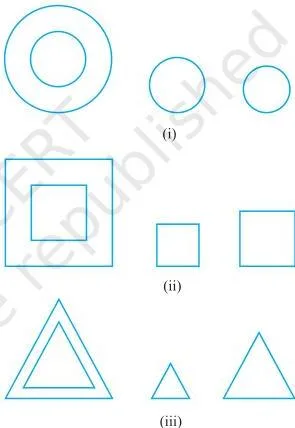
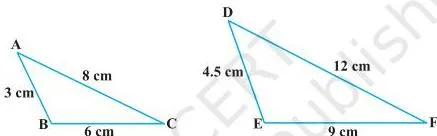
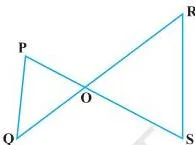
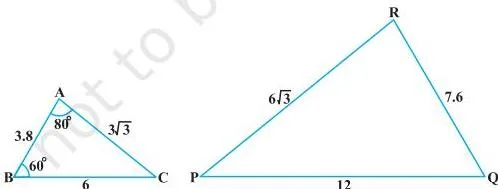
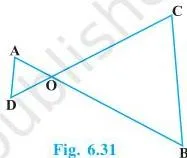
Similarity is the chapter’s core idea: two figures with the same shape, but not necessarily the same size. Everything later is this idea applied to triangles.
Definition (NCERT p. 75): two polygons of the same number of sides are similar if (i) their corresponding angles are equal and (ii) their corresponding sides are in the same ratio.
“Same ratio” means every side of one figure is the same multiple of its matching side in the other — one constant scale across all the side pairs.
Congruence is stricter: congruent figures have the same shape and the same size. So all congruent figures are similar, but similar figures need not be congruent (NCERT p. 74).
Fig. 6.1 shows why shape is the test. Every circle has the same shape, so all circles are similar whatever their radius; the same holds for all squares and all equilateral triangles. A circle and a square, however, are not similar — you can see the shapes differ, and no scaling turns a curved outline into four straight sides.
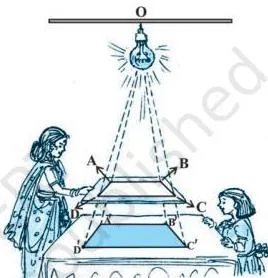
Fig. 6.4 is where the definition comes from. A bulb at O casts the shadow of a cardboard quadrilateral ABCD onto a table, and the shadow A’B’C’D’ is a magnified copy. Because light travels in straight lines, each shadow vertex lies on the ray from the bulb through the original vertex — A’ on OA, B’ on OB, and so on.
Measuring the shadow shows every angle equals the original, and every side is enlarged by the same factor. That constant factor is the scale factor (or Representative Fraction) — the number behind world maps and building blueprints (NCERT p. 76).
A photographer enlarging a 35 mm negative to 45 mm applies the same idea: each line segment grows in the ratio 45:35 while angles stay fixed.
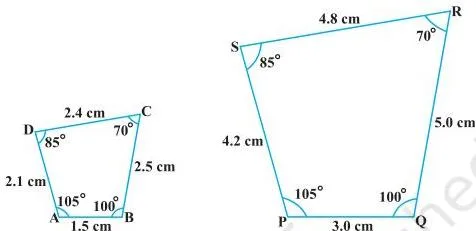
In Fig. 6.5, quadrilaterals ABCD and PQRS satisfy both conditions — matching angles and one common side ratio — so they are similar.
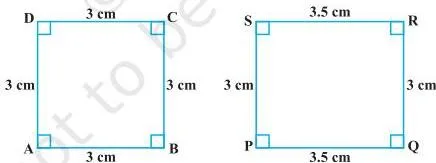
Now the chapter’s key caution, shown in Fig. 6.6 and the rhombus example that follows it. A square and a rectangle have all angles equal, but their sides are not in the same ratio — so they are not similar.
The mirror-image failure: a square and a rhombus have all four sides in the same ratio, but their angles differ. Either condition alone fails for general polygons (NCERT pp. 77–78).
For triangles this caution disappears. As Theorems 6.3 and 6.4 will show, in triangles one condition forces the other: equal angles give proportional sides, and proportional sides give equal angles. Do not carry the square-versus-rectangle rule into triangle problems.
Exercise 6.1 fixes these ideas: Q1 fills blanks in the definitions, Q2 asks for your own examples of similar and non-similar figures, Q3 checks whether two quadrilaterals satisfy both conditions.
Basic Proportionality Theorem (Thales’ Theorem)
In plain language: a line drawn parallel to one side of a triangle cuts the other two sides in the same ratio. This is the theorem the rest of the chapter uses again and again.
Theorem 6.1 (BPT, NCERT p. 80): if a line is drawn parallel to one side of a triangle to intersect the other two sides in distinct points, the other two sides are divided in the same ratio. In symbols: in \( \triangle ABC \), if \( DE \parallel BC \) with D on AB and E on AC, then \( \frac{AD}{DB} = \frac{AE}{EC} \).
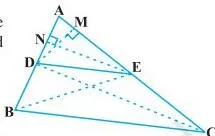
The proof works by areas — the setup is in Fig. 6.10. Join BE and CD, and drop perpendiculars EN on AB and DM on AC. Each ratio below is just “same base, same height”:
\[ \frac{\text{ar}(\triangle ADE)}{\text{ar}(\triangle BDE)} = \frac{AD}{DB}, \qquad \frac{\text{ar}(\triangle ADE)}{\text{ar}(\triangle DEC)} = \frac{AE}{EC} \]
The first pair of triangles shares the height EN, so their areas are in the ratio of the bases AD and DB. The second pair shares the height DM.
Triangles BDE and DEC have the same base DE and lie between the same parallels DE and BC, so their areas are equal. Two ratios equal to the same pair of areas are equal — hence \( \frac{AD}{DB} = \frac{AE}{EC} \).
Worked example: use BPT with original numbers
Step 1: In \( \triangle ABC \), \( DE \parallel BC \) with D on AB and E on AC.
Given \( AD = 4\ \text{cm} \), \( DB = 6\ \text{cm} \), \( AE = 5\ \text{cm} \).
Step 2: Apply BPT: \( \frac{AD}{DB} = \frac{AE}{EC} \).
\[ \frac{4}{6} = \frac{5}{EC} \]
- Step 1: Cross-multiply: \( EC = \frac{5 \times 6}{4} = 7.5\ \text{cm} \).
- Step 2: \( AC = AE + EC = 5 + 7.5 = 12.5\ \text{cm} \).
Final answer: \( EC = 7.5\ \text{cm} \) and \( AC = 12.5\ \text{cm} \).
The converse: Theorem 6.2
Theorem 6.2 (converse of BPT, NCERT p. 82): if a line divides any two sides of a triangle in the same ratio, then the line is parallel to the third side.
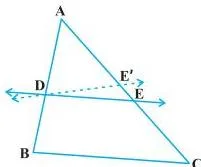
The proof is by contradiction, using Fig. 6.12. Suppose DE is not parallel to BC, and draw DE’ parallel to BC instead. By BPT, \( \frac{AD}{DB} = \frac{AE’}{E’C} \). But the given ratio \( \frac{AD}{DB} = \frac{AE}{EC} \) then forces \( \frac{AE}{EC} = \frac{AE’}{E’C} \).
Adding 1 to both sides shows \( \frac{AC}{EC} = \frac{AC}{E’C} \), so \( EC = E’C \) — E and E’ are the same point. The assumption fails, so DE really is parallel to BC.
A useful variant of BPT, proved by inverting and adding 1 in Theorem 6.1’s ratio: \( \frac{AD}{AB} = \frac{AE}{AC} \). Memorise all three forms — the two ratios and the converse — and notice which one the question gives you.
Example 3 (NCERT pp. 83–84) puts the converse to work. In \( \triangle PQR \), \( \frac{PS}{SQ} = \frac{PT}{TR} \). By Theorem 6.2, \( ST \parallel QR \). Then \( \angle PST = \angle PQR \) (corresponding angles).
The question also gives \( \angle PST = \angle PRQ \), so \( \angle PRQ = \angle PQR \), which makes \( PQ = PR \) — the triangle is isosceles.
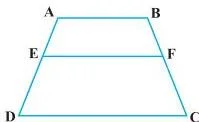
Example 2 applies BPT to a trapezium. In trapezium ABCD with \( AB \parallel DC \), the segment EF parallel to AB cuts AD at E and BC at F.
Joining diagonal AC splits the figure into two triangles: in \( \triangle ADC \), \( EG \parallel DC \) gives \( \frac{AE}{ED} = \frac{AG}{GC} \), and in \( \triangle CAB \), \( GF \parallel AB \) gives \( \frac{AG}{GC} = \frac{BF}{FC} \). Hence \( \frac{AE}{ED} = \frac{BF}{FC} \) (NCERT p. 83).
Exercise 6.2 Q9–Q10 extend the same idea to diagonals: in a trapezium with \( AB \parallel DC \), the diagonals meet at O and \( \frac{AO}{BO} = \frac{CO}{DO} \); Q9 proves this, Q10 proves the converse — that this diagonal ratio makes the quadrilateral a trapezium.
Criteria for Similarity of Triangles: AAA, SSS, SAS
Checking similarity from the definition means checking six things — three angle pairs and three side ratios. The criteria cut that to three checks, just as the congruence criteria did in Class IX.
For triangles the definition is the polygon rule restated (NCERT p. 79): similar if corresponding angles are equal and corresponding sides are in the same ratio.
Triangles with equal corresponding angles are called equiangular. A result credited to Thales says that in equiangular triangles the ratio of any two corresponding sides is always the same.
Write the vertices in order. \( \triangle ABC \sim \triangle DEF \) means A corresponds to D, B to E, C to F. The book warns explicitly: for the same pair of triangles you cannot write \( \triangle ABC \sim \triangle EDF \), because that pairs B with D and C with F — the wrong correspondence (NCERT p. 86).
You may write \( \triangle BAC \sim \triangle EDF \) as long as each position carries the correct matching vertex.
AAA (and its practical form, AA): Theorem 6.3
Theorem 6.3 (AAA criterion, NCERT p. 87): if corresponding angles of two triangles are equal, then their corresponding sides are in the same ratio, and hence the triangles are similar.
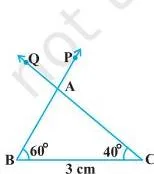
Fig. 6.23 is the activity that suggests this. Draw bases BC = 3 cm and EF = 5 cm; at both ends of each base construct angles 60° and 40°. The rays meet at A and D. Two angles match, so the third (80°) matches too, and measuring the sides shows \( \frac{AB}{DE} = \frac{BC}{EF} = \frac{CA}{FD} = \frac{3}{5} \). Equal angles produced proportional sides.
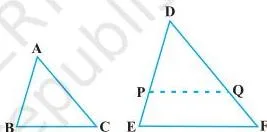
The proof in Fig. 6.24 places a copy of ABC inside DEF with DP = AB and DQ = AC; congruence plus BPT shows PQ is parallel to EF, and the side ratios follow. You should know why the criterion holds, even if you do not reproduce the full construction in an answer.
AA form (NCERT pp. 87–88): because a triangle’s angles sum to 180°, checking two pairs of equal angles is enough — the third pair follows. In practice AAA is almost always applied as AA: if two angles of one triangle equal two angles of the other, the triangles are similar.
SSS: Theorem 6.4
Theorem 6.4 (SSS criterion, NCERT p. 88): if the sides of one triangle are proportional to the sides of the other, then the corresponding angles are equal, and the triangles are similar.
Fig. 6.25 is the verifying activity: \( AB = 3, BC = 6, CA = 8 \) and \( DE = 4.5, EF = 9, FD = 12 \). Every ratio is \( \frac{2}{3} \), and measuring the angles confirms \( \angle A = \angle D \), \( \angle B = \angle E \), \( \angle C = \angle F \).
Worked example: check similarity by SSS with original numbers
Step 1: \( \triangle ABC \) has sides \( AB = 4 \), \( BC = 6 \), \( CA = 8 \); \( \triangle DEF \) has sides \( DE = 6 \), \( EF = 9 \), \( FD = 12 \).
Pair shortest with shortest, longest with longest.
\[ \frac{AB}{DE} = \frac{4}{6} = \frac{2}{3}, \quad \frac{BC}{EF} = \frac{6}{9} = \frac{2}{3}, \quad \frac{CA}{FD} = \frac{8}{12} = \frac{2}{3} \]
- Step 1: All three ratios equal \( \frac{2}{3} \), so by Theorem 6.4 the triangles are similar.
- Step 2: Write the correspondence: A with D, B with E, C with F.
Final answer: \( \triangle ABC \sim \triangle DEF \) by SSS, with scale factor \( 2:3 \).
Check your ordering: the smallest side of the first triangle must pair with the smallest of the second. That is how the correspondence A with D, B with E, C with F was found above.
SAS: Theorem 6.5
Theorem 6.5 (SAS criterion, NCERT p. 90): if one angle of a triangle equals one angle of another, and the sides including these angles are proportional, then the triangles are similar.
The single most common error here is the word including. The equal angle must lie between the two sides you compared — the same caution as SAS congruence. If the equal angle is not between the proportional sides, SAS similarity does not apply.
Example 4 shows a typical application (Fig. 6.29). With \( PQ \parallel RS \), alternate angles give \( \angle P = \angle S \) and \( \angle Q = \angle R \), and the angles at O are vertically opposite — equal. By AAA, \( \triangle POQ \sim \triangle SOR \).
Keep the remark from NCERT p. 89 in mind: because of Theorems 6.3 and 6.4, for triangles one condition implies the other. You never need to check all six pairs for a triangle — unlike the quadrilaterals in section 6.2.
Applying Similarity: Shadows, Trapeziums and Medians
Why learn this? The chapter’s introduction promised that similarity measures what a tape cannot — a mountain, the moon, a lamp-post. The worked examples turn that promise into arithmetic.
The lamp-post shadow problem (Example 7, NCERT pp. 92–93)
A girl 90 cm tall walks away from a 3.6 m lamp-post at 1.2 m/s; find her shadow 4 s later. The book’s steps:
- Distance walked in 4 s: \( 1.2 \times 4 = 4.8\ \text{m} \).
- Convert before comparing: \( 90\ \text{cm} = 0.9\ \text{m} \).
- The lamp-post and the girl are both vertical, so both right angles are equal; the light ray from the lamp to the shadow tip gives the common angle at E. Hence \( \triangle ABE \sim \triangle CDE \) by AA.
- \( \frac{BE}{DE} = \frac{AB}{CD} \), i.e. \( \frac{4.8 + x}{x} = \frac{3.6}{0.9} = 4 \).
- \( 4.8 + x = 4x \), so \( x = 1.6 \). The shadow is 1.6 m long.
Fig. 6.32 shows the geometry: BE is the full distance from the lamp base to the shadow tip, DE is the shadow itself, and the two similar right triangles share the angle at E.
Practice problem: a boy and a street lamp (original numbers)
Step 1: A 1.5 m boy walks away from a 6 m street lamp at 1 m/s.
Distance walked in 3 s: \( 1 \times 3 = 3\ \text{m} \).
Step 2: Let the shadow be \( x \) m.
Both figures are vertical, so the two right triangles are similar by AA.
\[ \frac{3 + x}{x} = \frac{6}{1.5} = 4 \]
Step 3: Solve: \( 3 + x = 4x \), so \( 3x = 3 \), giving \( x = 1 \).
Final answer: the shadow is \( 1\ \text{m} \) long after 3 seconds.
What to carry away from the trapezium and median problems
Two results from this chapter deserve a place in your memory:
- Trapezium diagonals (Exercise 6.2 Q9): in a trapezium with \( AB \parallel DC \), the diagonals meet at O and \( \frac{AO}{BO} = \frac{CO}{DO} \). The triangles AOB and COD are similar by AA — the vertically opposite angles at O and alternate angles made by the parallel sides.
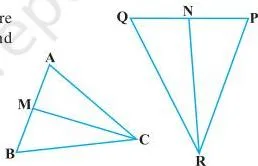
- Medians of similar triangles (Example 8, NCERT pp. 93–94): if \( \triangle ABC \sim \triangle PQR \), then the medians are in the same ratio as the sides: \( \frac{CM}{RN} = \frac{AB}{PQ} \). A median halves the opposite side, so the two small triangles formed (AMC and PNR) are similar by SAS, and their sides scale by the same factor.
Fig. 6.33 is the figure for Example 8 — medians CM and RN drawn to the bases AB and PQ of the similar triangles. Exercise 6.3 Q16 asks for the same result in the form \( \frac{AB}{PQ} = \frac{AD}{PM} \).
Key Definitions and Theorems: Quick Reference Table
This table is the chapter in shorthand — every definition and theorem you must know, with the page where the book states it. Use it to revise; read the proofs in the book.
| Term | Meaning | NCERT page |
|---|---|---|
| Similar figures | Same shape, not necessarily same size | p. 74 |
| Congruent figures | Same shape and same size; all congruent figures are similar | p. 72 |
| Similar polygons | Same number of sides; corresponding angles equal AND corresponding sides in the same ratio | p. 75 |
| Scale factor (Representative Fraction) | The common ratio of corresponding sides of two similar figures | p. 76 |
| Equiangular triangles | Triangles with corresponding angles equal | p. 79 |
| Theorem 6.1 (BPT) | A line parallel to one side of a triangle divides the other two sides in the same ratio | p. 80 |
| Theorem 6.2 (converse of BPT) | A line dividing two sides of a triangle in the same ratio is parallel to the third side | p. 82 |
| Theorem 6.3 (AAA) | Equal corresponding angles \( \Rightarrow \) sides proportional \( \Rightarrow \) similar | p. 87 |
| AA form | Two pairs of equal angles \( \Rightarrow \) similar; the third pair follows from the angle sum | pp. 87–88 |
| Theorem 6.4 (SSS) | Sides proportional \( \Rightarrow \) corresponding angles equal \( \Rightarrow \) similar | p. 88 |
| Theorem 6.5 (SAS) | One angle equal and the sides including it proportional \( \Rightarrow \) similar | p. 90 |
| RHS similarity | Right triangles: hypotenuse and one side proportional \( \Rightarrow \) similar | p. 98 |
Common Mistakes Students Make in This Chapter
The chapter itself warns about most of these — read them now, before making them.
| Mistake | Correct rule | How to check your answer |
|---|---|---|
| Using only “same shape” for a polygon and skipping one condition | For any polygon, similarity needs BOTH equal corresponding angles AND proportional corresponding sides — the square vs rectangle fails on sides, the square vs rhombus fails on angles | Test both conditions; only for triangles does one condition force the other |
| Writing the similarity in the wrong order, e.g. \( \triangle ABC \sim \triangle EDF \) | Write vertices in matching order: \( \triangle ABC \sim \triangle DEF \) means A pairs with D, B with E, C with F (NCERT p. 86) | Read the two names aloud; each paired vertex must be a pair of equal angles |
| Applying SAS similarity with a non-included angle | The equal angle must lie between the two proportional sides | Mark the angle; its two arms must be the two sides whose ratio you used |
| SSS: checking only two of the three side ratios | All three ratios must be equal | Write all three fractions in the same vertex order and compare |
| Confusing BPT with its converse | BPT: parallel given \( \Rightarrow \) ratio follows. Converse: ratio given \( \Rightarrow \) parallel follows | Ask what the question gives you — a parallel line or a ratio |
| Unit errors in shadow problems (90 cm vs 0.9 m) | Convert every length to the same unit before forming a ratio | Check that both heights and both shadow lengths are in the same unit |
How to Revise Triangles in One Night
Work in this fixed order — every step names a specific exercise, so you never wonder what to solve next.
- Learn the five theorems and RHS with their exact conditions from the table above.
- Do Exercise 6.1 Q1–Q3 — they fix the similar-versus-congruent idea in ten minutes.
- Master BPT with Exercise 6.2 Q1–Q2 (numbers), then Q7–Q8 (the mid-point results, proved with Theorems 6.1 and 6.2) and Q9–Q10 (trapezium and its converse).
- Practice identifying the criterion: Exercise 6.3 Q1 gives a set of triangles in Fig. 6.34 and asks you to name the criterion and write the symbolic form — this one question type tests the whole section.
- Finish with Exercise 6.3 Q15, the pole-and-tower shadow problem, which connects to the chapter’s opening promise of indirect measurement: a 6 m pole casts a 4 m shadow while a tower casts a 28 m shadow, so the tower is \( \frac{6}{4} \times 28 = 42\ \text{m} \) high.
As you work each question, write the full form: name the criterion, state the similarity with vertices in the correct order, then give the conclusion.
Also note: the chapter’s introduction says similarity gives a simple proof of Pythagoras Theorem learnt earlier. And textbook contents and the examinable syllabus are not always identical — check the current official syllabus.
Revision Summary: The Chapter in Nine Points
The chapter’s own summary, reworded for last-minute revision — nine points, plus the RHS bonus from the Note to the Reader.
- Similar figures have the same shape but not necessarily the same size.
- Every pair of congruent figures is similar, but similar figures need not be congruent.
- Two polygons with the same number of sides are similar exactly when their corresponding angles are equal and their corresponding sides are in the same ratio.
- BPT: a line parallel to one side of a triangle divides the other two sides in the same ratio.
- Converse of BPT: a line dividing two sides in the same ratio is parallel to the third side.
- AAA: equal corresponding angles force proportional sides, hence similar triangles.
- AA: two pairs of equal angles are enough, because the third pair follows from the \( 180^\circ \) angle sum.
- SSS: proportional sides force equal corresponding angles, hence similar triangles.
- SAS: one equal angle with the including sides proportional is enough.
Plus, from “A Note to the Reader” (NCERT p. 98): in two right triangles, if the hypotenuse and one side of one are proportional to the hypotenuse and one side of the other, the triangles are similar — the RHS similarity criterion.
Because of Theorems 6.3 and 6.4, in triangles one condition implies the other — you never check both, the way you must for quadrilaterals.
Related Resources for Class 10 Maths
This listing is maintained for the 2026-27 academic session using the NCERT textbook information available to us. NCERT remains the authority for confirming the latest edition.
Keep your revision in one place: the Class 10 Mathematics chapter notes work every exercise step by step, and the Class 10 study hub holds every subject. The CBSE revision notes index covers the other classes too.
The chapters around this one are Arithmetic Progressions and Coordinate Geometry, both with their own notes pages. For the official source, the NCERT Class 10 Mathematics textbook page on ncert.nic.in is where this chapter’s PDF is published.
Sources and data verification
This page follows the current NCERT Class 10 Mathematics textbook as published on ncert.nic.in. Chapter 6 (Triangles) spans NCERT pages 72–98 of that edition; the theorem statements, definitions and page numbers above come from that chapter.
NCERT settles the textbooks and their editions; the examinable syllabus is set by CBSE and can differ from the textbook contents, so check the official CBSE syllabus for your session. The worked examples on this page use original numbers.
| What the chapter holds | Count | Where it is used |
|---|---|---|
| Printed pages | 26 | |
| Sections in the chapter | 5 | |
| Figures with NCERT captions | 16 | |
| Exercise questions | 29 | answered in our NCERT Solutions |
| Official NCERT PDF | Download the chapter PDF | the chapter exactly as NCERT publishes it |
Frequently Asked Questions
Is AAA a similarity criterion and is it the same as AA?
Yes. AAA (Theorem 6.3) states that equal corresponding angles force proportional sides, so the triangles are similar.
In practice you use the AA form: because a triangle’s angles sum to \( 180^\circ \), checking two pairs of equal angles is enough — the third pair follows automatically. For triangles, AAA and AA are effectively the same statement (NCERT pp. 87–88).
What is the difference between similar and congruent triangles?
Congruent triangles have the same shape and the same size — all corresponding sides equal. Similar triangles have the same shape but sizes may differ — angles equal and sides in the same ratio.
Every pair of congruent triangles is similar with scale factor 1, but similar triangles are congruent only when that scale factor is 1.
When do I use SAS similarity instead of SAS congruence?
Use SAS congruence when two sides and the included angle of one triangle are equal to the corresponding parts of the other — the triangles are congruent.
Use SAS similarity when two sides of one triangle are proportional to two sides of the other and the included angle is equal — the triangles are similar. Check the two sides: equal means congruence; a common ratio means similarity.
How is the Basic Proportionality Theorem different from its converse?
BPT (Theorem 6.1) starts from a parallel line: if \( DE \parallel BC \), then \( \frac{AD}{DB} = \frac{AE}{EC} \). Its converse (Theorem 6.2) starts from the ratio: if \( \frac{AD}{DB} = \frac{AE}{EC} \), then \( DE \parallel BC \).
One goes parallel to ratio; the other goes ratio to parallel. The trap in questions is misreading which one is given.
What is the RHS similarity criterion?
In two right triangles, if the hypotenuse and one side of one triangle are proportional to the hypotenuse and one side of the other, the triangles are similar. The chapter states this in “A Note to the Reader” (NCERT p. 98).
It mirrors the RHS congruence you learnt in Class IX, with proportionality in place of equality.
Reference: NCERT Class 10 Mathematics textbook, Chapter 6, official edition on ncert.nic.in.
Explore Class 10 Mathematics Books
Related chapters: