
This page is the arithmetic progressions class 10 chapter itself — Chapter 5 of the NCERT Mathematics textbook for Class 10. The chapter runs 24 printed pages (pp. 48–72), from the first everyday pattern to the summary, and the official NCERT PDF is right below.
Download the Official Chapter 5 PDF
Arithmetic progressions class 10 NCERT chapter 5 PDF — the official file of this exact chapter, Sections 5.1 to 5.5 with all worked examples and exercises, exactly as printed in the NCERT Class 10 Mathematics book.
The file contains the numbered sections 5.1 to 5.5, the four exercises, and the book’s own marker that Exercise 5.4 is “not from the examination point of view” (p. 72). To confirm you have the current edition, check the NCERT textbook portal, where every official NCERT textbook is listed.
Chapter 5 at a Glance
Before you open the file, here is what is inside it — the chapter’s size and contents in one table. The four exercises (5.1 to 5.4) are also named in the section map below.
| What is counted | Number |
|---|---|
| Printed pages | 24 (pp. 48–72) |
| Numbered sections | 5 (5.1–5.5) |
| Exercises | 4 (5.1–5.4) |
| Figures | 6 |
| Exercise questions | 44 |
The book prints its own marker on the last exercise: “* These exercises are not from the examination point of view” (NCERT, p. 72). Read the notes below before you decide how to treat Exercise 5.4.
What This Chapter Covers, Section by Section
This map shows where each idea lives, so you can jump to the part you need. The chapter moves in four steps: spot the pattern, name its two numbers a and d, find any single term, then add any run of terms.
| Section | Printed pages | What it teaches |
|---|---|---|
| 5.1 Introduction | 49–51 | Six everyday patterns (salary, ladder rungs, savings scheme, unit squares, money box, rabbit pairs) and which of them grow by adding a fixed number. |
| 5.2 Arithmetic Progressions | 51–56 | The definition of an AP, the common difference d, the general form \(a, a+d, a+2d, \dots\), finite and infinite APs; Exercise 5.1 sits at pp. 55–56. |
| 5.3 nth Term of an AP | 56–63 | The formula \(a_n = a + (n-1)d\), built from the salary example; Examples 3–10; Exercise 5.2 sits at pp. 61–63. |
| 5.4 Sum of First n Terms | 63–71 | Gauss’s 1-to-100 trick; the two sum forms \(S = \frac{n}{2}[2a + (n-1)d]\) and \(S = \frac{n}{2}(a + l)\); Examples 11–16; Exercise 5.3 sits at pp. 68–71. |
| 5.5 Summary and A Note to the Reader | 72 | The five summary points of the chapter and the arithmetic-mean note. |
The Core Formulas: One Table for the Whole Chapter
The whole chapter runs on two facts — the nth term and the sum of n terms — joined by the common difference. This table puts every formula in one place, with its symbols and the situation it is built for.
| Formula | What each symbol means | When to use it |
|---|---|---|
| \(a, a+d, a+2d, a+3d, \dots\) | \(a\) = first term; \(d\) = common difference; this is the general form of an AP (NCERT, p. 52). | Writing out an AP once you know its two defining numbers. |
| \(d = a_{k+1} – a_k\) | \(d\) = common difference; \(a_{k+1}\) = the term after \(a_k\) (NCERT, p. 53). | Reading d off a given list: subtract the kth term from the one that follows it. |
| \(a_n = a + (n-1)d\) | \(a_n\) = the nth term (general term); \(n\) = position of the term (NCERT, p. 58). | Finding any single term without writing the whole list. |
| \(S = \frac{n}{2}[2a + (n-1)d]\) | \(S\) = sum of the first n terms (NCERT, p. 64). | Adding n terms when you know \(a\), \(d\) and \(n\). |
| \(S = \frac{n}{2}(a + l)\) | \(l\) = last term of the finite AP (NCERT, p. 64). | Adding all terms when you know the first and last terms only. |
| \(a_n = S_n – S_{n-1}\) | \(S_n\) = sum of first n terms; \(S_{n-1}\) = sum of first n−1 terms (NCERT, p. 65). | Recovering one term from two consecutive sums — the book’s own remark. |
| \(b = \frac{a+c}{2}\) | \(b\) = arithmetic mean of \(a\) and \(c\), when \(a, b, c\) are in AP (NCERT, p. 72). | Finding the middle number between two terms of an AP. |
In every formula, n counts the terms you are working with, so n is a positive integer; d may be positive, negative or zero (NCERT, p. 52).
Here is the two-equation method the chapter uses when it gives you two terms and asks for the AP itself (the book’s Examples 5 and 16 do this).
Question: The 5th term of an AP is 17 and the 9th term is 33.
Find the first term and the common difference.
Step 1: Write both facts with \(a_n = a + (n-1)d\): \(a_5 = a + 4d = 17\) and \(a_9 = a + 8d = 33\).
\[ a + 4d = 17 \quad (1), \qquad a + 8d = 33 \quad (2) \]
Step 2: Subtract (1) from (2) to eliminate a: \(4d = 16\), so \(d = 4\).
Then \(a + 16 = 17\), so \(a = 1\).
Step 3: Check by writing the AP: 1, 5, 9, 13, 17, 21, 25, 29, 33, … The 5th term is 17 and the 9th is 33.
✓ Final answer: \(a = 1\), \(d = 4\); the AP is \(1, 5, 9, 13, \dots\).
What Makes a List an AP: The Definition Through Six Examples
An arithmetic progression is a list in which each term after the first is made by adding the same fixed number to the previous term (NCERT, p. 51). That fixed number is the common difference d, and it may be positive, negative or zero (NCERT, p. 52).
To test any list, subtract each term from the one that follows it: the difference \(a_{k+1} – a_k\) must come out the same for every k (NCERT, p. 53). Checking one pair is never enough.
The six opening patterns of Section 5.1 (pp. 49–50) are the quickest way to fix this idea. Three are APs and three are not.
| Pattern | The list it makes | AP? | Why |
|---|---|---|---|
| Reena’s salary — ₹8000, then + ₹500 each year | \(8000, 8500, 9000, \dots\) | Yes | Each term adds 500; \(d = 500\). |
| Ladder rungs — 45 cm at the bottom, then −2 cm each rung | \(45, 43, 41, 39, 37, 35, 33, 31\) | Yes | Each term subtracts 2; \(d = -2\). |
| Savings scheme — value becomes \(\frac{5}{4}\) times itself every 3 years | \(10000, 12500, 15625, 19531.25\) | No | Each term is multiplied by \(\frac{5}{4}\), not added to a fixed number; the gaps 2500, 3125, 3906.25 keep growing. |
| Unit squares — squares of side 1, 2, 3, … | \(1, 4, 9, \dots\) (that is, \(1^2, 2^2, 3^2, \dots\)) | No | Square numbers; the gaps 3, 5, … grow, so no fixed difference exists. |
| Shakila’s money box — ₹100, then + ₹50 each birthday | \(100, 150, 200, 250, \dots\) | Yes | Each term adds 50; \(d = 50\). |
| Rabbit pairs — a new pair appears from the second month onward | \(1, 1, 2, 3, 5, 8\) | No | Each term is the sum of the two before it; the differences 0, 1, 1, 2 are not constant. |
The three figures below show the non-AP cases, so you can see why “grows by a fixed number” is different from “grows”.

Figure 5.1 shows the maturity amounts racing away from each other: 10000 → 12500 → 15625 → 19531.25. The gaps are 2500, then 3125, then 3906.25 — they grow because each step multiplies by \(\frac{5}{4}\). An AP needs gaps that stay the same, so this pattern is not an AP.
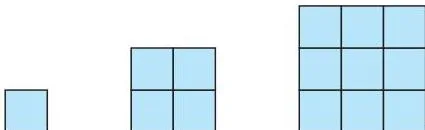
Figure 5.2 draws squares of side 1, 2 and 3 units. They hold 1, 4 and 9 unit squares — the square numbers. Between them the gaps are 3 and then 5, so the list 1, 4, 9, … is not an AP.
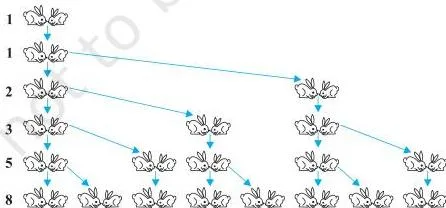
Figure 5.3 counts rabbit pairs month by month: 1, 1, 2, 3, 5, 8. Each new number is the sum of the two before it, so the differences (0, 1, 1, 2) never settle. This Fibonacci-style list is not an AP.
Here is the membership test the chapter teaches (its Example 6, p. 60), tried on fresh numbers.
Question: Is 150 a term of the AP 3, 10, 17, 24, …?
Is 155?
- Step 1: Read the two numbers of the AP: \(a = 3\), \(d = 10 – 3 = 7\).
- Step 2: Assume the number is the nth term and substitute: \(150 = 3 + (n-1) \times 7\).
\[ 150 = 3 + 7(n-1) \Rightarrow 147 = 7(n-1) \Rightarrow n-1 = 21 \Rightarrow n = 22 \]
Step 3: n = 22 is a positive integer, so 150 is the 22nd term.
Repeat for 155: \(155 = 3 + 7(n-1) \Rightarrow 152 = 7(n-1) \Rightarrow n-1 = \frac{152}{7}\), which is not an integer.
Final answer: 150 is the 22nd term of the AP; 155 is not a term, because solving for n gives a value that is not a positive integer.
A finite AP has a last term; an infinite AP goes on forever and has none (NCERT, p. 52). The opening lists like 1, 2, 3, 4, … and 100, 70, 40, 10, … are infinite APs; the ladder rungs 45, 43, …, 31 form a finite one.
Reading the Chapter Figures: Money Box, Logs and the Potato Race
Three diagrams carry the working of the chapter: the money box drawing that opens the sum section, and the two figures behind the stacked-logs and potato-race questions. In each, the picture is a word problem wearing a drawing — read the numbers off it and the AP appears.

The figure reopens Shakila’s money box from Section 5.1: ₹100 on the first birthday, ₹150 on the second, ₹200 on the third, and so on. The chapter’s question is a total: how much money sits in the box by the 21st birthday?
Writing out and adding 21 numbers is tedious, so the book turns to a trick Gauss used at age ten for adding 1 to 100. He wrote the sum forward, then backward, and added column-wise (NCERT, p. 63):
\[ S = 1 + 2 + 3 + \dots + 100, \qquad S = 100 + 99 + 98 + \dots + 1 \]
\[ 2S = (1+100) + (2+99) + \dots + (100+1) = 101 \times 100 = 10100 \]
\[ S = \frac{100 \times 101}{2} = 5050 \]
Each column adds to 101, there are 100 columns, and dividing by 2 removes the double counting. The same trick applied to the general AP gives the sum formula \(S = \frac{n}{2}[2a + (n-1)d]\) (NCERT, p. 64).
The money box question then applies it with a = 100, d = 50, n = 21 and lands on ₹12,600 (NCERT, p. 65).
One warning the book prints after its own Example 13 (NCERT, p. 66): a sum question can have two answers. Here is the same effect with fresh numbers.
Question: How many terms of the AP 15, 13, 11, … give the sum 48?
Step 1: Here \(a = 15\), \(d = 13 – 15 = -2\).
Substitute into the sum formula:
\[ 48 = \frac{n}{2}\left[2(15) + (n-1)(-2)\right] = \frac{n}{2}(32 – 2n) = n(16 – n) \]
- Step 1: Rearrange: \(n^2 – 16n + 48 = 0\), so \((n-4)(n-12) = 0\), giving \(n = 4\) or \(n = 12\).
- Step 2: Why two answers?
The first 4 terms, 15 + 13 + 11 + 9, total 48.
Terms 5 to 12 are 7, 5, 3, 1, −1, −3, −5, −7; each positive term is matched by a negative one, so they cancel and add zero — the first 12 terms also total 48.
Final answer: n = 4 or n = 12. The middle terms cancel, exactly as the book explains for its own example (NCERT, p. 66).

The picture shows 200 logs stacked in rows: 20 in the bottom row, 19 in the next, 18 in the next, and so on. The row counts 20, 19, 18, … form an AP with a = 20 and d = −1.
The question is a sum problem, not a term problem: find how many rows hold all 200 logs (set \(S_n = 200\)), then find the count in the top row once n is known. This is Exercise 5.3, Question 19 (NCERT, p. 70).

The diagram shows the bucket at the starting point, with ten potatoes in a line: the first 5 m away and each next potato 3 m further. A competitor runs out and back for every potato.
The first potato costs \(2 \times 5 = 10\) m, the second \(2 \times (5+3) = 16\) m, the third \(2 \times (5+6) = 22\) m. The runs 10, 16, 22, … are an AP with a = 10 and d = 6.
So the total distance is the sum of the first 10 terms of this AP — that is Exercise 5.3, Question 20 (NCERT, p. 70).
Key Terms, Defined in Plain Words
Fix the vocabulary first; the formulas then read like sentences. Here is every term the chapter uses, in plain words.
- Term — each number in the list (NCERT, p. 51).
- Arithmetic progression (AP) — a list in which each term after the first is made by adding a fixed number to the term before it (NCERT, p. 51).
- Common difference (d) — that fixed number; it can be positive, negative or zero (NCERT, p. 52).
- General form — \(a, a + d, a + 2d, a + 3d, \dots\) (NCERT, p. 52).
- Finite / infinite AP — a finite AP has a last term; an infinite AP has none (NCERT, p. 52).
- General term (a_n) — the nth term of the AP, given by \(a_n = a + (n-1)d\) (NCERT, p. 58).
- Last term (l) — the final term of a finite AP, \(l = a + (n-1)d\) (NCERT, p. 58).
- Sum (S_n) — the sum of the first n terms of the AP (NCERT, p. 65).
- Arithmetic mean — when a, b, c are in AP, \(b = \frac{a+c}{2}\), and b is the arithmetic mean of a and c (NCERT, p. 72).
Common Mistakes, and the Warnings NCERT Prints
Each of these errors is named in the book itself, so read the warnings before you make the mistake. The table pairs the common error with the correct rule and a way to check your work.
| Mistake | Correct rule | How to check your answer |
|---|---|---|
| Finding d backwards in a decreasing AP — for 6, 3, 0, −3, … writing d = 6 − 3 = 3. | Always subtract the kth term from the (k+1)th: d = 3 − 6 = −3 (NCERT, p. 54). | Ask: does each next term equal (previous + d)? From 6, adding −3 gives 3, then 0, then −3. ✓ |
| Calling a list an AP after checking only the first two differences — −2, 2, −2, 2, … looks like d = 4. | The difference must be the same for every consecutive pair; the third pair fails: \(a_3 – a_2 = -2 – 2 = -4 \neq 4\) (NCERT, p. 55). | Test at least three consecutive pairs before deciding (Example 2 checks three). |
| Forgetting that n must be a positive integer — asking whether 301 is a term of 5, 11, 17, 23, … gives \(n = \frac{151}{3}\). | A number is a term only if solving \(a_n = \text{number}\) produces a positive integer n (NCERT, p. 60, Example 6). | After solving, ask: is n a whole number? If n is a fraction, the number is not in the list. |
| Miscounting from the last term — calling the 11th term from the last of a 25-term AP the 14th term. | The 11th from the last of n terms is the (n − 11 + 1)th, i.e. the 15th (NCERT, p. 60, Example 8). | Count backwards including the last term itself: 25th, 24th, …, 15th is the 11th from the end. |
| Missing the second solution in a sum problem — 24, 21, 18, … totals 78 only at n = 4. | The sum formula is quadratic in n, so two values of n can give the same sum: n = 4 and n = 13 here, because terms 5 to 13 cancel to zero (NCERT, p. 66). | Factor the quadratic completely; accept every positive integer root, then re-add the cancelling block to verify. |
| Using a single term a_n where a total S_n is wanted — the logs and potato-race questions ask for totals. | Word problems with “total”, “sum”, “how many in all” need S_n, not a_n (Exercise 5.3, pp. 68–71). | Underline the question word: “which row?” asks for a term; “how many altogether?” asks for a sum. |
The chapter’s own Summary (NCERT, p. 72) is the fastest self-check: if you can state all five points, you have the chapter.
How the Four Exercises Test Each Idea
The exercises move in one direction: recognise an AP, then find single terms, then add terms, then — optionally — harder sums. Practise by skill rather than by page number.
| Exercise | Printed pages | What it trains | What a full answer includes |
|---|---|---|---|
| 5.1 | 55–56 | Recognising APs in word situations (taxi fare, vacuum pump, well digging, compound interest) and writing terms from a and d. | For each situation, state the list, then show one constant difference; for compound interest, point out the multiplier, so it is not an AP. Every answer needs the reason. |
| 5.2 | 61–63 | The nth term: the a–d–n–a_n table (Q1), membership checks (Q4, Q6), building an AP from two conditions (Q7–Q9), counting problems (Q13, Q14), word problems (Q19, Q20). | Q2 is the chapter’s MCQ in two parts — give the computed term AND the simplifying line. For counting problems, name the AP, then use \(a_n = a + (n-1)d\) and solve for n. |
| 5.3 | 68–71 | Sums: direct sums (Q1–Q2), sums with one unknown (Q3–Q11), sums of multiples and odds (Q12–Q14), applications (Q15–Q20: penalty, prizes, trees, spiral, logs, potato race). | Choose the right S formula first — \(a + l\) when the last term is given, else \(2a + (n-1)d\). State a, d, n before substituting, and end with the unit (₹, m, logs, trees). |
| 5.4 | 71–72 | Optional. Harder problems (first negative term, ladder rungs, houses numbered 1–49, concrete terrace), each with a hint. | The book prints its own marker: “* These exercises are not from the examination point of view” (NCERT, p. 72). |
One note worth keeping in mind: textbook contents and the examinable syllabus are not always identical. Check the current official CBSE syllabus before deciding what to skip, and treat “optional” as the book’s own judgment, not a promise about any exam.
Quick Revision: The Five Points NCERT Summarises
Cover the right-hand column, say each point to yourself, then check. These are the chapter’s own five summary points (NCERT, p. 72) in fresh words.
| You should know | In symbols |
|---|---|
| An AP is a list built by adding one fixed number d to each term to get the next; the general form starts with a and keeps adding d. | \(a, a+d, a+2d, a+3d, \dots\) |
| A list of numbers is an AP exactly when every term minus the one before it gives the same number. | \(a_{k+1} – a_k = d\) for every k |
| The nth term, or general term, of an AP with first term a and common difference d. | \(a_n = a + (n-1)d\) |
| The sum of the first n terms of the AP. | \(S = \frac{n}{2}[2a + (n-1)d]\) |
| When the last term l is known, the same sum is written with a and l only. | \(S = \frac{n}{2}(a + l)\) |
The book closes with a note to the reader: if a, b, c are in AP, then \(b = \frac{a+c}{2}\), and b is the arithmetic mean of a and c (NCERT, p. 72).
Related Chapters and Resources
This listing is maintained for the 2026-27 academic session using the NCERT textbook information available to us. NCERT remains the authority for confirming the latest edition.
The Class 10 Mathematics chapter notes gather this book’s chapters in one place. The previous chapter, Quadratic Equations, is the kind of equation the sum formula produces when two values of n give the same sum; the next chapter is Triangles.
The Class 10 study hub links every subject on one page, and the CBSE notes home page is the starting point for other classes. The official NCERT textbook portal lists the current edition of this book.
Sources and Data Verification
- The figures and page references on this page describe the NCERT Mathematics textbook for Class 10, Chapter 5 (Arithmetic Progressions), official edition on ncert.nic.in.
- This page covers Chapter 5 of that book only; it does not cover other chapters or other subjects.
- The listing is maintained for the current academic session using the NCERT information available to us. Textbook contents and the examinable syllabus are not always identical — check the current official CBSE syllabus.
- NCERT settles textbook editions and PDFs; CBSE settles curriculum, syllabus and examinations.
| What the chapter holds | Count | Where it is used |
|---|---|---|
| Printed pages | 24 | |
| Sections in the chapter | 5 | |
| Figures with NCERT captions | 6 | |
| Tables | 1 | |
| Worked examples | 2 | solved step by step in our NCERT Solutions |
| Exercise questions | 44 | answered in our NCERT Solutions |
| Official NCERT PDF | Download the chapter PDF | the chapter exactly as NCERT publishes it |
Chapter-wise notes for this subject are not published yet. The unit-wise syllabus on this page is complete and verified against the official CBSE curriculum document.
Frequently Asked Questions
Which of the six opening patterns in Section 5.1 are arithmetic progressions and which are not?
Three of the six are APs, and three are not (NCERT, pp. 49–50).
- AP: salary 8000, 8500, 9000, … — adds 500 each year (\(d = 500\)).
- AP: ladder rungs 45, 43, 41, … — subtracts 2 each rung (\(d = -2\)).
- AP: money box 100, 150, 200, 250, … — adds 50 each birthday (\(d = 50\)).
- Not AP: savings scheme 10000, 12500, 15625, 19531.25 — multiplies by \(\frac{5}{4}\), so the gaps widen.
- Not AP: unit squares 1, 4, 9, … — square numbers, gaps 3, 5, … grow.
- Not AP: rabbit pairs 1, 1, 2, 3, 5, 8 — each term is the sum of the two before it.
The test is always the same: subtract each term from the next and check the difference never changes.
How do I check whether a given number is a term of an AP?
Put the number into \(a_n = a + (n-1)d\) and solve for n (NCERT, p. 58). If n is a positive integer, the number is the nth term; if n comes out a fraction or a negative number, the number is not in the list.
The book checks 301 against 5, 11, 17, 23, … and gets \(n = \frac{151}{3}\), so 301 is not a term (NCERT, p. 60).
When should I use S = n/2(a + l) instead of S = n/2[2a + (n-1)d]?
Use \(S = \frac{n}{2}(a+l)\) when you know the first and last terms and do not have, or need, the common difference (NCERT, p. 64). The book uses it for \(1 + 2 + 3 + \dots + 1000\), where a = 1 and l = 1000.
Use \(S = \frac{n}{2}[2a + (n-1)d]\) when you know a, d and n. Both give the same sum — the second is the first with \(l = a + (n-1)d\) written out.
Why can the sum of an AP be the same for two different values of n?
Because \(S_n\) is a quadratic expression in n, the equation “sum = a number” can have two positive integer solutions (NCERT, p. 66, Example 13).
When a is positive and d is negative, the later terms turn negative and cancel the positive ones: in 24, 21, 18, …, the terms from the 5th to the 13th add to zero, so the sum is 78 at both n = 4 and n = 13.
Is Exercise 5.4 important for the exam?
The book prints its own marker at the foot of the exercise: “* These exercises are not from the examination point of view” (NCERT, p. 72). The exercise is labelled optional, but textbook contents and the examinable syllabus are not always identical — the current official CBSE syllabus is the final word, and no one can guarantee which questions will appear.
What is the arithmetic mean, and how is it connected to APs?
If a, b, c are in AP, then \(b = \frac{a+c}{2}\), and b is called the arithmetic mean of a and c (NCERT, p. 72). So the middle number of any three consecutive terms of an AP is the average of the two around it — “mean” and “middle term” are the same idea here.
Reference: NCERT Class 10 Mathematics textbook, chapter 5, official edition on ncert.nic.in.
Explore Class 10 Mathematics Books
Related chapters: