
Looking for real numbers class 10 material? This page carries the NCERT Class 10 Mathematics Chapter 1 — Real Numbers, a nine-page chapter — and the official chapter PDF is linked right below.
The rest of the page explains what the chapter teaches: the Fundamental Theorem of Arithmetic, HCF and LCM by prime factorisation, and the proof that \( \sqrt{2} \) is irrational.
Download the NCERT Class 10 Maths Chapter 1 PDF
Open the NCERT Class 10 Maths Chapter 1 Real Numbers PDF — the official chapter file from ncert.nic.in, in English, exactly as printed in the NCERT Mathematics textbook for Class X. It is NCERT’s own publication, so the page numbers and exercise numbers quoted on this page match the file.
Keep the PDF open beside the explanation below and follow along section by section.
Chapter 1 at a Glance: Sections, Figures and Exercises
The table below lists how much the chapter holds — its numbered sections, figures, worked examples and exercise questions — counted from the printed NCERT book.
In the book itself the chapter runs from page 1 to page 9 and ends with the Summary and a note to the reader.
How the Chapter Is Organised: From Unique Factorisation to Irrationality Proofs
This roadmap shows what each part of the chapter does and why it leads to the next. If you feel lost, find your section in the list and see what it is supposed to achieve.
- 1.1 Introduction (p. 1) — mentions the two classical tools behind the chapter, Euclid’s division algorithm and the Fundamental Theorem of Arithmetic, and previews two applications: proving numbers irrational and reading off decimal behaviour from the denominator of a rational \( \frac{p}{q} \).
- 1.2 The Fundamental Theorem of Arithmetic (pp. 2–5) — states the theorem, factorises 32760 with a factor tree, and turns the theorem into working rules for HCF and LCM. Exercise 1.1 follows on pages 5–6.
- 1.3 Revisiting Irrational Numbers (pp. 6–9) — proves \( \sqrt{2} \) and \( \sqrt{3} \) irrational, then extends the result to expressions like \( 5 – \sqrt{3} \) and \( 3\sqrt{2} \). Exercise 1.2 follows on page 9.
- 1.4 Summary (p. 9) — the chapter’s takeaway points, followed by a note to the reader on the three-number HCF–LCM formulas.
This edition contains no separate section teaching terminating and non-terminating decimal expansions. The introduction previews the idea, and the two body sections develop factorisation and irrationality — the decimal application is not built out here.
Key Concepts: The Fundamental Theorem of Arithmetic, HCF-LCM and the Proof That √2 Is Irrational
These are the ideas that do all the work in the chapter. Once you see why prime factorisation is unique, HCF, LCM and the irrationality proofs all follow from it.
What the Fundamental Theorem Says
The theorem is the chapter’s core claim: primes are the fixed building blocks of every composite number, and no number can be assembled from them in two different ways. NCERT states it as Theorem 1.1 on page 3:
Every composite number can be expressed as a product of primes, and this factorisation is unique, apart from the order in which the prime factors occur.
The book also states the idea in a form used throughout: the prime factorisation of a natural number is unique, except for the order of its factors (p. 4). To make “unique” visible, it adopts a convention — write the primes in ascending order, \( p_1 \le p_2 \le \dots \le p_n \).
Once the order is fixed, the factorisation is one and only one. For 32760:
\[ 32760 = 2 \times 2 \times 2 \times 3 \times 3 \times 5 \times 7 \times 13 = 2^3 \times 3^2 \times 5 \times 7 \times 13 \]
Why uniqueness matters: it turns a question about a number into a question about its primes. Example 1 (p. 4) asks whether \( 4^n \) can ever end with the digit 0. If it could, it would be divisible by 5, so 5 would have to appear in its prime factorisation. But \( 4^n = (2^2)^n = 2^{2n} \) has only the prime 2, and uniqueness leaves no room for a 5.
HCF and LCM by Prime Factorisation
The theorem gives a mechanical route to HCF and LCM: factorise the numbers, then pick powers by two rules (p. 4).
- HCF = product of the smallest power of each common prime factor.
- LCM = product of the greatest power of each prime factor involved in the numbers.
For 6 and 20: \( 6 = 2^1 \times 3^1 \) and \( 20 = 2^2 \times 5 \), so \( \text{HCF}(6,20) = 2 \) and \( \text{LCM}(6,20) = 2^2 \times 3 \times 5 = 60 \) (p. 4).
Why the rules work: a common divisor can only use primes that appear in every number, and only up to the smallest exponent. A common multiple must carry every prime that appears anywhere, up to the largest exponent.
For any two positive integers \( a \) and \( b \), the book records this identity (pp. 4–5):
\[ \text{HCF}(a,b) \times \text{LCM}(a,b) = a \times b \]
The identity holds because, for each prime, the HCF takes the smaller exponent and the LCM the larger, and together they add up to the exponent in the product \( a \times b \).
That gives the shortcut used in Example 3 (p. 5):
\[ \text{LCM}(a,b) = \frac{a \times b}{\text{HCF}(a,b)} \]
For 96 and 404: \( 96 = 2^5 \times 3 \), \( 404 = 2^2 \times 101 \), so \( \text{HCF} = 4 \) and \[ \text{LCM}(96,404) = \frac{96 \times 404}{4} = 9696 \]
The Three-Number Case and the Page 9 Formulas
Here is the chapter’s quiet trap. Move from two numbers to three and the identity breaks — the book warns about it in a remark after Example 4 (p. 5).
For 6, 72 and 120: \( \text{HCF}(6,72,120) \times \text{LCM}(6,72,120) \neq 6 \times 72 \times 120 \). With three numbers each prime has three exponents, and the minimum plus the maximum no longer adds up to the total.
The note to the reader on page 9 supplies the two formulas that do work for three positive integers \( p, q, r \):
\[ \text{LCM}(p,q,r) = \frac{p \cdot q \cdot r \cdot \text{HCF}(p,q,r)}{\text{HCF}(p,q) \cdot \text{HCF}(q,r) \cdot \text{HCF}(p,r)} \]
\[ \text{HCF}(p,q,r) = \frac{p \cdot q \cdot r \cdot \text{LCM}(p,q,r)}{\text{LCM}(p,q) \cdot \text{LCM}(q,r) \cdot \text{LCM}(p,r)} \]
Both formulas need the pairwise values first: compute the three pair-HCFs or pair-LCMs, then substitute.
| Case | What actually holds | Where the book says so |
|---|---|---|
| Two numbers \( a, b \) | \( \text{HCF}(a,b) \times \text{LCM}(a,b) = a \times b \), so \( \text{LCM} = \frac{a \times b}{\text{HCF}(a,b)} \) | pp. 4–5, Example 3 |
| Three numbers \( p, q, r \) | \( \text{HCF}(p,q,r) \times \text{LCM}(p,q,r) \neq p \times q \times r \) — use the two formulas above, from p. 9 | remark after Example 4, p. 5; note, p. 9 |
Theorem 1.2 and the Irrationality Proof Pattern
To prove \( \sqrt{2} \) irrational, the chapter needs one bridge: a prime that divides \( a^2 \) must also divide \( a \). That is Theorem 1.2 (p. 6):
Theorem 1.2: Let \( p \) be a prime number. If \( p \) divides \( a^2 \), then \( p \) divides \( a \), where \( a \) is a positive integer.
Why it is true: write \( a = p_1 p_2 \dots p_n \). Squaring doubles every prime, so \( a^2 \) has exactly the same primes as \( a \). If \( p \) divides \( a^2 \), uniqueness forces \( p \) to be one of them — so \( p \) divides \( a \) (p. 6).
The proof of Theorem 1.2 carries an asterisk in the book: “Not from the examination point of view.” The statement itself, however, is the engine of every irrationality proof in the chapter — know it and know when to use it.
Now the contradiction pattern, for \( \sqrt{2} \) (Theorem 1.3, pp. 6–7):
Step 1: Assume the opposite — that \( \sqrt{2} \) is rational.
Then \( \sqrt{2} = \frac{r}{s} \) for integers \( r, s \) with \( s \neq 0 \).
Step 2: Divide out any common factor so that \( \sqrt{2} = \frac{a}{b} \) with \( a, b \) coprime.
This step is essential: the contradiction at the end is precisely that \( a \) and \( b \) must share a factor.
Step 3: Square both sides: \( 2b^2 = a^2 \).
So 2 divides \( a^2 \); by Theorem 1.2, 2 divides \( a \).
Write \( a = 2c \).
Step 4: Substitute: \( 2b^2 = (2c)^2 = 4c^2 \), so \( b^2 = 2c^2 \).
Hence 2 divides \( b^2 \); again by Theorem 1.2, 2 divides \( b \).
Step 5: Now both \( a \) and \( b \) are divisible by 2, contradicting that they are coprime.
The assumption must be wrong.
Conclusion: \( \sqrt{2} \) is irrational.
The same proof with 3 in place of 2 shows \( \sqrt{3} \) irrational (Example 5, p. 7).
Sum, Difference, Product and Quotient Rules
Once \( \sqrt{2} \) and \( \sqrt{3} \) are known to be irrational, the chapter extends the result in bulk. It restates these Class IX facts on page 8:
| Operation | Result | Example |
|---|---|---|
| rational + irrational | irrational | \( 6 + \sqrt{2} \) (Exercise 1.2) |
| rational − irrational | irrational | \( 5 – \sqrt{3} \) (Example 6, p. 8) |
| non-zero rational × irrational | irrational | \( 3\sqrt{2} \) (Example 7, p. 9) |
| non-zero rational ÷ irrational | irrational | \( \frac{1}{\sqrt{2}} \) (Exercise 1.2) |
The proof follows one script (Example 6, p. 8): assume the combination is rational, rearrange to isolate the irrational part, and you land on “this irrational is rational” — a contradiction.
For instance, if \( 5 – \sqrt{3} = \frac{a}{b} \), then \( \sqrt{3} = 5 – \frac{a}{b} \), a rational number, contradicting Example 5.
Figures in the Chapter: The 32760 Factor Tree and the Portrait of Gauss
The figures in this chapter each carry real content: the factor tree demonstrates the theorem, and the portrait honours the mathematician who proved it.
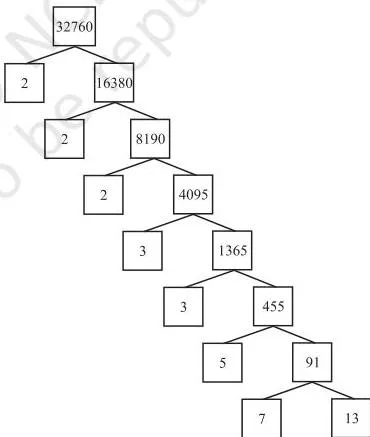
Read the tree from the top down: 32760 splits into two factors; each factor splits again; the splitting stops only when a branch reaches a single prime. Collecting the leaves gives \( 2 \times 2 \times 2 \times 3 \times 3 \times 5 \times 7 \times 13 \), written compactly as \( 2^3 \times 3^2 \times 5 \times 7 \times 13 \).
The deeper point: your tree may split differently, but the leaves are always these primes — any valid splitting of 32760 ends at the same factorisation. The same primes drive the HCF and LCM rules later in the chapter; the theorem is at work here before it is even stated.
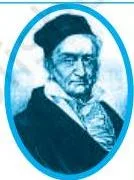
Why a portrait inside a number theory chapter? Because the theorem has a history: the statement was probably recorded as Proposition 14 of Book IX of Euclid’s Elements, but the first correct proof came from Gauss in his Disquisitiones Arithmeticae (p. 3).
The portrait fixes the right mental picture: factorising a number is routine, but proving the factorisation unique was a genuine mathematical achievement.
Definitions to Hold Onto: Prime, Composite, HCF, LCM, Coprime and Irrational
A quick lookup of the words the chapter uses constantly. Each entry gives the plain meaning and a page where the book relies on it.
- Prime number — a natural number greater than 1 whose only factors are 1 and itself: 2, 3, 5, 7, 11, 13 … . Primes are the building blocks of the chapter (p. 2).
- Composite number — a natural number greater than 1 that has factors besides 1 and itself, so it can be written as a product of primes: 4, 6, 9, 32760 … (pp. 2–3).
- HCF (highest common factor) — the largest number that divides every number in the list; the product of the smallest power of each common prime factor (p. 4).
- LCM (lowest common multiple) — the smallest number that every number in the list divides; the product of the greatest power of each prime factor involved (p. 4).
- Coprime numbers — two integers whose only common factor is 1. The irrationality proofs reduce \( \frac{r}{s} \) to \( \frac{a}{b} \) with \( a, b \) coprime before building the contradiction (p. 7).
- Irrational number — a number that cannot be written as \( \frac{p}{q} \) with integers \( p, q \) and \( q \neq 0 \). The book’s examples: \( \sqrt{2}, \sqrt{3}, \sqrt{15}, \pi, -\frac{\sqrt{2}}{\sqrt{3}}, 0.10110111011110 \dots \) (p. 6).
Three Worked Examples with Fresh Numbers
These apply the book’s methods to new numbers, so you can test yourself instead of re-reading the solved examples.
Example A: HCF and LCM of 84 and 90, with the identity check
Step 1: Prime factorise both numbers.
\[ 84 = 2^2 \times 3 \times 7, \qquad 90 = 2 \times 3^2 \times 5 \]
Step 2: HCF = product of the smallest power of each common prime.
The common primes are 2 and 3, with smallest powers \( 2^1 \) and \( 3^1 \):
\[ \text{HCF}(84,90) = 2^1 \times 3^1 = 6 \]
Step 3: LCM = product of the greatest power of each prime involved.
Primes 2, 3, 5, 7 appear; the greatest powers are \( 2^2, 3^2, 5^1, 7^1 \):
\[ \text{LCM}(84,90) = 2^2 \times 3^2 \times 5 \times 7 = 4 \times 9 \times 5 \times 7 = 1260 \]
Step 4: Verify the identity \( \text{HCF} \times \text{LCM} = a \times b \).
\[ 6 \times 1260 = 7560 \qquad \text{and} \qquad 84 \times 90 = 7560 \]
Final answer: \( \text{HCF} = 6 \), \( \text{LCM} = 1260 \), and the identity \( \text{HCF} \times \text{LCM} = 84 \times 90 \) is verified.
Example B: Show that 7√3 is irrational
Step 1: Suppose the contrary — that \( 7\sqrt{3} \) is rational.
Then \( 7\sqrt{3} = \frac{a}{b} \) with \( a, b \) coprime integers, \( b \neq 0 \).
Step 2: Rearrange to isolate \( \sqrt{3} \):
\[ \sqrt{3} = \frac{a}{7b} \]
Step 3: Since \( a, b, 7 \) are integers and \( b \neq 0 \), \( \frac{a}{7b} \) is rational.
So the equation says \( \sqrt{3} \) is rational.
Step 4: But Example 5 of the book proves \( \sqrt{3} \) irrational (p. 7).
Contradiction.
Conclusion: \( 7\sqrt{3} \) is irrational — the same script as Example 7, which proves \( 3\sqrt{2} \) irrational (p. 9).
Example C: Can 12^n end with the digit 0?
Step 1: Factorise the base:
\[ 12 = 2^2 \times 3 \quad \Rightarrow \quad 12^n = (2^2 \times 3)^n = 2^{2n} \times 3^n \]
- Step 1: A number ending in 0 is divisible by 10, hence by 5, so 5 must appear in its prime factorisation.
- Step 2: The factorisation of \( 12^n \) contains only primes 2 and 3 — no 5.
By the uniqueness of prime factorisation (p. 4), it can never gain a 5.
Conclusion: No natural number \( n \) makes \( 12^n \) end with the digit 0. This is the reasoning of Example 1 (\( 4^n \), p. 4) and Exercise 1.1 Q5 (\( 6^n \), pp. 5–6) with a different base.
Common Mistakes in This Chapter and How to Fix Them
The book itself flags the first trap, in the remark after Example 4 (p. 5) and again in the note to the reader (p. 9). Here are the mistakes with their fixes.
| Mistake | Correct rule | How to check your answer |
|---|---|---|
| Applying \( \text{HCF} \times \text{LCM} = a \times b \) to three numbers | The identity holds for exactly two numbers. For three numbers use the page-9 formulas, which need the pairwise HCFs or LCMs first. | Test 6, 72, 120 (p. 5): \( 6 \times 72 \times 120 = 51840 \), but \( \text{HCF} \times \text{LCM} = 6 \times 360 = 2160 \). Not equal — the book says this is expected. |
| Squaring before reducing the fraction to coprime form | Cancel the common factor first so \( \sqrt{2} = \frac{a}{b} \) with \( a, b \) coprime; only then square both sides. | If your proof ends with “\( a \) and \( b \) share a factor”, you must have declared them coprime at the start (p. 7). |
| Checking only divisibility by 2 in “ends with digit 0” questions | Ending in 0 means divisible by 10, hence by 5 — so the prime factorisation must contain 5. | \( 4^n, 6^n, 12^n \) contain only primes 2 and 3; with no 5, none can end in 0 (pp. 4–6). |
| Reading “unique apart from the order” as if order matters | Order is irrelevant; writing primes in ascending order is only a convention that exposes the one factorisation. | \( 2 \times 3 \times 5 \times 7 \) and \( 3 \times 5 \times 7 \times 2 \) are the same factorisation (p. 4). |
| Learning only the three summary points, skipping the note to the reader | The note on page 9 carries the three-number correction the chapter ends on. | Whenever a question involves HCF or LCM of three numbers, reach for the page-9 formulas, not the two-number identity. |
Exam Notes: What the Textbook Itself Flags
These points come from the book’s own markers and its exercise design — not from guesses about question papers.
- The asterisk under Theorem 1.2 (p. 6). The proof is marked “Not from the examination point of view”. The statement — if a prime \( p \) divides \( a^2 \), then \( p \) divides \( a \) — is still the tool behind every irrationality proof, so know it and how to apply it.
- Exercise 1.1 (pp. 5–6). Q1 is direct prime factorisation. Q2–Q4 run on the HCF–LCM identity and its shortcut: Q2 verifies \( \text{LCM} \times \text{HCF} = \) product; Q4 gives \( \text{HCF}(306,657)=9 \) and asks for the LCM, so \( \text{LCM} = \frac{306 \times 657}{9} = 22338 \). Q5–Q6 are reasoning questions built on uniqueness; Q7 is a real-life LCM problem — the meeting time is \( \text{LCM}(18,12) = 36 \) minutes.
- Exercise 1.2 (p. 9). Entirely proof-based: \( \sqrt{5} \), \( 3 + 2\sqrt{5} \), \( \frac{1}{\sqrt{2}} \), \( 7\sqrt{5} \), \( 6 + \sqrt{2} \). A complete answer states the contrary assumption, reduces to coprime \( a, b \), applies Theorem 1.2, reaches the contradiction, and states the conclusion.
- Textbook contents and the examinable syllabus are not always identical — check the current official syllabus.
Chapter 1 Summary, Made Plain for Quick Revision
This is the chapter’s own Summary (p. 9) rebuilt in plainer words for last-minute revision:
- The Fundamental Theorem of Arithmetic — every composite number is a product of primes, and there is exactly one such product apart from the order of the factors.
- Theorem 1.2 — if \( p \) is a prime and \( p \) divides \( a^2 \), then \( p \) divides \( a \), where \( a \) is a positive integer.
- Consequences — using these two facts, \( \sqrt{2} \) and \( \sqrt{3} \) are proved irrational.
- Three-number warning — \( \text{HCF}(p,q,r) \times \text{LCM}(p,q,r) \neq p \times q \times r \); for three numbers use the two formulas from the note to the reader (p. 9).
Related NCERT Class 10 Maths Resources
This listing is maintained for the 2026-27 academic session using the NCERT textbook information available to us. NCERT remains the authority for confirming the latest edition.
Chapter 1 opens the Class X Mathematics book, so the natural next stop is Chapter 2. The links below keep you moving through the book and its study materials.
- Chapter 2, Polynomials — the next chapter in the same book.
- Class 10 Mathematics book page — every chapter of this book in one place.
- Class 10 hub — all Class 10 NCERT textbooks indexed here.
- Polynomials — Chapter 2 notes for when you move on.
- Class 10 Maths notes — revision-style notes for this book’s chapters.
- Class 10 study resources — every Class 10 subject in one place.
- CBSE notes index — all classes and subjects.
And the official file once more: the NCERT Class 10 Maths Chapter 1 Real Numbers PDF is the chapter exactly as NCERT publishes it, and the download link at the top of this page points to the same file.
Sources and Data Verification
- The chapter contents and figures on this page describe the NCERT Mathematics textbook for Class X (English medium), Chapter 1, “Real Numbers”.
- This page covers that single chapter of that book — not the CBSE curriculum, and not other classes or subjects.
- The listing is maintained for the current academic session using the NCERT information available to us.
- Who settles what: NCERT settles textbooks, editions and PDFs; CBSE settles curriculum, syllabus and examinations.
| What the chapter holds | Count | Where it is used |
|---|---|---|
| Printed pages | 9 | |
| Sections in the chapter | 4 | |
| Figures with NCERT captions | 2 | |
| Exercise questions | 10 | answered in our NCERT Solutions |
| Official NCERT PDF | Download the chapter PDF | the chapter exactly as NCERT publishes it |
Chapter-wise notes for this subject are not published yet. The unit-wise syllabus on this page is complete and verified against the official CBSE curriculum document.
Reference: NCERT Class 10 Mathematics textbook, chapter 1, official edition on ncert.nic.in.
Frequently Asked Questions About Real Numbers (NCERT Class 10)
Why can 6 to the power of n never end with the digit zero?
Because \( 6^n = (2 \times 3)^n = 2^n \times 3^n \), so its prime factorisation holds only primes 2 and 3. A number ending in 0 is divisible by 5, so 5 would have to appear in its factorisation. The uniqueness of prime factorisation (p. 4) rules that out — this is Exercise 1.1 Q5 (pp. 5–6).
What is the proof that the square root of 2 is irrational?
Assume \( \sqrt{2} \) is rational, so \( \sqrt{2} = \frac{a}{b} \) with \( a, b \) coprime and \( b \neq 0 \). Squaring gives \( 2b^2 = a^2 \), so 2 divides \( a^2 \); by Theorem 1.2, 2 divides \( a \), so \( a = 2c \).
Then \( b^2 = 2c^2 \), so 2 divides \( b \) too. Both \( a \) and \( b \) are divisible by 2, contradicting that they are coprime. Hence \( \sqrt{2} \) is irrational (Theorem 1.3, pp. 6–7).
Why does HCF times LCM equal a times b for two numbers but not for three?
For two numbers, the HCF takes the smaller exponent of each prime and the LCM the larger, and the two add up to the exponent in \( a \times b \). With three numbers there is a middle exponent that neither minimum nor maximum captures, so the product rule fails — the book shows this with 6, 72 and 120 (p. 5).
The note to the reader on page 9 gives the correct three-number formulas.
Is the decimal 0.10110111011110… rational or irrational?
Irrational. The chapter lists \( 0.10110111011110 \dots \) among its examples of irrational numbers (p. 6): the decimal never settles into a repeating block, so it cannot be written as \( \frac{p}{q} \) with integers \( p, q \).
What is the Fundamental Theorem of Arithmetic in simple words?
Every composite number is a product of primes, and there is only one such product — only the order of the factors can change. So \( 32760 = 2^3 \times 3^2 \times 5 \times 7 \times 13 \), and no other set of primes multiplies to 32760 (Theorem 1.1, p. 3; factorisation, p. 4).
Where can I get the official NCERT Class 10 Maths Chapter 1 PDF?
From the official NCERT site, ncert.nic.in: the file NCERT Class 10 Maths Chapter 1 Real Numbers PDF is the official chapter file, and the download block at the top of this page links to the same file.
Explore Class 10 Mathematics Books
Related chapters: