
Here is the converse of the cyclic quadrilateral theorem exactly as NCERT prints it in Class 9 Mathematics: the book’s statement, its figure, and a step-by-step proof you can reproduce in an exam. The theorem appears as Theorem 12 in Chapter 5 of Ganita Manjari and is the last named result of the chapter’s circle unit.
The short version: if two opposite angles of a quadrilateral add up to \(180^\circ\), all four vertices lie on one circle. The page below follows the book’s own proof, with every step and the reason for it.
The Statement as NCERT Prints It
NCERT prints this result as Theorem 12 on printed page 113 of the Class 9 Mathematics textbook, Ganita Manjari (chapter 5, “I’m Up and Down, and Round and Round”). It is the final named theorem of the circle unit — the lesson text that follows closes the unit, and the end-of-chapter exercises come next. Here is the statement word for word:
Theorem 12 (NCERT Class 9 Mathematics, page 113) If two opposite angles of a quadrilateral add up to \(180^\circ\), then the vertices of the quadrilateral lie on a circle, i.e., they are concyclic.
New: practise this theorem. Drag the book’s figure and watch the numbers change, try to break the theorem on purpose, then solve fresh questions with hints.
What the Theorem Means in Plain Words
In ordinary language: take any quadrilateral. If one pair of its opposite angles adds up to \(180^\circ\), then its four vertices all sit on one and the same circle.
Concyclic means exactly that: four points are concyclic when a single circle passes through all four of them. A quadrilateral whose vertices lie on one circle is a cyclic quadrilateral, so the theorem is saying that the quadrilateral is cyclic.
Why is one pair of opposite angles enough? The two conditions in the book’s Given are one condition in disguise. The four angles of every quadrilateral total \(360^\circ\). If \(\angle BAD + \angle BCD = 180^\circ\), then the other pair, \(\angle ABC + \angle CDA\), must also sum to \(180^\circ\) — the two pairs together make the full \(360^\circ\).
The proof uses only the first pair.
One thing the theorem does not do: it guarantees that the circle exists, but it does not tell you where its centre is or what its radius is. This result answers a yes/no question — are the four points concyclic? — and nothing more.
Fig. 5.29: The Figure the Proof Is Built On
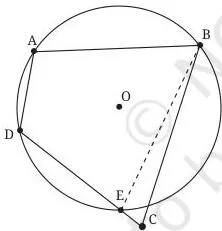
The diagram, Fig. 5.29 on NCERT printed page 113, shows the situation the proof starts from. The circle shown passes through A, B and D only. Point C is drawn outside the circle, matching the case the book proves, and E is the point where side CD meets the circle.
Read the positions carefully — the proof depends on them. The points C, E and D lie on one straight line, in that order. Triangle BEC sits with its base on that line, and the angle at E that lies outside the triangle, \(\angle BED\), is the exterior angle where the contradiction will strike.
Given, To Prove and the Construction
Given: ABCD is a 4-gon (Fig. 5.29) — the book writes “4-gon” for quadrilateral — with \[ \angle BAD + \angle BCD = 180^\circ \quad \text{and} \quad \angle ABC + \angle CDA = 180^\circ. \]
To show that: ABCD is cyclic.
Construction (by contradiction): Suppose ABCD is not cyclic. As the book notes, A, D and B are not collinear — they are three vertices of a quadrilateral — so a unique circle passes through the three points. This is Theorem 1, the three-point circle.
If that circle does not pass through C, there are two cases: C lies outside the circle, or C lies inside it.
The book proves the outside case in full and leaves the inside case to the reader. In the outside case, let E be the point where side CD meets the circle, so the points lie on line CD in the order C–E–D. One notation note: the proof line writes \(\angle DCB\) where the Given writes \(\angle BCD\).
These are the same angle — the corner at C between CB and CD.
Proof: Why the Converse Holds
The book presents the argument under its own heading, “Why is this true?”, on printed page 113. In numbered steps, with the reason for each step:
- Step 1 — assume the opposite. Suppose ABCD is not cyclic. This is the assumption the proof will contradict.
- Step 2 — draw the circle through A, B and D. Since A, D and B are not collinear, a unique circle passes through the three points (Theorem 1, the three-point circle).
- Step 3 — face the two cases. If this circle does not pass through C, then C is either outside it or inside it. The book carries out the outside case and leaves the inside case to the reader; both fail by the same kind of contradiction, as shown after the proof.
- Step 4 — name the meeting point. In the outside case, let E be the point where the line CD meets the circle. Since C is outside and D is on the circle, the points lie on the line in the order C–E–D.
- Step 5 — apply Theorem 11 to ABED. All four of A, B, E, D lie on the circle, so ABED is a cyclic 4-gon. Theorem 11, the forward direction, applied to it gives
\[ \angle BAD + \angle BED = 180^\circ. \]
- Step 6 — force an equality. The Given says the same about \(\angle BAD + \angle BCD = 180^\circ\) (the book writes \(\angle DCB\) here; the name does not change the angle). Both sums equal \(180^\circ\), so subtracting \(\angle BAD\) from each forces
\[ \angle BED = \angle BCD. \]
- Step 7 — the inequality that kills the equality. In triangle BEC, the angle \(\angle BED\) is an exterior angle: it lies at E, outside the triangle, formed by BE and the extension ED of CE. An exterior angle of a triangle is strictly greater than the interior opposite angle, so \(\angle BED \gt \angle BCE\). Because E lies on CD, \(\angle BCE\) is the same angle as \(\angle BCD\). Hence
\[ \angle BED \gt \angle BCD, \]
which directly contradicts the equality from step 6. This is the step students miss: the contradiction is an inequality, not another equality.
- Step 8 — conclude. The assumption was false. The circle through A, B and D must also pass through C, so A, B, C, D all lie on one circle and ABCD is cyclic.
The inside case: the book leaves it to the reader (NCERT, p. 113), and the outline of the argument is the same. If C lies inside the circle, let E be the other point where the line CD meets the circle (so the order on the line is E–C–D).
ABED is still cyclic, so the two angle sums again force the equality \(\angle BED = \angle BCD\). But in this configuration the same equality cannot survive triangle BEC — a forced equality meets an angle inequality there too, exactly as in the outside case. The case fails the same way.
Try it yourself: a live practice figure
Where the Chapter Uses This Theorem
The book tries the converse out immediately. On page 113, just before Theorem 12 is formally stated, NCERT’s printed exercise asks whether a quadrilateral whose angles measure \(80^\circ, 110^\circ, 100^\circ\) and \(70^\circ\) can be drawn.
That runs the theorem’s own direction: the angles are given, and the existence of the quadrilateral — equivalently, whether its vertices are concyclic — is what has to be decided.
The end-of-chapter exercises on page 114 run the same pair of theorems the other way. Question 7 names a cyclic quadrilateral ABCD with \(\angle A = 75^\circ\) and \(\angle B = 110^\circ\) and asks for the missing opposite angles; Question 8 names a cyclic quadrilateral PQRS with \(\angle P = (2x + 10)^\circ\) and \(\angle R = (3x – 20)^\circ\) and asks for x.
Both give the circle and ask for angles, which is the forward direction of Theorem 11.
| Question in the book | Direction it tests | What the answer uses |
|---|---|---|
| Exercise printed with Theorem 12 (p. 113): angles \(80^\circ, 110^\circ, 100^\circ, 70^\circ\) — can such a quadrilateral be drawn? | Converse — Theorem 12 | Whether the two pairs of opposite angles each sum to \(180^\circ\), and so whether the quadrilateral exists. |
| End-of-chapter Q7 (p. 114): cyclic ABCD, \(\angle A = 75^\circ\), \(\angle B = 110^\circ\) | Forward — Theorem 11 | Opposite angles of the given cyclic quadrilateral sum to \(180^\circ\). |
| End-of-chapter Q8 (p. 114): cyclic PQRS, \(\angle P = (2x + 10)^\circ\), \(\angle R = (3x – 20)^\circ\) | Forward — Theorem 11 | The opposite-pair sum gives an equation for x. |
Page 114’s closing lines of lesson text end the circle unit with a note that further circle results come in the next class. Theorem 12 is the final named theorem of the unit, and the exercises that follow assume the pair of results — Theorem 11 and its converse — together.
The Converse and the Related Circle Theorems
Theorem 12 reverses Theorem 11. Theorem 11, the forward direction, starts from a cyclic quadrilateral and concludes that its opposite angles sum to \(180^\circ\); Theorem 12 starts from that angle sum and concludes the quadrilateral is cyclic. Use one when the circle is given and an angle is missing, and the other when the circle itself has to be proved.
The proof’s first move leans on Theorem 1, the three-point circle, which makes the starting circle through A, B and D legitimate. Theorem 10, the same-side concyclicity result, is the chapter’s other way to show points are concyclic — there, equal angles do the work that the \(180^\circ\) sum does here.
The chapter’s other named circle theorems:
- Theorem 2, equal chords
- Theorem 3, its converse
- Theorem 4, chord midpoint
- Theorem 6, equal chords equidistant
- Theorem 8, longer chord nearer
- Theorem 9, angle at centre
- Theorem 10, equal angles
- Theorem 11, forward direction
Common Mistakes When Proving or Applying It
Each row names an error students actually make on this theorem, the correct rule, and a way to catch it before submission.
| Mistake | Correct rule | How to check your answer |
|---|---|---|
| Using adjacent angles: two neighbouring angles that sum to \(180^\circ\) do not make a quadrilateral cyclic. A parallelogram is the standard counterexample — its adjacent angles are supplementary, yet it is not cyclic. | The theorem needs opposite angles: \(\angle BAD + \angle BCD\), or equivalently \(\angle ABC + \angle CDA\). | Mark the pairs of angles that do not share a side. If the pair you checked shares a side, the theorem does not apply. |
| Quoting Theorem 11 to prove that four points are concyclic. | Theorem 11 runs forward — from a cyclic quadrilateral to the \(180^\circ\) sum. Theorem 12 runs the reverse — from the \(180^\circ\) sum to a cyclic quadrilateral. | Ask what is given. “ABCD is cyclic …” means Theorem 11. “Prove ABCD is cyclic” or “are the points concyclic?” means Theorem 12. |
| Writing \(\angle BED = \angle BCD\) and stopping. | The contradiction lives in the strict inequality \(\angle BED \gt \angle BCD\), from the exterior-angle fact; the middle step is \(\angle BCE = \angle BCD\). | Look for an exterior angle of triangle BEC. \(\angle BED\) lies outside the triangle at E, so it is strictly larger than the interior opposite angle. An equality alone cannot contradict anything. |
| Treating the inside case as a separate theorem. | The inside case is the same argument with the other point where line CD meets the circle. | Write which case you are proving. If you begin “suppose C is outside”, add that the inside case follows by the same reasoning — or work it out with the second intersection point. |
| Assuming a circle through A, B and D without saying why. | A, D, B are not collinear because they are vertices of a quadrilateral, so Theorem 1 guarantees a unique circle through them. | Your construction should include one line naming Theorem 1. A proof that starts “take the circle through C” is circular reasoning. |
Questions Students Search About This Theorem
What is the converse of the cyclic quadrilateral theorem?
It is Theorem 12 of Class 9 Mathematics: if two opposite angles of a quadrilateral add up to \(180^\circ\), then the vertices of the quadrilateral lie on a circle — the quadrilateral is cyclic. It reverses Theorem 11, which starts from a cyclic quadrilateral and concludes the \(180^\circ\) sum.
How do you prove the converse of the cyclic quadrilateral theorem?
Assume ABCD is not cyclic. A circle passes through A, B and D (Theorem 1); in the outside case, E is where CD meets the circle. ABED is cyclic, so Theorem 11 gives \(\angle BAD + \angle BED = 180^\circ\). The given sum \(\angle BAD + \angle BCD = 180^\circ\) then forces \(\angle BED = \angle BCD\).
But \(\angle BED\) is an exterior angle of triangle BEC, so it is strictly greater than \(\angle BCD\) — a contradiction. The inside case repeats the same argument with the other intersection point. The numbered proof steps above give the full version to write in an exam.
What does it mean for four points to be concyclic?
Four points are concyclic when a single circle passes through all four of them. A quadrilateral whose four vertices lie on such a circle is a cyclic quadrilateral.
Why is one pair of opposite angles enough to prove a quadrilateral is cyclic?
The four angles of any quadrilateral total \(360^\circ\). If one opposite pair sums to \(180^\circ\), the other pair must sum to \(180^\circ\) as well, because the two pairs together make the full \(360^\circ\). The proof uses only the first pair, \(\angle BAD + \angle BCD\).
What is the difference between the cyclic quadrilateral theorem and its converse?
The forward theorem (Theorem 11) goes from circle to angles: given a cyclic quadrilateral, opposite angles sum to \(180^\circ\). The converse (Theorem 12) goes from angles to circle: given an opposite pair summing to \(180^\circ\), the quadrilateral is cyclic. Use Theorem 11 when the circle is given and Theorem 12 when it must be proved.
What happens in the proof when C lies inside the circle?
The book proves only the outside case and leaves the inside case to the reader (NCERT, p. 113). With C inside, take E as the other point where the line CD meets the circle.
ABED is still cyclic, so the angle sums again force a forced equality, while triangle BEC supplies an angle inequality the equality cannot survive — the same clash as in the outside case.
Related Resources
This listing is maintained for the 2026-27 academic session using the NCERT textbook information available to us. NCERT remains the authority for confirming the latest edition.
- Read the full chapter: I’m Up and Down, and Round and Round — Class 9 Ganita Manjari.
- The forward half of this pair: Theorem 11, and the sibling concyclicity result: Theorem 10.
- All Class 9 theorems and notes: Class 9 mathematics, the Class 9 hub, and the main index of NCERT subjects.
The current edition of Ganita Manjari, including this chapter in full, can be verified and downloaded from NCERT’s official e-textbook portal.
NCERT settles the textbook and its edition; CBSE settles the examinable syllabus, and textbook contents and the syllabus are not always identical — check the current official syllabus.
Reference: NCERT Class 9 Mathematics textbook, chapter 5, Theorem 12, official edition on ncert.nic.in.
Explore Class 9 Mathematics
Related chapters: