
NCERT Class 9 Mathematics Theorem 9 (printed page 108) says the angle subtended by an arc at the centre is double the angle subtended by the same arc at any point on the circle outside the arc. This page gives the book’s own statement, its figure, both proof cases, and the equal-angles result on page 109.
The Exact Statement NCERT Prints
Theorem 9 (NCERT Class 9 Mathematics, page 108) The angle subtended by an arc at the centre of the circle is double the angle subtended by the arc at any point on the circle outside the arc.
NCERT prints this as Theorem 9 on printed page 108 of Ganita Manjari, its Class 9 Mathematics textbook (NCERT, p. 108). Learn the sentence word for word — it is the statement an exam expects when it asks you to state the theorem.
New: practise this theorem. Drag the book’s figure and watch the numbers change, try to break the theorem on purpose, then solve fresh questions with hints.
What the Statement Means in Plain Words
Decode the vocabulary before touching the proof; each term tells you where to look in the figure.
| Term | What it names |
|---|---|
| arc | a part of the circle’s circumference, named by its endpoints — here AFB |
| subtended by an arc | the angle whose two arms end at the arc’s two endpoints |
| angle at the centre | the angle whose vertex is the centre C |
| point on the circle outside the arc | a point such as D on the circle but not on the arc AFB |
So the theorem compares two angles standing on the same arc: one at the centre, one at a point on the circle outside the arc. The centre angle is double the circle angle. Memory aid: moving from the circle to the centre doubles the angle; moving from the centre back to the circle halves it.
The Figure Behind the Theorem
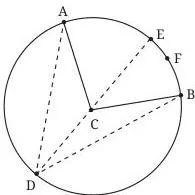
Fig 5.21 sets up case 1. The arc AFB lies on the circle, C is the centre, and \(\angle ACB\) is the angle the arc subtends at the centre. Point D lies on the circle outside the arc AFB.
The one construction line the proof needs is D–C–E: join D to C, then extend DC to cut the circle again at E.
The position of E decides the method. In Fig 5.21, E lands on the arc AFB, so the two exterior angles add. In Fig 5.22 (NCERT, p. 109), E lies outside the arc AFB, so the exterior angles overlap and the proof subtracts.
Fig 5.23, also on page 109, shows three points D, E, F on the circle outside one arc and the equal angles they give.
Given, To Prove and Construction
The book sets the proof up in three parts (NCERT, p. 108).
Given. AFB is an arc of the circle, \(\angle ACB\) is the angle it subtends at the centre C, and D is a point on the circle outside the arc AFB.
To prove. \(\angle BCA = 2\angle BDA\). The book writes the central angle both ways — ACB and BCA — the same angle.
Construction. Join D to C and extend the line DC to cut the circle again at E. Whether E lands on the arc AFB or outside it decides which proof case applies; no other construction line is needed.
The Full Proof, Step by Step
Both cases use the same two tools: isosceles triangles formed by the radii, and the exterior angle theorem — an exterior angle of a triangle equals the sum of the two opposite interior angles.
Case 1: E on the arc AFB (Fig 5.21) — the angles add
- In \(\triangle DCB\), \(CB = CD\) because both are radii, so the triangle is isosceles and \(\angle CBD = \angle CDB\).
- \(\angle BCE\) is an exterior angle of \(\triangle BCD\). By the exterior angle theorem, \(\angle BCE = \angle CBD + \angle CDB = 2\angle BDC\).
- In \(\triangle ADC\), \(CA = CD\), so \(\angle CAD = \angle CDA\), and the same theorem gives \(\angle ACE = \angle CAD + \angle CDA = 2\angle CDA\).
- Along the line through B, C, E, the central angle splits into the two exterior angles: \(\angle BCA = \angle BCE + \angle ECA\).
- Since D, C, E are collinear, \(\angle BDE = \angle BDC\) and \(\angle EDA = \angle CDA\), so \(\angle BDA = \angle BDC + \angle CDA\).
- Substitute: \(\angle BCA = 2\angle BDC + 2\angle CDA = 2(\angle BDC + \angle CDA) = 2\angle BDA\). Hence proved for case 1.
Case 2: E outside the arc AFB (Fig 5.22) — the angles subtract
The book notes that case 1’s explanation no longer works here (NCERT, p. 109), so the working is redone.
- The isosceles facts still hold: since \(CA = CD\), \(\angle ACE = \angle ADC + \angle CAD = 2\angle ADC\), and since \(CB = CD\), \(\angle BCE = \angle BDC + \angle CBD = 2\angle BDC\).
- The two exterior angles now overlap, so the central angle is the part left over: \(\angle ACB = \angle ACE – \angle BCE\).
- Along the line DC, the angle at D is a difference too: \(\angle ADB = \angle ADC – \angle BDC\).
- Therefore \(\angle ACB = 2\angle ADC – 2\angle BDC = 2(\angle ADC – \angle BDC) = 2\angle ADB\). Hence proved for case 2.
Why the change from addition to subtraction? In Fig 5.21 the exterior angles sit side by side, so the central angle is their sum; in Fig 5.22 they overlap, so the central angle is what remains after subtracting one from the other.
| Where the extended line DC meets the circle | How the two exterior angles combine |
|---|---|
| On the arc AFB (Fig 5.21) | Add: \(\angle BCA = \angle BCE + \angle ECA\), so \(\angle BCA = 2\angle BDA\) |
| Outside the arc AFB (Fig 5.22) | Subtract: \(\angle ACB = \angle ACE – \angle BCE\), so \(\angle ACB = 2\angle ADB\) |
Try it yourself: a live practice figure
Where the Book Uses Theorem 9 Next
On page 109 the book applies Theorem 9 to one arc AB and takes any three points D, E, F on the circle outside that arc (NCERT, p. 109). Each angle is half of the same central angle, so \(\angle AEB = \angle ADB = \angle AFB = \frac{1}{2}\angle ACB\).
The book notes this is exactly what the activity before Theorem 9 suggested: no matter where D sits outside the arc, \(\angle ADB\) is the same.
Worked example (fresh numbers). An arc subtends \(128^\circ\) at the centre.
Step 1: The central angle is \(\angle ACB = 128^\circ\).
Step 2: Take any point D on the circle outside the arc.
By Theorem 9, \[ \angle ADB = \frac{1}{2}\angle ACB = \frac{1}{2} \times 128^\circ = 64^\circ \]
Step 3: The same half applies to every such point, so E and F also give \(64^\circ\).
Answer: every angle subtended by this arc at a point on the circle outside the arc measures \(64^\circ\).
This equal-angles observation is the bridge to the cyclic quadrilateral theorems later in the chapter — it is the idea Theorem 10 builds on.
Related Theorems: the Converse and Its Neighbours
Revision note: Theorem 9 is the hinge of the chapter — it links the chord theorems that come before it to the angle theorems that follow it. In the book’s sequence it sits between Theorem 8, the preceding chord result, and Theorem 10, it reverses this theorem; then come Theorem 11, it extends this theorem, and Theorem 12, its converse.
The book prints no separate converse of Theorem 9; that role is filled by Theorem 10, which reverses this theorem’s idea.
Common Mistakes When Proving or Using This Theorem
Five errors appear again and again in this proof — each with its fix.
| Mistake | Correct rule | How to check |
|---|---|---|
| Adding in a Fig 5.22 situation | Check where the extended line DC meets the circle before choosing the method | Trace DC past C: does E fall on arc AFB or outside it? |
| Treating \(\angle BDA\) as one triangle’s angle | It is the sum (case 1) or the difference (case 2) of two angles along the ray DC | Split \(\angle BDA\) at the ray DC and name both pieces |
| Using the exterior angle theorem on the wrong triangle | The isosceles triangles are \(\triangle BCD\) (with \(CB = CD\)) and \(\triangle ACD\) (with \(CA = CD\)) | Your triangle must have C as a vertex and D plus one endpoint of the arc |
| Applying the theorem when D is on the arc AFB | The statement requires D outside the arc; the doubling relation fails on the arc itself | Ask: is D on the arc AFB? If yes, Theorem 9 does not apply |
| Doubling the circle angle instead of the central one | The angle at the centre is the double one; halve the central angle to get the circle angle | Check that the central angle equals \(2 \times\) the circle angle |
Questions Students Ask About This Theorem
What does ‘angle subtended by an arc’ mean in Theorem 9?
It is the angle whose two arms end at the arc’s two endpoints. Its vertex is either the centre or a point on the circle outside the arc.
Why does the proof use subtraction in Fig 5.22 but addition in Fig 5.21?
Because of where the extended line DC meets the circle. In Fig 5.21 it meets the arc AFB, so the exterior angles add; in Fig 5.22 it meets the circle outside the arc, so one exterior angle overlaps the other and the central angle is the difference.
Are all angles subtended by the same arc at the circle equal?
Yes. Each is half of the same central angle by Theorem 9, so every point on the circle outside the arc gives the same angle.
Can I use Theorem 9 when the point D lies on the arc itself?
No. The statement restricts D to points on the circle outside the arc, and the doubling relation is not guaranteed for a point on the arc itself.
Why does this theorem matter for the cyclic quadrilateral theorems later in the chapter?
Because the equal-angles result on page 109 — every angle on the same arc equals half the central angle — is what the cyclic quadrilateral theorems build on.
How do I know which angle to double and which to halve in a circle problem?
The angle at the centre is double the angle on the circle. Double when you move from the circle to the centre; halve when you move from the centre to the circle.
Sources and Related Pages
This listing is maintained for the 2026-27 academic session using the NCERT textbook information available to us. NCERT remains the authority for confirming the latest edition.
NCERT settles the textbook text and its editions; CBSE settles the curriculum and examinations. The authority for the book itself is the NCERT textbook portal, where the current Class 9 Ganita Manjari edition is available free.
Useful pages: the chapter page for I’m Up and Down, and Round and Round; the Class 9 Maths theorems hub; and the notes directories for Class 9 Mathematics, for Class 9, and the main notes index.
Textbook contents and the examinable syllabus are not always identical — check the current official syllabus before deciding what to revise.
Reference: NCERT Class 9 Mathematics textbook, chapter 5, Theorem 9, official edition on ncert.nic.in.
Explore Class 9 Mathematics
Related chapters:
Official source: download the NCERT textbook free from ncert.nic.in.