
In one circle, the longer chord lies closer to the centre than the shorter chord. That is Theorem 8 of NCERT Class 9 Mathematics (Ganita Manjari, chapter 5, page 105), and this page gives the book’s own statement, its Fig. 5.16, and the proof to reproduce in an exam.
The proof is short — two right triangles, the Baudhāyana–Pythagoras theorem, and one careful inequality — so it is easy to score full marks once you know its shape. The theorem is stated and proved on the same printed page, with nothing else needed from the chapter.
Theorem 8 as NCERT prints it
NCERT leads into the theorem with the observation “The longer the chord, the closer it is to the centre”, then states it formally. The block below is the book’s own wording, printed on page 105.
Theorem 8 (NCERT Class 9 Mathematics, page 105) Let AB and DE be two chords of a circle with centre C. Suppose AB > DE. Then the distance from C to AB is less than the distance from C to DE.
New: practise this theorem. Drag the book’s figure and watch the numbers change, try to break the theorem on purpose, then solve fresh questions with hints.
The theorem gives that observation a precise shape: it names two chords of one circle, fixes the centre, and tells you which perpendicular distance is the smaller one.
What the theorem means in plain words
“Distance from C to AB” means the perpendicular distance — the length of the perpendicular dropped from the centre C onto the chord AB. This is the same idea as the distance from a point to a line: the shortest path, meeting the line at a right angle.
All chords live in the same circle with centre C. The theorem never compares chords from different circles. It compares two chords at once: the longer one sits closer to the centre.
Why this should be true: a fixed circle can only fit a long straight segment through it if the segment passes near the centre. Cuts near the rim are short; cuts through the middle are long.
| Chord | Length | Perpendicular distance from centre C |
|---|---|---|
| AB | longer | CF — shorter |
| DE | shorter | CG — longer |
Fig. 5.16: the figure NCERT uses
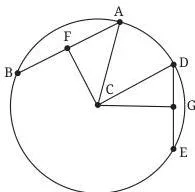
This is Fig. 5.16 from page 105 — the book’s figure for Theorem 8. It shows a circle with centre C and two chords: AB, drawn longer, and DE, drawn shorter. From C the perpendiculars CF and CG are dropped to AB and DE.
Read the labels carefully. AC is a radius of the circle, and so is CD. Because CF is perpendicular to AB, triangle ACF is right-angled at F; because CG is perpendicular to DE, triangle DCG is right-angled at G, so both angles are \(90^\circ\).
Those two right triangles are exactly what makes the Baudhāyana–Pythagoras step of the proof valid.
Given, to prove and the construction
The book sets the proof up in three lines, also on page 105:
- Given: AB > DE, where AB and DE are two chords of the circle with centre C.
- To show that: CF < CG.
- Construction: drop the perpendiculars CF and CG from C to AB and DE respectively.
The construction is forced by the meaning of “distance”. Since the distance from the centre to a chord means the perpendicular distance, the two perpendiculars are exactly the lengths the theorem compares.
Proof of Theorem 8, step by step
The book’s proof runs on page 105. Every line below gives the book’s step and the reason it is true.
| Step | Statement | Reason |
|---|---|---|
| 1 | AC = CD | Both are radii of the same circle. |
| 2 | Triangles ACF and DCG are right-angled at F and G. | CF and CG were dropped perpendicular to AB and DE in the construction. |
| 3 | \(AC^2 = CF^2 + AF^2\) and \(CD^2 = CG^2 + GD^2\) | The Baudhāyana–Pythagoras theorem, applied to the two right triangles of step 2. |
| 4 | \(CF^2 + AF^2 = CG^2 + GD^2\) | AC = CD from step 1, so both left sides equal the same number — the square of the radius. |
| 5 | F and G are the midpoints of AB and DE, so \(AF = \frac{AB}{2}\) and \(GD = \frac{DE}{2}\). | The perpendicular from the centre to a chord bisects the chord — the chapter’s earlier midpoint theorem. |
| 6 | AF > GD, hence \(AF^2 \gt GD^2\). | Given AB > DE, each half-chord keeps the order; squaring a larger positive number keeps it larger. |
| 7 | \(CF^2 \lt CG^2\) | In step 4 the two sums are equal, but the left sum has the larger first square, so its second square must be the smaller one. |
| 8 | \(CF \lt CG\) | Lengths are positive, so taking the square root preserves the inequality. |
The only line students hesitate on is step 7. Both sums are the same number; the left sum has the larger half-chord square, so its distance square must be the smaller of the two. That is why the inequality turns around instead of staying the same.
Hence proved. The longer chord AB is nearer the centre C than the shorter chord DE.
Worked example: radius 10, chords 16 and 12
Take a circle of radius 10 units. One chord has length 16; another has length 12, so the half-chords are 8 and 6. Each distance from the centre is the remaining leg of a right triangle whose hypotenuse is the radius.
| Chord length | Half-chord | Distance from centre |
|---|---|---|
| 16 | 8 | \(d = \sqrt{10^2 – 8^2} = \sqrt{100 – 64} = \sqrt{36} = 6\) |
| 12 | 6 | \(d = \sqrt{10^2 – 6^2} = \sqrt{100 – 36} = \sqrt{64} = 8\) |
The longer chord (16) sits 6 units from the centre; the shorter chord (12) sits 8 units away. \(16 \gt 12\) gives \(6 \lt 8\) — exactly the direction in which the theorem points.
Try the inequality yourself
Move the chords in the practice figure and watch the perpendicular distance from the centre respond.
Try it yourself: a live practice figure
Memory aid for the direction: long chord, short distance, diameter zero. Stretch a chord toward the centre and the distance shrinks; shrink a chord toward the rim and the distance grows.
Where the book uses Theorem 8 next
On the same page 105 the book draws two immediate conclusions from the theorem.
- The chord nearest the centre is the chord that contains the centre — its distance is zero, so the diameter is the greatest chord of the circle.
- Push a chord away from the centre and it shrinks; at some stage it becomes a single point of length zero, and its distance from C equals the radius.
Exercise Set 5.5 then opens with two questions that use this same right-triangle picture. Question 1 asks for the length of a chord when the radius is 7 cm and the perpendicular distance is 6 cm; Question 2 asks you to explain why the chord length is \(2\sqrt{r^2 – d^2}\) when the perpendicular distance is d and the radius is r.
The theorem itself is not cited again later in the chapter.
Converse and related theorems in the chapter
Converse. NCERT numbers no separate converse for Theorem 8, but the proof runs backwards in two sentences. If \(CF \lt CG\), then \(CF^2 \lt CG^2\); the equality of the two sums in step 4 then forces \(AF^2 \gt GD^2\), so \(AF \gt GD\) and therefore \(AB \gt DE\). In words: the chord closer to the centre is the longer chord.
Related theorems in the same chapter, by number:
- Theorem 6, the equal case — the one this theorem generalises.
- Theorem 4, the midpoint theorem — the fact the proof quotes in step 5.
- Theorem 2, central angles — the chapter’s earlier chord comparison.
- Theorem 9, the angle theorem — the next theorem proved in the book.
Mistakes to avoid in this proof
| Mistake | Correct rule | How to check your answer |
|---|---|---|
| Treating any segment from the centre to the chord as the distance. | The distance is the perpendicular from the centre to the chord; CF and CG are dropped at right angles. | Look for the right angle at F and G on your figure before you accept a distance. |
| Putting the whole chord AB into the right triangle. | The right triangle uses the half-chord: \(AF = \frac{AB}{2}\), not AB. | Check that the side you square in \(AC^2 = CF^2 + AF^2\) is half the chord. |
| Getting the final inequality backwards. | \(AB \gt DE \Rightarrow AF^2 \gt GD^2 \Rightarrow CF^2 \lt CG^2 \Rightarrow CF \lt CG\). | Test with numbers: chord 16 gives distance 6; chord 12 gives distance 8 — longer chord, smaller distance. |
| Calling F and G midpoints without a reason. | They are midpoints because the perpendicular from the centre to a chord bisects the chord. | Write one line: “F and G are midpoints, since CF and CG are perpendiculars from the centre.” |
| Applying Baudhāyana–Pythagoras to a triangle that is not right-angled. | The theorem needs a right angle; the perpendiculars create right angles at F and G. | Name the right angle before you write \(AC^2 = CF^2 + AF^2\). |
Questions students ask about Theorem 8
Why is a longer chord closer to the centre than a shorter chord?
Because the radius of the circle is fixed. The radius, the half-chord and the perpendicular distance form a right triangle with the radius as hypotenuse; a longer chord means a longer half-chord, so the remaining perpendicular side must be shorter.
What does “distance of a chord from the centre” mean?
It is the shortest distance from the centre to the chord: the length of the perpendicular dropped from the centre onto the chord — CF or CG in the figure. Any other segment from C to a point of the chord is longer.
Why is the diameter the longest chord of a circle?
Because a diameter is a chord that passes through the centre, so its distance from the centre is zero. By Theorem 8 the chord closest to the centre is the longest, so the diameter is the greatest chord — the book states this right below the proof.
Does the converse of Theorem 8 hold, and how would you show it?
Yes. Reverse the proof: if \(CF \lt CG\), then \(CF^2 \lt CG^2\), and the equality \(CF^2 + AF^2 = CG^2 + GD^2\) forces \(AF^2 \gt GD^2\), so \(AB \gt DE\). NCERT gives no separate converse; this backward run of the proof is the converse.
Why does the proof use half the chord rather than the whole chord?
Because the perpendicular from the centre to a chord bisects the chord, so F and G are midpoints. The right triangle ACF then has legs CF and AF, with \(AF = \frac{AB}{2}\), and this is the triangle Baudhāyana–Pythagoras is applied to.
Where does the chord length formula \(2\sqrt{r^2 – d^2}\) come from?
From the same right triangle: \(r^2 = d^2 + (\text{half-chord})^2\), so the half-chord is \(\sqrt{r^2 – d^2}\) and the whole chord is twice that. Explaining this is exactly Question 2 of Exercise Set 5.5.
Related resources and attribution
This listing is maintained for the 2026-27 academic session using the NCERT textbook information available to us. NCERT remains the authority for confirming the latest edition.
For the full chapter, open the chapter page for “I’m Up and Down, and Round and Round”, or jump to the Class 9 Mathematics theorems hub for the chapter’s other theorems by number.
For chapter notes on the same class, see Class 9 Mathematics notes, the Class 9 notes index, or the notes home page. The current edition of the Class 9 Mathematics textbook (Ganita Manjari) is published by NCERT and can be downloaded from the official NCERT website (ncert.nic.in).
Reference: NCERT Class 9 Mathematics textbook, chapter 5, Theorem 8, official edition on ncert.nic.in.
Explore Class 9 Mathematics
Related chapters: