
In the current NCERT Class 9 Mathematics text (Ganita Manjari, Grade 9, Part I), Chapter 5 – “I’m Up and Down, and Round and Round” – Theorem 6, equal chords are equidistant from the centre, is stated and proved on printed pages 103–104 with Fig 5.14.
This page gives the book’s exact statement, the figure, both proofs as the book runs them, the converse, and the mistakes to avoid. Read the statement first, then the figure, then either proof — each step below carries its reason.
The exact statement from the NCERT book
Here is the sentence the book prints on page 103. Write it out exactly as it appears below when you are asked to state the theorem.
Theorem 6 (NCERT Class 9 Mathematics, page 103) Chords of a circle having the same length are all at the same distance from the centre of the circle.
New: practise this theorem. Drag the book’s figure and watch the numbers change, try to break the theorem on purpose, then solve fresh questions with hints.
The statement above is Theorem 6 of Chapter 5, printed on page 103 of the official edition.
What this theorem actually means
A chord is a straight segment joining two points of the circle. The distance from the centre to a chord means the perpendicular distance — the length of the perpendicular dropped from the centre onto the chord, not any slanting segment.
Why does the theorem make sense? A chord closer to the centre cuts deeper across the circle, so it has to be longer. Two chords of equal length therefore cannot sit at different distances, because the nearer one would be the longer one.
In Fig 5.14 the two chords are AB and FG, with midpoints E and H. The theorem says: because AB and FG have the same length, the two perpendicular distances CE and CH are equal.
The figure the book uses: Fig 5.14
This is the book’s own figure for the theorem (Fig 5.14, page 103).
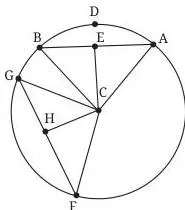
Read the figure before writing the proof. There is a circle with centre C, and two chords AB and FG. The point E is the midpoint of AB and H is the midpoint of FG; the segments CE and CH are drawn from the centre to those midpoints.
By the chord theorem the book cites as Theorem 5 on page 103, those two segments are perpendicular to their chords. So the proof’s task is to show that the two perpendicular segments CE and CH have equal length.
Label caution: the second chord is FG, not GH. The letters GH appear only in the next figure (Fig 5.15, page 104) for the converse, and the given equality is AB = FG.
Given and to prove: the setup
Given: a circle with centre C; AB = FG; E and H are the midpoints of AB and FG respectively.
To prove: CE = CH.
No construction is needed. The radii CA, CB, CF and CG are already the sides of the triangles the proof compares, and the points E and H come from the given itself.
The book’s first move (page 103) is to apply the earlier chord result it labels Theorem 5. That result gives CE as the perpendicular to AB and CH as the perpendicular to FG. Only after that can the proof call CE and CH “the distances” from C to the two chords — distance means perpendicular distance.
Proof of Theorem 6: two routes in the book
Before both routes, the same opening step (page 103): from the theorem the book labels Theorem 5, \( CE \perp AB \) and \( CH \perp FG \). So CE and CH are the perpendicular distances from C to the two chords.
Route 1: congruent triangles CAB and CFG (SSS)
- \( CA = CF \) and \( CB = CG \), because all four are radii of the same circle.
- \( AB = FG \), given.
- So \( \triangle CAB \cong \triangle CFG \) by SSS congruence.
- Hence the altitudes of the congruent triangles are equal. CE is the altitude of \( \triangle CAB \) standing on AB, and CH is the altitude of \( \triangle CFG \) standing on FG; the congruence sends C to C and side AB to side FG, so it sends the altitude CE to the altitude CH.
- Therefore \( CE = CH \), so the chords AB and FG are equidistant from the centre C.
Route 2: congruent triangles CEA and CHF (RHS)
- From the same Theorem 5 (page 103), the perpendicular from the centre bisects the chord: E and H are the midpoints of AB and FG.
- \( AE = FH \), because the equal chords AB and FG are halved at E and H.
- \( \angle CEA = \angle CHF = 90^\circ \), by the same perpendicular result.
- \( CF = CA \), as radii of the circle.
- So \( \triangle CEA \cong \triangle CHF \) by RHS congruence — right angle, hypotenuse \( CA = CF \), side \( AE = FH \).
- Hence \( CE = CH \). The chords of equal length are therefore equidistant from the centre.
Try it yourself: a live practice figure
The table below compares the two routes at a glance.
| Route | Triangles compared | Congruence rule | Equalities relied on | One idea to remember |
|---|---|---|---|---|
| 1 | \( \triangle CAB \) and \( \triangle CFG \) | SSS | \( CA = CF \), \( CB = CG \) (radii); \( AB = FG \) (given) | Congruent triangles have equal altitudes |
| 2 | \( \triangle CEA \) and \( \triangle CHF \) | RHS | \( AE = FH \); \( \angle CEA = \angle CHF = 90^\circ \); \( CF = CA \) (radii) | Right angle + hypotenuse + a side |
Quick check: a numeric example with the Baudhāyana–Pythagoras theorem
The book’s proofs are the syllabus; this check is ours, using the same Baudhāyana–Pythagoras theorem that Exercise Set 5.4 (page 104) asks you to apply. Dropping a perpendicular from the centre to a chord splits the chord in half. The radius, half the chord and the perpendicular make a right triangle, so:
\[ \text{distance from centre} = \sqrt{(\text{radius})^2 – (\text{half-chord})^2}. \]
Worked check with original numbers on a circle of radius 5 cm:
- A chord of 8 cm splits into halves of 4 cm and 4 cm; the distance is \( \sqrt{25 – 16} = 3 \) cm.
- A second chord of 8 cm gives the same \( \sqrt{25 – 16} = 3 \) cm — equal chords, equal distance.
- A chord of 6 cm splits into halves of 3 cm and 3 cm; the distance is \( \sqrt{25 – 9} = 4 \) cm.
Two observations follow. Equal chords land at equal distances, which is exactly Theorem 6. And the shorter chord (6 cm) sits farther out (4 cm) than the longer one (8 cm at 3 cm) — the question taken up in Section 5.6.1 on page 104 and settled by Theorem 8.
Exercise Set 5.4 questions 1 and 3 (page 104) ask for exactly this Baudhāyana–Pythagoras justification of Theorem 6 and of its converse.
| Chord length | Half-chord after perpendicular | Distance from centre per Baudhāyana–Pythagoras |
|---|---|---|
| 8 cm | 4 cm | \( \sqrt{25 – 16} = 3 \) cm |
| 8 cm (equal chord) | 4 cm | \( \sqrt{25 – 16} = 3 \) cm — same distance |
| 6 cm | 3 cm | \( \sqrt{25 – 9} = 4 \) cm |
Where the book uses this theorem next
- Exercise Set 5.4, question 1 (page 104): use the Baudhāyana–Pythagoras theorem to show why Theorem 6 must be true.
- Exercise Set 5.4, question 2 (page 104): with Fig 5.15, establishes the reverse result, which the book prints right after the exercise set as Theorem 7.
- Exercise Set 5.4, question 3: solves that reverse result again, this time through the Baudhāyana–Pythagoras theorem.
- Section 5.6.1, “Which of the two unequal chords is farther from the centre?” (page 104): an activity asks you to draw chords of various lengths, drop a perpendicular from the centre to each, and record chord length and distance from the centre in a table — and it leads to Theorem 8.
Each of these depends on the distance idea that Theorem 6 fixes: distance to a chord is the perpendicular drop from the centre.
The converse and the related theorems
The next theorem in the book, Theorem 7 (page 104), reverses this theorem: it swaps the condition and the conclusion of Theorem 6. The book derives it from Exercise Set 5.4 question 2.
Two-way reading hint: Theorem 6 together with its converse forms a single rule that works in both directions — equal chords, equal distances; equal distances, equal chords. That single rule settles most chord-distance questions in this chapter.
The same chapter’s other theorems, by number:
- Theorem 8 (longer chord nearer centre)
- Theorem 2 (equal angles at centre)
- Theorem 3 (its converse)
- Theorem 1 (three non-collinear points)
The proof of Theorem 6 leans on the chord result the book labels Theorem 5 on page 103; that theorem has its own page: the line from the centre to the midpoint of a chord is perpendicular.
Mistakes to avoid when writing this proof
Six errors come up again and again on this proof. The table names each mistake and the fix.
| Mistake | Correct rule | How to check your answer |
|---|---|---|
| Calling CE the distance before showing CE is perpendicular to AB | Distance means perpendicular distance; show \( CE \perp AB \) and \( CH \perp FG \) first (Theorem 5, page 103), then call them distances | Your setup should mention the perpendicular step before any use of the word distance |
| Reaching for SAS in Route 2 | The book uses RHS: right angle \( \angle CEA = \angle CHF = 90^\circ \), hypotenuse \( CA = CF \), side \( AE = FH \) | SAS would need an included angle you have not shown; check that both right angles come from the perpendicular result |
| Missing the radii equalities CA = CF and CB = CG | Every segment from the centre to the circle is a radius, so CA = CF = CB = CG | In the figure, each vertex of the triangles on the circle is joined to C; mark all four radii |
| Writing “altitudes of congruent triangles are equal” without fixing which altitude | Name them: CE stands on AB in \( \triangle CAB \); CH stands on FG in \( \triangle CFG \) — the congruence sends one to the other | Every altitude statement should name both the triangle and the side it falls on |
| Using the converse before it is proved | Theorem 7 has its own proof (Exercise Set 5.4, question 2, page 104) | For a converse question, write a separate argument; do not reuse the proof of Theorem 6 |
| Copying labels wrongly: writing “GH” for the second chord | The figure for this theorem uses FG for the second chord; the given is AB = FG | Re-read the Given line against Fig 5.14; GH belongs to Fig 5.15 only |
Questions students ask about this theorem
What is the distance of a chord from the centre of a circle?
It is the perpendicular distance: the length of the perpendicular dropped from the centre onto the chord. On page 103 the book argues from Theorem 5 that CE and CH are exactly those perpendiculars.
How do you prove that equal chords are equidistant from the centre?
Take two equal chords AB and FG with midpoints E and H. Either show \( \triangle CAB \cong \triangle CFG \) by SSS and use equal altitudes, or show \( \triangle CEA \cong \triangle CHF \) by RHS. Both routes end with \( CE = CH \).
Is the converse of Theorem 6 also true?
Yes. The reverse is stated as Theorem 7 on page 104 and follows from Exercise Set 5.4 question 2.
Which chord lies nearer the centre: the longer chord or the shorter chord?
The longer chord. In the numeric check above, the 8 cm chord sits 3 cm from the centre while the 6 cm chord sits 4 cm away. Section 5.6.1 (page 104) and Theorem 8 deal with this properly.
Why does the book give two proofs of this theorem?
The book says it will explain the result in two different ways (page 103). Route 1 is shorter but needs the idea that congruent triangles have equal altitudes; Route 2 works directly with the half-chords and needs only what you can read from the figure.
How can the Baudhāyana–Pythagoras theorem prove this result?
Because the perpendicular from the centre bisects the chord, the radius, half the chord and the distance form a right triangle. So \( \text{distance} = \sqrt{r^2 – (\text{half-chord})^2} \). For a 5 cm radius, an 8 cm chord gives \( \sqrt{25 – 16} = 3 \) cm, and a second 8 cm chord gives the same 3 cm — that is the equal-distance conclusion.
This is what Exercise Set 5.4 questions 1 and 3 ask for.
Related resources and the source
This listing is maintained for the 2026-27 academic session using the NCERT textbook information available to us. NCERT remains the authority for confirming the latest edition.
This page follows the current NCERT edition of the Class 9 Mathematics textbook: Ganita Manjari, Grade 9, Part I, Chapter 5, “I’m Up and Down, and Round and Round”. NCERT settles the textbook and its editions; textbook contents and the examinable syllabus are not always identical, so check the current official syllabus for what is examinable.
Continue with the chapter itself, the surrounding theorems, and the Class 9 maths notes: Chapter 5 of Ganita Manjari, Class 9 maths theorems and notes, Class 9 resources, and the main CBSE notes index.
For the book’s own layout, the official PDF of this chapter on ncert.nic.in shows Theorem 6 on printed pages 103 and 104 exactly as printed. NCERT’s textbook portal (ncert.nic.in/textbook.php) lists the current editions of every NCERT book.
Reference: NCERT Class 9 Mathematics textbook, chapter 5, Theorem 6, official edition on ncert.nic.in.
Explore Class 9 Mathematics
Related chapters: