
The NCERT Class 9 theorem on printed page 96 of Ganita Manjari is short: three points that do not lie on one straight line fix exactly one circle. The centre of that circle is found where the perpendicular bisectors of two sides meet.
This page gives you the exact statement to memorise, the Fig. 5.5 construction, and a proof you can reproduce in the exam. The same fact is why every triangle has a circumcircle — its three vertices are never collinear.
The theorem exactly as the book states it
Theorem 1 (NCERT Class 9 Mathematics, page 96) There is a unique circle passing through three non-collinear points.
NCERT prints this as Theorem 1 on printed page 96 of Ganita Manjari, Class 9 Mathematics, Chapter 5, “I’m Up and Down, and Round and Round”. The two words an examiner reads first are unique and non-collinear — the next section explains both.
New: practise this theorem. Drag the book’s figure and watch the numbers change, try to break the theorem on purpose, then solve fresh questions with hints.
What “unique” and “non-collinear” mean here
Non-collinear points do not lie on a single straight line. If A, B and C all lie on one line, they are collinear, and the theorem simply does not apply to them.
Unique means exactly one circle, so the statement makes two separate claims. The proof must answer both:
- Existence — at least one circle passes through A, B and C.
- Uniqueness — no more than one such circle exists.
Counting the circles for each configuration shows why “non-collinear” earns its place in the statement:
| Points given | Circles through them | Reason |
|---|---|---|
| One point | Infinitely many | Any point can serve as the centre with any radius. |
| Two distinct points | Infinitely many | Their centres all lie on the perpendicular bisector of the join. |
| Three collinear points | None | The perpendicular bisectors of AB and AC are parallel and never meet. |
| Three non-collinear points | Exactly one | The perpendicular bisectors of AB and AC meet at one point O. |
Fig. 5.5: the circumcircle of triangle ABC
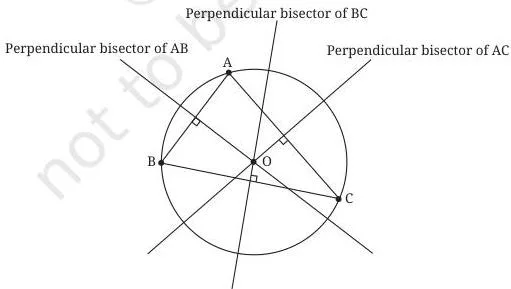
The figure shows the construction complete: the single circle passes through all three vertices A, B and C of the triangle. Point O, where the perpendicular bisectors of AB and AC meet, is the centre.
The segment \( OA \) is the radius. Because O lies on both bisectors, the same radius also reaches B and C.
The figure introduces the three terms you should be able to define:
| Term | Meaning |
|---|---|
| Circumcircle | The circle that passes through all three vertices of a triangle. |
| Circumcentre | The centre O of that circle, where the perpendicular bisectors of the sides meet. |
| Circumradius | The radius \( OA \), the distance from the circumcentre to any vertex. |
Because the vertices of any triangle are non-collinear, every triangle has a circumcircle. That is the practical content of Theorem 1 (NCERT, p. 96).
Given, to prove, and construction
NCERT presents the proof under the heading “Why is this true?” rather than in three labelled parts. But the proof’s own logic has exactly this structure (NCERT, p. 96):
- Given: A, B and C are three non-collinear points.
- To prove: A, B and C lie on exactly one common circle.
- Construction: draw the perpendicular bisectors of AB and AC; let them meet at O; draw the circle with centre O and radius OA.
Notice what the construction does not do: it never draws the perpendicular bisector of BC. Two bisectors are enough, and a third would only pass through the same point O.
Proof: why the circle exists and why it is unique
The proof follows the book’s own steps (NCERT, p. 96). Each step below carries a reason, so you can write the proof in the exam without hesitation.
- Any circle through A and B has its centre on the perpendicular bisector of AB. Reason: the centre is equidistant from A and B, and the perpendicular bisector of a segment is exactly the set of points equidistant from its two ends.
- Any circle through A and C has its centre on the perpendicular bisector of AC. Reason: the same argument applied to the pair A and C.
- The two perpendicular bisectors meet at exactly one point O. Reason: AB and AC are two different lines because A, B and C are non-collinear. Their perpendicular bisectors are therefore not parallel, and two non-parallel lines meet at exactly one point.
- The distances from O to the three points are equal. Reason: O lies on the bisector of AB, so \( OA = OB \); O lies on the bisector of AC, so \( OA = OC \). Hence \( OA = OB = OC \).
- A circle through all three points exists. Reason: draw the circle with centre O and radius OA. By step 4, this radius reaches B and C as well.
- No second circle can exist. Reason: any circle through A, B and C needs its centre on both perpendicular bisectors (steps 1 and 2). By step 3 that point is unique, so the centre must be O, and the radius must be OA. The circle is therefore the same one.
Steps 1 to 5 prove existence; step 6 proves uniqueness. Both halves together justify the single word “unique” in the statement.
If A, B and C were collinear, the proof would break at step 3: the perpendicular bisectors of AB and AC would be parallel and never meet, so no point could be equidistant from all three points and no circle could exist.
The practice panel below asks you to repeat the construction: place three non-collinear points, draw the two perpendicular bisectors, locate the circumcentre, and check that the radius reaches all three vertices.
Try it yourself: a live practice figure
Where the book uses this theorem next
Theorem 1 is not an isolated result (NCERT, p. 111). The book leans on it again in two places on that page:
- In the proof of Theorem 10. To show that four points A, B, C, D lie on one circle, the book reasons that A, B and C are non-collinear, so by Theorem 1 a circle passes through them. The rest of the argument decides whether D lies on that same circle.
- In question 2(iii). The question asks whether the circle through A, B and X must also pass through Y when the two stated angles are equal. That question cannot even be framed without Theorem 1, because the circle through A, B and X is exactly the circle Theorem 1 guarantees.
After Theorem 1, the chapter carries the same circle-through-three-points idea into results about four points. The cyclic quadrilateral theorems — Opposite Angles of a Cyclic Quadrilateral Add Up to \( 180^\circ \) and its converse — extend the idea to four points on a common circle.
Related results: concyclicity and the cyclic quadrilateral
NCERT prints no separate converse of Theorem 1. The closest forward results are three theorems that use the same circle-through-three-points fact to decide when four points lie on one circle:
- Theorem 10 — Equal Angles on the Same Side Mean the Points Are Concyclic, whose proof opens by applying Theorem 1 to three of the four points.
- Theorem 11 — Opposite Angles of a Cyclic Quadrilateral Add Up to \( 180^\circ \).
- Theorem 12 — Converse of the Cyclic Quadrilateral Theorem.
These three move the reader from “three points fix one circle” to “when four points share that circle” — the chapter’s notion of concyclicity, points that lie on the same circle (NCERT, p. 111).
The practical reading of Theorem 1 stays simple: the vertices of any triangle are non-collinear, so every triangle has a circumcircle — the circle Fig. 5.5 draws.
Common mistakes when proving this theorem
| Mistake | Correct rule | How to check your answer |
|---|---|---|
| Saying “three points always determine a circle”. | Only three non-collinear points do. A collinear triple has no circle. | Ask: can all three points lie on one straight line? If yes, the theorem does not apply. |
| Proving only that a circle exists. | “Unique” means exactly one, so existence and uniqueness both need proof. | Your final paragraph must argue that no second centre is possible. |
| Drawing the perpendicular bisectors of all three sides. | Two bisectors are enough; the third would only pass through the same point O. | Your proof uses only AB and AC. The side BC never appears. |
| Calling O the centroid or the incentre. | O is the circumcentre — the intersection of the perpendicular bisectors. | Medians and angle bisectors are not used anywhere in this proof. |
| Writing that the perpendicular bisectors are parallel. | They are parallel only when the points are collinear. For non-collinear points they meet at O. | If your diagram shows them crossing, that is exactly the case the theorem covers. |
Questions students search about this theorem
How many circles pass through three non-collinear points?
Exactly one. The centre must lie on the perpendicular bisectors of AB and AC (NCERT, p. 96). Those two lines meet at a single point O, and the circle with centre O and radius OA is that unique circle.
Can a circle be drawn through three collinear points?
No. The perpendicular bisectors of AB and AC become parallel lines that never meet, so no point can be equidistant from all three points. Without a centre, no circle exists.
Why do the perpendicular bisectors of AB and AC always meet?
Because AB and AC are two different lines when A, B and C are non-collinear. Their perpendicular bisectors are then not parallel, and two non-parallel lines in a plane meet at exactly one point, as the book notes on page 96.
What is the circumcentre of a triangle?
The circumcentre is the centre of the triangle’s circumcircle — the point where the perpendicular bisectors of the sides meet. It is the unique point equidistant from all three vertices.
Do I need to prove both existence and uniqueness in the exam?
Yes. “Unique” means exactly one circle. A full answer shows first that a circle through A, B and C exists, and then that no different circle can exist. A proof that stops after the first half has not proved the theorem.
Related resources and sources
This listing is maintained for the 2026-27 academic session using the NCERT textbook information available to us. NCERT remains the authority for confirming the latest edition.
Keep the theorem fresh by working with adjacent material: the chapter page for “I’m Up and Down, and Round and Round” holds Chapter 5 with its figures, and the Class 9 Mathematics notes hold the other theorems of the book.
The next theorem after this one, Equal Chords Subtend Equal Angles at the Centre (Theorem 2), moves on to chords. From there you can move up to the Class 9 notes or the CBSE notes home.
The official Ganita Manjari Class 9 Mathematics textbook page on ncert.nic.in carries Theorem 1 and Fig. 5.5 on printed page 96; opening the official page lets you compare the statement and the figure directly against this page.
Sources and data verification
This page describes the NCERT Class 9 Mathematics textbook Ganita Manjari, Chapter 5, Theorem 1, printed page 96, as published on ncert.nic.in. NCERT settles the textbook, its editions and its official PDFs; CBSE settles the curriculum and examinations. Textbook contents and the examinable syllabus are not always identical — check the current official syllabus.
Reference: NCERT Class 9 Mathematics textbook, chapter 5, Theorem 1, official edition on ncert.nic.in.
Explore Class 9 Mathematics
Related chapters: