
This page is about Ways to Multiply and Divide Class 5, Chapter 13 of the NCERT Math-Magic book — a 17-page chapter that teaches multiplication by splitting numbers, division as repeated subtraction, and how to handle remainders in real-life problems. Whether you want the official chapter file or a clear explanation of each method, you are in the right place.
The official Ways to Multiply and Divide Class 5 Chapter 13 PDF from ncert.nic.in is available right below.
Download the Ways to Multiply and Divide Class 5 Chapter 13 PDF from the official NCERT website — this is the complete, current NCERT Math-Magic textbook chapter, so you can read the original text, follow every story problem, and attempt the practice sums yourself.
Chapter 13 at a Glance
Before you open the PDF, here is a quick look at what the chapter holds. The table below is generated directly from the chapter’s contents, so it always matches the book.
| What the chapter holds | Count |
|---|---|
| Printed pages | 17 |
| Sections (stories and practice blocks) | 22 |
| Images (figures in the chapter) | 14 |
| Tables (salary charts, practice grids) | 9 |
| Equations and worked layouts | 15 |
| Activities (a “Find out” prompt) | 1 |
The chapter is built around people’s real money problems. It opens with Maniratnam the Cashier, a salary chart, and a first multiplication method. It then moves through story problems about a cook, a boy who looks after goats, a farmer’s wife with a cow, and a landlord with three fields — each one training a different multiplication or division skill.
It closes with a division grid puzzle where solving sums and colouring answers reveals a picture.
What the Chapter Teaches, Story by Story
Each story in the chapter exists to train one calculation. If you know which idea you need, jump straight to that row.
| Chapter section | What students calculate | Operation |
|---|---|---|
| Maniratnam — The Cashier | The cook’s and minister’s salary for January using a split multiplication table | Multiplication |
| Practice time (p. 2) | Sums such as 32 × 46 and 67 × 18, using Bela’s method | Multiplication |
| Shantaram a Special Cook | A cook’s pay for 28 days and for a full year (165 × 365) | Multiplication |
| Years and Years | Glasses of water, heartbeats, and litres of milk over days, months and years | Multiplication |
| Karunya — The Landlord | Area of three fields, cost at a rate per square metre, and farm wages | Multiplication |
| Satish’s story | Earnings from 17 goats at ₹1 per goat per day, over a month and a year | Multiplication |
| Kamla Bai’s story | Government share of a cow’s cost, daily spending, and monthly milk income | Multiplication and comparison |
| Practice time (p. 8) | Farm wages, loan repayments, and milk sales at a rate per litre | Multiplication |
| Fun with multiplication | 123 × 9 pattern, the aaa puzzle, the age trick, and the 142857 rotation | Patterns |
| Division | Dolma’s moped loan ₹9,588 divided equally over 6 months | Division as repeated subtraction |
| Practice time (p. 11) | Sums such as 4228 ÷ 4 and 770 ÷ 22, in as few steps as possible | Division |
| How Many Times? | Buses needed for 976 children at 25 per bus — including the remainder | Division with remainder |
| How Much Petrol? | Litres Isha can buy with ₹1000 at ₹47 per litre | Division |
| Children’s Day | Children who get 4 pencils each from 969 pencils (969 ÷ 4) | Division with remainder |
| More with Multiplication and Division | Tanks of water, boxes of laddoos, and plants needing water | Multiplication then division |
| Make the Best Story Problem | Choosing the one question a story’s facts can actually answer | Reasoning |
| Cross Check for Harisharan | Dividing ₹2,456 among 4 sons and checking by multiplication | Division and check |
| Practice Time (p. 17) | Division sums checked by multiplication, plus the colour-the-grid puzzle | Division and check |
Key Concepts: Multiplying by Splitting
The first and most reused idea in the chapter is Bela’s method: split one number into tens and ones, multiply each part separately, then add the results.
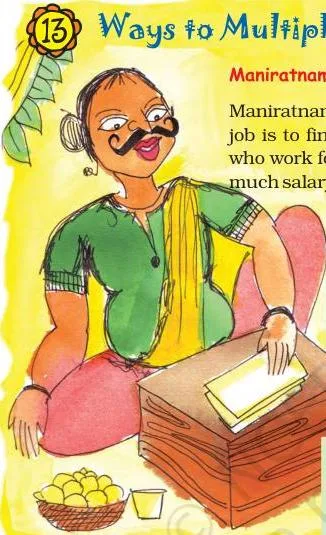
The salary chart above is the context for the whole method: Maniratnam must find how much the cook earns in January. The chapter shows 65 × 31 by writing 31 as 30 + 1, then multiplying 65 by 1 and by 30 separately, and adding the two partial products.
Here is the same method with new numbers. Suppose a worker earns ₹85 per day and works for 24 days.
- Step 1: Split 24 into tens and ones: \( 24 = 20 + 4 \).
- Step 2: Multiply each part separately:
\[ 85 \times 20 = 1700 \]
\[ 85 \times 4 = 340 \]
Step 3: Add the partial products.
\[ 1700 + 340 = 2040 \]
Final answer: The worker earns ₹2,040 in 24 days.
Why does this work? Because multiplication distributes over addition: \( 85 \times (20 + 4) \) is exactly the same as \( (85 \times 20) + (85 \times 4) \). Splitting just makes each small multiplication easier to do mentally. The chapter’s Bela’s-method practice sums (32 × 46 and 67 × 18) work the same way, with the partial products written one under the other.
Why the Zero Appears When Multiplying by 30
A place-value confusion hits almost every student here: when you multiply by 30, why does a zero appear in the ones column? Because 30 means 3 tens, so the product of any number × 30 belongs in the tens place, not the ones place.
The chapter shows this with Bhanu’s working for 195 × 31. He multiplies 195 × 1 to get 195, then multiplies 195 × 30: he writes a zero in the ones place first, then only multiplies 195 by 3. So \( 195 \times 30 = 5850\), not 585. The zero is a place-holder that keeps the 5850 in the correct columns when the two partial products are added.
- Step 1: \(195 \times 1 = 195\).
- Step 2: For \(195 \times 30\), write a zero in the ones column, then multiply \(195 \times 3 = 585\).
That zero turns 585 into 5850.
Step 3: Add the two partial products.
\[ 195 + 5850 = 6045 \]
Final answer: \(195 \times 31 = 6045\).
Key Concepts: Division as Repeated Subtraction
The chapter’s division idea is simple and powerful: division can be done by taking away equal chunks and counting how many chunks you took. More than one correct route works, and the chapter deliberately shows two children using different routes.
Dolma borrowed ₹9,588 to buy a moped and must repay it in equal monthly amounts over 6 months. Her daughter subtracts big chunks: 3000, 3000, 3000, 540 and 48. Her son starts differently, subtracting 6000 first. Both should reach the same answer — ₹1,598 each month — because the total subtracted is the same however you split it. The daughter’s chunks add up as:
\[ 500 + 500 + 500 + 90 + 8 = 1598 \]
Here is the same repeated-subtraction method with new numbers. Suppose a ₹2,700 loan is repaid over 5 months.
- Step 1: Start with ₹2,700 and subtract ₹500 five times: \(2700 – 500 – 500 – 500 – 500 – 500 = 200\).
- Step 2: The remaining ₹200 is less than ₹500, so it must be shared further: \(200 \div 5 = 40\).
- Step 3: Each month’s payment is \(500 + 40\).
\[ 500 + 40 = 540 \]
Final answer: Each monthly payment is ₹540. Check: \(540 \times 5 = 2700\).
Why both routes reach the same answer
Subtracting equal chunks in a different order does not change the total you end up subtracting. The daughter went 3000 + 3000 + 3000 + 540 + 48; a shortcut method would just divide 9588 ÷ 6 directly. All three are the same division — the chapter’s Practice Time (p. 11) asks students to try sums like 4228 ÷ 4 and 9872 ÷ 8 in as few steps as they can, which is the natural next step after repeated subtraction.
When Division Leaves a Remainder: the Picnic Buses
The chapter’s most important word-problem trap: what do you do with the leftover after division? The answer depends on the real-world situation.
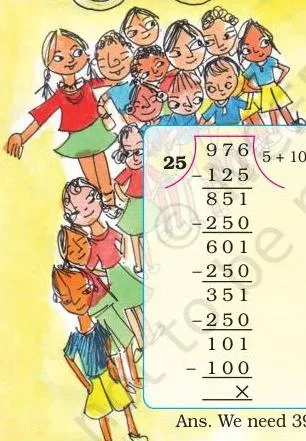
The problem: 976 children are going on a picnic, and 25 children fit in one bus. How many buses are needed? Division gives 39 buses with 1 child left over. But that leftover child still needs a bus — so you must take 40 buses.
- Step 1: Divide 976 by 25 repeatedly: \(976 – 25 \times 39 = 976 – 975 = 1\).
- Step 2: So 25 children fit into 39 full buses, and 1 child is left over.
- Step 3: The leftover child needs one more bus: \(39 + 1 = 40\).
Final answer: They need 40 buses — the chapter’s own second child got this right, while the first child forgot the remainder.
Which error is which? The first child’s working subtracts 125, 250, 250, 250 and 100, then stops at 1 leftover — but his answer says 39 buses, forgetting the remaining child. The second child’s working contains a simple multiplication slip (215 should be 225 in the subtraction), yet still arrives at the right practical answer of 40 buses.
The chapter’s teacher note explains: in the first attempt children often forget or do not understand the remainder; in the second there is a simple multiplication error, and the interesting question is whether the child has shown one extra bus for the one remaining child.
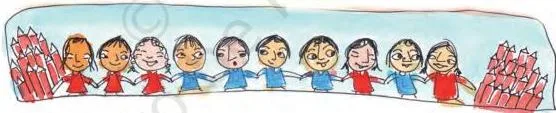
The Children’s Day pencil problem is the same idea in a shorter sum. The school has 969 pencils and gives 4 pencils to each child. The division works out as:
\[ 969 \div 4 = 242 \text{ remainder } 1 \]

242 children get 4 pencils each, and 1 pencil is left over. Here the remainder is simply reported — you do not add an extra “child” because a pencil is not a child. The remainder’s meaning depends entirely on the story.
Multiplication Patterns: 123 × 9 and the 142857 Cycle
This section shows the puzzle side of multiplication. Spotting a pattern can also help you check an answer — if the next line does not follow the pattern, something is wrong.
The \( 123 \times 9 \) pattern
The chapter’s first pattern is written in lines:
\[ (0 \times 9) + 1 = 1 \]
\[ (1 \times 9) + 2 = 11 \]
\[ (12 \times 9) + 3 = 111 \]
Each line adds one more digit to the left-hand number (0, 1, 12, 123, …), adds a number that increases by 1, and the answer gains an extra 1. So the next lines are:
\[ (123 \times 9) + 4 = 1111 \]
\[ (1234 \times 9) + 5 = 11111 \]
\[ (12345 \times 9) + 6 = 111111 \]
The 142857 rotation
The second puzzle gives the number 142857 and asks what happens when you multiply it by 1, 2, 3, 4 and 5. Work these out yourself and look closely:
\[ 142857 \times 2 = 285714 \]
\[ 142857 \times 3 = 428571 \]
\[ 142857 \times 4 = 571428 \]
\[ 142857 \times 5 = 714285 \]
The same six digits appear in every answer, just in a different order — they rotate around. This is a famous property of 142857, and noticing it is a useful way to check that a multiplication is right.
The \( aaa \) puzzle
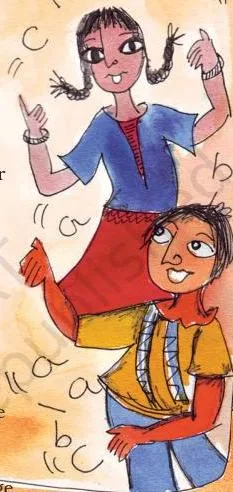
This puzzle is a first look at letters standing for numbers, which students will meet properly in algebra later. The layout shows \( aaa \times aaa \) with the product \( abcba \). If \( a = 1 \), then \( aaa = 111 \), and the working becomes:
\[ 111 \times 111 = 12321 \]
Which means \( b = 2 \) and \( c = 3 \). This is a beautiful pattern: \( 111 \times 111 \) produces 12321, a palindrome.
Word Problems: Heartbeats, Milk, Fields and Wages
This chapter turns multiplication and division into real quantities — and the single biggest skill is keeping the same unit throughout a calculation. Days become months, months become years; square metres get multiplied by a rate; litres get multiplied by days.
| Story problem | What it teaches | Unit to watch |
|---|---|---|
| Sohan drinks 8 glasses of water a day | Multiply a daily amount into a month and a year | Days → month → year |
| Soha’s heart beats 72 times a minute | Multiply a per-minute rate into an hour and a day | Minutes → hours → days |
| Baby elephant drinks 12 L milk a day | Multiply a daily amount over two years | Days → years |
| Karunya’s three fields | Area in square metres, then cost at a rate per square metre | Square metres × rate |
| Satish’s 17 goats | Earnings per goat per day, over a month and a year | Per goat × per day |
| Kamla Bai’s cow | Daily spending vs monthly milk income | Per day → per month |
| Milk-seller practice sums | Litres × rate per litre | Litres × ₹ per litre |
If Soha’s heart beats 72 times a minute, it beats \( 72 \times 60 = 4320 \) times in an hour, then \( 4320 \times 24 = 1,03,680 \) times in a day. The chapter then asks students to guess — an estimate — how many times it beats in a year, which trains the skill of estimating a large multiplication.
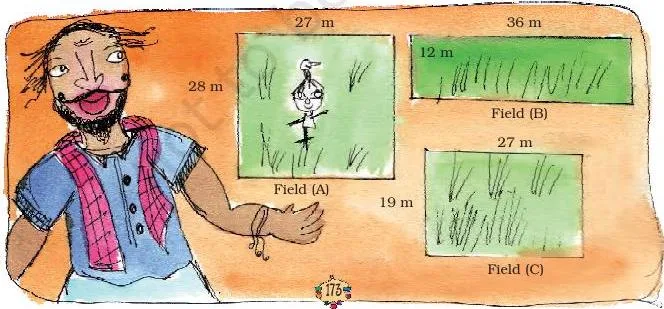
Karunya’s fields teach unit rate: the cost of one square metre. If one square metre costs ₹95, then the whole field costs area × 95. This is the same multiplication pattern as “milk per litre × litres” — a rate is just a cost for one unit, and multiplying by the number of units gives the total.
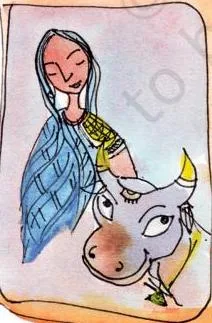
Kamla Bai’s cow gives 8 litres of milk every day. In one month (30 days) that is \( 8 \times 30 = 240 \) litres, and at ₹9 per litre she earns \( 240 \times 9 = ₹2,160 \) in a month. But she spends ₹85 a day on the cow, which is \( 85 \times 30 = ₹2,550 \) in a month — so she spends more than she earns, which is exactly why she wants to sell the cow.
Here is an original worked example with the same skill. Suppose a family uses 4 litres of milk a day for 15 days, and milk costs ₹11 per litre.
- Step 1: Total milk over 15 days: \( 4 \times 15 = 60 \) litres.
- Step 2: Cost at ₹11 per litre: \( 60 \times 11 = 660 \).
Final answer: The family spends ₹660 on milk in 15 days.
The chapter’s own “Find out” prompt on page 12 asks readers to check the price of petrol in their own city — a quick way to practise the same division (how many litres can you buy with ₹1000?) with local numbers.
Choosing the Right Question for a Story Problem
This is the reading skill the chapter is really about: deciding which question can be answered from the given facts. A story gives you certain information; some questions are answerable, others are not — no matter how good your multiplication is.
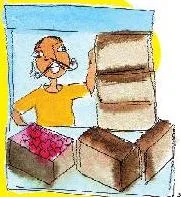
Take the first example: a shopkeeper has 50 boxes, and there are 48 fruits in one box. The ticked question is “How many fruits are there in all?” — which is \( 50 \times 48 = 2400 \). Question (a) asks how much the shopkeeper will pay, but the story never gives a price per box, so it cannot be answered.
Question (c) asks how many more boxes he will need, but the story gives no target number of fruits, so that cannot be answered either.
The same test applies to the other examples in this section:
- Tents: 352 children, 4 per tent → “How many tents?” is answerable (352 ÷ 4); “How many children in all are in the school?” is not (the trip is only part of the school).
- Eggs: 204 eggs, 12 per tray → “How many trays?” is answerable (204 ÷ 12); “How many more eggs?” and “How many fresh eggs?” are not given by the facts.
- Books: one book costs ₹47, Sonu buys 23 → “How much does she pay?” is answerable (23 × 47); “How much money does she have?” is not stated.
Before solving any story problem, ask: do the facts in the story give me this number? If not, that question is not a good choice — even if you could invent an answer.
Reading the Harisharan Pictures: Checking Division by Multiplication
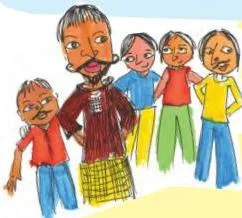
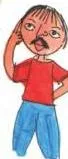
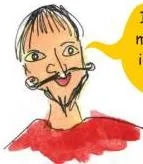
The chapter’s visual lesson on verification: every division can be checked by multiplying the quotient by the divisor (and adding the remainder, if there is one). The Harisharan story runs through four pictures as a mini storyboard.
Harisharan asks his eldest son to divide ₹2,456 among the 4 sons.
The son first says each will get ₹624. But when Harisharan starts giving out ₹624, there is not enough money — the wrong quotient fails the real-world test.
Harisharan checks by multiplication: \( 624 \times 4 = 2496 \), which is ₹40 more than ₹2456. The division must be wrong.
The son divides again: \( 2456 \div 4 = 614 \). Before telling his father, he checks on his own: \( 614 \times 4 = 2456 \). Now it is correct — each son gets ₹614.
The general check: multiply the answer (quotient) by the number you divided by (divisor).
\[ \text{quotient} \times \text{divisor} + \text{remainder} = \text{the original number} \]
Example: \( 614 \times 4 = 2456 \), so \( 2456 \div 4 = 614 \) is correct.
This is exactly what the chapter’s final Practice Time (p. 17) asks: do the divisions and check your results by multiplication.
Definitions Students Need for Chapter 13
Here are the plain-language meanings of the words this chapter uses, each tied to an example inside the book.
| Word | Plain meaning | Example from the chapter |
|---|---|---|
| Salary per day | How much a person earns for one day of work | The minister gets ₹195 a day; the horse rider ₹76; the cook ₹65 |
| Rate | Cost for one unit of something (one square metre, one litre, one day) | Karunya’s field at ₹95 per square metre; milk at ₹9 per litre |
| Area | The size of a surface, measured in square metres | Karunya’s three fields, each with an area in square metres |
| Quotient | The answer in a division — how many equal shares you get | 2456 ÷ 4 = 614, so the quotient is 614 |
| Remainder | What is left over after equal sharing | 969 ÷ 4 = 242 with remainder 1 (one pencil left) |
Common Mistakes in Ways to Multiply and Divide
The textbook itself flags the errors students make in this chapter. Here they are, named before you make them, with the fix for each.
| Mistake | Correct rule | How to check your answer |
|---|---|---|
| Forgetting the remainder in division (the first child’s picnic answer of 39 buses) | The leftover child still needs a bus, so add 1 to the quotient | Read the question again: does it ask for a number that must cover everyone? If yes, round up. |
| A simple multiplication slip inside a subtraction step (the second child’s 215 instead of 225) | Check each subtraction separately as you go, not only at the end | Add the amount you subtracted to the remainder; you should get the number you started that step with. |
| Not adding one extra bus for the remaining child | In real life, a leftover person cannot be left behind — round up to the next whole bus | Ask: does the story allow a partial bus? If not, round up. |
| Choosing a question the story cannot answer | Only pick a question whose facts appear in the story | Point to the exact number in the story that would let you answer; if you cannot, the question is not a good choice. |
| Failing to check a division answer by multiplication | Multiply quotient × divisor, then add the remainder, and compare with the original number | 614 × 4 = 2456, so 2456 ÷ 4 = 614 is correct; 624 × 4 = 2496, so 624 is wrong. |
How to Practise Ways to Multiply and Divide
Practise in the order the chapter itself teaches, because each idea builds on the one before it.
- Bela’s-method practice first (p. 2): 32 × 46, 67 × 18, then 47 × 19, 188 × 91 and the other listed sums — write every partial product.
- Then the salary and yearly sums (pp. 3–8): Shantaram’s 165 × 365, Sohan’s glasses, Soha’s heartbeats, Satish’s goats and Kamla Bai’s cow — practise keeping the unit (day → month → year) consistent.
- Then division practice (pp. 10–11): Dolma’s moped loan by repeated subtraction, then the fewest-steps sums like 4228 ÷ 4 and 770 ÷ 22.
- Then the story-problem test (p. 15): for each story, say which question is answerable and which is not, before calculating.
- Finally, the division grid puzzle (p. 17): solve each sum, colour the answers in the grid, and see what picture appears.
Make checking a habit: the chapter itself teaches that a division is only trustworthy after you verify it by multiplication. Note also that textbook contents and the examinable syllabus are not always identical — check the current official syllabus for what is examinable this session.
What to Remember from Ways to Multiply and Divide
The chapter closes with a division grid puzzle rather than a printed summary, so this recap follows the chapter’s own teaching order, in original words.
- Split to multiply: break a number into tens and ones, multiply each part, then add (Bela’s method). For 31, multiply by 1 and by 30 separately.
- Place a zero when multiplying by tens: 195 × 30 needs a zero in the ones column first, then 195 × 3 — the product is 5850, not 585.
- Division is repeated subtraction: take away equal chunks and count them; different chunk sizes still reach the same quotient (the daughter’s and son’s ways on ₹9,588).
- Remainders mean something in real contexts: 976 children need 40 buses (39 full plus 1 for the leftover child); 969 pencils give pencils to 242 children with 1 pencil left.
- Multiplication patterns help check answers: (123 × 9) + 4 = 1111, (1234 × 9) + 5 = 11111, and 142857 × 2, 3, 4, 5 all rotate the same six digits.
- Check division by multiplication: \( 614 \times 4 = 2456 \), so 2456 ÷ 4 = 614 is correct — before you tell anyone the answer, verify it.
Related Resources for Class 5 Maths
This listing is maintained for the 2026-27 academic session using the NCERT textbook information available to us. NCERT remains the authority for confirming the latest edition.
Continue with the rest of the Math-Magic book: Class 5 Mathematics notes and chapter resources cover the whole book, and the Class 5 study hub groups every subject.
For the chapters next to this one, see Chapter 12, Racing Seconds (on before you reached this chapter) and Chapter 14, How Big? How Heavy? which follows it.
Sources and Data Verification
The figures on this page describe the NCERT Class 5 Mathematics Math-Magic textbook, Chapter 13, official edition on ncert.nic.in — the same file linked at the top. NCERT settles textbooks, editions and PDFs; CBSE settles the syllabus and examinations. This page is maintained for the current academic session using the NCERT information available to us.
| What the chapter holds | Count | Where it is used |
|---|---|---|
| Printed pages | 17 | |
| Figures with NCERT captions | 14 | |
| Tables | 9 | |
| Activities | 1 | |
| Official NCERT PDF | Download the chapter PDF | the chapter exactly as NCERT publishes it |
FAQs about Ways to Multiply and Divide Class 5
How do you use Bela’s method to multiply 67 × 18?
Split 18 into 10 and 8. Multiply 67 by 10 to get 670, and 67 by 8 to get 536. Add the two partial products: \( 670 + 536 = 1206 \). So 67 × 18 = 1206. The chapter’s Bela’s-method layout writes one partial product (67 × 8) and the other (67 × 10 = 670) one below the other, then adds.
Why do we write a zero when multiplying 195 by 30?
Because 30 means 3 tens. The product of 195 × 3 is 585, but that is 585 tens, not 585 ones. Writing a zero in the ones column first turns 585 into 5850, which keeps the place values correct when you add it to 195 × 1 = 195. So \( 195 \times 31 = 195 + 5850 = 6045 \).
How many buses are needed for 976 children going on a picnic?
25 children fit in one bus. Dividing 976 by 25 gives 39 full buses with 1 child left over. Since that leftover child still needs a bus, you need 39 + 1 = 40 buses. The chapter’s first child forgot the remainder; the second child got the right practical answer.
How can you check that 2456 ÷ 4 = 614 is correct?
Multiply the quotient by the divisor: \( 614 \times 4 = 2456 \). Because the product equals the original number, the division is correct. The chapter contrasts this with the wrong quotient 624, for which \( 624 \times 4 = 2496 \) — too much, which is why Harisharan ran out of money.
In Kamla Bai’s story, which is more — money spent on the cow or money earned from milk?
Money spent is more. She spends ₹85 a day, which is \( 85 \times 30 = ₹2,550 \) in a month. The cow gives 8 litres of milk a day, so 240 litres in a month, sold at ₹9 per litre: \( 240 \times 9 = ₹2,160 \). She earns ₹2,160 but spends ₹2,550, so she loses ₹390 in a month — which explains why she wanted to sell the cow.
Reference: NCERT Class 5 Mathematics Math-Magic textbook, chapter 13, official edition on ncert.nic.in.
Explore Class 5 Mathematics Books
- Previous: Racing Seconds
- Next: How Big? How Heavy?
Related chapters: