
Parts and Wholes Class 5 is Chapter 4 of the NCERT Class 5 Mathematics textbook Math-Magic — 21 printed pages (book pages 49-70) of fraction activities, from drawing the Indian flag to a late train at the railway station.
The official NCERT chapter PDF is linked right below, and the rest of this page walks through what is inside, activity by activity, so you can jump straight to the part you are stuck on.
Download the Parts and Wholes Class 5 chapter PDF
The Parts and Wholes Class 5 NCERT Math-Magic Chapter 4 PDF is the official chapter file from ncert.nic.in — the same 21 pages the printed book numbers 49 to 70, so every page number used below matches the copy in a student’s hand. Open it in any browser or PDF reader; there is no login and no special app needed.
What is inside Parts and Wholes
This chapter teaches fractions by doing: drawing flags, sharing chocolate, cutting halwa, spinning a magic top and colouring circles. There is no wall of definitions — every idea arrives through an activity.
| What the chapter holds | Count |
|---|---|
| Sections (activities, games and puzzles) | 30 |
| Figures and pictures | 20 |
| Worked examples | 0 |
| Exercise questions | 0 |
The book’s questions are woven into the activities themselves rather than collected in one exercise set at the end — each activity asks its own questions as you go.
| Phase of the chapter | What it teaches | Book pages |
|---|---|---|
| 1. Recognising fractions | Flags, chocolate, hats, triangles, rectangles | 49-54 |
| 2. Equivalent fractions | Grids, coloured parts, halwa, strips | 57-64 |
| 3. Fractions in real life | Paise, the camel will, time, shopping, distance | 65-70 |
How Parts and Wholes teaches fractions, activity by activity
Here is the chapter in the book’s own order, with the printed page where each activity starts. If a teacher has said “look at the halwa page”, this list finds it in seconds.
- Our Flag — the Indian flag as three equal bands of saffron, white and green (pp. 49-50).
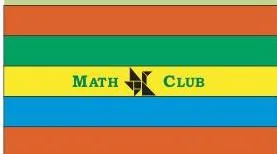
- Find out — collecting flags and designing a Math Club flag (p. 51).
- Magic Top — a cardboard circle cut into eighths (p. 52).
- Manju’s chocolate — one-fourth, one-third and one-sixth of a bar (p. 52).
- Colour the hats — fractions of a set of hats (p. 53).
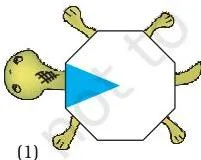
- Equal parts of a triangle and Six parts of a rectangle (pp. 53-54).
- Discuss — is one-sixth of the big rectangle bigger than one-sixth of the blue one? Plus the Birbal gatekeeper story, whose shares one-tenth, two-fifths and one-half absorb the whole prize (pp. 54-56).
- Patterns in Parts — 16-square grids showing \( \frac{8}{16} = \frac{1}{2} \) (p. 57).
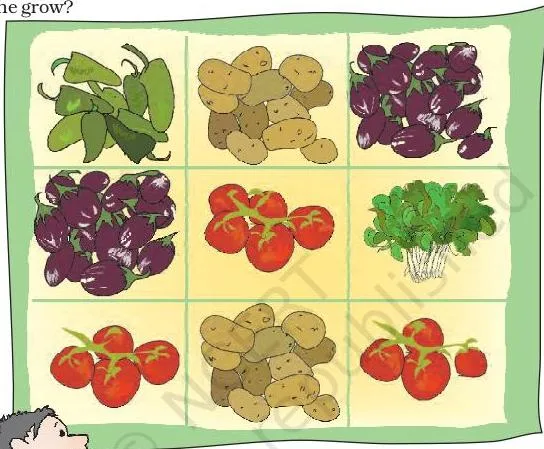
- Ramu’s Vegetable Field — ninths of a field (pp. 58-59).
- Who Colours the Circle First? and The Card Puzzle — ordering fraction tokens and dividing a square into 2, 3, 4 and 7 equal parts (pp. 60-61).
- Coloured Parts, Cutting the Halwa, Parts of the Strip — the equivalence chain \( \frac{1}{2} = \frac{2}{4} = \frac{3}{6} = \frac{4}{8} \) (pp. 62-64).
- From a Part to the Whole and Rupees and Paise (p. 65).
- An Old Woman’s Will — the 19-camel puzzle (p. 66).
- Arun’s Time Table — fractions of 24 hours (p. 67).
- School Magazine and Sleeping Beauty! — fractions of a year (p. 68).
- Keerti’s Shopping List, Raheem’s journey, What coins?, At the railway station — mixed quantities like \( 2\frac{1}{2} \) in money, distance and time (pp. 69-70).
The order is the chapter’s teaching design: first you picture parts (flags, chocolate), then you rename parts in different ways (equivalence), and only then do you meet fractions inside daily life — money, clock time and shopping.
The five fraction ideas at the heart of Parts and Wholes
A fraction in this chapter always answers one question: a part of what? The answer is always equal parts of a whole object (a flag, a circle) or of a whole collection (hats, chocolate pieces). Hold on to that “part of what?” and every activity in the chapter starts to make sense.
Idea 1: a fraction names one of the equal parts of a whole
The very first activity draws the Indian flag as a rectangle 9 cm long and 6 cm wide, divided into three equal bands (NCERT, p. 49). One band is one-third of the flag: 1 part out of 3 equal parts, written \( \frac{1}{3} \). Saffron, white and green are each one-third.
Now look at the two rectangles on p. 54. The green rectangle is bigger than the blue one, yet both are cut into six equal parts. Equal parts means equal size, not identical shape — that is why one-sixth of the green rectangle is larger than one-sixth of the blue rectangle.
A fraction has no size of its own until you say whose whole it is a part of.
Idea 2: a fraction can name part of a collection
Manju’s chocolate (p. 52), the hats (p. 53) and Ramu’s field (pp. 58-59) treat the whole as a set of objects. To find a fraction of a collection, split the collection into equal groups first.
Try it with a new example. Suppose a 24-piece chocolate bar is shared in three ways — one-third, one-fourth and one-eighth of the bar.
- Step 1: One-third of 24 pieces: \( 24 \div 3 = 8 \) pieces.
- Step 2: One-fourth of 24 pieces: \( 24 \div 4 = 6 \) pieces.
- Step 3: One-eighth of 24 pieces: \( 24 \div 8 = 3 \) pieces.
\[ 8 + 6 + 3 = 17 \text{ pieces shared, so } 24 – 17 = 7 \text{ pieces are left.} \]
Final answer: the shares are 8, 6 and 3 pieces, and the leftover 7 pieces are \( \frac{7}{24} \) of the whole bar.
Idea 3: different fractions can name the same amount
Four activities build the same chain. The coloured circles (p. 62) let you read \( \frac{1}{2} = \frac{2}{4} = \frac{3}{6} = \frac{4}{8} \) straight off the pictures. Cutting the halwa (p. 63) halves the halves: \( \frac{1}{2} = \frac{2}{4} = \frac{4}{8} \). The fraction strip (p. 64) asks you to count: two one-fourths make a half, two eighths make a quarter, four eighths make a half.
The 16-square grid (p. 57) shows \( \frac{8}{16} = \frac{1}{2} \).
Why does this work? When you cut every part into two smaller equal parts, the top number (the part count) and the bottom number (the total count) both double. The amount you are talking about never changes — only its name. The book’s own wording is equivalent fractions: different fraction names for the same amount (p. 64).
Idea 4: from one part you can rebuild the whole
The activity From a Part to the Whole (p. 65) works backwards. If one-fifth of a flower is drawn, the complete flower has five such petals. If one-third of a fan is shown, the fan has three blades. If half the blades are shown, the whole fan has double that number.
The rule in one line: the whole is the number of equal parts multiplied by the size of the shown part. Drawing the missing petals, blades or fan parts is exactly that multiplication on paper.
Idea 5: fractions sit inside real things — money, time and distance
From p. 65 onward, fractions stop being only shapes. In money: 100 paise make a rupee, so 50 paise is one-half, 25 paise is one-fourth, 20 paise is one-fifth and 10 paise is one-tenth of a rupee (p. 65). In time: 24 hours make a day, so one-third of a day is 8 hours, one-fourth is 6 hours and one-eighth is 3 hours (p. 67).
A quarter of a year is 3 months, so a quarterly magazine comes out 4 times a year — at the end of March, June, September and December (p. 68).
Mixed quantities like \( 2\frac{1}{2} \) kg mean two whole kilograms plus half a kilogram (p. 69). Here is a price example with new numbers.
Step 1: Two and a half kilograms at twenty rupees per kilogram: \( 2 \times 20 = 40 \) and \( \frac{1}{2} \times 20 = 10 \).
\[ 40 + 10 = 50 \]
Step 2: Three quarters of a kilogram at twenty-four rupees per kilogram: one-quarter of 24 is 6, so three-quarters is \( 3 \times 6 = 18 \).
Final answer: \( 2\frac{1}{2} \) kg costs ₹50 and \( \frac{3}{4} \) kg costs ₹18.
Distance works the same way: Raheem’s \( 1\frac{1}{4} \) km walk to school means \( 2\frac{1}{2} \) km for the trip there and back (p. 70).
Reading the pictures in Parts and Wholes
In this chapter most activities come with a picture, and the picture is the problem. Each figure below is one of the chapter’s key diagrams, with what to look for in it.
Flags: finding the fraction in a design
The Afghanistan flag on p. 50 asks you to guess how much of it is black, then decide whether the red part is more than \( \frac{1}{2} \) and more than \( \frac{3}{4} \).
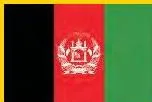
The Math Club flag on p. 51 is a division puzzle: count the equal parts of the design, then say what part is red and what part is green. Both flags make the same point — you cannot name a fraction until the design is split into equal parts.
A magic top and a chocolate bar: fractions as counts of pieces
The magic top (p. 52) starts with a cardboard circle of radius 3 cm cut into 8 equal parts — so each part is \( \frac{1}{8} \). You then colour \( \frac{2}{8} \) red, \( \frac{1}{8} \) orange and \( \frac{1}{8} \) yellow. Here the fractions are simply counts of equal wedges.
Manju’s chocolate (p. 52) works the same way on a bar: the drawing divides the bar into equal pieces, so one-fourth, one-third and one-sixth become counts of pieces, and the unmarked part is the piece Manju ate. To read either picture, find the equal divisions first, then count.

Same fraction, different whole: the two rectangles
This is the chapter’s clearest answer to “a fraction has no size until you name its whole.”
Both rectangles are cut into six equal parts. Is \( \frac{1}{6} \) of the green rectangle bigger than \( \frac{1}{6} \) of the blue one? Yes — because one-sixth of a bigger whole is a bigger part (NCERT, p. 54).
Grids, triangles and circles: seeing the same fraction twice
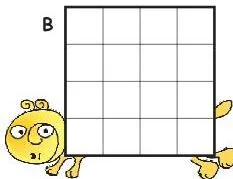
Grid A on p. 57 is 16 squares, 8 blue and 8 white. That is \( \frac{8}{16} \) blue and \( \frac{8}{16} \) white — in other words \( \frac{1}{2} \) and \( \frac{1}{2} \). The chapter then lists four descriptions and asks which one is wrong; “\( \frac{3}{8} \) blue, \( \frac{5}{8} \) white” is the wrong one, because \( \frac{3}{8} \) of 16 squares means only 6 squares.
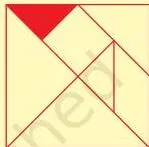
The triangle picture on p. 62 asks what part of the square the red small triangle is: divide the big shapes into small triangles like the red one and count how many fit. The coloured circles beside it spell the chain \( \frac{1}{2} = \frac{2}{4} = \frac{3}{6} = \frac{4}{8} \). All three pictures show the same amount wearing different names.
The fraction strip: counting how many small parts fit
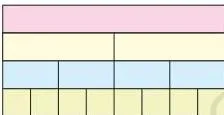
The strip on p. 64 is divided into halves, quarters and eighths, and the question is always “how many small parts fit into a bigger part?” By counting on the strip: two one-fourths make a half, two eighths make a quarter, four eighths make a half.
The book then asks you to invent your own questions on the same picture — a good habit, because asking “how many eighths make a half?” is the whole idea of equivalence.
Petals and fan blades: from a part back to the whole
These two pictures on p. 65 are the reverse of every earlier one: you are given one part and must build the whole.

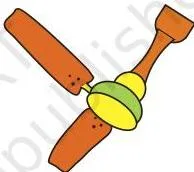
One-fifth of the flower is drawn, so the whole flower has five such petals. Half of the fan’s blades are drawn, so the whole fan has twice as many blades as you can see. In both, multiply the shown part by the number of equal parts in the whole.
The late train: reading fractions on a clock
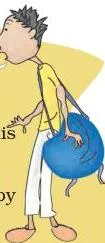
The final picture is a railway station (p. 70). The train is due at “a quarter to 7”, Nazia gets off after \( 2\frac{1}{2} \) hours, and Shaji reaches Ernakulam after 5 hours. Count on the clock face:
- A quarter to 7 is 6:45.
- \( 2\frac{1}{2} \) hours after 6:45 is 9:15 — two full hours take you to 8:45, half an hour more is 9:15.
- 5 hours after 6:45 is 11:45 — clock-wise: 7:45, 8:45, 9:45, 10:45, 11:45.
Fraction words the chapter uses, in plain language
The chapter teaches fractions in words and pictures first, so it never needs the formal words numerator or denominator. This table collects the words it does use.
| Word the book uses | What it means here | Where it appears |
|---|---|---|
| equal parts | Parts of the same size — the only rule before a fraction can be named | p. 49 |
| one-third, one-fourth, one-fifth, one-sixth, one-eighth | 1 part out of N equal parts | pp. 49-54 |
| the whole | The full object (flag, circle) or full set (hats, chocolate) you take a fraction of | pp. 49, 52 |
| part of a whole vs part of a collection | Fractions work on one object and on sets of objects | pp. 52-53 |
| equivalent fractions | Different fraction names for the same amount, like \( \frac{1}{2} = \frac{2}{4} = \frac{3}{6} = \frac{4}{8} \) | p. 64 |
| quarter | One of four equal parts; a quarter of a year is 3 months | p. 68 |
| quantities like \( 2\frac{1}{2} \) kg | A whole plus a fraction of a whole | p. 69 |
Where students slip up in Parts and Wholes
The chapter plants its own traps in the discussion questions. Knowing them is half the learning.
| The mistake | The correct idea | How to check your answer |
|---|---|---|
| Thinking equal parts must be identical in shape. | They only need equal size — the triangle puzzle (p. 53) and the Card Puzzle (pp. 60-61) use parts of different shapes that are still equal. | Fold or trace one part and place it on another. |
| Comparing fractions of different wholes. | \( \frac{1}{6} \) of the green rectangle is bigger than \( \frac{1}{6} \) of the blue one, because the green whole is bigger (p. 54). | Always ask “a fraction of what whole?” |
| Finding a fraction of a set without the total. | One-third of a set means the set split into three equal groups (p. 53). | Count the whole set first, then divide. |
| Adding unlike fractions by adding the top numbers and the bottom numbers. | Rename to fifteenths: \( \frac{1}{3} = \frac{5}{15} \) and \( \frac{3}{5} = \frac{9}{15} \), so \( \frac{14}{15} \) of the hats are coloured and \( \frac{1}{15} \) is not (p. 53). | Add the coloured parts: 5 + 9 = 14 out of 15 hats. |
| Believing the camel will works by ordinary division of 19. | \( \frac{1}{2} + \frac{1}{4} + \frac{1}{5} = \frac{19}{20} \), not one whole. The aunt’s 20th camel is borrowed, used for the shares 10, 5 and 4, and returned (p. 66). | Check that 10 + 5 + 4 = 19 camels, with one camel left over. |
| Reading the white band of the Indian flag as “a little less than one-third” from the drawing itself. | The three equal bands make white exactly \( \frac{1}{3} \) of the area; the book notes the blue chakra inside the white band is what makes it look a little less (p. 50). | Trace the three bands onto paper — they match exactly. |
Using Parts and Wholes for test preparation
Class 5 has no board exam — tests are set by the school, and textbook contents and the examinable syllabus are not always identical, so check the current official syllabus. Within that, this chapter’s own practice tasks are the standard asks at this level:
- Write the fraction for a shaded part — the flags, grids and circles.
- Complete equivalence chains like \( \frac{1}{2} = \frac{?}{4} = \frac{?}{6} = \frac{?}{8} \) (p. 62).
- Find a fraction of a number — one-fourth of 12 hats, one-third of 24 hours (pp. 53, 67).
- Rebuild the whole from one part — petals and fan blades (p. 65).
- Money and time word problems with mixed quantities like \( 2\frac{1}{2} \) kg and “a quarter to 7” (pp. 69-70).
Use the book’s concrete methods — folding paper, cutting strips, tracing parts. A student who can show \( \frac{1}{2} = \frac{2}{4} \) with a strip understands it; one who only memorises the chain does not. And take part in the games — Who Colours the Circle First? and The Card Puzzle (pp. 60-61) — because ordering and naming fractions is exactly what they train.
The whole chapter in one read
This chapter prints no summary box, so the ten points below collect its main ideas from the activities.
| Idea | Page |
|---|---|
| A fraction names equal parts of a whole — the flag is three equal bands | p. 49 |
| The same fraction can name part of a set — hats and chocolate | pp. 52-53 |
| Equivalent fractions name one amount — \( \frac{1}{2} = \frac{2}{4} = \frac{3}{6} = \frac{4}{8} \) from circles, halwa and the strip | pp. 62-64 |
| From one part you rebuild the whole — petals and fan blades | p. 65 |
| Paise are fractions of a rupee: 50 p = \( \frac{1}{2} \), 25 p = \( \frac{1}{4} \) | p. 65 |
| The Birbal gatekeepers’ shares one-tenth, two-fifths and one-half add up to exactly one full prize | p. 56 |
| The camel will needs a borrowed camel because \( \frac{1}{2} + \frac{1}{4} + \frac{1}{5} = \frac{19}{20} \) | p. 66 |
| One-third of a day is 8 hours | p. 67 |
| A quarter of a year is 3 months — so 4 magazines a year, and 8 hours a night for 60 years is 20 years asleep | p. 68 |
| Mixed quantities like \( 2\frac{1}{2} \) kg in shopping, and a \( 1\frac{1}{4} \) km trip is \( 2\frac{1}{2} \) km there and back | pp. 69-70 |
Related chapters and resources
This listing is maintained for the 2026-27 academic session using the NCERT textbook information available to us. NCERT remains the authority for confirming the latest edition.
If you are working through Math-Magic in order, the previous chapter, How Many Squares?, folds paper into halves and quarters — the very fractions this chapter names. The following chapter, Does it Look the Same?, is about symmetry, and a shape that looks the same after a half-turn or quarter-turn is practising halves and quarters again.
The Class 5 Math-Magic book page lists every chapter of this book, and the Class 5 hub links the NCERT books for all Class 5 subjects.
For a quicker recap, the Class 5 mathematics notes and the Class 5 notes hub (from the notes index) keep the same ideas in short form; the angles-as-turns notes connects quarter-turns to fractions, and the Does it Look the Same? notes turns the symmetry chapter into quick revision.
Sources and data verification
This page describes the NCERT Class 5 Mathematics textbook Math-Magic, Chapter 4, Parts and Wholes — book pages 49-70 of the current NCERT edition available on ncert.nic.in.
It covers Chapter 4 only, not the rest of Math-Magic or other Class 5 subjects.
It is maintained for the current academic session using the NCERT information available to us.
NCERT settles textbook editions and official PDFs; CBSE settles the curriculum, syllabus and examinations.
| What the chapter holds | Count | Where it is used |
|---|---|---|
| Printed pages | 21 | |
| Figures with NCERT captions | 19 | |
| Tables | 2 | |
| Activities | 1 | |
| Official NCERT PDF | Download the chapter PDF | the chapter exactly as NCERT publishes it |

Reference: NCERT Class 5 Mathematics textbook, chapter 4, official edition on ncert.nic.in.
Parts and Wholes Class 5: common questions
How does the 19-camel will problem in Parts and Wholes work?
It works because half plus one-fourth plus one-fifth is nineteen-twentieths, not one whole (NCERT, p. 66): \( \frac{1}{2} + \frac{1}{4} + \frac{1}{5} = \frac{10}{20} + \frac{5}{20} + \frac{4}{20} = \frac{19}{20} \). The aunt lends her camel, the daughters divide 20 camels into shares of 10, 5 and 4, the shares add back to 19, and the aunt takes her camel home.
What part of the Indian flag is white?
The white band is one-third of the flag, because the rectangle drawn on p. 49 is divided into three equal bands. The book adds a discussion point: the blue chakra inside the white band makes the white appear a little less than one-third (p. 50).
How many hours does Arun sleep, study and play in the time table problem?
Arun sleeps 8 hours, studies 6 hours and plays 3 hours (NCERT, p. 67): one-third of 24 is 8, one-fourth is 6 and one-eighth is 3. That uses 17 of the 24 hours, so the remaining 7 hours are \( \frac{7}{24} \) of the day.
Is half of half equal to one-third of three-quarters?
Yes (NCERT, p. 64). Half of half is one-fourth. And one-third of three-quarters is one quarter: share the three quarters among three people, and each gets one quarter. So both are \( \frac{1}{4} \) — Ammini is right.
How many magazines does the school bring out in a year?
Four. A quarter of a year is 3 months, so a magazine “every quarter of the year” means one at the end of March, June, September and December (NCERT, p. 68).
Where can I download the official Parts and Wholes Class 5 PDF?
The official Parts and Wholes Class 5 PDF is the NCERT chapter file linked near the top of this page — the same 21 pages, book pages 49-70, as the printed Math-Magic book, so activity and page references match any printed copy.
Explore Class 5 Mathematics Books
- Previous: Angles as Turns
- Next: Does it Look the Same?
Related chapters: