
This is the official Can You See the Pattern? Class 5 NCERT chapter — Chapter 7 of the Math-Magic book. The chapter runs 13 printed pages and is a tour of pattern puzzles: turning blocks, magic squares and hexagons, palindromes, calendar tricks and secret-number clues.
The official chapter PDF is right here, and each pattern rule from the chapter is explained below in plain words.
If you want to follow the activities with the original NCERT pages in front of you, download the Can You See the Pattern? Class 5 NCERT PDF from the official NCERT textbook portal. That is the same source your school’s Math-Magic copy is printed from, chapter by chapter.
Chapter at a Glance
The table below lists how much this chapter holds, so you know what you are opening before you download it.
| What the chapter holds | Count |
|---|---|
| Printed pages | 13 |
| Named sections | 15 |
| Figures (diagrams and pattern pictures) | 12 |
| Number patterns and equations | 9 |
| Separate exercise blocks | 0 — the practice sits inside the sections themselves |
What This Chapter Covers
This chapter is a tour of patterns — first in shapes, then in numbers. The same small block or the same rule keeps returning, and your job is to spot what stays the same and what changes.
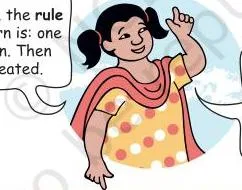
The chapter opens with Isha’s skirt, whose rule is one up, one down, and her brother’s kurta, whose rule repeats the same block with a quarter turn each time. Two fabrics, one block, two different patterns — that is the whole chapter in one picture.
- Shape patterns and turns: the opening skirt-and-kurta conversation, Turns and Patterns, Practice Time and Look for a Pattern — deciding the rule of a pattern, continuing it, and finding the picture that breaks it.
- Magic arrangements: Magic Squares and Magic Hexagons — filling empty cells so every line obeys the same rule.
- Number properties and patterns: Numbers and Numbers, Left Right — Same to Same, Calendar Magic, Some More Number Patterns, Smart Adding and Fun with Odd Numbers — order of addition, palindromes, calendar sums and odd-number sums.
- Puzzles and tricks: Secret Numbers and Number Surprises — clue puzzles that filter down to one number, and tricks that return your own number.
Figure Walkthrough: Reading the Pictures in the Chapter








The pictures in this chapter are not decoration — each one carries the rule you are expected to learn. Read each picture here, then look at it again in your own book.
The same block, two rules
Look at the skirt picture first. One block sits upright, the next sits one step down, then upright again — the sentence one up, one down repeated across the fabric. The rule is the whole pattern.
The kurta picture keeps the same starting block but changes the rule: once up, then a one-fourth turn before the next repeat. The block never changes — only the rule does — which is why the two fabrics look completely different.
Three turn rules
The Turns and Patterns section turns that same block clockwise by three different amounts to build three patterns. Each picture shows the block after every repeat.
Rule 1 turns the block by \( \frac{1}{4} \) of a full turn — a right angle — at every step, so the block faces a new direction each time it appears.
Rule 2 turns the block by \( \frac{1}{2} \) of a full turn, which lands it upside down. You can think of a half turn as flipping the block top to bottom.
Rule 3 turns the block by \( \frac{3}{4} \) of a full turn — three right angles. It lands in the same final position as a one-fourth turn in the other direction, which is why the book allows anticlockwise answers too.
The 45-degree rule
This Practice Time picture turns the block by only \( 45^\circ \) — half of a right angle — at each step. The tempting block that has jumped by \( 90^\circ \) breaks the rule. Keep applying the rule until you get back where you started: \( 45^\circ \times 8 = 360^\circ \), a full circle, so the block returns home after eight steps.
Magic arrangements
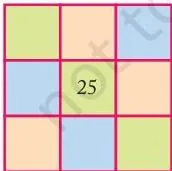
The first magic square picture is a \( 3 \times 3 \) grid to be filled with the numbers 46 to 54. Every line must add to 150 — and the centre cell is the quiet key: it holds the middle number, 50.
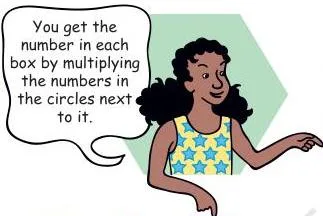
The hexagon picture shows the rule in numbers: the circles 5 and 13 sit next to the box, and \( 5 \times 13 = 65 \) sits inside it. On every side, the box holds the product of the two circles beside it.
Palindromes in pictures
The first palindrome picture shows the method working in one step: 43 reversed is 34, and \( 43 + 34 = 77 \). The book calls 77 a special number — a number that reads the same from both ends.
The second picture shows 48 failing at first — \( 48 + 84 = 132 \) is not special — and then succeeding: \( 132 + 231 = 363 \). Some numbers need more than one step.
The odd-number and secret-number figures
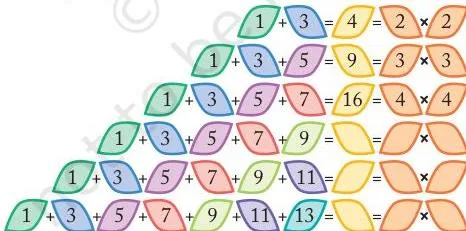
The odd-number picture starts at 1, adds the next odd number 3 to get 4, then 5 to get 9, then 7 to get 16. The answers 1, 4, 9, 16 are square numbers — that is the pattern to notice.
The secret-number picture is the clue card of Banno’s puzzle. The last clue — the digits together have a sum of 11 — is the filter that picks the single number out of the candidates.
Turning a Block into a Pattern: Quarter, Half and Three-Quarter Turns
The key idea of this chapter is that a pattern is a rule plus a repeat. Change the rule and the whole design changes, even when the block stays the same.
- One-fourth turn — turn the block by \( \frac{1}{4} \) of a full circle (a right angle).
- Half turn — turn it by \( \frac{1}{2} \) of a full circle, so it ends upside down.
- Three-fourth turn — turn it by \( \frac{3}{4} \) of a circle, which lands exactly where a one-fourth turn the other way would.
- 45-degree turn — turn it by \( 45^\circ \), only half of a right angle, at every step.
The book’s note to teachers says that answers obtained by anticlockwise turns should also be accepted and discussed. So a pattern can have more than one correct rule — what matters is that the rule you state explains every picture in the row. Use the figure walkthrough above as your picture reference for these turns.
Magic Squares and Magic Hexagons
A magic square is a square where every line — each row, each column and each diagonal — adds to the same total. The section opens by recalling the magic triangles of an earlier class, then sets two squares to fill: numbers 46 to 54 with every line totalling 150, and numbers 21 to 29 with every side totalling 75.
There is a shortcut for a \( 3 \times 3 \) square made from consecutive numbers: put the middle number of the list in the middle cell, and every line totals 3 times that number. The two squares use 50, so \( 3 \times 50 = 150 \), and 25, so \( 3 \times 25 = 75 \).
Try an original square with the numbers 2 to 10. The middle number is 6, so every line must total \( 3 \times 6 = 18 \). One working arrangement is:
| 9 | 2 | 7 |
| 4 | 6 | 8 |
| 5 | 10 | 3 |
Check the grid: rows \( 9 + 2 + 7 = 18 \), \( 4 + 6 + 8 = 18 \), \( 5 + 10 + 3 = 18 \); columns \( 9 + 4 + 5 = 18 \), \( 2 + 6 + 10 = 18 \), \( 7 + 8 + 3 = 18 \); diagonals \( 9 + 6 + 3 = 18 \) and \( 7 + 6 + 5 = 18 \). Every line gives the same total.
The magic hexagon works differently: on each side, the box holds the product of the two circle numbers beside it. The filled example shows \( 5 \times 13 = 65 \). After filling the empty hexagons, the book asks you to design your own. It also notes that a hexagon is a six-sided closed figure and that this discussion is not to be evaluated.
Numbers and Numbers: Why Order Does Not Change the Sum
This section is about a number habit worth keeping for life: when you add, the order of the numbers does not change the answer. The chapter prints two equalities to test — \( 24 + 19 + 37 = 37 + 24 + 19 \) and \( 215 + 120 + 600 = 600 + 215 + 120 \) — and both are true.
Because several different fillings of the blanks that follow give correct answers, more than one answer can be right. The chapter’s note to teachers says to discuss this point: changing the order of numbers makes no difference to the sum.
The same habit holds for multiplication. Check \( 48 \times 13 = 13 \times 48 \), then try an original pair: \( 156 + 89 + 44 = 44 + 156 + 89 = 289 \), and \( 25 \times 12 = 12 \times 25 = 300 \).
Palindromes: Left Right — Same to Same
A palindrome is a word or number that reads the same from both ends — left to right and right to left. The chapter shows a method that turns almost any number into one: reverse it, add, and repeat.
The book’s path starts with 43: reversed it is 34, and \( 43 + 34 = 77 \), a palindrome in one step. Then 48: \( 48 + 84 = 132 \), not a palindrome yet, but one more step saves it — \( 132 + 231 = 363 \).
Try 69 with the same method: \( 69 + 96 = 165 \), \( 165 + 561 = 726 \), \( 726 + 627 = 1353 \), \( 1353 + 3531 = 4884 \) — a palindrome after four steps.
Words work too: the letter-strings “NOLEMONS NOMELON” and “STEP NOT ON PETS” read the same left to right and right to left. The classic mistake is stopping at 132 and declaring failure — keep reversing and adding until the number reads the same both ways.
Calendar Magic: Why the Middle Date Works
Mark any \( 3 \times 3 \) block of nine dates on a calendar, and you can find the total in seconds. The chapter gives two shortcuts: take the smallest date, add 8, then multiply by 9; or simply take the middle date and multiply by 9.
The book’s own block runs 3 to 19 with middle date 11: \( 3 + 8 = 11 \), then \( 11 \times 9 = 99 \), and the nine dates do total 99. That is the trick demonstrated in the chapter.
Why does it work? In a \( 3 \times 3 \) calendar block, opposite corners and opposite edge-pairs add to twice the middle date. For the block 8 to 24, the pairs are \( 8 + 24 \), \( 9 + 23 \), \( 10 + 22 \) and \( 15 + 17 \) — each equals 32, which is \( 2 \times 16 \).
Four pairs of 32 plus the middle 16 give \( 4 \times 32 + 16 = 144 \), and \( 16 \times 9 = 144 \). That is exactly why the shortcut is middle times 9. The book points back to Class III for other calendar tricks.
Fun with Odd Numbers and Other Number Patterns
Numbers hide patterns too, and this chapter gives three famous ones, then a multiplying trick. Start with the odd numbers.
Odd-number sums: \( 1 = 1 \times 1 \), \( 1 + 3 = 4 = 2 \times 2 \), \( 1 + 3 + 5 = 9 = 3 \times 3 \), \( 1 + 3 + 5 + 7 = 16 = 4 \times 4 \). The book states the rule plainly: when we add the first \( n \) odd numbers, the sum is \( n \times n \). One step further: \( 1 + 3 + 5 + 7 + 9 = 25 = 5 \times 5 \).
Equal-difference chain: \( 12 \times 2 + 3 = 27 \), \( 12 \times 3 + 3 = 39 \), \( 12 \times 4 + 3 = 51 \), \( 12 \times 5 + 3 = 63 \). The answers jump by 12 at every step. The book asks you to try a different starting number and a different number to add, and to check whether the gap stays the same.
Divide-by-8 chain: \( (9 – 1) \div 8 = 1 \), \( (98 – 2) \div 8 = 12 \), \( (987 – 3) \div 8 = 123 \). Carry it forward: \( (9876 – 4) \div 8 = 1234 \) and \( (98765 – 5) \div 8 = 12345 \). The chain runs on — \( (987654 – 6) \div 8 = 123456 \), \( (9876543 – 7) \div 8 = 1234567 \).
The 111 trick: the last activity, Number Surprises, closes with \( 1 = 1 \times 1 \), \( 121 = 11 \times 11 \), \( 12321 = 111 \times 111 \), so \( 1234321 = 1111 \times 1111 \).
The one-page Smart Adding section in between simply asks you to notice patterns in the answers of addition chains.
Secret Numbers: Solving the Clues
A secret number is found not by guessing but by reading each clue as a filter that removes wrong numbers. Here is the first puzzle, worked through its clues:
- Larger than half of 100 — so above 50.
- More than 6 tens and less than 7 tens — so it is 60 to 69.
- The tens digit is one more than the ones digit — 65 fits (6 is one more than 5); the other candidate, 76, fails the 60s filter.
- The digits together have a sum of 11 — \( 6 + 5 = 11 \). The secret number is 65.
The second puzzle filters the same way:
- Smaller than half of 100 — so below 50.
- More than 4 tens and less than 5 tens — so it is 40 to 49.
- The tens digit is two more than the ones digit — 42 fits (4 is two more than 2).
- The digits together have a sum of 6 — \( 4 + 2 = 6 \). The secret number is 42.
When you can solve both, write a set of clues of your own, as the book asks, and let a friend guess.
Definitions in This Chapter
This chapter introduces a few words that do most of the work. Keep the six below straight.
| Term | Plain meaning |
|---|---|
| Rule of a pattern | The instruction that tells you how to repeat the block — for example “one up, one down” or “repeat with a quarter turn” |
| One-fourth, half and three-fourth turns | How far the block rotates clockwise at each repeat: a quarter, half or three-quarters of a full turn |
| Magic square | A square where the total of every line — each row, column and diagonal — is the same (150 in the first activity, 75 in the second) |
| Palindrome | A word or number that reads the same both ways, left to right and right to left |
| Special number | The chapter’s earlier name for a palindrome; 77 and 363 are the two it shows |
| Hexagon | A six-sided closed figure, as the book’s note explains |
Common Mistakes in This Chapter
This chapter has four predictable slip-ups, and the book’s own notes to teachers point at every one of them. Name the mistake before you make it.
| The mistake | Correct rule | How to check your answer |
|---|---|---|
| Choosing the block that turned by \( 90^\circ \) in a \( 45^\circ \) turn pattern | Each step is only half a right angle — \( 45^\circ \), not a whole right angle | Compare with the corner of a page: half of that corner, not a whole one, at every step |
| Thinking a pattern has only one right answer | The book’s note accepts and discusses anticlockwise turns, so any rule that explains the pictures is valid | Say your rule out loud; if it explains every picture in order, it is correct |
| Filling rows in a magic square but letting diagonals differ | Every line — row, column and diagonal — must give the same total; put the middle number of the list in the middle cell (50 for 46 to 54, 25 for 21 to 29) | Total a row, a column and both diagonals: all four must match |
| Stopping the reverse-and-add method too early | A number that is not a palindrome may become one after more steps — 132 reaches 363 only after \( 132 + 231 \) | Reverse and add again; finish only when the number reads the same from both ends |
Students also often do the odd-number activity without noticing that the answers 1, 4, 9, 16 are square numbers — noticing that is the point of the activity.
What to Practise from This Chapter
Pattern chapters are about being able to do things, not memorise things. Test yourself on this checklist:
- Say the rule of a shape pattern in words before you draw it.
- Continue a turn pattern and find the picture that breaks the rule, including the \( 45^\circ \) rule.
- Fill a magic square when you are told the total of each line.
- Reverse-and-add until you reach a palindrome, however many steps it takes.
- Use the middle-date trick on any \( 3 \times 3 \) calendar block.
- State the sum of the first \( n \) odd numbers as \( n \times n \).
Two honest notes. First, the book itself says the magic hexagon discussion is not to be evaluated. Second, textbook contents and the examinable syllabus are not always identical — check the current official syllabus.
For a faster recap, browse the Class 5 notes page, which collects Class 5 study material in one place.
Revision Summary: The Chapter in One Glance
Here is the whole chapter on one screen — a last-minute recap of what each section leaves behind.
| Section | The idea it leaves you with |
|---|---|
| Opening: skirt and kurta | The same block can follow different rules, and the rule changes the whole design |
| Turns and Patterns | One-fourth, half and three-fourth turns make three different patterns from one block |
| Practice Time | Continue a pattern and choose the next step, including the \( 45^\circ \) rule |
| Look for a Pattern | Find the picture that breaks the rule and correct it |
| Magic Squares | Every line — row, column and diagonal — totals the same |
| Magic Hexagons | The box on each side holds the product of the two circles beside it |
| Numbers and Numbers | Changing the order of numbers does not change the sum or the product |
| Left Right — Same to Same | Palindromes are made by reversing a number and adding — again if needed |
| Calendar Magic | A \( 3 \times 3 \) block of dates totals 9 times the middle date |
| Some More Number Patterns | Answers keep a steady gap; the divide-by-8 chain builds 1, 12, 123, 1234 and beyond |
| Smart Adding | Notice the pattern in the answers before adding the next line |
| Fun with Odd Numbers | The sum of the first \( n \) odd numbers is \( n \times n \) |
| Secret Numbers | Each clue filters out wrong numbers until one is left |
| Number Surprises | Tricks return your own number; and 1, 121, 12321, 1234321 are \( 1, 11, 111, 1111 \) squared |
Where This Chapter Sits in Math-Magic Class 5
This is Chapter 7 of the NCERT Math-Magic Class 5 book. Use the links below to move around the book or the site.
- Class 5 Mathematics book page
- Previous chapter: Chapter 6
- Next chapter: Chapter 8
- Class 5 books hub
Related Class 5 Mathematics notes
- CBSE notes for every class
- Class 5 mathematics revision notes
- Class 5 Mathematics Mapping Your Way notes
- Class 5 Mathematics The Dairy Farm notes
Sources and Data Verification
This listing is maintained for the 2026-27 academic session using the NCERT textbook information available to us. NCERT remains the authority for confirming the latest edition.
The four points below say where the information on this page comes from.
- The section names and figures on this page come from the NCERT Class 5 Mathematics textbook (Math-Magic), Chapter 7, Can You See the Pattern?, official edition published on ncert.nic.in.
- This page covers that one chapter of that one book — it does not attempt to list the whole CBSE scheme.
- The listing is maintained for the current academic session using the NCERT information available to this site.
- NCERT settles textbook editions and PDFs; CBSE settles the curriculum and examinations.
| What the chapter holds | Count | Where it is used |
|---|---|---|
| Printed pages | 13 | |
| Figures with NCERT captions | 12 | |
| Tables | 1 | |
| Official NCERT PDF | Download the chapter PDF | the chapter exactly as NCERT publishes it |
Reference: NCERT Class 5 Mathematics textbook, chapter 7, official edition on ncert.nic.in.
FAQs: Can You See the Pattern? Class 5 Questions Answered
What is the magic square rule in NCERT Class 5 Chapter 7?
Every line in the square — each row, each column and each diagonal — must add to the same total. The two squares in this chapter use consecutive numbers: 46 to 54 with every line totalling 150, and 21 to 29 with every side totalling 75. Put the middle number of the list in the middle cell (50 and 25 here), and every line totals 3 times that number.
How do you change a number into a palindrome?
Reverse the number and add it to itself. If the answer reads the same from both ends, you are done; if not, repeat. The chapter’s own example is 48: \( 48 + 84 = 132 \) (not a palindrome), then \( 132 + 231 = 363 \) — a palindrome after one more step.
Why does the calendar trick work so fast?
In a \( 3 \times 3 \) block of calendar dates, each pair of opposite numbers adds to twice the middle date. The eight surrounding dates form four such pairs, so the whole block totals 9 times the middle date. That is why the book’s example block totals 99: its middle date is 11, and \( 11 \times 9 = 99 \).
What comes next in the pattern 1, 121, 12321, 1234321?
Each term is a square of a number made of ones: \( 1 = 1 \times 1 \), \( 121 = 11 \times 11 \), \( 12321 = 111 \times 111 \), and \( 1234321 = 1111 \times 1111 \). The next term would be \( 123454321 = 11111 \times 11111 \).
Is the magic hexagon activity to be evaluated?
No — the book’s own note says the hexagon discussion, including that a hexagon is a six-sided closed figure, is not to be evaluated. Do it anyway — the rule trains the same multiplication thinking as the magic squares.
Which book is Can You See the Pattern? in?
Can You See the Pattern? is Chapter 7 of the NCERT Math-Magic book for Class 5. It sits between Chapter 6 and Chapter 8 in the same book.