
This page covers the NCERT Class 5 Mathematics book (Math-Magic, English medium), chapter 10, Tents and Hundredths — a 12-page chapter that teaches tenths and hundredths through measuring, buying and colouring activities. The official 10 Tents and Hundredths Class 5 PDF is right here, and the rest of this page explains what the chapter contains, picture by picture.
Download the 10 Tents and Hundredths Class 5 PDF (Math-Magic Chapter 10)
For the chapter as published by NCERT, download the 10 Tents and Hundredths Class 5 PDF from the official portal for the Math-Magic textbook — the same file printed in the book, ready to read on screen or print for practice.
Chapter 10 Tents and Hundredths at a glance
The table below lists what Chapter 10 holds — its sections, figures, worked examples and exercise questions — so you can see its size before you start.
The chapter is activity-led, not drill-led. Five activity clusters carry the ideas rather than one long exercise set.
Frogs introduces the world’s smallest and biggest frogs. Guess and Colour and Guess, Draw and Measure train the eye. At the market works with paise and rupees. Colourful Design shows tenths and hundredths as boxes on a grid. Sports Day reads decimal lengths from a long jump.
The path of the chapter: pencil, frogs, market and city temperatures
Here is the route the chapter takes, so you can find your place in the book.
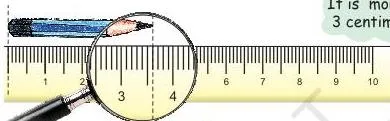
- The pencil and the millimetre — measuring a pencil shows it is “more than 3 centimetres”; one centimetre split into 10 parts gives the millimetre, 0.1 cm.
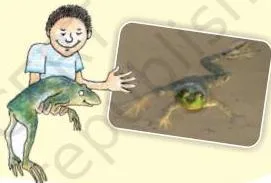
- Frogs, Gold Frogs, Bull Frog — two real frogs, 0.9 cm and 30.5 cm, are the first decimal lengths to read and convert.
- Guess and Colour, Guess, Draw and Measure, Our Eyes Get Confused?, Whose Tail is the Longest?, The Longest Rupee Notes? — five guess-measure-compare activities that train estimation against the scale.
- At the market — matchboxes, soap, eggs and pens, with prices in rupees and paise.
- Practice time — Match these and Colourful Design — matching equivalent forms, then painting tenths and hundredths as coloured boxes on a grid.
- Sports Day — the long jump in metres, and the rule 1 metre = 100 centimetres.
- Write in Metres and How Big Can You Get — heights and chest sizes written as decimal metres.
- Currency from different countries — Shivam Bank’s exchange chart, from 0.04 Won to 77.76 Pounds.
- Which city is cool? — the temperature table and simple decimal subtraction.
At every stop the decimal comes from a real situation — a length, a price, a temperature. There are no abstract decimal drills in this chapter.
Why the chapter keeps asking you to guess first
The whole chapter runs on one loop: guess, measure, compare. The loop repeats because a decimal reading means nothing until you have felt how hard a millimetre is to judge by eye.
The loop appears at least five times: Guess and Colour, Guess, Draw and Measure, Our Eyes Get Confused?, Whose Tail is the Longest? and The Longest Rupee Notes?. The question “How good is your guess?” comes back on every one of them, on purpose.
The opening lens picture is the clue. Anju uses a lens because the ten divisions inside one centimetre are too fine for the eye. The eye-trick lines (A or B, C or D) look different in length even when measuring proves they are not. Eyes judge whole centimetres; tenths and hundredths need a scale.
You can run the same loop at home: guess the length of a pencil, a leaf or a rupee note, measure it, and write both numbers down. The gap between your guess and the scale is exactly the gap this chapter trains you to close.
Key concepts: the tenths and hundredths behind every activity
The frogs, the colour sheets and the shop bills in this chapter all test the same small set of equivalences. Learn these first and the activities stop being puzzles.
| In words | Fraction | Decimal | Where the chapter uses it |
|---|---|---|---|
| one tenth | \( \frac{1}{10} \) | 0.1 | 1 mm = 0.1 cm; the blue strip is 0.1 of the sheet; 10 paise = 0.1 rupee |
| one hundredth | \( \frac{1}{100} \) | 0.01 | one box of the second sheet; 1 cm = 0.01 m; 1 paisa = 0.01 rupee |
| ten hundredths | \( \frac{10}{100} \) | 0.10 | the ten blue boxes — the same amount as \( \frac{1}{10} \) and 0.1 |
| nine tenths | \( \frac{9}{10} \) | 0.9 | the gold frog, 0.9 cm = 9 mm |
| forty-five hundredths | \( \frac{45}{100} \) | 0.45 | colouring 0.45 of the design square red means 45 boxes of 100 |
- Length: \( 1\ \text{cm} = 10\ \text{mm} \), so \( 1\ \text{mm} = 0.1\ \text{cm} \).
- Metres: \( 1\ \text{m} = 100\ \text{cm} \), so \( 1\ \text{cm} = 0.01\ \text{m} \).
- Money: \( 1\ \text{rupee} = 100\ \text{paise} \), so \( 1\ \text{paisa} = 0.01\ \text{rupee} \).
- Equivalence: \( \frac{10}{100} = \frac{1}{10} = 0.10 = 0.1 \).
The book reads 0.1 aloud as “zero point one centimetre” — each digit after the point is said one by one. The first digit after the point counts tenths; the second counts hundredths. The same two places handle length, money and parts of a sheet.
One worked pair with new numbers: \( 4\ \text{cm}\ 7\ \text{mm} = 4.7\ \text{cm} \), because the 7 mm are seven of the ten parts of a centimetre and seven tenths is written 0.7. The reverse move: \( 6.3\ \text{cm} = 6\ \text{cm}\ 3\ \text{mm} \), because 0.3 cm is three tenths of a centimetre, and each tenth is one millimetre.
Both directions work because every millimetre is one of the ten equal divisions of a centimetre. Count the divisions and the decimal writes itself.
Definitions to keep from this chapter
The chapter introduces only a handful of technical words. Here they are in student language, grounded in the book’s own use.
- Millimetre (mm) — one-tenth of a centimetre. Ten millimetres make one centimetre; the small divisions on a scale are millimetres. The pencil opening defines it: one centimetre has 10 equal parts, and each part is one millimetre.
- Tenth — one part out of ten equal parts. Written \( \frac{1}{10} \) as a fraction and 0.1 as a decimal, and read “zero point one”. The blue strip is one tenth of the sheet.
- Hundredth — one part out of one hundred equal parts. Written \( \frac{1}{100} \) and 0.01. On the second colour sheet each small box is one hundredth; paise are hundredths of a rupee.
- “Zero point one” — the way 0.1 is read aloud, digit by digit after the point. It means one tenth — of a centimetre, a metre, a sheet or a rupee.
Reading the chapter’s pictures: what each figure shows and teaches




The chapter teaches through its pictures, so each one below is worth a minute of attention. Follow the order of the book: tenths on a scale first, then hundredths on a grid, then decimals at work in measures and money.
Tenths on a scale: pencil, frogs, nail and candles
The first six figures build the idea that a decimal length is just counting the ten divisions inside a centimetre.
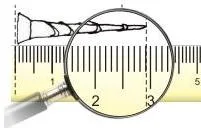
The opening picture shows the pencil through Anju’s lens, clearly past the 3 cm mark but not at a whole number. The lens is the point: without it the small divisions are invisible, and the length cannot be said exactly. “More than 3 centimetres” is a guess; the scale gives the decimal.
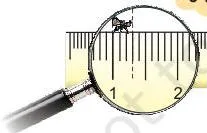
Here the same centimetre is blown up: 10 equal parts. Each part is one-tenth of a centimetre = one millimetre (mm). The book reads it aloud as “zero point one centimetre”: \( 1\ \text{mm} = 0.1\ \text{cm} \). Every decimal on a scale is just a count of these tenths.
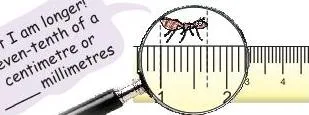
Beside the pencil, two tiny insects argue about which is longer: “See I am 3 mm long!” / “But I am longer! Seven-tenth of a centimetre.” Seven tenths of a centimetre is 0.7 cm, and 0.7 cm is 7 mm — the second insect is more than twice as long. Same language, one decimal.
The gold frog is 0.9 cm long and among the smallest frogs in the world. Read 0.9 cm as nine-tenths of a centimetre = 9 mm. The finger in the picture is the test: a frog that is 9 mm long is shorter than a fingernail, which is why so many can sit on one finger.
The bull frog is 30.5 cm. The 5 after the point is five-tenths of a centimetre = 5 mm, so 30.5 cm = 30 cm 5 mm — the exact trap many readers fall into.
Since 1 m = 100 cm, about 3 bull frogs (\( 3 \times 30.5\ \text{cm} = 91.5\ \text{cm} \)) fit on a 1 m scale; roughly a hundred of the 0.9 cm gold frogs cover the same metre, because 0.9 cm is just under 1 cm.
The nail lies along a scale past the 2 cm mark. The blanks ask the same count twice: first in millimetres (“2 cm and ___ mm”), then as a decimal (“2. ___ cm”). Whatever number of small divisions the nail reaches, that digit goes straight after the point — a length of 2 cm and n mm is always 2.n cm.
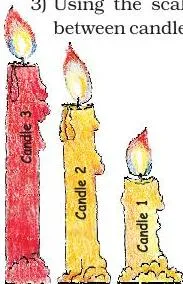
The candles give first practice in measuring and subtracting. Measure candle 1 and candle 3, write each in both columns — “cm and mm” and “cm” — then subtract the shorter from the longer.
Example: if candle 1 measured 4 cm 2 mm and candle 3 measured 5 cm 8 mm, the difference is 1 cm 6 mm = 1.6 cm. Subtract the millimetres first, then the centimetres.
Hundredths on a grid: strips, boxes and the design square
These three figures move from length to parts of a whole sheet — the hundredths idea, where the chapter’s central equivalence is painted.
Before the sheets, the “Practice time — Match these” puzzle asks you to match each yellow box with one green and one pink box — three ways of writing the same amount. The colour sheets give the same idea in pictures.
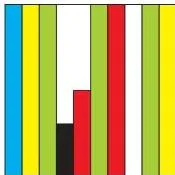
The first colour sheet is 10 strips. One blue strip is 1 out of 10 — one tenth, written \( \frac{1}{10} \) or 0.1. Two strips would be \( \frac{2}{10} \) = 0.2, which is the colour the book asks about next.
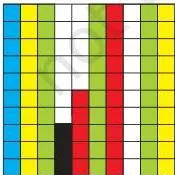
Now each strip is split into 10 boxes: 10 × 10 = 100 boxes in all. Each box is one-hundredth of the sheet, \( \frac{1}{100} = 0.01 \). The ten blue boxes are 10 hundredths — \( \frac{10}{100} \) — and since they also form one whole strip, they are \( \frac{1}{10} \) and 0.1 as well.
That gives the chapter’s central line: \( \frac{10}{100} = \frac{1}{10} = 0.10 = 0.1 \). The same reasoning answers the book’s question “Can we write ten paise as 0.1 of a rupee?” — yes, because 10 paise is 10 hundredths of a rupee. Red and black boxes continue the pattern: 15 boxes are \( \frac{15}{100} = 0.15 \), and \( \frac{3}{100} \) is 0.03.
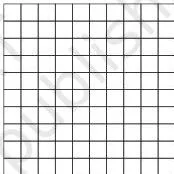
The design square is a 10 × 10 grid again, but now you choose the colours. “Colour 0.45 part red” means 45 boxes out of 100, since \( 0.45 = \frac{45}{100} \).
Four colours each covering 0.05 means 5 boxes each — \( 4 \times 5 = 20 \) boxes in all. The remaining 0.35 of the square, 35 boxes, stays uncoloured.
Decimals in measures and money: jump lengths, metres, currencies and a bill
The last four figures show decimals doing real work: measuring a jump, converting a metre, reading a currency chart and adding a shop bill.
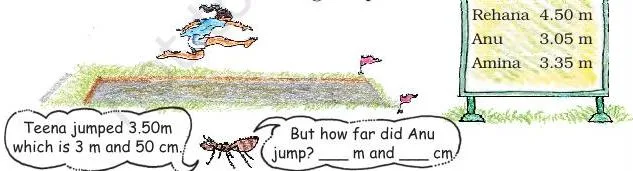
The long jump lines up the first five children, each with a distance in metres. Compare the decimals to find the winner: whole metres first, then tenths, then hundredths. A jump of 3.50 m beats 3.35 m because, after the equal 3 metres, 5 tenths beat 3 tenths.
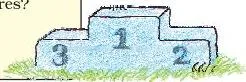
The I, II and III stands go to the three longest jumps — the three largest decimals.
This scale picture fixes the metre connection. Since 1 m = 100 cm, one cm is \( \frac{1}{100} \) of a metre, written 0.01 m. The “Write in Metres” questions then follow: 3 m 45 cm = 3.45 m, 99 cm = 0.99 m, and 1 m 5 cm = 1.05 m.
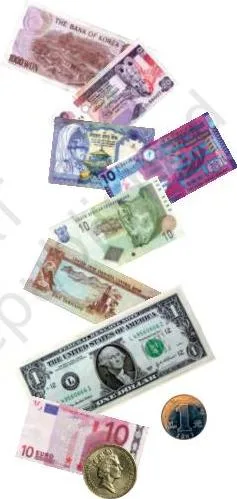
Shivam Bank’s chart shows how many Indian rupees each foreign unit changes into — from Korea’s Won at 0.04 rupee to England’s Pound at 77.76 rupees (rates on 15-2-2008). Every amount is a decimal, and comparing them is a reading exercise: the Pound costs the most, the Won the least.
The caption carries the book’s teacher note: children are not expected to carry out long multiplication involving decimals — think in coins and splits instead.

Kiran’s bill is the chapter’s test of decimal addition. The shopkeeper forgot the points, so first you place them: the last two digits of each price are paise. Soap 1250 becomes ₹ 12.50, green gram 5025 becomes ₹ 50.25, tea 2725 becomes ₹ 27.25 and coconut oil 6000 becomes ₹ 60.00.
Now add with all the points in one column:
\[ 12.50 + 50.25 + 27.25 + 60.00 = 150.00\ \text{rupees} \]
Kiran set out with ₹ 200 and the bill came to ₹ 150, so she gets ₹ 50 back.
The same method works on any bill: place the paise two digits from the right, line up the points, and add place by place. Try a fresh bill: a biscuit pack (3575), a notebook (2860) and a pen (1050): \( 35.75 + 28.60 + 10.50 = 74.85 \) rupees.
Where Class 5 readers trip in this chapter
The book itself keeps probing the same soft spots — “What does 0.9 cm mean?”, “Can we say 10/100 = 1/10 = 0.10 = 0.1?”, “Can we write ten paise as 0.1 of a rupee?” — because these are the places readers actually go wrong.
| Mistake | Correct rule | How to check your answer |
|---|---|---|
| Reading 30.5 cm as “30 cm 50 mm” | 30.5 cm = 30 cm 5 mm. The digit after the point is tenths of a centimetre, and one tenth of a centimetre is one millimetre. | 30 cm 50 mm would come to 35 cm, not 30.5 cm. |
| Writing 1 m 5 cm as 1.5 m | 1 m 5 cm = 1.05 m. Five cm is five hundredths of a metre, so it sits in the hundredths place. | 1.5 m would be 1 m 50 cm — ten times too much. |
| Thinking 0.9 cm means 90 mm | 0.9 cm = 9 mm. Nine tenths of a centimetre; each tenth is a millimetre. | 90 mm is 9 cm — ten times too long. |
| Comparing decimals by the whole-number part only | Compare tenths, then hundredths. 0.9 beats 0.35 because 9 tenths beat 3 tenths after the whole parts are equal. | Rewrite as 0.90 vs 0.35 — 90 hundredths beat 35 hundredths. |
| Mixing tenths and hundredths of a rupee | 100 paise = ₹ 1, so 75 paise = 0.75 rupee and 99 paise = 0.99 rupee. | Say it in words: 75 paise is 75 hundredths of a rupee. |
Every mistake above comes from reading the digits after the point as if they were a separate whole number. They are not: they are tenths, then hundredths, of the unit before the point.
How to practise tenths and hundredths for Class 5
This chapter builds five skills, and each can be trained at home with a scale, some coins and a newspaper temperature list.
| Skill | What it looks like | Quick check |
|---|---|---|
| Reading tenths on a scale | 0.9 cm is 9 mm; 3.6 cm is 3 cm 6 mm | The digit after the point counts millimetres |
| Writing cm and mm as one decimal, and back | 4 cm 7 mm = 4.7 cm; 6.3 cm = 6 cm 3 mm | Reverse the conversion you just did |
| Converting centimetres to metres | 45 cm = 0.45 m; 99 cm = 0.99 m | 1 cm = 0.01 m, so the digits move two places |
| Converting paise to rupees | 75 paise = ₹ 0.75; 99 paise = ₹ 0.99 | 100 paise = ₹ 1 |
| Comparing and subtracting decimals | Long-jump lengths, temperatures, chest sizes | Line up the points, then compare or subtract |
Model 1 — chest size. Breathe out and measure: 1.40 m. Take a deep breath and measure again: 1.55 m. The difference is \( 1.55 – 1.40 = 0.15\ \text{m} \), which is 15 cm because \( 1\ \text{m} = 100\ \text{cm} \).
Model 2 — temperature gap. One city reads \( 24.6^{\circ}\text{C} \), another \( 17.3^{\circ}\text{C} \). The difference is \( 24.6 – 17.3 = 7.3^{\circ}\text{C} \) — subtract the tenths (\( 6 – 3 \)) and the whole degrees (\( 24 – 17 \)) separately.
Model 3 — money without long multiplication. The book’s teacher note says children are not expected to carry out long multiplication with decimals; think in coins and splits instead. Two lots of ₹ 4.75 is two lots of ₹ 4 (₹ 8) plus two lots of 75 paise (₹ 1.50) — ₹ 9.50 in all.
One honest caution: textbook contents and the examinable syllabus are not always identical. Check the current official CBSE syllabus at cbse.gov.in before deciding what to revise.
One look back at Chapter 10: the ideas that carry it
A rapid reread of the ideas that carry the chapter, in the order the book builds them.
- \( 1\ \text{cm} = 10\ \text{mm} \), so \( 1\ \text{mm} = 0.1\ \text{cm} \) — the pencil’s ten divisions.
- \( 1\ \text{m} = 100\ \text{cm} \), so \( 1\ \text{cm} = 0.01\ \text{m} \) — the Sports Day rule.
- \( 1\ \text{rupee} = 100\ \text{paise} \), so \( 1\ \text{paisa} = 0.01\ \text{rupee} \) and \( 10\ \text{paise} = 0.1\ \text{rupee} \).
- \( \frac{10}{100} = \frac{1}{10} = 0.10 = 0.1 \) — the ten blue boxes on the hundredths sheet.
- After the point, the first digit is tenths and the second is hundredths.
- \( 3\ \text{cm}\ 6\ \text{mm} = 3.6\ \text{cm} \); \( 30.5\ \text{cm} = 30\ \text{cm}\ 5\ \text{mm} \); \( 3\ \text{m}\ 45\ \text{cm} = 3.45\ \text{m} \).
- Guess first, then measure — the scale is the judge, not the eye.
Related resources for Class 5 Math-Magic
This listing is maintained for the 2026-27 academic session using the NCERT textbook information available to us. NCERT remains the authority for confirming the latest edition.
Use these links to move around the Class 5 study pages on this site.
- Class 5 Mathematics (Math-Magic) book page — the full chapter list for this book.
- Class 5 hub — study pages for every Class 5 subject.
- CBSE notes home — class-wise notes across subjects.
- Coconut Farm — the chapter just before Tenths and Hundredths in this book’s sequence.
- Area and its Boundary — the chapter that follows.
The official NCERT portal for the Class 5 Math-Magic textbook publishes every chapter PDF, including this one — open the textbook page and follow the Chapter 10 link to the file.
And a final reminder: what a textbook contains and what the examinable syllabus includes are not always identical — the CBSE syllabus page is the authority on what is examinable.
Sources and data verification
The facts below tell you exactly which edition this page describes and who settles what.
- What this page describes: the NCERT Class 5 Mathematics textbook, Math-Magic, English medium, Chapter 10, Tents and Hundredths, as published on ncert.nic.in.
- What it covers: this one chapter only — not the whole book, and not the full curriculum.
- Session: maintained for the current academic session using the NCERT information available to us.
- Who settles what: NCERT settles the textbook, its editions and its PDFs; CBSE settles the curriculum, the syllabus and the examinations.
| What the chapter holds | Count | Where it is used |
|---|---|---|
| Printed pages | 12 | |
| Figures with NCERT captions | 19 | |
| Tables | 6 | |
| Official NCERT PDF | Download the chapter PDF | the chapter exactly as NCERT publishes it |
Reference: NCERT Class 5 Mathematics textbook (Math-Magic), chapter 10, official edition on ncert.nic.in.
Frequently asked questions about tenths and hundredths
Quick answers to the small questions that stop a student mid-practice.
How do I write a length like 3 cm 6 mm as a decimal?
\( 3\ \text{cm}\ 6\ \text{mm} = 3.6\ \text{cm} \). Write the whole centimetres before the point and the millimetres after it: the 6 mm are six-tenths of a centimetre, six tenths is written 0.6, so the 6 goes in the first place after the point. Read it aloud as “three point six centimetres”.
Why does the chapter say 10/100 = 1/10 = 0.10 = 0.1?
Because all four names mean the same amount. On the second colour sheet, ten blue boxes are 10 out of 100 boxes (\( \frac{10}{100} \)), the same ten boxes form one whole strip out of ten (\( \frac{1}{10} \)), and as a decimal the amount can keep its zero — 0.10 — or drop it — 0.1. Ten hundredths is one tenth.
How do you write 3 metre 45 centimetre in metres?
3.45 m. The 45 cm are 45 hundredths of a metre, because \( 100\ \text{cm} = 1\ \text{m} \), so they take the two places after the point. The same rule gives \( 1\ \text{m}\ 5\ \text{cm} = 1.05\ \text{m} \): 5 cm is only five hundredths, so it needs the hundredths place. 1.5 m would be 1 m 50 cm.
Why is 0.9 cm the same as 9 mm and not 90 mm?
Because the digit after the point counts tenths of a centimetre, and each tenth of a centimetre is one millimetre. 0.9 cm is nine tenths of a centimetre, so it is 9 mm. 90 mm is 9 cm — ten times longer.
How do you change 99 paise into rupees?
₹ 0.99, read “zero point nine nine rupees”. Since \( 100\ \text{paise} = 1\ \text{rupee} \), one paisa is one hundredth of a rupee, so 99 paise is 99 hundredths of a rupee: \( 99\ \text{paise} = 0.99\ \text{rupee} \). The book itself uses this as the hint on the colour sheet: “we wrote 99 paise as 0.99 rupee”.
Which city was coolest at 3 am in the chapter’s temperature table, and how much higher was Chennai’s temperature than Srinagar’s?
Srinagar, at \( 1.3^{\circ}\text{C} \), was the coolest at 3 am. Chennai read \( 21.1^{\circ}\text{C} \), which is \( 21.1 – 1.3 = 19.8^{\circ}\text{C} \) higher.
Explore Class 5 Mathematics Books
- Previous: Coconut Farm
- Next: Area and its Boundary
Related chapters: