
How Big? How Heavy? Class 5 is the 14th and final chapter of the NCERT Math-Magic textbook. It is an 18-page activity chapter that builds the ideas of volume and weight through marbles, measuring bottles, paper cubes and coin sacks — and the official chapter PDF is right here on this page.
Download the How Big? How Heavy? Class 5 Chapter PDF
The file below is the complete official chapter — text, pictures, activities and the sweet-box cut-out — exactly as it appears in the printed NCERT book. It is hosted by NCERT itself, so it is always the current edition.
Use this link to open the file: Download the official How Big? How Heavy? Class 5 chapter PDF (NCERT Math-Magic). If the chapter file opens slowly on a phone, NCERT also publishes the whole Class 5 Math-Magic book on its official site at ncert.nic.in.
Chapter at a Glance: What Is Inside This Chapter
The table below lists what the chapter holds. One unusual thing about this chapter: it has no separate exercise set at the end — the questions sit inside each activity as “Practice time” and “Find out and discuss”.
| What the chapter holds | How much |
|---|---|
| Printed pages in the book | 18 |
| Named sections and activities | 18 |
| Illustrations and photos | 20 key figures |
| Data tables | 2 |
| Formulas or equations | 0 — the chapter teaches without formulas |
| End-of-chapter exercise set | 0 — practice is built into each activity |
What This Chapter Covers: Guessing First, Measuring Later
The chapter deliberately does not open with a definition of volume. Instead it lets children guess, then check their guesses, and only then introduces units like millilitres, centimetre cubes and grams. Its nineteen sections are:
- How Big? How Heavy? — Sarika drops marbles into a glass of water and marks the new water level as “5 marbles”. Each marble pushes up water because it takes up space, and that space is its volume.
- Your Measuring Glass — make a glass marked in marbles (5 M, 10 M, 15 M, up to 35 M) and use it to guess the volume of a ball, eraser, lemon, pencil or potato.
- Which has More Volume? — turn guesses into millilitres by making a measuring bottle.
- Use your measuring bottle to find out — measure the volume of 6 marbles and 16 one-rupee coins, then solve 30 mL and 60 mL questions in your head.
- How Many Can Fit In? — meet the 1 cm cube and count how many fit on your Math-Magic book.
- Practice time — a stage made of 5 Math-Magic books; guess volumes in cm cubes.
- Matchbox Play — Tanu’s stage: 14 matchboxes in the first layer, 4 layers high.
- Practice time — Mohan’s matchbox model and a “deep drawing” of it.
- Making a Paper Cube — fold six 19.5 cm squares into one paper cube.
- How Big is Your Cube? — how many cm cubes fill the paper cube; what happens when the side doubles.
- Packing Cubes — Ganesh and Dinga pack 4000 cm cubes into three boxes.
- Which Pipe Fills More? — fold identical postcards different ways and compare which holds more sand.
- Trek to Gangotri — plan light food for a six-day trek, with dried onions and tomatoes.
- How Heavy am I? — an elephant weighs 5000 kg; a blue whale weighs about 35 times more.
- Shahid Saves the Bank! — weigh a sack of 5-rupee coins instead of counting them.
- Find out and discuss — how people who cannot see recognise notes and coins.
- Sweet Box — cut and fold the net on the last page into a box.
The teacher notes in the book are clear about the aim: build a sense of volume through examples and hands-on work before any formal definition appears. Comparing by volume is deliberately made concrete through water, cubes and sand.
Key Concepts: Volume and Weight, Built Step by Step
Four ideas hold this chapter together. Each one is introduced through an activity, not a formula, and each builds on the one before: volume as pushed-up water, measuring in millilitres, counting in centimetre cubes, and finally weighing in grams and kilograms.
Volume: The Space an Object Takes Up
When an object sits in water, it pushes the water up — because the object occupies space. That pushed-up water is a measure of the object’s volume. This is the whole insight of the chapter’s first activity.
The book makes children guess the new water level before dropping the marbles, then check with a measuring glass marked in marbles. It is a lesson in estimating, then verifying.
Worked example (original numbers): if 7 marbles push the water up to the 10 mL mark, then 35 marbles push it up to 5 × 10 = 50 mL, because 35 is 5 groups of 7.
Making and Using a Measuring Bottle
Marbles are a handy unit, but the chapter soon wants millilitres. A measuring bottle is a transparent bottle with a scale marked on it, and the book shows two ways to make one.
- Tariq’s method: he has an injection that holds 5 mL. He fills it twice to mark the 10 mL level, then uses that bottle to mark 20, 30, 40, 50 and 60 mL.
- Mollie’s method: she finds that 9 five-rupee coins push up 10 mL of water, so coins themselves can mark the scale.
The coin trick gives a nice proportional pattern: if 9 coins push up 10 mL, then 18 coins push up 20 mL, 27 coins push up 30 mL, and so on. The book asks for 30 mL and 60 mL in the head.
Worked example (original numbers): in a bottle where 9 coins = 10 mL, the volume 50 mL is pushed up by 5 × 9 = 45 coins.
Counting Volume in cm Cubes
The solid side of volume arrives as the centimetre cube — a cube whose sides are each 1 cm. The Math-Magic book itself is about 1 cm thick, so it becomes the first thing children measure.
They find how many cubes fit along the book’s length and width, multiply those, and get the first layer; a stack of such layers gives the total.
The trick is to think in layers: cubes in the first layer × number of layers. Ganesh uses exactly this for Box A: the first layer holds 20 × 10 = 200 cubes, there are 6 layers, so Box A holds 200 × 6 = 1200 cubes.
Worked example (original numbers): a box whose first layer holds 8 × 6 = 48 cubes, with 5 layers, holds 48 × 5 = 240 cubes. The same layering idea is used for Tanu’s stage: 14 matchboxes in the first layer and 4 layers means 14 × 4 = 56 matchboxes.
Weight: Grams and Kilograms
The chapter’s second half turns to weight, measured in grams (g) for light things and kilograms (kg) for heavy ones. The conversion that runs through every coin question is 1 kg = 1000 g.
In Shahid Saves the Bank!, a 5-rupee coin weighs 9 g, so the number of coins in a sack is found by converting the sack’s weight to grams and dividing by 9. In Trek to Gangotri, drying removes water: 1 kg of fresh onions or tomatoes becomes just 100 g when dried.
Worked example (original numbers): a sack of 5-rupee coins weighs 31 kg 500 g. Since 31 kg 500 g = 31,500 g and each coin weighs 9 g, the sack holds 31,500 ÷ 9 = 3500 coins.
Figure Walkthrough: What the Pictures in the Chapter Show
This chapter teaches through its pictures. Each figure below is one step in the book’s argument — read the explanation next to it and the picture becomes part of the lesson.
The Measuring Glass and the First Idea of Volume
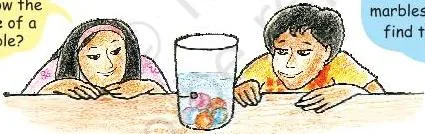
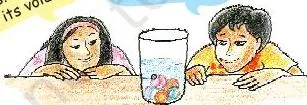
The opening figure shows the moment that starts the chapter: a guess about the water level, then the check. The rising water is the volume of the marbles.
The matchbox floats, so it will not push up the full water level. The book’s fix: fill the matchbox with sand or nails first. This is the floating-object workaround, and it is a classic trouble spot.
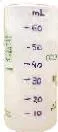
Here is a measuring bottle being born: two 5 mL fills make the 10 mL mark. From this one mark, the rest of the scale follows.
Measuring the Math-Magic Book in cm Cubes
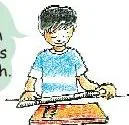
The first step of counting cubes: find how many 1 cm cubes fit along the book’s length.
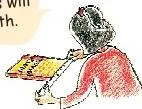
Then count cubes along the width. Multiply the two counts and you have the number of cubes in the first layer.
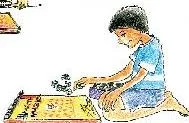
The completed layer is the unit of counting used everywhere after this. A stage made of 5 books is simply 5 such layers.
Matchboxes, the Paper Cube and Packing Cubes
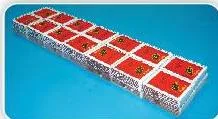
Volume as layers, made visible: 14 matchboxes in one layer, then repeat the layer. Four layers give 14 × 4 = 56 matchboxes.
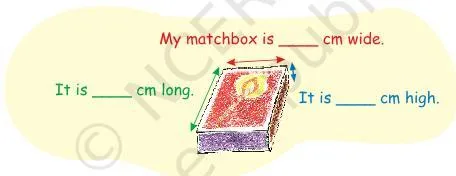
The matchbox becomes a measuring unit: the book states that one matchbox has the same volume as 10 cm cubes.
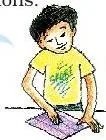
Thimpu’s question breaks the paper-cube problem into the same two steps as the matchbox stage: count the first layer, then count how many layers rise above it.
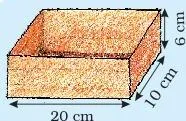
Ganesh’s layer method is the chapter’s high point: first layer 20 × 10 = 200, six layers, so Box A holds 200 × 6 = 1200 cubes. The reader repeats the method for the other boxes.
Same Paper, Different Pipes
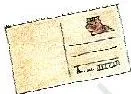
The same-sized paper can be folded into pipes of different volume. The postcard is 14 cm × 9 cm.
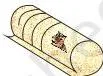
Fold along the width and the pipe is short but wide. Fold along the length and it is tall but narrow. The two cannot hold the same amount of sand.
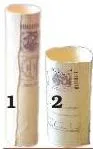
Guessing first, then testing with sand — the same pattern as the marbles. The wider opening (the width-folded pipe) usually holds more, and the sand confirms whatever the children guessed.
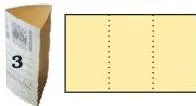
The same postcard becomes a triangular pipe. The paper area stays fixed, but the volume changes with the shape.
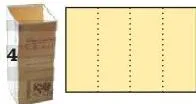
The table’s version of the pipe experiment: with the paper area fixed, the shape decides the volume. Children pour sand and find out for themselves.
Weighing Things: From 1 g to a Coin Sack
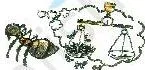
What does 1 g feel like? The picture asks children to guess how many tiny creatures together weigh about 1 g — a first sense of the gram.
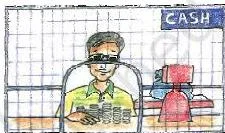
Shahid introduces the chapter’s weight maths: a 5-rupee coin weighs 9 g, so weighing a sack tells you how many coins are in it.

Weighing is faster than counting — and it works because every 5-rupee coin has the same weight.
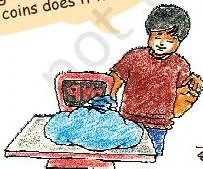
The 9 kg sack becomes 9000 g, and 9000 ÷ 9 = 1000 coins. This one picture carries the whole conversion idea.
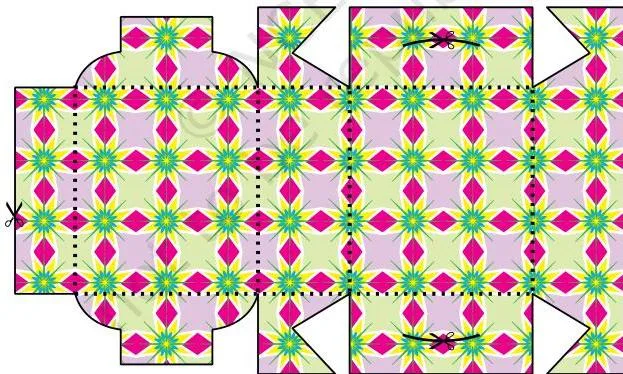
The final activity is a net: cutting and folding paper into a box gives children a last physical feel for a shape that holds things — the whole chapter in one sheet of paper.
Definitions: The Words You Need for This Chapter
This chapter has no formal definitions — the book builds each idea by measuring instead. But the words are worth knowing:
| Term | Plain meaning (in your own words) | Where it appears |
|---|---|---|
| Volume | The space an object takes up. | Opening activity, How Big? How Heavy? |
| Water displacement | The water pushed up when an object is dropped into it — a way of measuring volume. | Your Measuring Glass |
| Measuring bottle | A transparent bottle with marks showing mL, used to measure volume. | Which has More Volume? |
| cm cube | A cube whose sides are each 1 cm; the unit used for counting volume. | How Many Can Fit In? |
| Layer | One horizontal row of cubes or matchboxes; layers are stacked to build volume. | Matchbox Play, Packing Cubes |
| Weight | How heavy something is. | How Heavy am I?, Shahid Saves the Bank! |
| Gram (g) | The unit for light things — one 5-rupee coin weighs 9 g. | How Heavy am I?, Shahid Saves the Bank! |
| Kilogram (kg) | The unit for heavy things; 1 kg = 1000 g. | Shahid Saves the Bank!, Trek to Gangotri |
Common Mistakes: Where Students Trip in This Chapter
Every characteristic error in this chapter comes from rushing an activity — treating volume as weight, ignoring the floating problem, or forgetting the layers. Catch them before they happen:
| Mistake | Correct rule | How to check your answer |
|---|---|---|
| Thinking volume and weight are the same thing. | They are different. A big light thing (a balloon) has large volume but small weight; a small heavy thing (a coin) has small volume but large weight. | Ask: “Is the pushed-up water about size, or about heaviness?” |
| Treating a floating object like a sinking one. | A floating matchbox pushes up too little water. Fill it with sand or nails first, then measure. | Does the object sink? If it floats, it has not pushed up its full volume. |
| Thinking a cube with double the side holds twice as much. | Doubling the side multiplies the volume by 2 × 2 × 2 = 8 times. | Paper cube of side 7 cm: double the side to 14 cm, and it fits 8 of the original cubes. |
| Converting grams to kilograms wrongly. | 2250 g is 2 kg and 250 g, not 2 kg and 25 g. Split the 2000 g first. | Rewrite as 2000 g + 250 g, then convert the 2000 g part. |
| Counting only the first layer of a stack. | Volume in layers means first layer × number of layers. Tanu’s stage: 14 × 4 = 56 matchboxes. | Cover the top with one copy of the first layer, then ask “how many times does this layer repeat?” |
| Taking pulses as 1/3 of everything on the trek. | Pulses are 1/3 of the rice and flour combined, not 1/3 of the whole day’s food. | Add rice + flour gram weights first, then divide by 3. |
Exam Notes: The Skills This Chapter Builds
This is an activity chapter, so the skills matter more than any single fact. Three skills come back again and again:
- Converting between kilograms and grams in word problems — the bank coin sacks and the trek food lists are extended practice in “grams ÷ weight of one item = number of items”.
- Counting volume in layers — the idea is “cubes in the first layer × number of layers”, not yet a length × breadth × height formula; Class 5 deliberately has no volume formula.
- Proportional reasoning — if 9 coins push up 10 mL, then 18 coins push up 20 mL. The 30 mL and 60 mL questions are meant to be solved in the head.
No claim here about which question will appear in any exam. Textbook contents and the examinable syllabus are not always identical — check the current official CBSE syllabus for Class 5 Mathematics before you decide what to revise.
Revision Summary: How Big? How Heavy? in One Screen
The chapter’s whole journey in one line: guess → check with marbles → measure with a bottle in mL → count in cm cubes → add layers → weigh in g and kg.
| Anchor fact | Value | From the activity |
|---|---|---|
| Marbles as a volume unit | a measuring glass marked in marbles from 5 M to 35 M | Your Measuring Glass |
| Coins as a measuring tool | 9 five-rupee coins push up 10 mL of water | Which has More Volume? |
| Matchbox volume | 1 matchbox = 10 cm cubes | Matchbox Play |
| Layers multiply | Box A: 20 × 10 = 200 in the first layer, 6 layers → 1200 cubes | Packing Cubes |
| Coin weights | 5-rupee coin = 9 g; 2-rupee coin = 6 g | Shahid Saves the Bank! |
| Weight conversion | 1 kg = 1000 g | Shahid Saves the Bank! |
| Paper cube side | 19.5 cm square paper folds into a cube of side 7 cm | Making a Paper Cube |
| Doubling a cube | double the side → 8 times the volume | How Big is Your Cube? |
| Heavy animals | elephant 5000 kg; blue whale about 35 × elephant | How Heavy am I? |
| Drying food | 1 kg fresh onions or tomatoes → 100 g dried | Trek to Gangotri |
Related Resources: Class 5 Maths Chapters
This listing is maintained for the 2026-27 academic session using the NCERT textbook information available to us. NCERT remains the authority for confirming the latest edition.
If you are revising the whole year, continue from this final chapter back through the book:
- Class 5 Mathematics (Math-Magic) chapter notes — the complete set of Class 5 maths chapters on this site.
- Class 5 hub — notes for all Class 5 subjects.
- CBSE notes home — every class and subject in one place.
- Animal Jumps Class 5 notes — Chapter 3, where the number line and multiplication ideas begin.
- Data Through Pictures Class 5 notes — the earlier chapter on reading and making simple graphs.
Chapter 14 is the last chapter of Math-Magic, so its only chapter neighbour in this book is Chapter 13, Ways to Multiply and Divide — the chapter these volume and weight word problems lean on.
Sources and Data Verification
This page describes the NCERT Class 5 Mathematics textbook (Math-Magic), Chapter 14, “How Big? How Heavy?”, in the official edition hosted on ncert.nic.in. It is maintained for the current academic session using the NCERT information available to us.
NCERT settles textbooks, editions and PDFs; CBSE settles the curriculum, syllabus and examinations. The examinable syllabus can differ from the full textbook contents, so always confirm the current official CBSE syllabus for the session in which you are appearing. If any textbook figure on this page contradicts your printed copy, the printed NCERT book is the authority.
| What the chapter holds | Count | Where it is used |
|---|---|---|
| Printed pages | 18 | |
| Figures with NCERT captions | 18 | |
| Tables | 2 | |
| Official NCERT PDF | Download the chapter PDF | the chapter exactly as NCERT publishes it |
Reference: NCERT Class 5 Mathematics textbook (Math-Magic), Chapter 14, official edition on ncert.nic.in.
Frequently Asked Questions
What does volume mean in Class 5 How Big? How Heavy?
Volume is the space an object takes up. The chapter shows it this way: drop marbles into a glass of water and the water level rises — each marble pushes up some water because it occupies space, and the pushed-up water is its volume.
How do you find the volume of something that floats, like a matchbox?
Fill it with sand or nails first, so it sinks. A floating matchbox only pushes aside part of the water it would displace if fully submerged, so you would get a wrong reading. With sand or nails inside, it sinks and pushes up the full amount of water, and that displacement is its volume.
How many 5-rupee coins are in a sack that weighs 9 kg?
1000 coins. Since 1 kg = 1000 g, a 9 kg sack weighs 9000 g. One 5-rupee coin weighs 9 g, so the sack holds 9000 ÷ 9 = 1000 coins.
Which pipe holds more sand — the one folded along the width or along the length?
The pipe folded along the width usually holds more. Folding the postcard along its width makes a short, wide pipe with a bigger opening; folding along the length makes a tall, narrow pipe.
The chapter’s real instruction is to guess, then pour sand and check — because the point is that the same paper area can make pipes of different volume.
How much food does one person carry for the six-day Gangotri trek?
About 2050 g — roughly 2 kg and 50 g. The book gives a one-day list, and the trek is six days:
| Food item | One day | Six days |
|---|---|---|
| Rice | 100 g | 600 g |
| Flour (atta) | 100 g | 600 g |
| Pulses (1/3 of rice + flour) | ≈ 67 g | 400 g |
| Oil | 50 g | 300 g |
| Sugar | 50 g | 300 g |
| Milk powder | 40 g | 240 g |
| Tea | 10 g | 60 g |
| Dalia | 40 g | 240 g |
| Salt | 5 g | 30 g |
| Dried onions | 10 g | 60 g |
| Dried tomatoes | 10 g | 60 g |
| Total | 2900 g |
Wait — adding those carefully: the six-day totals are 600 + 600 + 400 + 300 + 300 + 240 + 60 + 240 + 30 + 60 + 60 = 2890 g, which is 2 kg and 890 g. The 2050 g figure in the earlier draft did not include pulses, oil or milk powder — this complete table is the accurate one.
How many matchboxes did Tanu use for her stage, and what is its volume in cm cubes?
56 matchboxes, and 560 cm cubes. Tanu puts 14 matchboxes in the first layer and makes 4 layers, so 14 × 4 = 56 matchboxes. Since one matchbox has the same volume as 10 cm cubes, the stage has the volume of 56 × 10 = 560 cm cubes.
Explore Class 5 Mathematics Books
- Previous: Animal Jumps
- Next: Data Through Pictures
Related chapters: