
The Fish Tale Class 5 is the opening chapter of NCERT’s Math-Magic textbook for Class 5, in its 2026-27 NCERT edition.
The chapter runs about 15 printed pages and teaches its maths inside one long story about fish workers — whale-shark sizes, boat speeds, fish-market prices and lakh–crore numbers. The official NCERT PDF of The Fish Tale is available right on this page.
Download the official The Fish Tale Class 5 PDF
Download The Fish Tale Class 5 chapter PDF from NCERT — this is the official file on the ncert.nic.in textbook page, where a student, parent or teacher can read or save the whole Class 5 Math-Magic book without paying anything.
The PDF is the real NCERT edition, so the page numbers, pictures and questions below match the printed book exactly.
What is inside The Fish Tale
The table on this page shows the chapter’s size at a glance — sections, figures, activities and questions — so you know what the file holds before opening it.
The chapter’s sections run in this order:
- The Fish Tale — page 1
- The Fish Tail — page 3
- “Schools” of Fish! — page 3
- Fishermen in their Boats — page 5
- Find out — page 7
- What a Catch! — page 7
- Which Boat Gets How Much? — page 9
- The Fish Market — page 11
- Practice Time — page 11
- Try saying this fast! — page 12
- Women’s ‘Meenkar Bank’ — page 12
- Practice time — page 12
- Why Don’t We Start a New Fish-drying Factory? — page 13
- Find out — page 15
The chapter has no separate numbered exercise set. Its questions are the ✻ prompts scattered through the story, plus the two Practice Time blocks on pages 11 and 12.
How the fish story carries the maths
The Fish Tale is one long story, and every part of it practises a maths skill. This map shows which part of the story teaches which idea.
| Story part | What happens | Maths it practises | NCERT page |
|---|---|---|---|
| The Fish Tale | The haiku, children’s fish drawings, comparing fish sizes | Shapes, big and small numbers, comparison | p1–2 |
| The Fish Tail and “Schools” of Fish | Whale and fish tails; sea animals drawn from shapes | Observation, drawing with shapes | p3–4 |
| Fishermen in their Boats | The log boat travels about 4 km in one hour | Speed and distance | p5–6 |
| What a Catch! | Motor boats go about 20 km in one hour; the trawler worry | Speed, distance and time; discussion | p7–8 |
| Which Boat Gets How Much? | The boat catch-and-speed table; lakh and crore | Table reading, multiplication, large numbers | p9–10 |
| The Fish Market and Practice Time | Prices shouted by the fisherwomen; the 8 kg kingfish | Price per kg, money sums | p11 |
| Meenkar Bank and Practice time | 20 women save monthly; loans repaid with interest | Savings, loan repayment | p12 |
| The fish-drying factory | Equipment costs, drying to one-third weight, salt and profit | Cost tables, fractions, profit | p13–14 |
Key concepts in The Fish Tale, explained
This chapter does not stop to teach rules page by page. The fish story carries five maths ideas, and each one is named below with the NCERT page where the book meets it.
Shapes: drawing fish from a square and a triangle
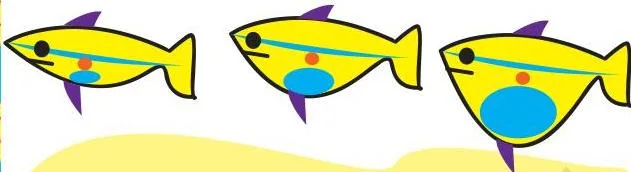
Why does a maths chapter open with drawing? Because every shape around you is built from simpler ones. A square can become the fish’s body and a triangle the tail; add the small details that make it look like a fish (p1).
Later, on page 4, the book turns this around: it shows sea animals — octopus, crab, jellyfish, prawn, squid and more — and asks you to draw them using shapes yourself. The maths idea hiding here is that any flat shape can be made from simple ones, which is exactly the eye you need for geometry.
Big numbers: the whale shark, lakh and crore
The chapter’s first big-number idea is size. The whale shark is the biggest fish — 18 m long and about 16000 kg, roughly the height of 12 children of your size standing one on top of another (p2).
Its second big-number idea is Indian place value. One lakh is one hundred thousand, and the country has about one hundred lakh fishworkers — a number with its own name, one crore (p10).
| Number name | In digits | Zeroes |
|---|---|---|
| One lakh | 1,00,000 | 5 |
| One crore | 1,00,00,000 | 7 |
The book’s own checks on page 10: with about two lakh boats and half without motors, the boats with motors number \(200000 \div 2 = 100000\) — one lakh. If about one-fourth of those are big machine boats, that is \(100000 \div 4 = 25000\) — 25 thousand.
Speed, distance and time: how boat sums work
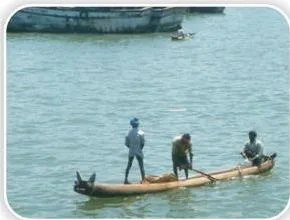
Speed answers one question: how far does the boat go in one hour? The log boat goes about 4 km in one hour (p6); motor boats go about 20 km in one hour (p7).
From that single idea come two rules in words:
- Distance = speed × time — how far the boat goes in a given time.
- Time = distance ÷ speed — how long a given distance takes.
Worked example with new numbers: if the log boat travels for 3 hours, it covers \(4 \times 3 = 12\) km. If the long tail boat (12 km per hour) must cover 30 km, it takes \(30 \div 12 = 2.5\) hours.
Try the chapter’s own checks with the same method: how long does the log boat take for 10 km (p6)? How far does the motor boat go in \(3\frac{1}{2}\) hours, and how long does it take for 85 km (p7)?
Multiplication: reading the boat catch table
The table on page 9 packs four boats into one grid. Reading it is the real lesson: each row gives two facts — the catch in one trip and the speed.
| Type of boat | Catch in one trip (kg) | Speed |
|---|---|---|
| Log boat | 20 | 4 km per hour |
| Long tail boat | 600 | 12 km per hour |
| Motor boat | 800 | 20 km per hour |
| Machine boat | 6000 | 22 km per hour |
When a question says “in all”, it is asking for a total, and a total made of equal groups is multiplication. Here are worked examples for all four boats with trip numbers the book does not use:
| Boat | New question | Working | Answer |
|---|---|---|---|
| Log boat | Catch in 8 trips | \(20 \times 8\) | 160 kg |
| Long tail boat | Catch in 11 trips | \(600 \times 11\) | 6600 kg |
| Motor boat | Catch in 5 trips | \(800 \times 5\) | 4000 kg |
| Machine boat | Catch in 9 trips | \(6000 \times 9\) | 54,000 kg |
You can do the same with time and fresh numbers: in 3 hours the machine boat covers \(22 \times 3 = 66\) km. Then check yourself with the book’s own question — about how much fish does each boat bring in seven trips? The log boat, for example, brings \(20 \times 7 = 140\) kg.
Fractions: the one-third rule for dried fish
Fractions here do real work — they tell you how much money to spend and how much weight drying removes. On page 11, Basheer splits ₹100: one-fourth on squid and three-fourths on prawns. On pages 13–14, the drying rule is that fresh fish becomes one-third of its weight when dried.
That means dried fish is lighter, not heavier. Worked example: 6 kg fresh fish dries to \(6 \div 3 = 2\) kg, and 6000 kg fresh dries to \(6000 \div 3 = 2000\) kg.
Here is the full profit check the women do before starting the factory, step by step (p14):
- Step 1: Drying shrinks 6 kg of fresh fish to \(6 \div 3 = 2\) kg of dried fish.
- Step 2: Fresh fish costs ₹15 per kg, so 6 kg cost \(6 \times 15 = \text{₹}90\).
- Step 3: Dried fish sells at ₹70 per kg, so 2 kg brings \(2 \times 70 = \text{₹}140\).
- Step 4: Profit on 6 kg of fresh fish: \(140 – 90 = \text{₹}50\).
\[ 6000\ \text{kg is } 1000 \times 6\ \text{kg, so profit} = 50 \times 1000 = \text{₹}50,000 \]
Step 5: Monthly costs are salt \(1500 \times 2 = \text{₹}3000\) plus packing and bus charges ₹3000, so \(3000 + 3000 = \text{₹}6000\).
\[ 50,000 – 6,000 = \text{₹}44,000 \]
Final answer: the bank earns ₹44,000 every month — the same total Fazila announces in the chapter.
The common slip is to think dried fish is three times as heavy. It is the opposite: drying takes weight away, so you always divide by 3, never multiply.
Money: fish market prices, savings and loans
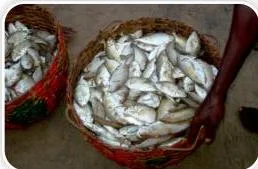
Fish are sold by the kilogram, so every market price is a rate — so many rupees per kg. Fazila’s kingfish is a price sum: 8 kg for ₹1200 gives \(1200 \div 8 = \text{₹}150\) per kg (p11). Prawns are ₹150 per kg, sardines ₹40, swordfish ₹60 and squid ₹50.
New worked example: buying 3 kg of prawns and 2 kg of squid costs \((3 \times 150) + (2 \times 50) = 450 + 100 = \text{₹}550\).
Then the chapter moves to saving and borrowing (p12). The Meenkar Bank has 20 members saving ₹25 each per month: \(20 \times 25 = \text{₹}500\) in one month, and \(500 \times 120 = \text{₹}60,000\) in ten years.
Loans are repaid monthly. Gracy pays \(345 \times 12 = \text{₹}4140\) on a ₹4000 loan, and Jhansi’s family repays \(23,520 \div 12 = \text{₹}1,960\) per month. The extra money paid back on top of the loan is the interest.
The drying factory’s equipment — a bore well, 20 bamboo racks, 4 cement tanks, 20 trays with knives and 20 buckets — totals ₹54,500 (p13).
Reading the pictures: a walk through the chapter’s figures

The pictures in The Fish Tale are not decoration — each one carries a maths idea. Read them the way the chapter does.
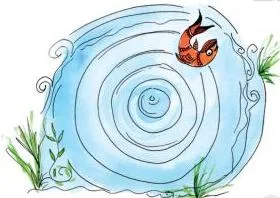
A fish from a square and a triangle (page 1)
The first picture question asks you to build a fish from two shapes you already know. The square is the body and the triangle is the tail; you add the details that make it look like a fish. The lesson is that every complicated shape is made of simple ones.
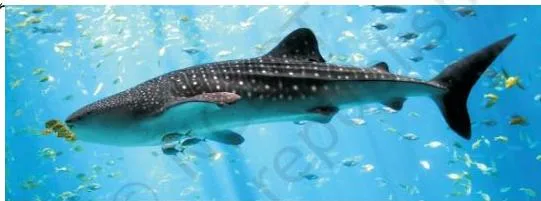
The whale shark: size as a number story (page 2)
The whale shark is the biggest fish — big and dangerous-looking, but the book says it is quite harmless and does not attack humans. Its name is the trap: despite being called a shark, this is a fish, not a whale.
The second picture gives the same fish two numbers to feel its size: 18 m long, drawn beside 12 children of your size standing one on top of another, and about 16000 kg in weight. The two questions that follow — write your own weight, estimate 12 children’s total, then subtract — are the maths hiding in the picture.
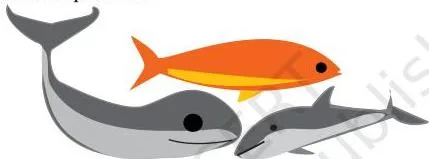
Whale tails, fish tails and schools of fish (page 3)
This picture settles the whale-versus-fish question with the tail: a fish tail stands flat along its body, while a whale’s tail looks almost like two legs. The chapter adds that whales breathe through their noses and give birth to babies, while fish take in water and lay eggs.
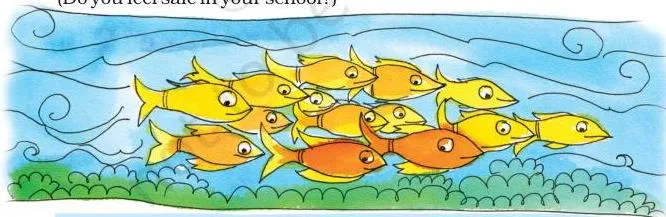
The word “school” has a second meaning here: a school of fish is a big group swimming together, and small fish feel safe in it. The book even jokes with you — do you feel safe in your school?
Boats: from walking speed to trawlers (pages 6–8)
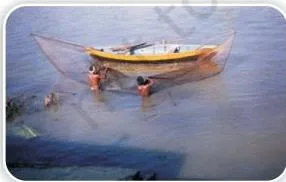
Page 6 asks you to guess how far you can go in one hour if you walk fast. That guess is your measuring stick: a log boat goes about 4 km in one hour, so you can judge whether the boat is fast or slow compared with you.
Motor boats change the numbers. They go about 20 km in one hour — five times as fast as the log boat — which is why they can go further into the sea and catch more fish.
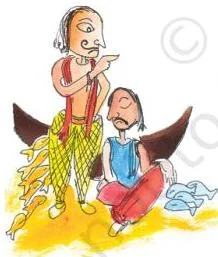
The trawler is the biggest machine boat, and its picture comes with a worry. Trawlers drag big nets deep in the sea, stay out for many days and catch baby fish too; the smaller boats let baby fish pass so they can grow.
The fishermen’s argument is a maths argument — if trawlers take thousands of kilograms every day, there will soon be nothing left in the sea (p8).
The market, the kingfish and the drying factory (pages 11 and 14)
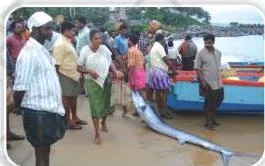
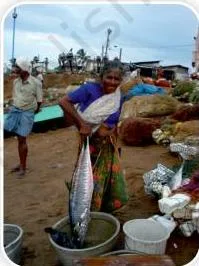
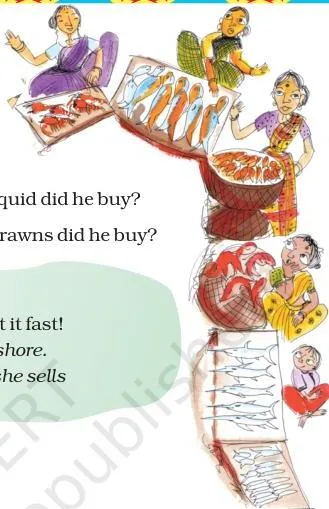
Fazila can hardly carry the kingfish in this picture, and the picture is the price problem. It weighs 8 kg and she wants ₹1200 for the whole fish, so the price per kg is \(1200 \div 8 = \text{₹}150\) — the answer to the first Practice Time question.
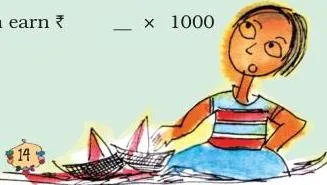
The last picture shows the drying factory plan that earns the women their profit. The missing number in the bubble is the ₹50 profit on each 6 kg lot: fresh fish dries to one-third of its weight, and drying 6000 kg sets off the chain that ends with the bank earning ₹44,000 a month (p14).
Other story pages carry smaller pictures too — the fish that swells up to scare bigger fish on page 4, the sun and the fishermen on page 7, and the sea-shell tongue twister on page 12. They are part of the story; the maths sits in the questions next to them.
Words to know from The Fish Tale
These are the chapter’s special words, in one line each — handy for a parent helping at home.
| Word | What it means | NCERT page |
|---|---|---|
| haiku | A three-line nature poem, popular in Japan | p1 |
| Meen, Meenakshi | “Meen” means fish; Meenakshi is a girl whose eyes look like a fish | p1 |
| whale shark | The biggest fish — harmless despite its size, and not a whale | p2 |
| school of fish | A big group of fish swimming together for safety | p3 |
| log boat | A simple boat made from logs of wood tied together | p5 |
| speed | How far a boat goes in one hour | p7 |
| trawler | A very big machine boat that drags deep nets and catches baby fish too | p8 |
| lakh | One hundred thousand — written 1,00,000 | p10 |
| crore | One hundred lakh — written 1,00,00,000 | p10 |
| interest | The extra money paid back on a loan, on top of the amount borrowed | p12 |
Common mistakes in The Fish Tale and how to fix them
The word problems in this chapter hide a few classic traps. Here they are, named before you meet them.
| Mistake | Correct rule | How to check your answer |
|---|---|---|
| Writing one lakh with the wrong number of zeroes | One lakh = 1,00,000 (5 zeroes); one crore = 1,00,00,000 (7 zeroes) | Count the zeroes after the 1 in groups of two — lakh ends with 5, crore with 7 |
| Multiplying instead of dividing to find time | Time = distance ÷ speed, so 10 km at 4 km/h is \(10 \div 4 = 2.5\) hours | Work backwards: 2.5 hours × 4 km/h = 10 km |
| Forgetting the half hour in three and a half hours | \(3\frac{1}{2}\) hours = 3.5 hours, so the motor boat covers \(20 \times 3.5 = 70\) km | Write \(3\frac{1}{2}\) as 3.5 before multiplying; 20 × 3 = 60 is only the whole hours |
| Thinking dried fish is three times heavier | Drying shrinks fish to one-third, so 6000 kg fresh gives \(6000 \div 3 = 2000\) kg dried | Dried fish must be lighter than fresh — divide by 3, never multiply |
| Mixing up kg and rupees in market sums | Always attach the unit: ₹1200 for 8 kg gives \(1200 \div 8 = \text{₹}150\) per kg | Read your answer aloud — “₹150 per kg” makes sense; “150 kg” does not |
| Forgetting a year of repayments is 12 months | Monthly × 12 = yearly: \(345 \times 12 = \text{₹}4140\); yearly ÷ 12 = monthly: \(23,520 \div 12 = \text{₹}1,960\) | For Gracy, compare ₹4140 with the ₹4000 borrowed — the extra ₹140 is the interest |
What you should be able to do after Chapter 1
Each item below comes from a question the chapter actually asks. If you can do all six, you have finished the chapter’s maths.
- Read the boat table (p9) and multiply a boat’s catch by the number of trips — the chapter asks for seven trips.
- Use speed to find distance or time — the log boat’s 10 km on page 6 and the motor boat’s \(3\frac{1}{2}\) hours on page 7.
- Write lakh and crore in digits without losing zeroes (p10).
- Work out price per kg from a total price, like Fazila’s 8 kg kingfish at ₹1200 (p11).
- Use one-fourth, three-fourths and one-third in money and weight sums (p11 and p14).
- Work out monthly savings and loan repayments, like the Meenkar Bank’s ₹25-a-month saving and Jhansi’s yearly repayment (p12).
The chapter’s two Practice Time blocks give you a quick self-test. Full working with units — ₹, kg, km, hours — is what a complete answer shows.
| Practice block | Question | Answer |
|---|---|---|
| Practice Time, p11 | Price per kg of Fazila’s kingfish | \(1200 \div 8 = \text{₹}150\) per kg |
| Practice Time, p11 | Floramma’s money from 10 kg prawns | \(10 \times 150 = \text{₹}1500\) |
| Practice Time, p11 | Mini’s sardines to match Gracy’s swordfish | Gracy earns \(6 \times 60 = \text{₹}360\); Mini sells \(360 \div 40 = 9\) kg |
| Practice Time, p11 | Basheer’s squid and prawns from ₹100 | One-fourth of ₹100 = ₹25 → \(25 \div 50 = \frac{1}{2}\) kg squid; three-fourths = ₹75 → \(75 \div 150 = \frac{1}{2}\) kg prawns |
| Practice time, p12 | Gracy’s repayment for one year | \(345 \times 12 = \text{₹}4140\) |
| Practice time, p12 | Jhansi’s payment every month | \(23,520 \div 12 = \text{₹}1,960\) per month |
The book’s own note calls this opening chapter a creative revision of ideas learnt earlier, and the checklist shows why: multiplication, money, fractions and shapes all come back inside one fish story. A textbook’s contents and the examinable syllabus are not always identical, so check the current official syllabus for what your school assesses.
The Fish Tale at a glance: every skill in one table
The chapter closes with a “Find out” activity rather than a printed summary, so this recap is built from the questions the chapter itself asks.
| Skill | One-line example | NCERT page |
|---|---|---|
| Shapes | Draw a fish from a square and a triangle | p1 |
| Length | The whale shark, 18 m, is as long as about 12 children stacked | p2 |
| Speed | Log boat 4 km per hour; motor boat 20 km per hour | p6–7 |
| Boat catch | 20 kg, 600 kg, 800 kg and 6000 kg in one trip | p9 |
| Large numbers | 1 lakh = 1,00,000; 1 crore = 1,00,00,000 | p10 |
| Price | 8 kg kingfish for ₹1200 → ₹150 per kg | p11 |
| Fractions | One-fourth and three-fourths of ₹100 | p11 |
| Savings | 20 × ₹25 = ₹500 per month; ₹60,000 in ten years | p12 |
| Loans | ₹23,520 ÷ 12 = ₹1,960 per month | p12 |
| Drying | 6000 kg fresh → 2000 kg dried; profit ₹44,000 | p14 |
Things to try: activities from The Fish Tale
This chapter is built around do-it activities, so try them while you read — each one takes a few minutes.
- Draw a fish using a square and a triangle (p1).
- Look for fish designs on cloth, in paintings and on mats (p1).
- Draw sea animals — octopus, crab, jellyfish, prawn and more — from shapes (p4).
- Watch where the sun rises from where you are, and name two things to your west (p7).
- Write a news report about the dangers faced by fish in rivers and seas (p8).
- Say the tongue twister, “She sells sea shells on the sea-shore”, faster and faster (p12).
- Find out about the words and tunes of fishermen’s songs (p15).
Related resources: the official PDF and other chapters
If the download at the top of this page does not open, go straight to the official NCERT Math-Magic page on ncert.nic.in, where the whole Class 5 book — including The Fish Tale — can be read or printed for free.
Working through the whole book? The Class 5 NCERT books hub gathers what this site holds for the class, and the Math-Magic book page places Chapter 1 among the other chapters of the Class 5 mathematics textbook.
For revision rather than the book itself, the CBSE notes section holds the Class 5 notes hub and the Class 5 mathematics notes; the next chapter in this book, Shapes and Angles, has its own revision notes page.
NCERT publishes the textbook and the official PDFs; boards and schools decide the syllabus and how the chapter is assessed.
| What the chapter holds | Count | Where it is used |
|---|---|---|
| Printed pages | 15 | |
| Figures with NCERT captions | 15 | |
| Tables | 4 | |
| Activities | 2 | |
| Official NCERT PDF | Download the chapter PDF | the chapter exactly as NCERT publishes it |
Reference: NCERT Class 5 Mathematics (Math-Magic) textbook, chapter 1, official edition on ncert.nic.in.
Frequently asked questions about The Fish Tale
Is the whale shark a whale or a fish?
The whale shark is a fish — the biggest fish in the story. Whales breathe through their noses and give birth to babies; fish take in water and lay eggs. The whale shark looks dangerous, but the book says it is quite harmless (p2).
How many zeroes are in one lakh and one crore?
One lakh has 5 zeroes: 1,00,000. One crore has 7 zeroes: 1,00,00,000. Because one crore is one hundred lakh, it is exactly one hundred times bigger (p10).
What are the speeds and catches of the boats in The Fish Tale?
- Log boat: 20 kg in one trip, 4 km per hour
- Long tail boat: 600 kg in one trip, 12 km per hour
- Motor boat: 800 kg in one trip, 20 km per hour
- Machine boat: 6000 kg in one trip, 22 km per hour
These are all on page 9.
How much dried fish do you get from fresh fish?
One-third. Fresh fish dries to one-third of its weight, so 6 kg of fresh fish gives 2 kg of dried fish, and 6000 kg gives 2000 kg (p14).
How does the Meenkar Bank work?
Twenty fisherwomen run it. Each saves ₹25 every month, so the group collects \(20 \times 25 = \text{₹}500\) per month. Members borrow for things like nets and boats and return the loan with interest, paying a fixed amount every month (p12).
Where can I download the official The Fish Tale Class 5 PDF?
The official NCERT PDF is linked at the top of this page — Download The Fish Tale Class 5 chapter PDF from NCERT — and the same file lives on the ncert.nic.in textbook page.
Explore Class 5 Mathematics Books
Related chapters: