
This page gives you the official NCERT Class 5 Math-Magic Chapter 6, “Be My Multiple, I’ll Be Your Factor” — 2026-27 edition — and explains what is inside it, block by block.
The chapter teaches multiples and factors through chases, games, dot grids, seed puzzles and tiling problems instead of through definition boxes. The official NCERT PDF is right here, below, and the rest of the page is a plain-language walkthrough of every activity in it.
Download the Be My Multiple, I’ll Be Your Factor Class 5 PDF
This is the file exactly as NCERT prints it — the same text, figures and activities as the paper book. Open the official Be My Multiple, I’ll Be Your Factor Class 5 NCERT PDF to read or download Chapter 6 of Math-Magic directly from the NCERT website.
Chapter 6 at a Glance
This chapter teaches through stories, games and hands-on puzzles instead of printed definitions. The main ideas are multiples, common multiples, factors, common factors and factor trees.
The table below lists how much the chapter holds — activity blocks, diagrams, tables and worked examples — drawn from the official edition.
What This Chapter Covers: From a Cat Chase to Tiling a Path
The book never says “today we learn multiples” — every idea arrives inside a game or a puzzle. Read these blocks in order and the chapter builds on itself.
- The Mouse and the Cat — a chase: list the steps the mouse and the cat land on and find the steps they share.
- Find out — a second chase with new starting steps and jump sizes, and an invitation to invent your own.
- Who is Monto waiting for? — a 1-to-60 number grid where coloured dots reveal a hidden name.
- Meow Game — counting aloud in a circle, replacing every number divisible by 3 with “Meow”.
- Dice Game — two dice give you two two-digit numbers; choose the one that is a multiple.
- Common Multiples — circle games for 3 and 5, 2 and 7, then 4, 6 and 5, with shared numbers in the overlap.
- Tamarind seeds — Sunita’s seed groups always leave one over; find the smallest possible number of seeds.
- More tamarind seeds — arranging 12 or 15 seeds into different rectangles.
- Colouring the Grid — a 20-box rectangle of width 2, coloured in every possible way.
- Bangles — grouping 18 bangles without leftovers, then a table of groupings for many numbers.
- Fill the Chart — the 1-to-12 multiplication chart, whose green cells reveal factor pairs of 12.
- Common factors — red and blue circles for the factors of 25 and 35, then 40 and 60.
- Factor Tree — splitting a number into branches, drawn three different ways for 24.
- Tiling Problems — paths and a room where tiles must fit without cutting.
The Monto Grid: Finding Multiples with Dots
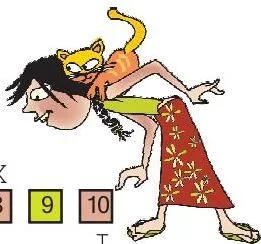
The chapter opens with a trick. Monto the cat is waiting for somebody, and the 1-to-60 grid hides the answer in a colour code.
Mark every number that 2 can divide with a red dot. Mark every number that 3 can divide with a yellow dot, and every number that 4 can divide with a blue dot.
The boxes that end up with dots of all three colours are numbers that 2, 3 and 4 can all divide — the smallest is 12, then 24, 36, 48 and 60. Those are exactly the multiples of 12 inside the grid.
Letters sit above some boxes. Write the letters from the triple-dot boxes in order, and they spell who Monto is waiting for. The trick works because a number carrying all three colours is simply a number all three rules divide at once — the chapter’s first meeting with common multiples, before the phrase is even used.
Multiples: What the Meow Game and Dice Game Teach
Multiples are the answers your counting tables produce: 3, 6, 9, 12… are the multiples of 3. The Meow game is where the word first appears in the chapter.
Everyone stands in a circle and counts up from one. A player who must say 3, or any number 3 can divide, says “Meow” instead, and anyone who forgets is out.
The replaced numbers — 3, 6, 9, 12, 15… — are what the book calls multiples of 3. Play again with 4, and the same pattern gives the multiples of 4: 4, 8, 12, 16, 20…
The prompt above asks for ten multiples of 5: 5, 10, 15, 20, 25, 30, 35, 40, 45, 50. You can always reach the next multiple by adding 5.
The dice game adds a decision. Throw two dice, make a two-digit number from the two faces, and write it in a circle if it is a multiple of one of the circle numbers.
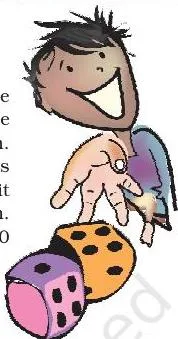
Step 1 (the book’s roll): dice show 3 and 2, so the choices are 23 and 32.
Step 2: 23 is not a multiple of any circle number, but 32 is a multiple of 4, so it goes in the red circle.
Step 3 (your roll): dice show 3 and 5, so the choices are 35 and 53.
35 is a multiple of 5; 53 fits no circle.
Rule to remember: always try both orders of the digits before you decide.
The same “find the shared step” idea works for the cat-and-mouse chase at the start of the chapter. Here is a new chase with fresh numbers.
- Step 1: the mouse starts on step 10 and jumps 2, so its landing steps are \( 12, 14, 16, 18, 20 \).
- Step 2: the cat starts on step 4 and jumps 4, so its landing steps are \( 8, 12, 16, 20 \).
- Step 3: compare round by round — after the first jump the pair is on 12 and 8; after the second, 14 and 12; after the third, both are on 16.
- Step 4: the shared step 16 comes before the hole at 20.
Final answer: the cat catches the mouse on step 16, before it can hide.
The book’s own chase works the same way. The mouse starts at 14 and jumps 2; the cat starts at 3 and jumps 3. The landing lists share the steps 18 and 24 — the common multiples of 2 and 3 in that range — and both lie before the hole at 28.
Common Multiples: The Overlap in the Circles
Some numbers belong to more than one multiples list at once. 15 is a multiple of 3 and a multiple of 5, so it sits where the two circles overlap — it is a common multiple of 3 and 5.
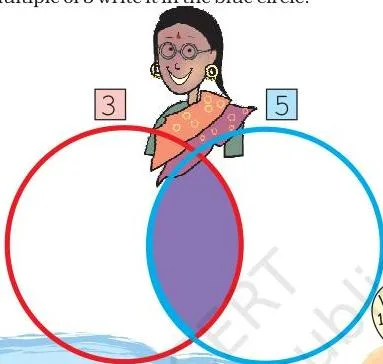
Write the multiples of 3 in the red circle and the multiples of 5 in the blue circle. The purple part is the overlap, and it holds the multiples common to both: 15, 30, 45… The smallest of these, 15, is the answer the book asks for.
The book stops to ask: if 15 moves into the purple part, does it stop being in the red and blue circles? No — the purple part is simply where the two circles share space. 15 is still a multiple of 3 and of 5; it is written once, in the shared part, instead of twice.

Repeat with 2 and 7. The common multiples of 2 and 7 are 14, 28, 42… and the smallest is 14.
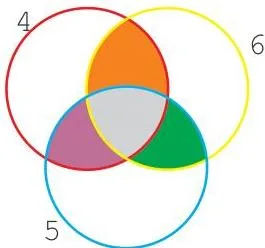
With three circles — for 4, 6 and 5 — the overlaps fill up in pairs. The green part holds common multiples of 5 and 6 (30, 60…), the orange part holds common multiples of 4 and 6 (12, 24, 36…), and the middle holds common multiples of 4, 6 and 5 all together (60, 120…). The smallest common multiple of 4, 6 and 5 is 60.
Tamarind Seeds and the “One Left Over” Puzzle
If Sunita had one seed fewer, her groups would all come out even. So her number of seeds is exactly one more than a number that 4, 5 and 6 all divide.
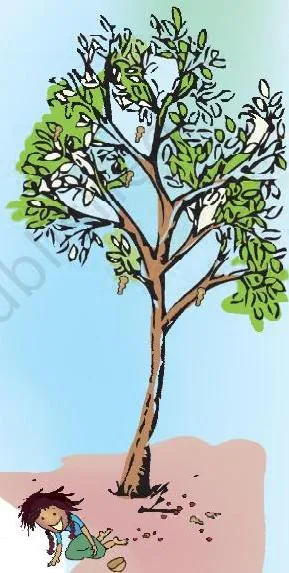
- Step 1: grouping by 5, 6 and 4 each leaves 1 seed, so the seed count is (a common multiple of 4, 5 and 6) + 1.
- Step 2: find the smallest common multiple of 4, 5 and 6: the multiples of 6 are 6, 12, 18, 24, 30, 36, 42, 48, 54, 60 — and 60 is the first of these that 4 and 5 also divide.
- Step 3: add the leftover seed: \( 60 + 1 = 61 \).
Step 4 (check): \( 61 \div 5 = 12 \) remainder 1; \( 61 \div 6 = 10 \) remainder 1; \( 61 \div 4 = 15 \) remainder 1.
Final answer: Sunita had 61 seeds.
Your turn with new numbers: Ravi’s pebbles leave 2 over when grouped in 4s, 5s and 6s.
The smallest common multiple is still 60, so the smallest count is \( 60 + 2 = 62 \).
Check: \( 62 \div 4 = 15 \) remainder 2; \( 62 \div 5 = 12 \) remainder 2; \( 62 \div 6 = 10 \) remainder 2.
Final answer: Ravi started with 62 pebbles.
The book invites you to try the same activity with seeds or pebbles at home. Keep the rule in mind: add the leftover, never subtract it.
Factors: Seed Rectangles, the Grid, and the Multiplication Chart
When 12 seeds arrange into a 2-by-6 rectangle, the 2 and the 6 are the numbers that multiply to make 12. A factor is one of those multipliers — a number that divides the given number exactly.
Try every rectangle 12 seeds can make: 1 by 12, 2 by 6 and 3 by 4 — three different rectangles, because 12 divides exactly into groups of 1, 2, 3, 4, 6 and 12. With 15 seeds there are only two: 1 by 15 and 3 by 5. A rectangle is a factor pair in disguise: its length and width are the two factors.
The 20-box grid asks the same question with boxes. A rectangle of width 2 has length 10, because \( 20 \div 2 = 10 \). The other colourings are 1 by 20 and 4 by 5, so 20 makes three rectangles in all.
The bangles table makes the idea practical. Eighteen bangles group perfectly into 1s, 2s, 3s, 6s, 9s and 18s — every group size is a factor of 18, and no other size works.
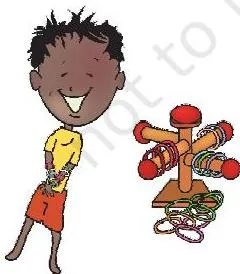
Completing the table for the other numbers means listing each number’s factors:
| Number of bangles | Different groups we can make (the factors) |
|---|---|
| 18 | 1, 2, 3, 6, 9, 18 |
| 24 | 1, 2, 3, 4, 6, 8, 12, 24 |
| 5 | 1, 5 |
| 9 | 1, 3, 9 |
| 7 | 1, 7 |
| 10 | 1, 2, 5, 10 |
| 20 | 1, 2, 4, 5, 10, 20 |
| 21 | 1, 3, 7, 21 |
The multiplication chart turns factors into a visual puzzle. The green cells show the ways to reach 12: \( 12 = 4 \times 3 = 6 \times 2 = 1 \times 12 \), so 1, 2, 3, 4, 6 and 12 are the factors of 12.
The chart reaches up to \( 12 \times 12 = 144 \), so it can give you the factors of 10 and 36 too. The factors of 10 are 1, 2, 5, 10; the factors of 36 are 1, 2, 3, 4, 6, 9, 12, 18, 36. For numbers beyond the chart’s reach, test by division instead.
Common Factors: Two Lists, One Shared Part
Factor lists can overlap just like multiples lists. The shared part of two factor lists holds the common factors — numbers that divide both original numbers exactly.
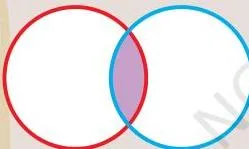
Write the factors of 25 in the red circle (1, 5, 25) and the factors of 35 in the blue circle (1, 5, 7, 35). The purple overlap holds 1 and 5 — the common factors of 25 and 35.
Now repeat for 40 and 60. The factors of 40 are 1, 2, 4, 5, 8, 10, 20, 40; the factors of 60 are 1, 2, 3, 4, 5, 6, 10, 12, 15, 20, 30, 60. The common part holds 1, 2, 4, 5, 10, 20, and the biggest common factor is 20.
Factor Trees: Splitting a Number Three Ways
A factor tree is a drawing of repeated splitting. Pick any factor pair of a number, split each piece into its own factor pair, and keep going until no branch splits further.
The three trees below all start differently but end the same.
| Tree | First split | Keep splitting | Building blocks left |
|---|---|---|---|
| 1 | \( 24 = 4 \times 6 \) | \( 4 = 2 \times 2 \), \( 6 = 2 \times 3 \) | 2, 2, 2, 3 |
| 2 | \( 24 = 3 \times 8 \) | \( 8 = 2 \times 4 \), \( 4 = 2 \times 2 \) | 2, 2, 2, 3 |
| 3 | \( 24 = 2 \times 12 \) | \( 12 = 3 \times 4 \), \( 4 = 2 \times 2 \) | 2, 2, 2, 3 |
Every route ends with the same building blocks — 2, 2, 2 and 3. That is the point of the tree: the branches are the factors of the factors, and the tree stops when a number has no smaller factor pair left.
Tiling Problems: Multiples and Factors in Real Life
A row of 2-foot tiles covers a path exactly only when the path length is a multiple of 2. So the chapter’s last puzzles are common multiples and common factors wearing a builder’s hat.
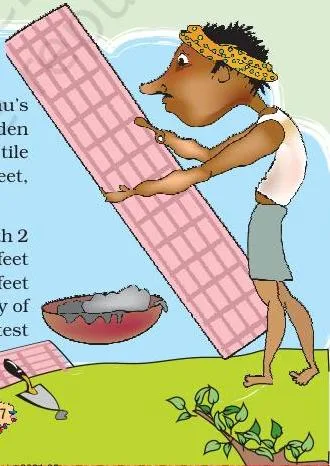
The first path has rows of 2-foot, 3-foot and 5-foot tiles, and the mason cuts nothing. So the path length must be a multiple of 2, of 3 and of 5 at the same time — the smallest such length is 30 feet. Check: \( 30 \div 2 = 15 \), \( 30 \div 3 = 10 \), \( 30 \div 5 = 6 \).
Manoj’s room is 9 feet by 12 feet, and a square tile must divide both sides. The 1-foot and 3-foot tiles divide both 9 and 12, so they work.
The 2-foot tile fails because 2 does not divide 9 — a row along the 9-foot side would need cutting. He should buy \( 1 \times 1 \) or \( 3 \times 3 \) tiles.
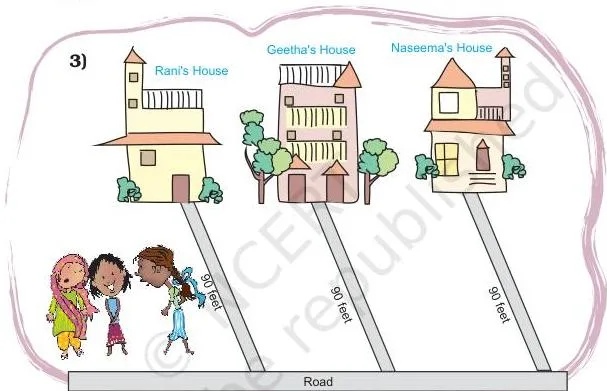
The 90-foot path asks for three tile lengths, each dividing 90 exactly. One set of answers is 3, 5 and 6 feet (90 ÷ 3 = 30, 90 ÷ 5 = 18, 90 ÷ 6 = 15); another is 2, 5 and 9 feet. The tile size is always a factor of 90.
Your turn with new numbers: a 60-foot path needs rows of 3-foot, 4-foot and 5-foot tiles without cutting.
- Step 1: 60 is a multiple of 3, 4 and 5 — in fact it is their smallest common multiple.
- Step 2: count the rows: \( 60 \div 3 = 20 \) rows, \( 60 \div 4 = 15 \) rows, \( 60 \div 5 = 12 \) rows.
Final answer: a 60-foot path takes exactly 20, 15 and 12 rows — every row ends evenly.
Figure Walkthrough: Reading the Diagrams at a Glance
The main diagrams of the chapter are explained in the sections above. Use this index to jump straight back to the one you need.
| Figure | What it shows | How to read it |
|---|---|---|
| Monto cat | the waiting-cat puzzle | the grid it points to hides a name in code |
| Monto letter grid | numbers 1–60 with letters above some boxes | boxes with all three dots are multiples of 12 |
| Ten multiples of 5 | a blank prompt | write 5, 10, 15… up to ten entries |
| Dice board | two dice and labelled circles | try both digit orders; keep the number that fits a circle |
| 3 and 5 circles | red and blue circles | purple overlap = common multiples; smallest 15 |
| 2 and 7 circles | two circles | common multiples 14, 28… |
| 4, 6 and 5 circles | three circles | triple overlap = common multiples of all three; smallest 60 |
| Seeds | a child grouping seeds | the one-seed-left-over puzzle |
| Bangles table | group sizes for 18 bangles | each size is a factor of 18 |
| Multiplication chart | 12 by 12 grid with green cells | green cells are factor pairs of 12 |
| 25 and 35 circles | factor lists in circles | purple overlap = common factors 1 and 5 |
| Factor tree | 24 split into branches | split until nothing branches further |
| Tiling rows | rows of 2-, 3-, 5-foot tiles | rows end evenly only at a common multiple |
| Manoj’s room | 9 by 12 floor | a tile must divide both 9 and 12 |
Definitions: Multiple, Common Multiple, Factor, Common Factor
The chapter never prints a definition box — the meanings come from playing the games. These are our plain-word restatements of what the activities show.
| Word | What it means | Where the chapter shows it |
|---|---|---|
| Multiple | a number you get by multiplying; one of a number’s times-table answers | Meow game: 3, 6, 9… are multiples of 3 |
| Common multiple | a multiple of two or more numbers at the same time | circle game: 15 is a common multiple of 3 and 5 |
| Factor | a number that divides a given number exactly | multiplication chart: 1, 2, 3, 4, 6, 12 are factors of 12 |
| Common factor | a factor shared by two numbers | circles: 1 and 5 are common factors of 25 and 35 |
Common Mistakes and How to Fix Them
Five slips come up again and again with this chapter’s activities. Each row names the mistake, the rule that fixes it, and a quick check.
| Mistake | Correct rule | How to check your answer |
|---|---|---|
| Confusing the words: “12 is a factor of 4” | 12 is a multiple of 4; 4 is a factor of 12 | read the sentence aloud: in \( 4 \times 3 = 12 \), the product is the multiple and the multipliers are the factors |
| Forgetting 1 and the number itself | every number has 1 and itself as factors; 7 has only 1 and 7 | start every factor list with \( 1 \times \) the number, then try 2, 3, 4… |
| In one-left-over puzzles, subtracting 1 | add the leftover: \( 60 + 1 = 61 \), not \( 60 – 1 \) | divide your answer and confirm the remainder matches the leftover |
| In the Meow game, stopping at 9 | every number divisible by 3 becomes Meow, so 12, 15, 18… also count | keep the times table of 3 running past 10 |
| In tiling puzzles, checking one side only | a tile must divide both the length and the width | test \( 9 \div 2 \): the remainder is 1, so a 2 × 2 tile fails on the 9-foot side |
What Teachers Check: Quick Practice Pointers
No marks promises here — just the skills a teacher listens for after this chapter. The biggest one is explaining an answer with a reason, not just a number.
- List multiples of a number from its times table — replay the Meow game with a new number.
- Say the first common multiple of two small numbers — repeat the circle games.
- Find factors from the multiplication chart — use the green-cell method.
- Name the biggest common factor of 40 and 60 — it is 20, from the two factor lists.
- Explain a tiling answer with a reason — why \( 3 \times 3 \) fits Manoj’s room but \( 2 \times 2 \) does not.
The smallest common multiple and the biggest common factor are the seeds of what later classes call LCM and HCF — that connection is ours, not a claim the chapter makes. Two no-prep revision moves: play the Meow game with 5, and draw three different factor trees for 24.
Revision Summary: The Chapter in a Few Lines
The chapter has no printed summary box, so this recap is ours. It follows the book’s own order of ideas.
- Multiples come from the multiplication table — the Meow game turns 3, 6, 9, 12… into “Meow”.
- Common multiples sit in the overlap of two multiples lists — 15 is common to 3 and 5.
- Factors are the multipliers that make a number — 1, 2, 3, 4, 6, 12 make 12.
- Every number lists 1 and itself among its factors — 7 has only 1 and 7.
- Common factors are the overlap of two factor lists — 1 and 5 are common to 25 and 35.
- A factor tree splits a number until the branches stop; every tree for 24 ends with 2, 2, 2, 3.
Two numbers worth remembering: the smallest common multiple of 4, 5 and 6 is 60, and of 2, 3 and 5 is 30.
Related Resources
Chapter 6 is part of the NCERT Class 5 Math-Magic book. Use these links to move to the full book, the class hub, or the chapters around this one.
- NCERT Class 5 Math-Magic book page — every chapter of the book in one place.
- Class 5 hub — notes pages for all Class 5 subjects.
- CBSE notes home — study resources across classes.
- Can You See the Pattern? notes — the chapter that follows this one in Math-Magic.
- Far and Near notes — a related Class 5 chapter notes page.
Two official sites settle the facts on this page. NCERT — ncert.nic.in — publishes the textbook and its chapter PDFs. CBSE — cbse.gov.in — settles the examinable syllabus, and textbook contents and the syllabus are not always identical, so check the current official syllabus.
Sources and Data Verification
This page describes Chapter 6 of the NCERT Math-Magic Class 5 (English) textbook, official edition published on ncert.nic.in. It covers this one chapter — the full list of chapters lives on the Class 5 Math-Magic book page. The page is kept in line with the current NCERT edition available on ncert.nic.in.
NCERT settles textbooks, editions and PDFs; CBSE settles the curriculum and examinations.
| What the chapter holds | Count | Where it is used |
|---|---|---|
| Printed pages | 12 | |
| Figures with NCERT captions | 14 | |
| Tables | 4 | |
| Activities | 1 | |
| Official NCERT PDF | Download the chapter PDF | the chapter exactly as NCERT publishes it |
Chapter-wise notes for this subject are not published yet. The unit-wise syllabus on this page is complete and verified against the official CBSE curriculum document.
Reference: NCERT Class 5 Mathematics (Math-Magic) textbook, chapter 6, official edition on ncert.nic.in.
Frequently Asked Questions
What is the answer to Sunita’s tamarind seeds question and why?
61 seeds. The groups of 4, 5 and 6 each leave one seed over, so the number must be one more than a common multiple of 4, 5 and 6. The smallest such common multiple is 60, and \( 60 + 1 = 61 \).
How do I find the factors of a number from the multiplication chart?
Look for every row-and-column product that equals the number. For 36, the chart shows \( 3 \times 12 \), \( 4 \times 9 \) and \( 6 \times 6 \); together with \( 1 \times 36 \) and \( 2 \times 18 \), the full factor list is 1, 2, 3, 4, 6, 9, 12, 18, 36. The green cells show the same trick for 12.
What is the difference between a multiple and a factor?
Multiples are the times-table answers of a number: 12, 24, 36… are multiples of 12. Factors are the multipliers that make the number: 1, 2, 3, 4, 6 and 12 are factors of 12. In the sentence \( 2 \times 6 = 12 \), the 2 and the 6 are factors, and 12 is the multiple.
Why can’t Manoj use \( 2 \times 2 \) tiles in his \( 9 \times 12 \) room?
A row of \( 2 \times 2 \) tiles along the 9-foot side cannot end evenly, because 2 does not divide 9 — \( 9 \div 2 \) leaves a remainder of 1. Since the tile must divide both the length and the width, only the \( 1 \times 1 \) and \( 3 \times 3 \) tiles work.
Which is the shortest path length in the first tiling problem?
30 feet. The path must be a multiple of 2, 3 and 5 at the same time, and 30 is the smallest common multiple of the three.
Explore Class 5 Mathematics Books
- Previous: Far and Near
- Next: Can You See the Pattern?
Related chapters:
- The Fish Tale
- Reading and writing large numbers
- Shapes and Angles