
This is the official NCERT Class 5 Mathematics (Math-Magic) textbook chapter 3, “How Many Squares?” — the chapter that builds the idea of area by counting unit squares before any formula appears. The How Many Squares? Class 5 chapter PDF from NCERT is right here, in its official edition, with the dotted sheets and squared grids the activities ask you to use.
Open the official How Many Squares? Class 5 Maths Chapter 3 PDF on the NCERT textbook portal to read the chapter on the squared paper it depends on — the dotted sheet for the opening rectangles, the stamp grid, the hand-tracing page and the five-square puzzles are all inside the same file.
How Many Squares? Class 5: chapter at a glance
The chapter-count table states how many sections, figures, worked examples and exercise questions this file holds. The chapter itself is built as a chain of activities, and what matters is what each activity trains.
- Opening activity — measure the red square and build rectangles from 12 such squares; the perimeter idea arrives here.
- Measure Stamps — count how many 1 cm squares each stamp covers; area starts as counting.
- Guess — compare footprints, notes and shapes by area and perimeter before measuring.
- How Big is My Hand? — trace a hand on squared paper and find its area in square cm.
- My Footprints — measure footprints, including the baby rhino’s, by grouping whole squares.
- How Many Squares in Me? — use symmetry so shapes that are half a rectangle are halved, not counted.
- Try Triangles — a triangle that is half of a rectangle has half its area.
- Complete the Shape — finish two given sides so the shape reaches a target area.
- Practice time — split a 20 square cm rectangle into equal triangles and equal rectangles.
- Puzzles with Five Squares — make 12 shapes from 5 squares and pack them into a 10 by 6 rectangle.
- Try another puzzle — pack the same 12 shapes into a 5 by 12 rectangle.
- Game Time — place the 12 shapes on a chessboard, five squares per move, without overlap.
- Make Your Own Tile — turn a 3 cm square into a tile and measure Ziri’s floor pattern.
- Practice time — test which tiles made from a 2 cm square cover a floor without gaps.
What this chapter teaches: area by counting, not by formula
This chapter builds the idea of area the way children actually learn it — by covering shapes with squares, not by memorising a formula. The printed note to teachers on the opening page says children are “not expected to learn the definition of the term ‘area’, but develop a sense of the concept through suitable examples.”
That note explains the whole style of the chapter: instead of a formula, every activity measures area by asking how many 1 cm by 1 cm squares cover a shape, and the answer is written in square cm.
Why counting replaces a formula. Before multiplying length by breadth can mean anything, a child has to know what area is — how much surface a shape covers. Counting unit squares supplies that meaning. The footprints activity’s note adds that the area of a rectangle will be done in chapter 11, so the book deliberately waits before introducing multiplication.
The chapter pairs area with perimeter from the very first activity: 12 equal squares make several rectangles that share the same area but have different boundary lengths, and the boundary length is the perimeter.
Key ideas: area, perimeter, halves and tiling
Everything in this chapter runs on four ideas — area, perimeter, half-rectangle triangles and tiling. Each idea below is taught from the activity that introduces it, with a fresh worked example so you get new numbers, not the book’s own.
Area: count the one-centimetre squares
What “area” means here: the number of 1 cm by 1 cm squares that cover a shape, written in square cm. The Measure Stamps activity uses exactly this — each stamp sits on a 1 cm grid, and its area is the count of squares it covers.
Worked example: if a shape covers 15 whole squares, each of side 1 cm, its area is 15 square cm. Compare two stamps: one covers 9 squares and another covers 13 squares, so the bigger stamp has area 13 square cm and the difference is \(13 – 9 = 4\) square cm.
The book also asks which two stamps have the same area, and ends with a suggestion: collect old stamps, place them on the square grid and find each stamp’s area and perimeter. (Measure Stamps activity)
Perimeter: the length of the boundary
Perimeter is the boundary length. Area tells how much surface a shape covers; perimeter tells how long its outline is. The opening activity shows that the same 12 squares can make different rectangles, and the figure below marks the outline that changes.
The marked outline running around the rectangle is the boundary, and its length is the perimeter. With 12 equal squares the three distinct rectangles are 1 by 12, 2 by 6 and 3 by 4:
| Rectangle | Perimeter |
|---|---|
| 1 by 12 | \(1+12+1+12 = 26\) cm |
| 2 by 6 | \(2+6+2+6 = 16\) cm |
| 3 by 4 | \(3+4+3+4 = 14\) cm |
All three rectangles have the same area — 12 square cm — yet three different perimeters. The long thin one is longest at 26 cm and the compact one shortest at 14 cm.
Extended with 20 squares, the pattern repeats: a 1 by 20 rectangle has perimeter \(1+20+1+20 = 42\) cm, 2 by 10 gives \(2+10+2+10 = 24\) cm, and 4 by 5 gives \(4+5+4+5 = 18\) cm. The closer a rectangle comes to a square, the shorter its perimeter for the same area.
Triangles: the half-rectangle idea
The most useful idea in the chapter: if a triangle is exactly half of a rectangle, its area is half of the rectangle’s area — no counting needed.
In the Try Triangles rectangle of area 20 square cm, the blue triangle is half of the big rectangle, so its area is \(20 \div 2 = 10\) square cm.
The blue triangle drawing shows the diagonal cut: the triangle sits in exactly half of the 20 square cm rectangle.
The red triangle looks harder, but Sadiq’s line is that it is two halves of two different rectangles. The two hidden rectangles have areas 4 square cm and 6 square cm, so the red triangle is \(4 + 6 = 10\) square cm — the same as the blue one.
This drawing shows the red triangle broken into those two halves, and the book asks you to find the two rectangle areas yourself.
Fresh model with new numbers: half of a 30 square cm rectangle is a triangle of 15 square cm; a triangle made from half of that rectangle plus half of a 10 square cm rectangle has area \(15 + 5 = 20\) square cm.
The big lesson: the two big triangles look very different yet both have area 10 square cm — area depends on covering, not on appearance. And the rectangle holds many more triangles of area 10 square cm; the activity asks you to draw at least five more. (Try Triangles activity)
Completing a shape to a target area
This activity works backwards. Instead of counting the area of a finished shape, you are given part of a shape and a target area, and you draw the missing sides to reach it.
Asif’s method: the green part of his completed shape is 4 square cm and the yellow part below it is 6 square cm, so the whole shape is \(4 + 6 = 10\) square cm.
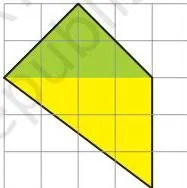
The “He completed the shape like this” figure shows exactly that split — one glance at the grid gives the two parts.
Suruchi completes the same start differently and still reaches 10 square cm, which is the point: a target area has many shapes, not just one answer.
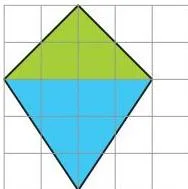
The three Practice time items then apply the idea. The first practice figure gives you a single drawn side and the target of 4 square cm; the second gives two sides and a target below 2 square cm, and curved edges are allowed.
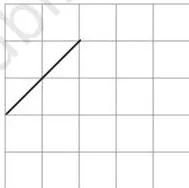
For the 20 square cm rectangle: a diagonal gives two equal triangles of \(20 \div 2 = 10\) square cm each; one straight line down the middle gives two equal rectangles of 10 square cm each; and two straight lines can leave one rectangle of 10 square cm plus two equal triangles of 5 square cm each, since \(10 + 5 + 5 = 20\).
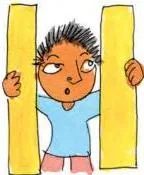
This is the 20 square cm rectangle itself — draw your dividing lines on it and check that every part’s area adds back to 20.
Twelve shapes from five squares
A puzzle about area and shape: how many different shapes can five squares make, and can all of them pack back into a rectangle?
The book’s own instruction is to measure the side of a small square on the squared paper on page 45. By “different” the puzzle counts shapes that are rotations or mirror images of each other as the same shape — that is why the answer is 12, not more.
Every shape uses exactly 5 squares, so every shape has area 5 square cm even though the perimeters differ. The book leaves the longest and shortest perimeters for you to measure on the squared paper.
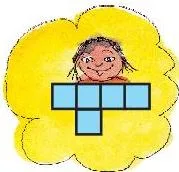
All 12 shapes fit together into a 10 by 6 rectangle — ten rows and six columns — and the book reports more than 2000 ways to arrange them. The second challenge packs the same 12 shapes into a 5 by 12 rectangle, with more than 1000 ways. (Puzzles with Five Squares activity)
Making a tile that repeats without gaps
Real-world area: a floor tile must repeat to cover a surface with no gaps and no overlaps, like the floor patterns Ziri sees in the shop.
The four steps: draw a square of side 3 cm; draw a triangle on any one side; draw the same-size triangle inside on another side; cut the shape out. Because the same triangle is added on one side and removed from another, the tile keeps the area of the original square: \(3 \times 3 = 9\) square cm.


The Step 2 drawing shows the triangle drawn on one side of the square; Step 3 draws the same triangle inside another side; Step 4 is the ready-to-cut tile.
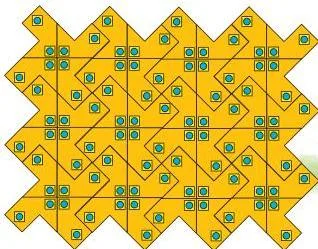
Ziri’s pattern is the tile repeated many times, and the figure lets you count the copies. The chapter asks how many tiles she used and the area of the whole pattern — count the tiles and multiply by 9 square cm.
Finally, the closing Practice time makes a subtle point: some shapes made from a 2 cm square keep the square’s area and yet do not tile a floor. Same area does not guarantee tiling. (Make Your Own Tile activity)
Reading the chapter’s figures: what each picture teaches
The book’s pictures are working tools, not decoration. These are the diagrams students often skip, and what each one is actually showing.
The hand picture is the How Big is My Hand? activity: trace your hand on the squared sheet, count the whole squares inside, then deal with the partial squares around the edge. Comparing your count with a friend’s decides whose hand is bigger.
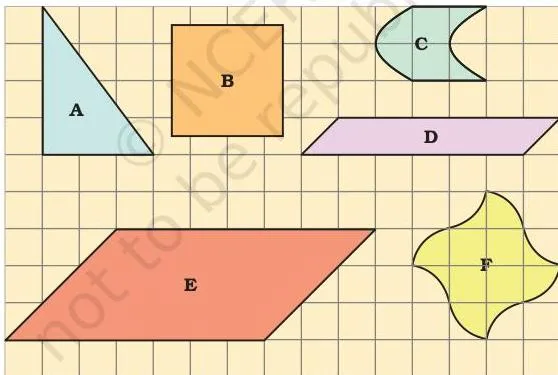
The “write the area” shapes rely on symmetry: each is half of a rectangle, so halve the rectangle’s area instead of counting every square. The note to teachers says children are expected to notice the geometrical symmetry to find the area.
The Sameena–Sadiq pair is the chapter’s strongest counter to judging area by looks: two big triangles inside the same rectangle look very different but have the same area.
This drawing reveals the two smaller rectangles inside the red triangle — their areas, 4 square cm and 6 square cm, are what Sadiq wants you to discover.
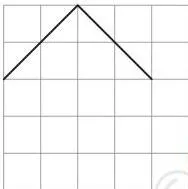
Suruchi’s two started sides are the raw puzzle: nothing but two sides exists, and two more sides must be added to fix the area at 10 square cm.
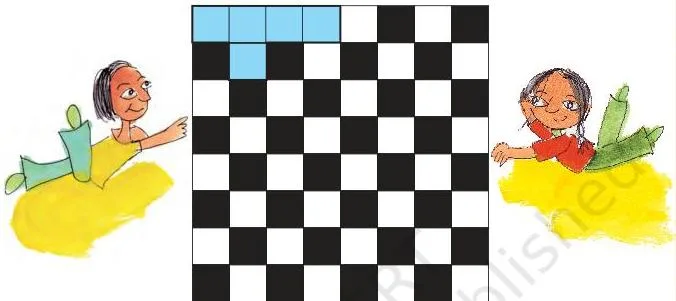
The chessboard is Game Time: players take turns placing the five-square shapes, each covering five squares, with no overlaps — the last player to place a piece wins. It is tiling as a game.
Definitions from this chapter: area, perimeter, tiling
The chapter keeps definitions plain because it builds meaning through activities. These are the words it actually uses.
| Term | What it means in this chapter |
|---|---|
| Perimeter | The length of the boundary of a shape. The opening activity’s own phrase: “Length of the boundary is called perimeter.” |
| Area | How many 1 cm by 1 cm squares cover the shape, written in square cm. |
| Square cm | The area of a square with side 1 cm — the unit used for all the counts in this chapter. |
| Half-rectangle triangle | A triangle drawn as half of a rectangle has half the rectangle’s area. |
| Tiling | Repeating one shape to cover a floor with no gaps and no overlaps. |
Common mistakes in this chapter
The chapter is designed around guesses children get wrong, and the book’s dialogues show the corrections. Each mistake below is named the way it actually appears in class.
| Mistake | Correct rule | How to check your answer |
|---|---|---|
| “My footprint is longer, so it is bigger.” | Compare by covering area, not by one dimension. | Put both footprints on the same square grid and count squares. |
| Confusing perimeter with area. | Area is the covering squares; perimeter is the boundary length. | The 12-square rectangles: all area 12 square cm, perimeters 26, 16 and 14 cm. |
| Counting every unit square one by one. | Group whole squares into the largest rectangles, then add the leftover partial squares. | Look for a big rectangle inside the shape before counting. |
| Judging area by how a shape looks. | Area depends on covering, not appearance. | Blue and red triangles: both 10 square cm although they look different. |
| Assuming any triangle is half of one rectangle. | Only true when the triangle really is half of one rectangle. | Can you see the parent rectangle? If not, split the triangle into halves of known rectangles. |
| Counting rotated or flipped shapes as new. | Rotations and mirror images are the same shape. | Turn the drawing around — if it matches, it is not new. |
| Assuming same area means the shape will tile. | Area does not guarantee tiling. | Repeat the shape on paper: are there gaps or overlaps? |
Practising this chapter: what the activities train
This is an activity chapter: the questions are fill-in blanks inside the activities rather than a block of exercises at the end. Since the questions are part of the activities, the skills they train are what matter:
- Counting squares to state an area in square cm.
- Comparing the areas of stamps, hands, footprints and shapes.
- Finding the biggest and smallest perimeter among equal-area rectangles.
- Using the half-rectangle rule for triangles.
- Completing a shape to a stated target area.
Textbook contents and the examinable syllabus are not always identical — check the current official syllabus for what applies this session.
A 15-minute self-test you can run from the book itself: redo the three Practice time parts on the 20 square cm rectangle, then draw at least five more triangles of area 10 square cm inside the Try Triangles rectangle. Both tasks check the two ideas the chapter leans on hardest — halving a rectangle and reaching a target area.
Recap: the chapter’s key points in ten lines
This chapter has no printed summary block, so the recap below is built from its activities.
- Area means the number of 1 cm squares that cover a shape, in square cm.
- Perimeter is the length of the boundary.
- The same area can go with very different perimeters.
- A triangle that is half of a rectangle has half its area.
- Irregular shapes are measured by grouping whole squares into rectangles.
- 12 different shapes can be made from 5 squares, each with area 5 square cm.
- Those 12 pack into a 10 by 6 rectangle and a 5 by 12 rectangle.
- A tile must cover a floor with no gaps between copies.
- A 3 cm square tile with a triangle moved from one side to another keeps its 9 square cm area.
- A shape can keep its area and still fail to tile.
Related chapters in Math-Magic
How Many Squares? is chapter 3 of the Class 5 book, sitting right after Shapes and Angles and before Parts and Wholes. The half-rectangle idea connects directly forward: the next chapter, Parts and Wholes, builds halves and fractions on the same ground.
The book’s own note in the footprints activity says the area of a rectangle by multiplication will be done in chapter 11 — this chapter deliberately stays with counting and grouping. Until then, the Class 5 Mathematics notes page and the Class 5 hub track every chapter of the book, and the fractions notes carry the half-and-quarter ideas forward.
For everything else, browse the CBSE notes library.
Sources and data verification
This listing is maintained for the 2026-27 academic session using the NCERT textbook information available to us. NCERT remains the authority for confirming the latest edition.
The descriptions on this page come from the NCERT Class 5 Mathematics textbook (Math-Magic), Chapter 3, “How Many Squares?”, in the official NCERT edition.
This page covers that single chapter; other Class 5 books and subjects are not described here.
It is maintained for the current academic session using the NCERT information available to us.
NCERT settles textbooks, editions and PDFs; CBSE settles curriculum, syllabus and examinations.
| What the chapter holds | Count | Where it is used |
|---|---|---|
| Printed pages | 16 | |
| Figures with NCERT captions | 21 | |
| Official NCERT PDF | Download the chapter PDF | the chapter exactly as NCERT publishes it |
Reference: NCERT Class 5 Mathematics textbook, chapter 3, official edition on ncert.nic.in.
Frequently asked questions
How many rectangles can you make using 12 squares in NCERT Class 5 Maths Chapter 3?
Three distinct rectangles: 1 by 12, 2 by 6 and 3 by 4. They all have the same area, 12 square cm, but their perimeters are 26 cm, 16 cm and 14 cm.
What is the area of stamp D in the How Many Squares? chapter?
Stamp D covers 12 squares, each of side 1 cm, so its area is 12 square cm. The chapter prints this as the worked example in the Measure Stamps activity.
How many different shapes can you make with 5 squares?
12 different shapes, each of area 5 square cm. Rotations and mirror images count as the same shape, which is why the total is 12.
A rectangle has an area of 20 square cm. What is the area of a triangle made from half of it?
10 square cm, because the triangle covers exactly half of the rectangle’s surface. The same Try Triangles rectangle holds many more triangles of this area, and the activity asks you to draw at least five of them.
How do you find the area of a footprint in Class 5 Maths Chapter 3?
Place the footprint on the square grid, group whole squares into the biggest rectangles you can see, then add the leftover partial squares. The footprints activity says to find the largest squares and rectangles inside the footprint first instead of counting each square.
What is the difference between area and perimeter in this chapter?
Area is how many 1 cm by 1 cm squares cover the shape, in square cm. Perimeter is the length of its boundary. The 12-square rectangles show both at once: same area, different perimeters.