
Looking for the Area and its Boundary Class 5 chapter PDF? This is Chapter 11 of the NCERT Math-Magic book, the chapter that builds area and perimeter through stamps, paper belts, threads and the King’s story. It runs about 13 printed pages, and the official PDF is linked right below.
The NCERT file is free on the official NCERT site and is the same file teachers use in class. Open it to read the whole chapter exactly as printed, with every activity, figure and practice set: NCERT Class 5 Math-Magic Chapter 11 Area and its Boundary PDF.
Chapter 11 at a glance
The table below lists what Chapter 11 holds — its sections, figures and questions — so you can see the size of the chapter and find the part you need before you start reading.
From aam paapad to the King’s story: what this chapter does
The chapter is one long hands-on activity: a shop slice, a stamp sheet, a paper belt, a thread and a king’s gift. Each activity builds one idea, and the order matters — counting squares first, formulas next, then stories that stretch the rules to their limits.
| Part of the chapter | What it teaches |
|---|---|
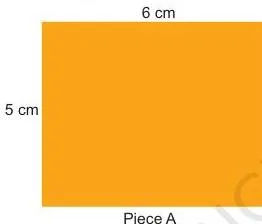
| Whose Slice is Bigger? | Comparing two irregular aam paapad slices by covering them with 1 cm squares. Piece A is 6 by 5, so its area is 30 square cm. |
| Cover with Stamps | Guessing how many 4-square-cm stamps cover a big rectangle, then checking the guess by counting. |
| Check your guess | Measuring the yellow rectangle to find its area and its perimeter. |
| Practice time | Applying area and perimeter to tiling a floor, fencing a garden and bending a wire into a rectangle. |
| My Belt is Longest! | Cutting one paper sheet into strips and joining them end to end keeps the same area but makes a much longer boundary. |
| Puzzle: Pass through a Postcard | A postcard cut along marked lines opens into one loop — the same area, with a suddenly enormous perimeter. |
| People People Everywhere | Building a feel for one square metre and one square km, and how many people fit in each. |
| Share the Land | Dividing Nasreena’s field into equal areas, then comparing the wire each share needs for fencing. |
| Thread Play | One 15 cm thread makes many shapes with the same perimeter but different areas. |
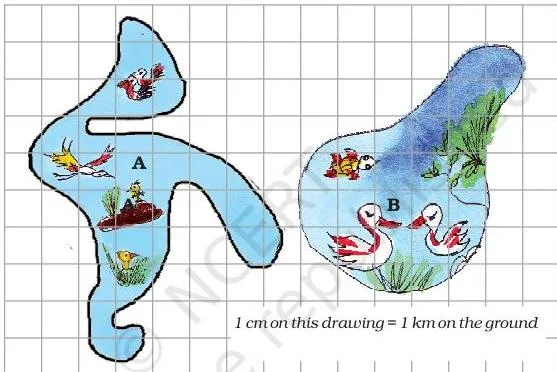
| Save the Birds | Using thread to measure the curved boundary of two lakes. |
| King’s Story | Cheggu’s and Anar’s rectangles show how far perimeter can stretch while area stays fixed. |
When you finish the King’s story you will have seen every idea of the chapter in action — that is why the activities come in this order.
Key concepts: area, perimeter, and the formulas the activities build
Two ideas run through everything in this chapter. Area counts the unit squares that fill a shape; perimeter is the length of the shape’s boundary. They are easy to confuse because both come from the same rectangle — so keep them separate from the start.
For a rectangle, the book’s counting method becomes a short cut: place 1 cm squares along the length, then along the width, and multiply. The aam paapad piece does this with 6 squares along the length and 5 along the width, giving \( 6 \times 5 = 30 \) square cm.
| Shape | Area | Perimeter |
|---|---|---|
| Rectangle | \( \text{length} \times \text{width} \) | \( 2 \times (\text{length} + \text{width}) \) |
| Square | \( \text{side} \times \text{side} \) | \( 4 \times \text{side} \) |
Why does the formula work? A rectangle’s boundary has two lengths and two widths, so you add one length and one width, then double it. Area works differently: the width tells you how many rows of squares fit, and the length tells you how many squares sit in each row — so you multiply.
Match the unit to the measurement. Lengths in cm give areas in square cm; lengths in m give areas in square m; lengths in km give areas in square km. A square cm is the area of a square with side 1 cm — not a centimetre of boundary.
Step 1: Identify the job.
A tray 25 cm long and 12 cm wide needs its whole surface covered — that is area.
Fencing its rim would be perimeter.
Step 2: Area = length × width.
\[ \text{Area} = 25 \times 12 = 300 \text{ square cm} \]
Step 3: Perimeter = 2 × (length + width).
\[ \text{Perimeter} = 2 \times (25 + 12) = 2 \times 37 = 74 \text{ cm} \]
Final answer: area = 300 square cm, perimeter = 74 cm. Two different answers for the same tray — the unit tells you which is which.
- Step 1: A 30 cm wire is bent into a rectangle, so the wire’s length is the rectangle’s perimeter.
- Step 2: Perimeter = 2 × (length + width); the width is 6 cm.
\[ 30 = 2 \times (\text{length} + 6) \]
Step 3: Halve both sides, then subtract the width.
\[ \text{length} + 6 = 15 \Rightarrow \text{length} = 9 \text{ cm} \]
Step 4: Now find the area the rectangle encloses.
\[ \text{Area} = 9 \times 6 = 54 \text{ square cm} \]
Final answer: length = 9 cm, area = 54 square cm. Notice the wire gave us a perimeter to start from, never an area directly.
The chapter’s squares A and B carry the same warning. Square A has area 9 square cm, so its side is 3 cm and its perimeter is 12 cm.
Square B has double the side, 6 cm. Its area is \( 6 \times 6 = 36 \) square cm — four times A’s area — but its perimeter is \( 4 \times 6 = 24 \) cm, only twice A’s. Doubling the side doubles the perimeter but makes the area four times larger.
What the pictures in this chapter show


The pictures in this chapter are working diagrams, not decoration — you measure from them, count on them, or cut along them. Read each one with the activity it belongs to.
The aam paapad slices: counting unit squares
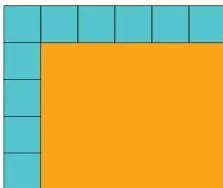
Parth and Gini’s dried mango slices start the chapter because their areas cannot be compared by eye. The friend’s trick is to cover each slice with 1 cm squares: 6 squares fit along piece A’s length and 5 along its width, so the whole slice holds \( 6 \times 5 = 30 \) squares — that is piece A’s area.
The second picture shows the grid drawn on piece A. Counting every square inside, not just the ones on the edge, gives the answer; multiplying rows by columns is the short cut the book points out.
Stamps and designs: from counting to multiplying
The stamp activity moves from counting squares to measuring. The stamp has area 4 square cm, so one stamp replaces four unit squares at once. Guessing how many stamps cover the rectangle, then checking, turns into a multiplication — the number along the length times the number along the width.
The triangle design is the same idea in halves. Each triangle in the drawing is half of a 1 cm square, so two triangles make one square cm — count the squares in the design to find its area in square cm.
Square metre and square km: how big is a unit?
The “People People Everywhere” pictures build a feel for units bigger than a square cm. Four Math-Magic books laid in a line come to about one metre and 9 cm. The square you draw from it is one square metre, and standing or sitting inside it shows how crowded a square metre really is.
The second picture pushes the question to a square km — a square with each side 1 km. The book’s contrast makes the size real: about 900 people live in a square km in West Bengal, but fewer than 15 in a square km in Arunachal Pradesh.
Nasreena’s land: equal shares need area, fences need perimeter
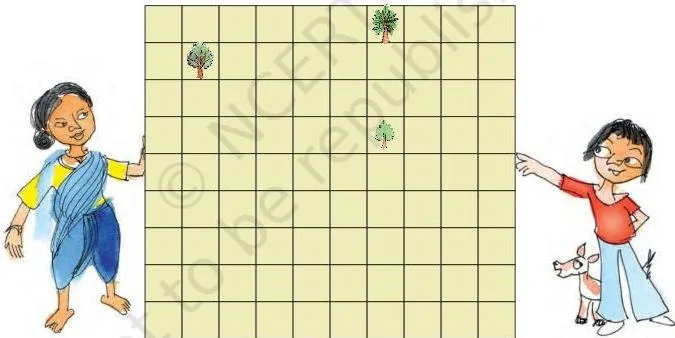
Nasreena’s field map brings area and perimeter together in one story problem. The land is drawn on a square grid where every square stands for 1 square metre.
Dividing it equally among her three children means each share has the same number of squares, and every share must keep one tree. The fencing question then switches to perimeter — whoever has the longest boundary needs the most wire.
Thread play: one perimeter, different areas
The 15 cm thread activity isolates perimeter. Every shape made from the same thread has the same perimeter — 15 cm — but the shapes trap different amounts of space inside.
The triangle, square, rectangle and circle made from the same thread show the same result in four familiar forms. The circle holds the most area — which is why Cheggu’s wife suggests a circle later.
Save the birds: measuring a curved boundary with thread
The two lakes have boundaries that no ruler can follow. The thread method solves this: lay the thread along the lake’s edge in the drawing, then measure the thread with a ruler.
That length is the lake’s boundary in the drawing, and the scale gives the real boundary in km. The lake with the longer boundary is kept for the birds — a longer edge gives more room for nests.
Cheggu and Anar: same wire, same area, very different perimeters
The last pictures stretch the ideas to breaking point. Cheggu’s 100 m of wire can make a \( 10 \text{ m} \times 40 \text{ m} \) rectangle with 400 square m of land or a \( 30 \text{ m} \times 20 \text{ m} \) rectangle with 600 square m — same wire, different land, so equal perimeter does not mean equal area.
Anar’s rectangles all enclose the same 800 square m but need very different boundaries: 40 by 20 needs 120 m of wire, 80 by 10 needs 180 m, 800 by 1 needs 1602 m, and 8000 by 0.1 needs more than 16000 m.
The boundary grows while the area stays fixed — that is why the king faints.
Definitions you need for Chapter 11
These are the words the activities keep using. Each one is grounded in something you meet in the chapter.
- Area — the number of unit squares that fill a shape. Piece A has area 30 square cm because 30 one-cm squares cover it.
- Perimeter — the total length of a shape’s boundary. The wire around Nasreena’s children’s fields measures their perimeters.
- Boundary — the outline you walk around when you trace the edge of a shape, from a starting point back to itself.
- Unit square — a square with side 1 unit, usually 1 cm in this chapter. One unit square has area 1 square cm.
- Square cm — the area of a 1 cm by 1 cm square, used for small things like a stamp or a handkerchief.
- Square m — the area of a 1 m by 1 m square, used for things like a classroom floor or a door.
- Square km — the area of a 1 km by 1 km square, used for whole cities, districts and the land a river flows over.
Common mistakes in Area and its Boundary
The activities in this chapter are designed to catch a handful of errors. Name each mistake before you make it, and use the check column to test your answer.
| Mistake | Correct rule | How to check |
|---|---|---|
| Using perimeter when the question asks for covering or tiling | Covering fills the inside — use area | Ask: is something being covered? Then it is area. |
| Using area when the question asks for fencing or wire | Fencing and bending wire measure the boundary — use perimeter | Ask: is something being fenced or bent? Then it is perimeter. |
| Counting only the squares on the edge of a figure | Count every unit square inside the shape | Multiply rows by columns: a 6 by 5 piece holds 30 squares, not 11. |
| Writing cm instead of square cm for area | Area always uses square units: square cm, square m or square km | Say your answer aloud — “300 square cm” must keep the word square. |
| Assuming the same area means the same perimeter | The same area can be stretched into a much longer boundary — the belt proves it | Re-cut the paper sheet into strips: the area is unchanged, the boundary is not. |
| Assuming the same wire means the same area | The same perimeter can enclose very different areas — Cheggu’s rectangles prove it | With 100 m of wire, 10 by 40 gives 400 square m but 30 by 20 gives 600 square m. |
| Choosing the wrong unit in the column table | Match the unit to the object’s size | Hand-size → square cm, room-size → square m, city-size → square km. |
One line to remember it all: area is what you cover, perimeter is what you fence.
Using Chapter 11 for class tests and homework
Chapter 11 is activity-based, so homework and class tests usually ask you to apply the two formulas to everyday objects. This is what each Practice time question type needs.
- Tiling a floor — find the area of the floor, then divide it by the area of one tile.
- Fencing a garden — find the perimeter: the fence goes around the boundary, not over the inside.
- A wire bent into a rectangle — the wire’s length is the perimeter. Halve it, subtract the width, and you have the length.
- A square carrom board — divide the perimeter by 4 to get the side, then multiply side × side for the area.
- The greeting-card table — fill one missing value at a time using perimeter = 2 × (length + width) and area = length × width.
The chapter itself notes that children are not expected to convert between square m and square km. The skill being tested is choosing the right unit for the object, not switching between big units.
One caution: textbook contents and the examinable syllabus are not always identical — check the current official CBSE syllabus for what is expected this session.
Chapter 11 recap: the ideas to carry with you
Keep these six ideas from Chapter 11.
- Area is the number of unit squares that fill a shape; perimeter is the length of its boundary — and the two do not rise and fall together.
- Area of a rectangle = length × width; area of a square = side × side.
- Perimeter of a rectangle = 2 × (length + width); perimeter of a square = 4 × side.
- The same area can take a much longer boundary — the paper belt and the postcard loop prove it.
- The same perimeter can give different areas — Cheggu’s 100 m of wire makes 400 square m or 600 square m of land.
- Square cm fits a hand, square m fits a room, square km fits a city — and doubling a side makes the area four times bigger.
Related chapters in Class 5 Math-Magic
Chapter 11 sits between two chapters that use the same skills. The previous chapter, Tenths and Hundredths, reaches the decimals this chapter uses in measurements like 0.1 m, and the next chapter, Smart Charts, follows it.
For quicker practice, open the Class 5 Mathematics notes, the Class 5 hub, or the wider CBSE notes section. You can also practise shapes and symmetry on the symmetrical designs page, and move on to the Smart Charts notes page when you are ready.
Sources and data verification
This listing is maintained for the 2026-27 academic session using the NCERT textbook information available to us. NCERT remains the authority for confirming the latest edition.
This page describes the NCERT Class 5 Math-Magic textbook, Chapter 11, “Area and its Boundary”, official edition published on ncert.nic.in. It covers only this chapter, not the whole Class 5 syllabus, and is maintained for the current academic session using the NCERT information available to us.
NCERT settles textbooks, editions and PDFs; CBSE settles curriculum, syllabus and examinations. Textbook contents and the examinable syllabus are not always identical, so check the current official syllabus for exam requirements. The official textbook files are available at ncert.nic.in.
| What the chapter holds | Count | Where it is used |
|---|---|---|
| Printed pages | 13 | |
| Figures with NCERT captions | 12 | |
| Tables | 2 | |
| Official NCERT PDF | Download the chapter PDF | the chapter exactly as NCERT publishes it |
Reference: NCERT Class 5 Math-Magic textbook, chapter 11, official edition on ncert.nic.in.
Frequently asked questions about Area and its Boundary
What is the difference between area and perimeter?
Area is the space inside a shape — the number of unit squares that fill it. Perimeter is the distance around it — the length of its boundary. For a classroom floor, the area is what you cover with tiles and the perimeter is the edge you would measure to run a skirting board around the walls.
How do you find the area of a rectangle in Class 5?
Multiply the length by the width. A rectangle 8 cm long and 5 cm wide has area \( 8 \times 5 = 40 \) square cm. Both measurements must be in the same unit before you multiply.
When should I use square cm, square m and square km?
Match the unit to the size of the thing you are measuring. Hand-sized objects like a handkerchief or a stamp take square cm; room-sized things like a floor or a door take square m; and huge areas like a city or the land a river flows over take square km.
Why is the belt made from a paper sheet longer than the sheet itself?
Cutting the sheet into strips and joining them end to end does not change the amount of paper, so the area stays the same. But the new shape is long and thin, so its boundary — the perimeter — becomes much longer. The belt activity exists to show that the same area can take very different perimeters.
How do you cut a postcard to pass through it?
Draw lines across the postcard in the pattern shown in the book and cut only on those lines. The cuts turn the card into one continuous loop — still the same area as the postcard — and the loop is big enough to pass through. The chapter’s answer box shows the exact lines to draw.
Why did the king faint at the end of the story?
Anar kept making thinner, longer rectangles with the same 800 square metres of area. A 40 by 20 rectangle needs 120 m of gold wire, 80 by 10 needs 180 m, 800 by 1 needs 1602 m, and 8000 by 0.1 needs more than 16000 m.
The king had promised as much gold wire as the boundary length, so the gift grew until he fainted.
Explore Class 5 Mathematics Books
- Previous: Symmetrical Designs
- Next: Smart Charts
Related chapters: