
Boxes and Sketches Class 5 is the ninth chapter of NCERT’s Math-Magic textbook for Class 5 mathematics (2026-27 edition). It shows how boxes, cubes and houses — three-dimensional shapes — live on flat paper as nets, floor maps and deep drawings.
The official NCERT chapter PDF is right here: download it, then use the walkthrough below to work through the chapter’s activities.
Download the NCERT Class 5 Boxes and Sketches chapter PDF
This is the official file from ncert.nic.in — the whole chapter exactly as NCERT printed it, including the sweet-box cut-out, every activity and both practice blocks.
Open the Boxes and Sketches Class 5 Maths NCERT chapter PDF to read the chapter in its original form, fold along with the activities, and keep the book’s own wording handy while you use the explanations below.
Chapter at a glance
The table below lists what sits inside the chapter file, section by section, so you can jump straight to the part you need. The chapter is a visual one — most of its teaching happens through drawings and cut-outs rather than long text.
| Section of the chapter | What it does |
|---|---|
| Sweet Box | Ramya’s sweet box and the flat cut-out that folds into it — your first net |
| Shapes that Fold into a Cube | Buddha’s two six-square shapes; you decide whether each folds into a cube |
| Shapes for an Open Box | The twelve five-square shapes from Chapter 3 tested as boxes without a top |
| Boxes and Boxes | Matching each flat shape to the box it will fold into — all boxes are not cubes |
| Floor Maps | Vibha’s house: a map that shows doors and windows but no height |
| Practice time | Adding doors and windows to a deep drawing; drawing a floor map of your own house |
| A Deep Drawing of a Cube | Soumitro and his friends’ drawings of a cube — which look correct? |
| Puzzle | A cut-out folded into a cube; choose the correct deep drawings of it |
| A Simple Way to Draw a Cube | Chanda’s two-square method for a deep drawing |
| Matchbox Play | Navin, Bhaskar and Pratigya’s bridge, drawn from different standing positions |
| Practice time | Top, front and side views of the bridge; a matchbox model; counting cubes |
Once you know what each section is for, use the explanation sections below to understand the ideas before you start folding.
What Boxes and Sketches Class 5 is about
This chapter exists for one reason: boxes, cubes and houses live in three dimensions, but the book you are reading is flat. The whole chapter trains you to move between the two — to unfold a box into a flat shape in your head, and to look at a flat drawing and see the box it came from.
The chapter works with three kinds of flat representation:
- Nets — flat shapes that fold into boxes. It opens with Ramya’s sweet box, which the shopkeeper folds from a paper cut-out in seconds.
- Floor maps — plans of a house seen from above. Vibha’s floor map shows where the doors and windows are, but tells you nothing about height.
- Deep drawings — perspective drawings that show length, width and height, like the drawings of Chanda’s cube and the matchbox bridge.
You will keep meeting four objects: Ramya’s sweet box, Vibha’s house, Chanda’s cube, and the matchbox bridge made by Navin, Bhaskar and Pratigya. There are no formulas in this chapter — the work is all seeing, folding and drawing.
Key ideas: nets, cubes, open boxes, floor maps and deep drawings
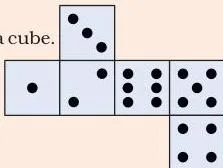
These are the words the chapter keeps using. Learn what each one means and every activity in the book makes sense.
- Net — a flat shape that folds up into a box. Ramya’s sweet box, unfolded and with its extra flaps removed, becomes a net.
- Cube — a box whose faces are all squares. Buddha uses this fact: all the faces of a cube are squares.
- Open box — a box without a top. The five-square shapes from Chapter 3 are tested here as open boxes.
- Floor map — a plan of a house that shows where the windows and doors are. It cannot show height.
- Deep drawing — a perspective drawing that shows length, width and height, so the object looks real.
- View — a drawing of an object from one standing position: the top, the front or the side.
Here is how the ideas compare:
| Idea | What it shows | Where it appears in the chapter |
|---|---|---|
| Net | The faces of a box laid out flat, ready to fold | Ramya’s sweet box; Boxes and Boxes |
| Cube | A box with six square faces, all equal | Buddha’s shapes; the puzzle |
| Open box | A box with no top — five faces | Shapes for an Open Box |
| Floor map | Doors and windows seen from above; no height | Vibha’s house |
| Deep drawing | Length, width and height together | The house drawings; Chanda’s cube |
| Top, front and side views | The same object from different positions | The matchbox bridge |
Mnemonic: to remember the cube’s six faces, count 1 up + 1 down + 4 around = 6. One top face, one bottom face, and four faces around the sides.
Reading the figures in this chapter
The figures in this chapter are the teaching, not decoration. Each drawing below is a question you answer by looking carefully, so do not skip past them.
The sweet box cut-out: a first net
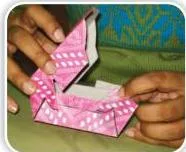
This is Ramya’s sweet box after she came home and unfolded it, removing the extra flaps. What is left is a net: one flat shape that folds back into the box.
Run your finger along the fold lines — every line becomes one edge of the finished box, and each separate square becomes one face. Time yourself folding the chapter’s cut-out, the way the shopkeeper folded it quickly.
Buddha’s two shapes: which fold into a cube?
Buddha wants a cube and knows that all the faces of a cube are squares. The two shapes he draws are each made of six squares, and the chapter asks: will both fold into a cube?
Do not guess. Fold along the dotted lines in your mind and check that no two faces end up on top of each other. Then draw one more six-square shape that folds into a cube, and one shape that will not fold.
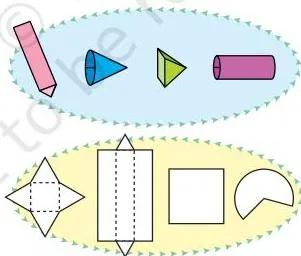
Boxes and boxes: matching a flat shape to a box
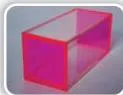
The caption gives the chapter’s key line: all boxes are not cubes. A cube has six equal square faces, but a box can have rectangular faces — longer than they are wide, or wider than they are tall.
To match a flat shape to a box, compare lengths, widths and heights. A long thin face in the net belongs with a long thin box; a square face belongs with a cube or with a box that is as wide as it is high.
Deep drawings of a cube: which look correct?
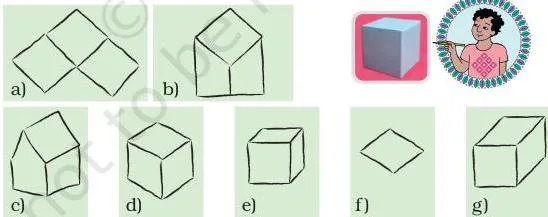
Soumitro and his friends all made deep drawings of the same cube, and their drawings disagree. The chapter asks you to discuss which look correct.
A correct deep drawing shows the back face sitting behind the front face. The chapter also asks what lines would turn drawing f into a deep drawing of the cube — those are the hidden edges joining the front square to the back square, the same joins Chanda uses in her method below.
The puzzle cut-out and its deep drawings
This cut-out folds into a cube, and the choices beside it are deep drawings of the cube. Before you compare them, imagine the fold: the squares at the edges of the cut-out stand up to become faces.
The test is the hidden edges. A correct deep drawing shows how the back face sits behind the front face; a drawing that shows only a flat front square is not deep. If a choice looks wrong, work out which edge would have to be visible and check whether the drawing shows it.
Chanda’s simple way to draw a cube
Chanda’s method is the one drawing recipe in this chapter, and it has three steps. Draw the front square. Draw the back square a little behind it. Join the matching corners of the two squares with straight lines.
The joined lines are the edges that link the front face to the back face, and they are what make the drawing look deep. The box in the figure is the target — after Chanda’s cube, draw this box the same way in your notebook.
The matchbox bridge: three viewpoints
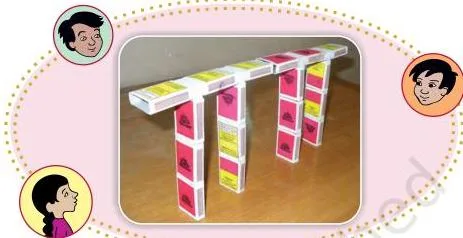
Navin, Bhaskar and Pratigya built this bridge from matchboxes. Then two of them drew it, and the drawings look different because they stood in different places.
One of the drawings shows how high the bridge is and how wide it is. As the children discuss, from the other drawing you can make out how long the bridge is and how high it is — but not how wide.
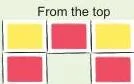
Each drawing shows only two of the three dimensions. That is why the chapter asks for three views: from the top you see length and width, from the front you see height and width, from the side you see length and height. No single view shows everything.
The matchbox model: top and side views
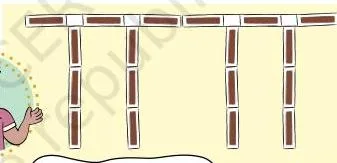
The second practice block asks you to make a matchbox model that looks like this, and then to make a deep drawing of it in your notebook. Building the model first makes the drawing much easier, because you can turn the object and see each face directly.
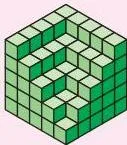
These are drawings of the model in different views. Mark the correct top view with T and the correct side view with S, the way the chapter asks. The same block also asks how many cubes are needed to make the model — count every matchbox, including the ones hidden underneath.
How to test whether a shape folds into a box
The chapter keeps asking the same question — will this flat shape fold into a box? — so it helps to have one method you can run on any shape.
- Count the faces. A closed cube needs exactly six squares. An open box needs five: four sides and a base, with no top. A shape with the wrong count cannot make that box.
- Name each square’s job. Every square becomes one face of the box — front, back, left, right, top or bottom.
- Fold along the dotted lines in your mind. Watch each square at the edge: it must stand up into its own face.
- Reject any shape where two faces would overlap. In a real box every face has its own place; no face sits on top of another.
- If you are stuck, fold real paper. Cut the shape out and fold it — the chapter expects you to fold actual cut-outs, starting with the sweet box.
Worked example — the T-shaped net. On 1 cm squared paper, draw three squares in a row and three more squares hanging from the middle square of that row. Six squares in all, shaped like a T:
Test it. Six squares — enough faces for a cube. The middle square of the top row becomes the front face; the squares to its left and right fold back to become the two side faces; the three squares hanging below fold down, back and up to become the base, the back face and the top.
Every face lands in its own position, so this T-shaped net folds into a cube.
Each face is a 1 cm × 1 cm square, so every face has area \(1\ \text{cm}^2\). Six faces together give \(6\ \text{cm}^2\) of surface.
Now the counter-check. Draw six squares in one straight strip. The count is still six, but fold it and the two end squares land on the same spot:
Same count, different result — the arrangement of the squares decides, not the number alone. This is why Buddha’s two shapes are worth checking one at a time. For an open box, run the same test with five squares: four sides and a base. The twelve five-square shapes from Chapter 3 are the ready-made pack to test.
Common mistakes in Boxes and Sketches
These are the errors this chapter is really training you out of. If you name the mistake before you make it, the activity becomes easy.
| Mistake | Correct rule | How to check your answer |
|---|---|---|
| Counting only the faces you can see and forgetting the one underneath a cube. | A cube has six faces: one top, one bottom and four around the sides. | Count 1 up + 1 down + 4 around = 6, the way Buddha counts faces before he draws. |
| Judging a net only by how many squares it has. | The arrangement decides, not the count. A straight strip of six squares does not fold into a cube. | Fold it in your mind: if two faces land on the same spot, reject the shape. |
| Treating a floor map as a picture of the house. | A floor map shows where the doors and windows are, seen from above. It cannot show height. | Can you tell how high a window is from the map? If not, it is a floor map, like Vibha’s. |
| Confusing a floor map with a deep drawing. | A deep drawing shows length, width and height; a floor map shows only the layout of doors and windows. | Ask which dimensions the drawing shows: all three means deep, two or none means a map or a view. |
| Drawing the same view for top, front and side. | Each standing position hides a different dimension: front shows height and width, side shows length and height, top shows length and width. | Name the two dimensions each drawing shows — they must differ for different views of the matchbox bridge. |
| Drawing only one square for a cube. | A deep drawing of a cube shows the back face behind the front face: two squares with corners joined. | Can you see the back face in your drawing? If not, use Chanda’s two-square method. |
What this chapter expects you to be able to do
This chapter is about skills, not memorised facts. Work through the activities and you should be able to:
- Recognise which six-square shapes fold into a cube, and draw one more that works and one that will not (Buddha’s shapes).
- Test the twelve five-square shapes from Chapter 3 and find which fold into an open box.
- Match a flat shape to the box it folds into by comparing lengths, widths and heights (Boxes and Boxes).
- Read a floor map: find the front side of a house and count its doors and windows (Vibha’s house).
- Place doors and windows on a deep drawing to match a floor map (Practice time).
- Choose the correct deep drawing of a cube and add lines to fix an incomplete one (Soumitro’s drawings and the puzzle).
- Draw any cube by the two-square deep drawing method (Chanda’s way).
- Identify top, front and side views, and mark them on drawings (the matchbox bridge and model).
- Count the cubes hidden in a model built from boxes (the matchbox model).
Hands-on activities the chapter asks you to try
This chapter is meant to be done, not just read. Every idea in it becomes obvious the moment you fold real paper.
- Fold a box from the sweet-box cut-out given with the book. Time yourself — the shopkeeper made the box quickly.
- Draw at least one more six-square shape that folds into a cube, and one shape that will not fold (Buddha’s task).
- Cut out the twelve five-square shapes from Chapter 3 and test which fold into an open box.
- Draw a floor map of your own house, showing where the doors and windows are.
- Build the matchbox bridge, then draw it from the top, from the front and from the side.
- Make the matchbox model from the book, draw a deep drawing of it, and count how many cubes it needs.
These are the chapter’s own activities. Doing them builds exactly the visualisation the questions in the chapter test.
The chapter in a nutshell
- A net is a flat shape that folds into a box; an unfolded box is a net.
- A cube has six square faces, all equal — one top, one bottom and four sides.
- An open box has no top, so it takes five squares.
- Not all boxes are cubes — other boxes have rectangular faces.
- A floor map shows where doors and windows are, but never height.
- A deep drawing shows length, width and height together.
- The same object looks different from the top, the front and the side — each view hides one dimension.
- To test a net: count the faces, fold in your mind, and reject any shape where two faces would overlap.
Related chapters and resources
This chapter reuses something you already met: the twelve different shapes made from five squares appeared in Chapter 3 as puzzles. Here some of them fold into open boxes — if you kept that chapter’s shapes, test them tonight. Floor maps are maps, so this chapter also pairs naturally with the map chapter that comes just before it in Math-Magic.
For more Class 5 mathematics practice, browse the Class 5 Maths notes or the wider Class 5 study hub. Useful companions from the same book: Tenths and Hundredths, the chapter that follows this one, and the Class 5 notes on weight and capacity for measuring and comparing sizes. The full set of CBSE notes is organised by class and subject.
Sources and data verification
| What the chapter holds | Count | Where it is used |
|---|---|---|
| Printed pages | 8 | |
| Figures with NCERT captions | 11 | |
| Official NCERT PDF | Download the chapter PDF | the chapter exactly as NCERT publishes it |
Reference: NCERT Class 5 Math-Magic textbook, chapter 9, official edition on ncert.nic.in.
- This page covers only NCERT Class 5 Math-Magic Chapter 9 (Boxes and Sketches) and is based on the 2026-27 NCERT printing.
- Textbook contents and the examinable syllabus are not always identical — check the current official syllabus for what is examinable this session.
- NCERT settles textbooks, editions and official PDFs; CBSE settles the syllabus and examinations.
Frequently asked questions
How many faces does a cube have?
A cube has six faces, and all six are squares. Count them as one top face, one bottom face and four faces around the sides. This is the fact Buddha starts from when he draws shapes that fold into a cube.
What is the difference between a floor map and a deep drawing?
A floor map is a plan of a house seen from above — it shows where the doors and windows are, but you cannot tell how high anything is. A deep drawing shows length, width and height, so it looks the way the house really does.
Vibha’s floor map does not decide which deep drawing is hers by itself; you match the doors and windows.
What is a net in Class 5 maths?
A net is a flat shape that folds up into a box. Ramya’s sweet box, unfolded and with its extra flaps removed, becomes a net. When you fold a net along its lines, each part of the flat shape becomes one face of the box.
How do you draw a cube using the deep drawing method?
Chanda’s method has three steps. Draw the front square. Draw the back square a little behind it. Join the matching corners of the two squares. The joined lines are the edges between the front and back faces, and they are what make the drawing look deep.
How do I know which five-square shapes fold into an open box?
An open box is a box without a top, so it needs five faces: four sides and a base. Fold each five-square shape along its lines and check that no two faces overlap. The twelve shapes from Chapter 3 are the pack to test — some fold into an open box and some do not.
Where can I download the official NCERT Class 5 Math-Magic Chapter 9 PDF?
Use the Boxes and Sketches Class 5 Maths NCERT chapter PDF link at the top of this page. It opens the official file for Chapter 9 on ncert.nic.in, the NCERT website.
Explore Class 5 Mathematics Books
- Previous: Weight and Capacity
- Next: Tents and Hundredths
Related chapters: