
Does it Look the Same? is Chapter 5 of the NCERT Math-Magic textbook for Class 5 (Mathematics, 2026-27 edition). It asks one question in two situations: after folding a shape along a line, and after turning it part-way around. The official chapter PDF is on this page — right below.
Get the Official Does it Look the Same? Class 5 Chapter PDF
This is the chapter your school follows, straight from NCERT — the same official file, free to open and read. Open the Does it Look the Same? Class 5 chapter PDF from ncert.nic.in to see the original text, colour figures and activity pages exactly as printed in Math-Magic.
Keep the PDF open in one tab and this page in the other: every figure below is the same picture from the book, and each explanation points to the section it belongs to.
Chapter at a Glance: What the Table Counts
The table below lists how much this chapter holds — its sections, figures, worked examples and exercise questions — so you can see the size of the file before you open it.
Inside the chapter, the sections run in this order:
- Make your pattern — the drop-of-colour fold and the first mirror-half test.
- Mirror Games — placing the mirror on the dotted line to complete a picture.
- Half a Turn — the king’s locker story, then a Practice time block on letters, words and numbers.
- Activity Time — making the toy windmill.
- One-fourth Turn — the fan, then a Practice time block on quarter and half turns.
- One-sixth Turn — a shape that survives a sixth turn, with the final Practice Time block.
What This Chapter Covers: Patterns, Mirrors and Turns
The chapter asks “does it look the same?” in two situations: folding a shape along a line to make mirror halves, and turning a shape part-way around. The ideas build in this order:
| Part of the chapter | What it teaches |
|---|---|
| Make your pattern | Folding paper and spreading a drop of colour, so the two sides of the pattern match. |
| Mirror Games | Where to place the mirror on a dotted line so the hidden half completes the picture. |
| Half a Turn | Turning a shape upside down, introduced by the king’s locker. |
| Practice time | Applying the half turn to letters, words and numbers. |
| Activity Time | Building a toy windmill and asking quarter-turn and half-turn questions about it. |
| One-fourth Turn | The fan, and drawing shapes after a quarter turn and a half turn. |
| Practice time | Marking shapes that survive a quarter or half turn, and changing shapes so they do. |
| One-sixth Turn | A shape that looks the same after a sixth turn — and why it also looks the same after a third turn. |
| Practice Time | Drawing shapes after a sixth turn and a third turn. |
Read the chapter in this order and the questions repeat themselves: first the fold, then the mirror, then the turns. Each new turn is just the same test with a different part of a full turn.
Key Concepts: Mirror Halves and Turns
Two ideas run through the whole chapter. Understand these two, and every exercise in it is the same test in a new picture.
Mirror halves: the fold test
A dotted line divides a shape into two halves. Fold the shape along that line: if one half covers the other completely, the two halves are mirror halves.
The book adds one warning: a shape can be symmetric in outline but not in colour. The fold test must compare the colour pattern too — that is why the chapter’s note points at shapes 10 and 12, where the colouring breaks the symmetry.
Turns: the trace-and-turn test
A half turn means turning the shape upside down — half of one full turn. A one-fourth turn, one-third turn or one-sixth turn is that named part of a full turn. The question is always the same: after the turn, does the shape look exactly as it did?
Guessing is hard, so the chapter gives a check you can do with any shape — the trace-and-turn test:
- Trace the shape’s outline onto a sheet of paper.
- Put the shape back exactly on its traced outline.
- Turn the shape through the turn and see whether it still fits the outline.
If the shape fits its outline after the turn, it looks the same; if any corner sticks out, it does not. The same test works for a quarter, third or sixth turn.
One clue from the end of the chapter saves time: a shape that looks the same after a \( \frac{1}{6} \) turn also looks the same after a \( \frac{1}{3} \) turn, because two sixth turns make one third turn.
Figure Walkthrough: Reading the Pictures in This Chapter
Each picture below is one of the chapter’s own figures. Read the caption, then the lines under the picture — they say what the figure shows and what to do with it.
Mirror half or not?
The chapter begins with two contrasting examples, so you can see a wrong dotted line next to a right one.
Fold along this dotted line and the left half does not cover the right half completely. Two halves that miss each other like this are not mirror halves.
Here the same fold works: one half covers the other similar half completely. These two are mirror halves.
The exercise then hands you a row of pictures. For each one, ask: would folding along the dotted line make the two halves cover each other? That question is the whole activity.
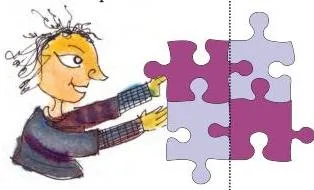
Mirror Games: where does the mirror go?
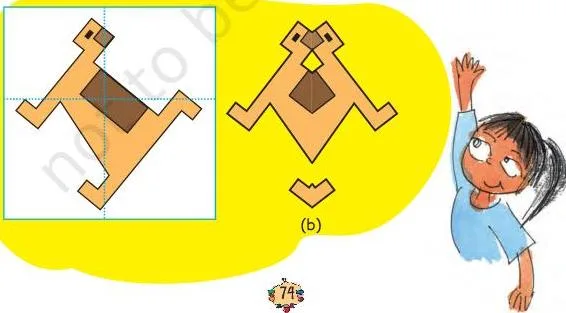
In Mirror Games the dotted line is where the mirror stands. The part on one side of the line hides behind the mirror, and the reflection completes the picture.
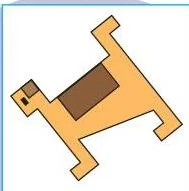
The dog at the start of the section works this way: put the mirror on the dotted line and the right half of the dog hides behind it. The white-box puzzles ask the reverse — given the finished picture, choose the dotted line for the mirror and say which part hides.
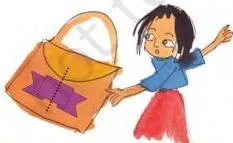
Now you draw the line yourself. The chapter’s advice: look at the final picture in each pair and guess where the line of symmetry must be on the shape in the white box.
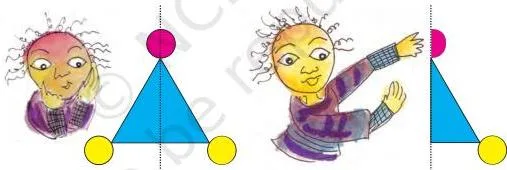
The king’s locker: why the dot?
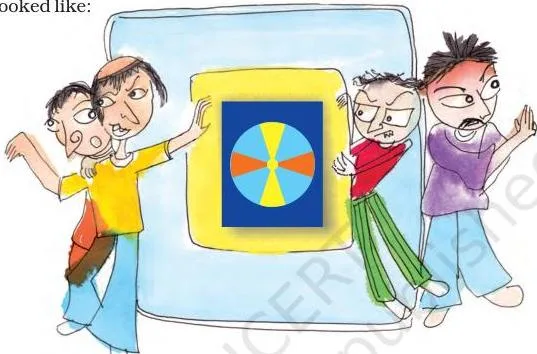
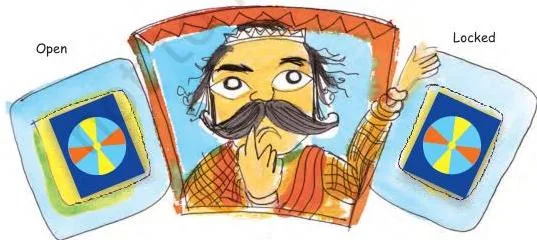
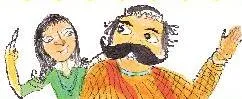
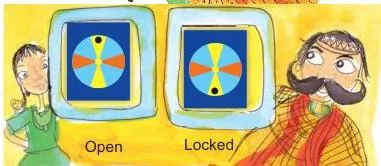
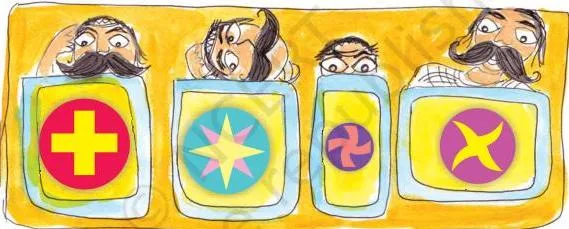
The story of the king is how the chapter introduces the half turn. The locker opens with half a turn of the handle; another half turn locks it again.
See the handle? Because it looks the same after a half turn, the locked position and the open position look identical.
That identical look is exactly why the king kept leaving the locker open — the handle gave him no clue about open or locked.
One dot fixes the problem. With a dot on one yellow blade, the handle with the dot at the top looks different from the handle with the dot at the bottom. The symmetry is broken, so the king can now tell open from locked at a glance.
The trace-and-turn test
The shapes just after the story are the practice set. Do not answer “same after half a turn?” for any of them by guessing — run the three-step trace-and-turn test from Key Concepts.
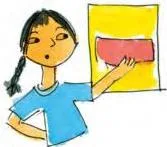
The figure shows the idea: choose one shape, trace its outline on a sheet, put the shape back on its outline, give it a half turn, and see whether it fits. If it does, that shape is “same after \( \frac{1}{2} \) turn”.
Numbers that survive a half turn
The Practice time block asks which digits from 0 to 9 still look the same after a half turn, and then asks you to build 2-, 3- and 4-digit numbers from the digits that survive.
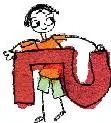
In the digit style the book prints, only 0, 1 and 8 stay unchanged after a half turn; 6 and 9 swap into each other. That is why the book’s own examples — 11, 101, 111, 1001, 1111 — all work: every digit survives and the number reads the same backwards.
Here is the step-by-step check for 10801, a 5-digit number that survives too:
- Write 10801 as its digits: 1, 0, 8, 0, 1.
- Turn each digit on its own: 1 stays 1, 0 stays 0, 8 stays 8, 0 stays 0, 1 stays 1.
- A half turn also reverses the order, so the first digit becomes the last. Reading backwards, 1, 0, 8, 0, 1 is still 10801.
- The turned number reads 10801 — exactly the original. So 10801 looks the same after a half turn.
The same rule explains why 69 and 96 work: a 6 turns into a 9 as the order flips, so each two-digit number reads the same after the turn.
Hands-On Activities: The Drop of Colour and the Windmill
Two activities in the chapter are make-it-yourself. Doing them answers the symmetry questions with your hands, not just your eyes.
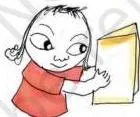
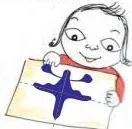
The drop-of-colour pattern
This is the opening activity of the chapter. It makes a pattern whose two sides match — which is exactly what mirror halves means.
- Take a sheet of paper.
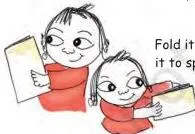
- Fold it into half.
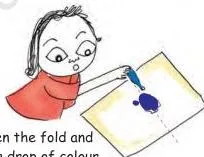
- Open the fold and put a drop of colour on the middle line.
- Fold it twice and press it, so the colour spreads.
- Open it and see a beautiful pattern.
The figures show steps 1, 2, 3 and 5; step 4 is the press between the drop and the opening. Both sides match because the colour soaked through the folded paper — each side got the same mark, like a mirror copy.
The chapter then asks: can you cut this pattern so you get two similar mirror halves, and in how many ways?
The toy windmill
The windmill activity is the quarter-turn lesson in disguise. Build it, then discuss the two questions at the end.
- Take a sheet of paper and fold it as shown in the picture.
- Cut out the blue part — your sheet now looks like a square.
- Fold along the red lines, open the fold, and draw a circle on the sheet.
- Cut along the red lines till you reach the circle.
- Take a pin and make holes on the four corners.
- Fold the corners so all the holes lie one on top of the other.
- Pass the pin through the holes and fix it into the stick.


Now come the two chapter questions: Does the windmill look the same on a \( \frac{1}{4} \) turn? Does it look the same on a half turn? The four corners give it four blades.
If every blade is folded alike, a quarter turn brings the next identical blade forward, and a half turn brings the opposite identical blade forward — so the answer to both is yes. Uneven folds will show up in the answer.
Definitions: The Words This Chapter Uses
Six terms carry the whole chapter. Each definition below comes with the test that decides whether it is true.
| Term | What it means | The test that goes with it |
|---|---|---|
| Mirror halves | Two halves of a shape that cover each other exactly when folded along the dotted line. | Fold along the dotted line; one half must cover the other completely. |
| Dotted line (line of symmetry) | The fold line that divides the shape, and the line where the mirror stands in Mirror Games. | Both sides of the line must match in shape and colour. |
| Half turn | Turning the shape upside down — \( \frac{1}{2} \) of a full turn (a 180-degree turn, if you know degrees). | Trace the outline, turn the shape, and see if it fits. |
| One-fourth turn | Turning the shape by \( \frac{1}{4} \) of a full turn — the turn the fan and windmill are tested on. | Same trace-and-turn test. |
| One-third turn | Turning the shape by \( \frac{1}{3} \) of a full turn. | Same trace-and-turn test; two sixth turns make one third turn. |
| One-sixth turn | Turning the shape by \( \frac{1}{6} \) of a full turn. | A shape that looks the same after a \( \frac{1}{6} \) turn also looks the same after a \( \frac{1}{3} \) turn. |
Common Mistakes in Does it Look the Same?
Four mistakes trip up students in this chapter. Each row names the mistake, the correct rule, and how to check your answer.
| Mistake | Correct rule | How to check your answer |
|---|---|---|
| Judging mirror halves by the outline only. | The colour scheme matters too. A shape can be symmetric in outline and asymmetric in colour, as the chapter’s own note points out for shapes 10 and 12. | Fold along the dotted line and compare both halves of the coloured pattern, not just the outline. |
| Answering “same after a half turn?” by guessing from memory. | Use the trace-and-turn test instead of deciding by eye. | Trace the outline, put the shape back on it, turn it, and see whether it fits exactly. |
| Treating a \( \frac{1}{6} \)-turn and a \( \frac{1}{3} \)-turn as unrelated. | Two \( \frac{1}{6} \) turns make one \( \frac{1}{3} \) turn, so a \( \frac{1}{6} \)-turn shape also looks the same on a \( \frac{1}{3} \) turn. | Turn a shape by \( \frac{1}{6} \), then another \( \frac{1}{6} \) — it has turned \( \frac{1}{3} \) in total. |
| Confusing the \( \frac{1}{4} \)-turn test with the \( \frac{1}{2} \)-turn test. | They are different turns with different answers. A shape can pass one test and fail the other. | Test them separately — the windmill section asks both questions one after the other. |
What You Should Be Able to Do After This Chapter
This chapter is activity-based, and its three Practice time blocks ask for a specific set of skills. When you finish, you should be able to:
- mark which shapes are divided into two mirror halves by the dotted line;
- draw the mirror line on the white box so the mirror completes the picture;
- find which letters of the English alphabet look the same after a half turn;
- decide which of ZOOM, MOW, SWIMS, SIS and NOON read the same on a half turn;
- find which digits from 0 to 9 survive a half turn and build 2-, 3- and 4-digit numbers from them;
- draw a shape after a \( \frac{1}{4} \) turn, a \( \frac{1}{2} \) turn, a \( \frac{1}{3} \) turn and a \( \frac{1}{6} \) turn;
- change a shape so the new shape looks the same after a half turn or a \( \frac{1}{3} \) turn;
- answer whether a fan or a windmill looks the same on a \( \frac{1}{4} \) turn, a \( \frac{1}{2} \) turn or a \( \frac{1}{3} \) turn.
Textbook contents and the examinable syllabus are not always identical — check the current official CBSE syllabus before you plan revision.
Quick Recap: Mirror Halves and Turns in Brief
One table, one list — the whole chapter in the order you would revise it.
| Turn | What it means | Where the chapter uses it |
|---|---|---|
| Half turn (\( \frac{1}{2} \)) | Turning the shape upside down. | The king’s locker handle, the windmill discussion, and the letters-words-numbers practice. |
| One-fourth turn (\( \frac{1}{4} \)) | A quarter of a full turn. | The fan, and the windmill’s first question. |
| One-third turn (\( \frac{1}{3} \)) | A third of a full turn. | The two fans, and the shapes you draw after a \( \frac{1}{3} \) turn. |
| One-sixth turn (\( \frac{1}{6} \)) | A sixth of a full turn. | The sixth-turn shape — which also looks the same on a \( \frac{1}{3} \) turn. |
Remembered facts from the chapter:
- The fold test decides mirror halves — and it checks colour as well as outline.
- Only 0, 1 and 8 stay unchanged after a half turn; 6 and 9 swap into each other, so 69 and 96 also work.
- In block capitals, H, I, N, O, S, X, Z look the same after a half turn.
- MOW, SWIMS, SIS and NOON read the same after a half turn; ZOOM does not, because M becomes W.
Related Chapters and Resources
Staying in the same book, Parts and Wholes (Chapter 4) is the chapter just before this one, and Be My Multiple, I’ll be Your Factor (Chapter 6) is the one that follows. The Class 5 Math-Magic book page lists every chapter in the book, and the Class 5 hub collects all subjects of the class.
For quick revision after the PDF, the Class 5 mathematics notes page follows the same chapters, including Be My Multiple, I’ll be Your Factor notes and Making Sums Equal notes. The Class 5 notes hub and the CBSE notes home sit above it if you want other subjects.
Sources and data verification
- The chapter described here is “Does it Look the Same?”, Chapter 5 of the NCERT Class 5 Math-Magic textbook (Mathematics), official NCERT edition published at ncert.nic.in — the same file this page links to above.
- This page covers this one chapter only, not the whole book and not the CBSE syllabus.
- The figures and captions on this page are NCERT’s own, from that edition; the listing is maintained for the current academic session.
- NCERT settles textbooks, editions and PDFs; CBSE settles the curriculum, syllabus and examinations.
| What the chapter holds | Count | Where it is used |
|---|---|---|
| Printed pages | 16 | |
| Figures with NCERT captions | 22 | |
| Tables | 1 | |
| Worked examples | 1 | solved step by step in our NCERT Solutions |
| Official NCERT PDF | Download the chapter PDF | the chapter exactly as NCERT publishes it |
Reference: NCERT Class 5 Math-Magic textbook, chapter 5, official edition on ncert.nic.in.
Frequently Asked Questions
Which numbers look the same after a half turn?
Among the digits 0 to 9, the ones that stay unchanged are 0, 1 and 8; 6 and 9 swap into each other. So 0, 1 and 8 each survive on their own, and 69 and 96 both work as two-digit numbers. Larger survivors need every digit to survive and the number to read the same backwards — that is why 11, 101, 111, 1001 and 1111 are the book’s own examples, and why 10801 also works.
Which English words read the same after a half turn?
From the chapter’s list — ZOOM, MOW, SWIMS, SIS, NOON — the ones that read the same are MOW, SWIMS, SIS and NOON. ZOOM does not, because its M turns into a W. The letters that survive a half turn in block capitals are H, I, N, O, S, X and Z.
How can I check if a shape looks the same after a half turn?
Use the chapter’s own trace-and-turn test. Trace the shape’s outline on a sheet of paper, put the shape back exactly on its outline, give it a half turn, and see whether it fits. If it fits, it looks the same; if any part sticks out, it does not.
Why did the king’s daughter put a dot on the locker handle?
Because the handle looked the same after a half turn, so the locked and open positions looked identical and the king could not tell them apart.
The dot on one yellow blade breaks that symmetry: with the dot at the top the handle looks different from with the dot at the bottom, so the two positions become easy to tell apart.
What does mirror halves mean in Class 5 Maths?
When a dotted line divides a shape into two halves, fold along the line. If one half covers the other completely, the two are mirror halves. Remember to check the colour scheme too, because a shape can be symmetric in outline but asymmetric in colour.
Is “Does it Look the Same?” part of the current Class 5 syllabus?
It is Chapter 5 of the current NCERT Class 5 Math-Magic textbook. Textbook contents and the examinable syllabus are not always identical, so check the current official CBSE syllabus to confirm what is examinable this session.
Explore Class 5 Mathematics Books
- Previous: Making Sums Equal
- Next: Be My Multiple, I'll be Your Factor
Related chapters: