
Here is the shapes and angles class 5 chapter: Chapter 2 of the NCERT Class 5 Mathematics book Math-Magic, in its official 2026-27 NCERT edition, running 18 printed pages (textbook pages 16 to 33).
The chapter is activity-based — you make an angle tester from cardboard strips, fold a paper degree clock, and find angles in matchsticks, letters, clock hands and yoga poses. The official chapter PDF is right below.
Download the Shapes and Angles Class 5 Chapter PDF
Download the NCERT Class 5 Math-Magic Chapter 2 Shapes and Angles PDF (official edition) — this is the complete chapter exactly as printed in the NCERT book, ready to read on screen or print for practice.
The file is the official NCERT edition published on ncert.nic.in.
Shapes and Angles Class 5: What the Official Chapter Contains
The table below shows what the printed chapter holds — sections, figures, activities and practice tasks — so you can see the chapter’s size at a glance.
By nature this chapter is different from a typical maths chapter: it has no formula list and no numbered exercise set. The work is observing, comparing, drawing, measuring and playing — you make tools and test real things around you.
How the Chapter Builds the Idea of an Angle
This chapter does not open with a definition. It opens with a puzzle, and each activity after it adds one piece of the angle idea.
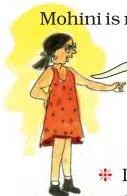
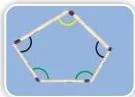
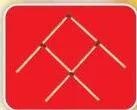
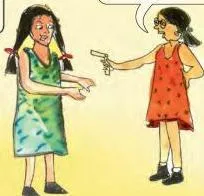
Rohini and Mohini both build closed shapes from six matchsticks (NCERT pages 16-17). The shapes have the same number of sides, yet they do not look the same. Shaila, their friend, gives the hint: ask about the angles the matchsticks make at the corners. So sides alone do not decide a shape — the angles at the corners do.

Count the sides in the figure: six. It is closed, it has six sides, and it still is not the shape Rohini made. The difference sits at the corners — the angles. That is why the next picture shows the same two matchsticks opening small, big and bigger (NCERT page 17).
With that question in place, the chapter hands out tools in order. The angle tester (NCERT page 20) lets you compare any corner with a right angle. The degree clock (NCERT pages 30-31) puts numbers on angles: \(90^\circ\) for a right angle, \(45^\circ\) for half of it.
The last pages (NCERT page 33) turn measuring into a game — estimate, then check with the ‘D’. The thread through all of it is the chapter’s own refrain: when the angle changes, the shape changes.
Key Ideas: Angles, Right Angles and Degrees
Three ideas carry the whole chapter. Learn these first and every activity makes sense.
An angle is an opening at a corner
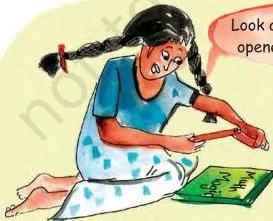
The matchstick corners on NCERT page 17 show the same two sticks opening small, big and bigger. An angle is the opening between two arms that meet at a point. The arms may be any length; the opening decides the angle. That is why a bigger drawing does not have a bigger angle — the opening does.
The right angle is the benchmark
When the angle tester opens like the letter L, the angle is a right angle, and the book writes it as L (NCERT page 20). NCERT page 31 gives it a number: \(90^\circ\) is a right angle.
Every angle in the chapter is judged against this L — less than a right angle, equal to it, or more than it (NCERT page 21).
| Kind of angle | What it looks like | Example from the chapter |
|---|---|---|
| Less than a right angle | Narrower than the tester’s L | A woodpecker’s beak (NCERT page 24); an angle made with your leg (NCERT page 23) |
| Right angle | Opens exactly like the letter L | The corner of the Maths book tested with the angle tester (NCERT page 20) |
| More than a right angle | Wider than the tester’s L | An angle made with your arm or body (NCERT page 23) |
Degrees put a number on the opening
Degree is the unit for measuring angles, written with a small circle: \(30^\circ\), \(45^\circ\), \(90^\circ\) (NCERT page 30). The folded degree clock marks \(0^\circ\), \(45^\circ\), \(90^\circ\) and \(180^\circ\), and from those marks you can read fractions of a right angle (NCERT page 31).
Worked example, using the degree clock: fold the clock so the red hand is one-third of the way from the \(0^\circ\) line to the \(90^\circ\) line.
\[ \frac{1}{3}\text{ of a right angle} = \frac{90^\circ}{3} = 30^\circ \]
The arms are now \(30^\circ\) apart. Two such openings together make \(30^\circ + 30^\circ = 60^\circ\) — the book’s \(60^\circ\) cut-out on the last page (NCERT page 32).
A right angle plus half a right angle opens to \(90^\circ + 45^\circ = 135^\circ\). And 2 times a right angle is \(2 \times 90^\circ = 180^\circ\) — the question the book asks on NCERT page 31.
Angle Words and Tools, Defined Simply
The chapter gives you tools first and names later. This glossary collects the terms you meet and what each tool is for.
| Term | What it is | What it does |
|---|---|---|
| Angle | The opening between two arms that meet at a corner | Tells you how wide a corner opens (NCERT pages 16-17) |
| Right angle | An angle that opens like the letter L | The \(90^\circ\) benchmark every angle is compared with (NCERT pages 20, 31) |
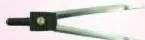
| Angle tester | Two cardboard strips fixed with a drawing pin so they can swing | Compares any angle with a right angle (NCERT page 20) |
| Divider | The angle tester already in your geometry box | Does the same comparison job (NCERT page 20) |
| Degree (\( ^\circ \)) | The unit for measuring angles | Gives the opening a number, like \(45^\circ\) or \(90^\circ\) (NCERT page 30) |
| Degree clock | Folded paper circle marked \(0^\circ, 45^\circ, 90^\circ, 180^\circ\) | Measures angles in degrees (NCERT pages 30-31) |
| ‘D’ | The protractor in your geometry box | Measures any angle, approximately (NCERT page 33) |
| Closed shape | A shape whose outline has no gap | The matchstick shapes are closed (NCERT page 16) |
The Chapter’s Main Figures, Explained


The diagrams below are the ones students stop on. Each figure is worth reading slowly — the notes say what to notice.
The same two matchsticks, three different openings
This is the chapter’s first picture of an angle. Two matchsticks meet at a corner, and the figure shows the corner three times: a small opening, a big opening, and a bigger one. The sticks are the same length every time; only the opening between them changes. That is the whole idea of an angle (NCERT page 17).
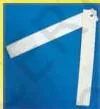
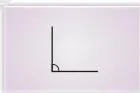
The tester opens like the letter L
Rohini tested the Maths book and the pencil box, and the tester opened like the letter L both times (NCERT page 20). This L is the right angle — the benchmark of the whole chapter.
Walk around with your own tester and collect every L-shaped corner you find: corners of books, boxes, windows. Are they all right angles? The tester settles it.
Angles hiding inside the letters of a name
The name SUKHMAN is written in straight lines, and every corner where two strokes meet is an angle. Sukhman counted 11 right angles and 10 angles less than a right angle in her own name (NCERT page 25).
Write your name with straight lines only — letters like A, K, M, N and H are full of corners — and count the angles in a table.
Clock hands that open like the letter L
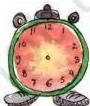
The clock face is a ready-made angle garden: the two hands meet at the centre and open wider as the minutes pass. The figure shows the times when the hands make a right angle and leaves blanks for you to draw more.
Check 3 o’clock with your tester — the hands point at 12 and 3, and the opening between them is the L shape. Now find the others (NCERT page 28).
Triangles holding up towers and bridges
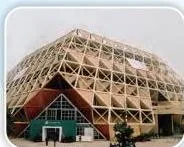
The pictures show towers and a bridge whose frames are full of triangles (NCERT page 28). After the Changing Shapes activity you already know why: push a 4-, 5- or 6-sided matchstick frame and its angles change; press a triangle and it holds.
The book also points to the diagonal beams in the bridge — they divide rectangles into triangles, and triangles lock the structure. Look around: electricity towers, gates and roof trusses use the same trick.
The carrom board: measure the angle, choose the point
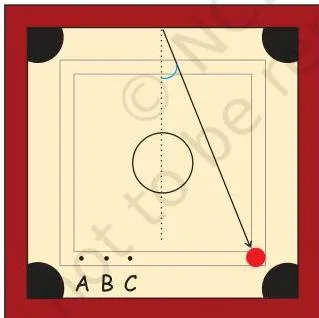
Appu hits the striker and it comes back at the same angle (NCERT page 30). The figure marks three points, A, B and C, and the question is which point Kittu should hit from to reach the queen.
The chapter suggests drawing the line — and if you want, measuring that angle in degrees with the degree clock. Once the angle is known, the path is decided.
The degree clock marks 90 degrees
After the paper circle is folded, the clock is marked \(0^\circ\), \(45^\circ\), \(90^\circ\) and \(180^\circ\). The figure points to \(90^\circ\): this is the measure of a right angle (NCERT page 31).
Now the L shape has a number. Read the rest from this one mark — \(45^\circ\) sits halfway between \(0^\circ\) and \(90^\circ\), and \(180^\circ\) is the straight opening on the other side.
The Chapter’s Main Activities and What Each One Teaches
Nearly all of this chapter is hands-on. The table below maps each main activity to the angle skill it builds, so you know what to practise from each one.
| Activity | Where in the book | Angle skill it builds |
|---|---|---|
| Make and use an angle tester | NCERT page 20 | Compare any corner with a right angle |
| Fold paper to mark the three kinds of angle | NCERT page 23 | Find a right angle, one smaller and one bigger, on a single paper |
| Make angles with your body | NCERT page 23 | Show all three kinds of angle with hands, legs and arms |
| Leaf prints and bird beaks | NCERT page 24 | Spot angles in nature and judge them against a right angle |
| Count angles in the letters of names | NCERT page 25 | Find and count angles hidden inside straight-line letters |
| Book-slide and park slides | NCERT page 25 | See how the angle controls the slide: the bigger angle is faster, the smaller one is safer |
| Changing shapes (matchsticks and tube) | NCERT pages 26-27 | Watch angles change when a shape is pressed; notice that only the triangle holds |
| Make and use a degree clock | NCERT page 31 | Measure angles in degrees, starting with the \(90^\circ\) right angle |
| Folds of a paper aeroplane | NCERT page 32 | Find the \(45^\circ\) and \(90^\circ\) folds in one object |
| Yoga asanas | NCERT page 33 | Estimate the size of body angles |
| The D game | NCERT page 33 | Guess an angle, then measure it with the ‘D’; the difference is your score |
Common Mistakes in This Chapter and How to Fix Them
Most mistakes in this chapter come from one habit: treating an angle like a size or a length instead of like an opening. The table names each error and its fix.
| Mistake | Correct rule | How to check your answer |
|---|---|---|
| “Same number of sides means the same shape” | Angles decide the look: two closed 6-sided shapes can look completely different (NCERT pages 16-17) | Compare the corners, not just the sides |
| “A bigger drawing has a bigger angle” | The length of the arms does not matter; only the opening does (NCERT page 17) | Keep the arms the same length and change only the opening |
| “A right angle only opens to the right” | The L opening is \(90^\circ\) in any direction (NCERT page 20) | Turn the tester or the page — the strips still match |
| “I can tell more than a right angle by eye” | Always compare with the tester (NCERT page 21) | Fit the tester into the corner before you decide |
| “A 4-, 5- or 6-sided frame will hold its shape” | Only the triangle stays rigid when pressed (NCERT pages 26-28) | Press each frame with a finger and watch the angles |
| “My guess is the exact measure” | A guess is an estimate; the ‘D’ measures (NCERT page 33) | Play the D game: measure after guessing and score the difference |
How to Practise the Chapter: Estimate, Compare, Measure
The chapter’s tasks fall into three skill groups. When you know which group a task belongs to, you know exactly what to do.
- Estimate — the yoga asanas and the D game ask you to guess the angle before measuring it (NCERT page 33). A guess is allowed; the point is to get close.
- Compare — the angle tester tasks are about less than, equal to, or more than a right angle (NCERT page 21). No numbers are needed.
- Measure — the degree clock and the ‘D’ give the angle a number in degrees (NCERT pages 30-31, 33).
Two honest notes. First, the matchstick puzzle answers are printed on NCERT page 29, so you can check yourself before asking anyone. Second, textbook contents and the examinable syllabus are not always identical — check the current official CBSE syllabus for Class 5 before planning what to study. This page makes no claim about marks or weightage for this chapter.
Quick Recap: The Chapter’s Ideas in One Minute
The chapter has no printed summary, so here is a one-minute version in the order the book builds the ideas.
- An angle is the opening at a corner where two arms meet — the opening decides its size, not the length of the arms.
- Two shapes can have the same sides and still look different; the angles at the corners tell them apart (NCERT pages 16-17).
- A right angle opens like the letter L and measures \(90^\circ\) (NCERT pages 20, 31).
- Every angle is less than, equal to, or more than a right angle — check with the tester (NCERT page 21).
- Degree (\( ^\circ \)) is the unit; the degree clock marks \(0^\circ\), \(45^\circ\), \(90^\circ\) and \(180^\circ\) (NCERT pages 30-31).
- Half a right angle is \(45^\circ\), one-third is \(30^\circ\), two right angles are \(180^\circ\) (NCERT pages 31-32).
- Triangles do not change shape when pressed; that is why towers and bridges use them (NCERT pages 26-28).
- Clock hands make right angles several times a day — find the times with your tester (NCERT page 28).
- Estimate first, then measure with the ‘D’ (NCERT page 33).
Related Chapters and Resources
Chapter 2 sits between Chapter 1 and Chapter 3 of the Class 5 Math-Magic book. For Chapter 1, The Fish Tale, use the Class 5 notes on reading and writing large numbers — that is where its number work lives. The next chapter, How Many Squares?, leaves angles and moves to counting and comparing area.
You can open every chapter from the NCERT Class 5 Math-Magic book page, browse other subjects from the Class 5 hub, or start at the CBSE notes section.
Sources and data verification
This page describes Chapter 2, “Shapes and Angles”, of the NCERT Class 5 Mathematics textbook Math-Magic (English edition). Page references follow the numbering printed in that edition — the chapter runs from textbook page 16 to page 33.
The page covers only this chapter of this book — not other Class 5 books, translations or editions. NCERT settles the textbook, its editions and the official PDF; CBSE settles the curriculum, syllabus and examinations.
| What the chapter holds | Count | Where it is used |
|---|---|---|
| Printed pages | 18 | |
| Figures with NCERT captions | 25 | |
| Tables | 4 | |
| Activities | 3 | |
| Official NCERT PDF | Download the chapter PDF | the chapter exactly as NCERT publishes it |
Frequently Asked Questions about Shapes and Angles Class 5
What is a right angle for Class 5 students?
A right angle is the opening that looks exactly like the letter L. It measures \(90^\circ\), and it is this chapter’s benchmark: every other angle is called less than, equal to, or more than a right angle (NCERT pages 20 and 31).
How do you make a degree clock at home?
Cut a circle out of paper and fold it in half, then into a quarter, then once more. Open it, mark \(0^\circ\), \(45^\circ\), \(90^\circ\) and \(180^\circ\), paste the paper on an old card, and fix a movable paper hand at the centre with a drawing pin (NCERT page 31).
How many degrees is half of a right angle?
Half of a right angle is \(45^\circ\), because a right angle is \(90^\circ\) and \(90^\circ \div 2 = 45^\circ\). The degree clock is marked with \(45^\circ\) exactly halfway between \(0^\circ\) and \(90^\circ\) (NCERT page 31).
Why are triangles used in bridges and towers?
Because a triangle does not change shape when pressed. In the Changing Shapes activity, 4-, 5- and 6-sided matchstick frames bend at their angles, but a triangular frame holds — which is why towers and bridges are built with triangles and diagonal beams (NCERT pages 26-28).
What is the angle tester in the geometry box called?
It is called a divider. The chapter says your geometry box already has an angle tester, and that tool is the divider (NCERT page 20). It compares angles with a right angle.
Is the D in the geometry box the same as a protractor?
Yes. The ‘D’ is the protractor, named for its shape. You use it to measure any angle, and at this stage you only need to read it approximately (NCERT page 33).
For the complete chapter as printed in the book, use the download link at the top of this page.
Reference: NCERT Class 5 Mathematics (Math-Magic) textbook, chapter 2, official edition on ncert.nic.in.