
Here is the NCERT Song of People Class 5 English chapter — Marigold, Chapter 9 — with the official PDF and a plain-language walkthrough of the whole unit. The chapter runs across 13 printed pages of the 2026-27 printing and is built around Lois Lenski’s poem about hurrying city crowds, followed by listening poems, grammar games and projects.
If you only need the file, the download link is right below; if you want the unit explained, each part is covered on this page.
Download the Song of People Class 5 chapter PDF
Open the NCERT Class 5 English Marigold Chapter 9 Song of People PDF to read the poem, the New Words box, the activity pages and the Teacher’s Page exactly as printed in the official textbook. The link is the NCERT Marigold Class 5 textbook page, which hosts the chapter file.
The file is the official NCERT Marigold Class 5 English textbook chapter, 2026-27 printing.
Chapter 9 at a glance
This is a poem unit, not a long prose lesson: the teaching happens in short activity boxes that follow each poem. A table on this page lists the chapter’s sections, figures and questions; what follows says what the unit actually is.
- One unit built around the poem Song of People by Lois Lenski.
- Practice comes through activity boxes — Reading is Fun, Language Use, Let’s Listen, Let’s Write, Fun Time and Fun with Sounds — rather than numbered exercises.
- The Teacher’s Page names the unit’s themes: Travel, Regard for others, Adventure, Imagination and Familiarity with reading maps.
What this chapter covers, section by section
This is a working map of the unit, so a student or parent can see what each task asks before opening the PDF.
| Part of the unit | What it asks you to do |
|---|---|
| Song of People | The main poem — Lois Lenski’s picture of hurrying city crowds. |
| New Words | Four glossary words from the poem: subway, underneath, elevators, grumpy. |
| Reading is Fun | Five comprehension questions on transport, what people carry, where crowds gather and why everyone hurries. |
| Language Use | Write the opposites of eight words that all appear in the poem. |
| Let’s Listen: The Village Child and The City Child | Two short poems to read with a partner, comparing two kinds of childhood. |
| Let’s Talk | Tell your partner two things you like and two you dislike about where you live. |
| Let’s Write | A four-line rhyming poem, questions about population and resources, and a survey table covering ten families. |
| Let’s Interview and My Teacher | Interview your teacher with five set questions, then write a paragraph beginning “My teacher says she became a teacher because…”. |
| Map route task | Answer five questions on a map of Ajay’s neighbourhood, then write directions using verbs and position words. |
| Day by Day I Float My Paper Boats | A Tagore poem — paper boats carry a name and message to a stranger in a strange land. |
| Travel Time writing | Seven questions about a holiday, sentences with two new words, and aeroplane versus ship. |
| Group names and adverbs | Match collective nouns to blanks; change adjectives into -ly adverbs. |
| Fun Time and Countries | A country project and the Seven Wonders, starting with the Taj Mahal. |
| Fun with Sounds | Twelve word pairs that change when a silent e is added. |
| A Little Bit of Nonsense | A limerick about an old man whose beard becomes a birds’ nest. |
| Teacher’s Page | Themes, reading suggestions and class discussions on travel. |
What the poem Song of People is about
You need the poem’s literal picture before you can answer the chapter’s questions about it. The poem watches city people moving everywhere at once — walking, riding buses and taxis, taking the subway, going up and down in elevators. Some are quiet, some talk loudly, some are grumpy; the one thing almost all of them share is hurry.
The last stanza gives the poem its point: people in a city are seen but never known. You pass strangers constantly without learning who they are.
That message connects to two themes on the chapter’s Teacher’s Page — regard for others (the poet notices the people who never look at you) and imagination (you can wonder about the lives of the people you see).
The rhyme pattern the chapter asks about
The chapter’s own writing task points out the rhyme scheme, so you need it for a class test. In every stanza, the second and fourth lines rhyme with each other; the first and third lines do not.
Sing a song of people / Walking fast or slow; / People in the city, / Up and down they go. — Lois Lenski
Here slow and go rhyme. Every stanza works the same way, which is why the poem’s opposite pairs — fast or slow, up and down, back and front — sit inside rhyming lines.
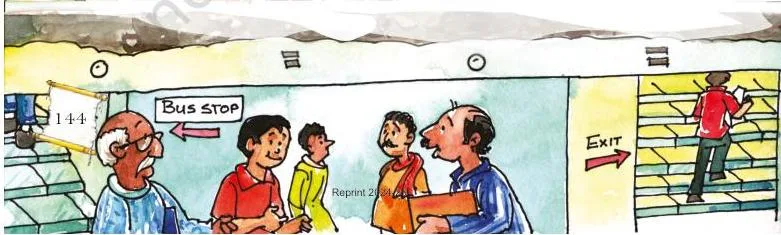
This picture belongs to the poem’s “people with umbrellas” lines — walkers in the rain, hurrying with umbrellas open, exactly the scene described when it rains and pours. Read it as the rain stanza in picture form: everyone has somewhere to go and no time to stop.
Village child and city child: two poems that answer each other
These two listening poems are best read as a pair. Each child lives in one kind of place and wishes for the other kind — the chapter’s quiet way of asking you to value what you have.
| The Village Child | The City Child | |
|---|---|---|
| Where the child lives | In a house near a wood | In a city street, crowded with traffic and feet |
| What surrounds the child | High trees, birds and flowers — but no one to play with | Buses, motors, trams and smoke everywhere |
| What the child feels | Lonely for hours | Does not like the noises |
| What the child wishes for | A street to live in | Meadows, lambs and woods near by |
So the village child wants the city and the city child wants the village. The book does not name an author for either poem. The Let’s Talk question that follows — do you like the place you live in? — uses the pair to make you notice your own surroundings.
Language work: opposites, group names and adverbs
Three grammar exercises sit inside this unit, and each one is quick to revise. The opposites come first.
Opposites from the poem
Every word in the opposites box appears in the poem itself — fast or slow, up and down, back and front. That is why the poem sounds full of pairs.
| Word | Opposite |
|---|---|
| slow | fast |
| up | down |
| back | front |
| tall | short |
| below | above |
| loud | quiet |
| go | come |
| crowd | the thinking word — the idea of being alone, or solitude |
For crowd, the book leaves the blank for you to think about. There is no single fixed answer printed in it; the opposite points to being alone, or to solitude.
Group names (collective nouns)
The group-names activity gives you a box of six words — clump, cluster, choir, bunch, flock, band — and six sentences to fill. Match the group word to the thing it collects:
| Sentence blank | Group word |
|---|---|
| The travellers rested under the ______ of trees. | clump |
| The ______ sang beautifully. | choir |
| The ______ of flowers was lying on the table. | bunch |
| The girl looked up at the ______ of stars. | cluster |
| The ______ of robbers escaped. | band |
| The hunter shot at the ______ of birds. | flock |
The chapter also lists six more group names as examples: troop of soldiers, swarm of bees, team of players, litter of puppies, fleet of ships, library of books.
The rule for any of them: ask what the thing is, then choose the word that names that thing’s group — robbers travel in a band, birds in a flock, trees in a clump.

The picture carries the group-words activity, and it keeps the scene in front of you while you choose. Match each word to the noun it collects: a flock collects birds, a clump collects trees, a choir collects singers.
Adverbs: the -ly rule
The adverb exercise changes adjectives into words that describe how an action is done. The girl danced beautifully is the book’s model sentence. The rule covers six words:
- Add -ly to the adjective: sound → soundly, quick → quickly, loud → loudly, quiet → quietly, neat → neatly.
- If the word ends in y, change y to i first: easy → easily.
That last one is where most slips happen: it is easily, not “easly” and not “easyly”.
The magic e rule from Fun with Sounds
This is the unit’s phonic lesson: one spelling rule that explains twelve pairs of words. When a silent e is added to the end of a word, the vowel before it says its own name — the short vowel sound becomes a long one.
| Vowel | Word pairs from the book |
|---|---|
| a | cap–cape, mat–mate, hat–hate |
| i | pin–pine, kit–kite, sit–site, fin–fine, bit–bite, din–dine, quit–quite |
| o | not–note |
| u | cut–cute |
So cap (short a) becomes cape (long a), pin becomes pine, not becomes note, cut becomes cute. Flag one pair where the meaning also changes completely: quit means stop, while quite means fully — the silent e does more than change the sound here.
Reading the pictures in this chapter
Pictures in this chapter are never decoration — they belong to the tasks and discussions printed around them. Four of them carry the rest of the unit’s work, and each one is explained below.
The map route: practising position words
The map of Ajay’s neighbourhood is a task, not a decoration. First answer the five questions on the page — what the dotted line shows, the road Ajay takes to the boat club, the building next to the picnic area, the road passing Ajay’s house, and an alternative route to his grandmother’s house.
Work from the map in your book: trace the dotted line first, then find each landmark and read off the road that reaches it.

The writing task after the questions needs two toolkits: verbs — go, turn, cross — and prepositions — across, between, in front of, beside, near, behind.
Describe your own way home from school with those words, and check each one against the picture: across means from one side to the other, between means with something on both sides, beside means at the side of, behind means at the back of.
The neighbourhood report
This picture belongs to the big survey task: count people by age group in ten families, total the columns, then talk to your partner and write a report about your neighbourhood.

Use the survey numbers as your facts — how many children, how many elders, how many in each family — and the report writes itself from the table you filled.
The travel picture
This picture belongs to the Teacher’s Page conversation, not to a worksheet. The class discusses why people travel — to see new places, for business — and the means of transport, ancient and modern.

The chapter’s question for this picture is the big one: what important things should you keep in mind while travelling? The discussion list includes the risks and hazards of a journey and how maps, signs and landmarks help you find your way — the same map-reading skill the route task practises.
The Seven Wonders project
This picture belongs to the Fun Time project. The chapter asks you to name the Seven Wonders, find the one in India, and research any one wonder in detail to present in class.

Use it as the project’s starting point: choose one wonder, collect its picture, and write the paragraph that explains why it is a wonder. The chapter’s own Countries list opens with the Taj Mahal — the one in India — then the Great Wall of China, with the remaining five left blank for you to find out.
New words in Song of People
The New Words box fixes the four words in the poem that a Class 5 reader is most likely to pause on. Plain meanings:
| Word | Meaning | In the poem |
|---|---|---|
| subway | an underground passage for people to cross | the underground route people ride |
| underneath | below | the subway running underneath the ground |
| elevators | lifts that carry people between floors | people riding elevators up and down |
| grumpy | ill-tempered, easily annoyed | the grumpy people among the hurrying crowd |
Parents helping at home may also meet a few grammar labels in this unit, so here they are in one line each: rhyme — matching end sounds in lines; opposite — a word with the contrary meaning; group name (collective noun) — a word for a set of things taken together; adverb — a word that describes how an action is done, often ending in -ly; silent e — a final e that is not pronounced but changes the vowel sound before it.
Common mistakes students make in this chapter
Five small errors cause most of the slips in this unit. Each one has a one-line fix.
| Mistake | Correct rule | How to check your answer |
|---|---|---|
| Writing “easly” for the adverb from easy | Change y to i, then add -ly: easy → easily | The adverb should sound like “easy-lee” and keeps the i before the l |
| Using quit and quite as the same word | quit = stop; quite = fully | Say the sentence aloud: “quit the game” and “quite finished” mean different things |
| Looking for rhyme on lines 1 and 3 | In this poem the second and fourth lines of each stanza rhyme | Read each stanza aloud and listen for the matching pair at the end |
| Choosing any group word that sounds possible | Group words match the noun: band for robbers, flock for birds, clump for trees, choir for singers | Ask “what is the thing?”, then pick the word that names that thing’s group |
| Guessing the wrong position word on the map | across, between, beside, near and behind each describe a different position | Point at the picture: does your finger cross, sit between, or stand beside the landmark? |
What to practise from this chapter for school tests
Class 5 tests are set by your school, and this chapter’s own activity boxes are what teachers draw on. The practice list is the unit itself:
- Comprehension of the poem — the five Reading is Fun questions.
- Opposites, group names and -ly adverbs — the three Language Use and Let’s Write grammar tasks.
- Rhyme writing — a four-line poem with the second and fourth lines rhyming.
- The interview paragraph — “My teacher says she became a teacher because…”.
- Magic e word pairs from Fun with Sounds.
Textbook contents and the examinable syllabus are not always identical — check the current official syllabus on the CBSE academic site before deciding what is examinable. For a revision-ready version of the unit, the Class 5 English notes gather the chapter’s points in study form, and the Class 5 notes hub holds every subject.
What to remember from this chapter
A night-before recap — ten points that hold the whole unit together.
- The poem watches hurried city people and ends: you see city people but never know them.
- New words: subway, underneath, elevators, grumpy.
- Opposites: slow–fast, up–down, back–front, tall–short, below–above, loud–quiet, go–come; crowd is the thinking word.
- Group names: clump of trees, choir of singers, bunch of flowers, cluster of stars, band of robbers, flock of birds.
- Adverbs: add -ly; easy becomes easily.
- Magic e: cap–cape, pin–pine, not–note, cut–cute — the vowel says its own name.
- The village child and the city child each want the other’s life.
- Tagore’s paper boats float a name and a message to a stranger in a strange land.
- The map task practises across, between, in front of, beside, near, behind.
- The chapter’s wonder in India is the Taj Mahal.
Related chapters in Marigold
Song of People is Chapter 9 of the Marigold Class 5 book. For the rest of the year, start at the Marigold Class 5 English book page or the Class 5 hub.
The chapters on either side are Chapter 8 and Chapter 10. For revision versions, use the Chapter 8 revision notes and the Chapter 10 revision notes, or browse the main notes index for the whole Class 5 English set.
Sources and data verification
Four things to know about the facts on this page:
- The poem text, activity boxes and pictures described here come from the NCERT Marigold Class 5 English textbook, 2026-27 printing, Chapter 9.
- This page covers that one chapter of that one book — not the whole Class 5 English syllabus.
- NCERT settles textbook editions and PDFs; CBSE settles the curriculum, syllabus and examinations.
- The listing is maintained for the 2026-27 session.
| What the chapter holds | Count | Where it is used |
|---|---|---|
| Printed pages | 13 | |
| Figures with NCERT captions | 5 | |
| Tables | 2 | |
| Official NCERT PDF | Download the chapter PDF | the chapter exactly as NCERT publishes it |
Reference: NCERT Class 5 English (Marigold) textbook, chapter 9, official edition on ncert.nic.in.
Frequently asked questions about Song of People Class 5
Short, direct answers to the questions this chapter keeps generating.
What is the poem Song of People about for Class 5?
The poem watches city people rushing everywhere at once — walking, on buses and taxis, on the subway, in elevators. Some are quiet, some loud, some grumpy, but nearly all are in a hurry, so the poem ends by saying you see city people but never know them.
Who wrote the poem Song of People?
Lois Lenski. Her name is printed at the end of the poem in the NCERT textbook.
What are the opposites of slow, up, back, tall, below, crowd, loud and go?
slow–fast, up–down, back–front, tall–short, below–above, loud–quiet and go–come. Crowd is the thinking word — the opposite points to being alone, or solitude, and the book leaves that blank for you.
What are the group names in this chapter?
The fill-in activity uses clump of trees, choir of singers, bunch of flowers, cluster of stars, band of robbers and flock of birds. The chapter also lists troop of soldiers, swarm of bees, team of players, litter of puppies, fleet of ships and library of books.
What is the magic e rule in Fun with Sounds?
Adding a silent e at the end makes the vowel say its own name, so the sound changes from short to long: cap becomes cape, pin becomes pine, not becomes note, cut becomes cute. In quit–quite the meaning changes completely too.
What is the difference between the village child and the city child?
The village child lives near a wood with birds and flowers but no one to play with, and wishes for a street. The city child lives in a smoky, noisy street full of traffic and wishes for meadows, lambs and woods — each wants the other’s life.
Explore Class 5 English Books
- Previous: The Decision of the Panchayat
- Next: Malu Bhalu
Related chapters: