
The NCERT Rip Van Winkle Class 5 chapter is the story in Unit 5 of the Marigold English textbook, adapted from Washington Irving’s The Legend of Rip Van Winkle. It is the tale of a good-natured, lazy man who sleeps for twenty years and wakes to a village that no longer knows him.
The official chapter PDF is right here, and below it you will find the story in six steps, every exercise worked out and the unit’s themes explained.
Download the NCERT Class 5 English Rip Van Winkle PDF
Open the official NCERT Class 5 English Marigold Chapter 5 Rip Van Winkle PDF on the NCERT textbook site to see Unit 5 in its original layout, with the full-page illustrations and the complete exercise pages. In Marigold, this story is the second half of Unit 5, right after the poem The Lazy Frog.
Chapter at a glance: what is inside this Marigold unit
The chapter you are holding is a complete story unit. It moves through the reading text, Fun with New Words, Let’s Read, Let’s Write, Vocabulary Building, Let’s Talk, Creative Writing and a closing Teacher’s Page. The table rendered below this section lists how much the unit holds; the walkthrough above it explains what each part does.
The Teacher’s Page is worth reading even for students: it says the exercises are meant to be used in a particular way — silent reading first, open-ended answers encouraged, and a project built on the proverb “Time and tide wait for no man”.
The Rip Van Winkle story in six steps
Use this quick retelling when you have not read the story yet, or when you need the sequence straight before attempting the exercises.
- Rip Van Winkle lives in a little village at the foothills of the Kaatskill mountains. He is a kind neighbour, ready to help anyone, and the village children love him — he plays with them, teaches them to fly kites and shoot marbles, and tells them long stories. His only fault is laziness: he does no work on his own farm and idles away his time.
- To avoid work, Rip walks away into the forest with his dog Wolf, his constant companion. One day he walks on and on until he reaches the highest part of the mountains; tired after the long climb, he lies down and begins daydreaming.
- In the evening he hears a voice calling his name. Rip looks around and sees a short, old man with thick hair and a grizzled beard, walking towards him with a barrel. The man makes signs asking Rip to help carry it, so Rip hurries to help, and the stranger catches his hand tightly.
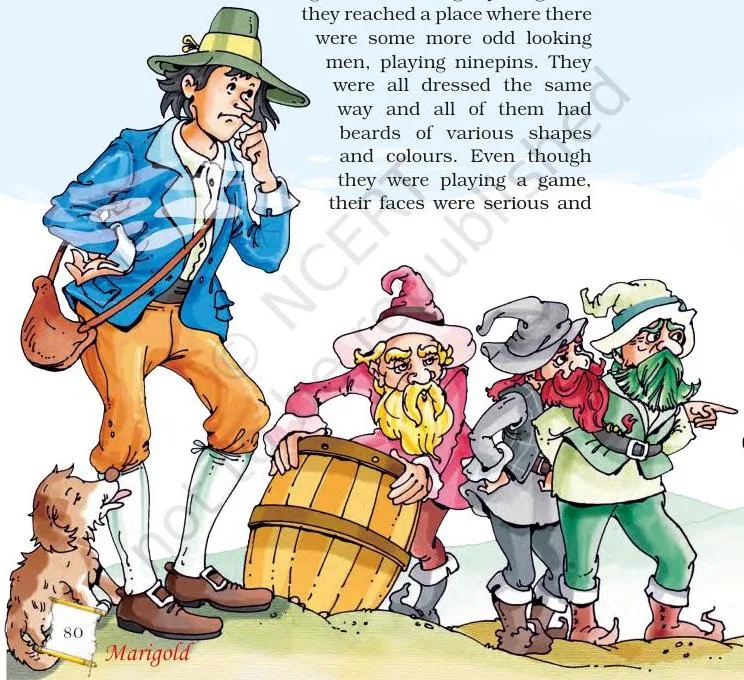
- They reach a group of odd-looking men playing ninepins. All are dressed alike, all have beards of various shapes and colours, and they play in total silence, staring at Rip with a fixed gaze. Frightened, Rip drinks what his companion pours from the barrel — and, being thirsty, drinks a few more glasses — then slowly falls into a deep sleep.
- He wakes on a bright sunny morning at the place where he first met the old man. Wolf is nowhere. Rip whistles and shouts for him, but no dog is to be seen, so he begins to descend the mountain towards his village.
- In the village nobody knows him. People stare at his long white beard and wrinkled face. Then an old woman looks at his face and exclaims, “It is Rip Van Winkle! Welcome home again, old neighbour! Where have you been these twenty long years?”
The chapter notes at its end that the story is adapted from The Legend of Rip Van Winkle by Washington Irving.
Who is who: Rip, Wolf and the mountain men
Clear up the characters before you answer the questions; one fact here is the most common confusion in the whole chapter.
| Character | Who they are |
|---|---|
| Rip Van Winkle | The main character — good-natured, ready to help anyone, loved by the children, but lazy on his own farm. |
| Wolf | Rip’s dog and his constant companion; Rip walks into the forest with him to avoid work. |
| The short old man with the barrel | A stranger with thick hair and a grizzled beard who signals Rip to help carry the barrel. |
| The ninepins players | Odd-looking, silent men, all dressed alike, with beards of various shapes and colours, who stare fixedly at Rip. |
| The old woman | A neighbour who recognises Rip and welcomes him home after twenty years. |
Notice the trap: Rip’s constant companion is Wolf, his dog — not the short old man, who appears only on the mountain.
Key ideas this chapter teaches: themes and skills
The Teacher’s Page names the values behind the story, and the exercises build the language skills around them.
- Value of time — twenty years vanish in one sleep; time, once gone, never returns.
- Social behaviour — how neighbours treat each other, and how Rip’s kind nature keeps him welcome.
- Discouraging laziness — Rip’s farm falls apart because he will not work.
- Encouraging hard work — the opposite of Rip’s habit, held up as the better choice.
The unit also practises real skills: using a dictionary on your own, silent reading with skimming and scanning, speaking in roleplay, and writing about yourself with frequency words.
The project centres on the proverb “Time and tide wait for no man” — time, like the tide, moves on whether you are ready or not, so waste none of it. The Teacher’s Page adds that the importance of being on time must be stressed, with examples from children’s own lives.
New words and meanings from the story
These are the words in Fun with New Words. The exercise lets you use a dictionary, as the Teacher’s Page advises.
| Word | What it means in the story |
|---|---|
| idled away | wasted time doing nothing |
| constant | steady; always the same — a constant companion is one who is always with you |
| companion | partner; a person or animal you spend time with |
| realise | to understand something |
| descend | to move down |
| barrel | a wooden container for holding liquid |
| contents | what is inside something |
| grizzled | grey, mixed with white — said of hair |
| foothills | the low hills near the lower part of a mountain |
| stroked | rubbed gently |
| astonished | very surprised |
| familiar | known to you |
Watch the two traps: realise is the verb “to understand”, not the word real, and descend means “to move down”, not decent.
Let’s Read: true or false and sentence completion
Every True/False answer needs a reason from the story; giving that reason is what the exercise is really checking.
| Statement | Answer | What the story says |
|---|---|---|
| (i) Rip was kind to children. | True | He played with them, taught them to fly kites and shoot marbles, and told them long stories, so the children shouted with joy when they saw him. |
| (ii) Rip was a hardworking man. | False | He did no work on his own farm and idled away his time; his fences were falling to pieces and weeds grew on his farm. |
| (iii) The short old man on the mountain was his constant companion. | False | Rip’s constant companion was his dog, named Wolf. |
| (iv) Rip helped the old man on the mountains because he wanted a drink from the barrel. | False | He helped because he was good-natured and the man signalled to him; he drank because he was frightened and thirsty. |
| (v) Rip was away for twenty years because he was asleep on the mountains. | True | He fell into a deep sleep there, and on his return the old woman asked where he had been “these twenty long years”. |
| (vi) The drink from the barrel made him fall asleep for twenty years. | True | He drank the contents of the barrel, slowly fell into a deep sleep, and slept through the twenty years. |
| (vii) Nobody recognised Rip when he came back because he had reached the wrong village. | False | He came back to the same village; his foot-long white beard and wrinkled face hid who he was. |
Now the sentence completions, with the blanks filled from the story:
- Rip’s village was situated at the foothills of the Kaatskill mountains.
- The children of the village loved him because he played with them, taught them to fly kites and shoot marbles, and told them long stories.
- Wolf, his dog was his constant companion.
- The villagers stared at him because they did not know him — they saw a stranger with a long white beard and a wrinkled face.
- The old woman who recognised Rip was a neighbour.
Let’s Write: describing Rip and the mountain men
This is a group writing task. Answer in complete sentences and support each point with the story, because the Teacher’s Page says open-ended answers may vary.
Strange things about the men on the mountains
- One was a short old man with thick hair and a grizzled beard.
- They were all dressed the same way.
- All of them had beards of various shapes and colours.
- They were playing ninepins.
- Their faces were serious and there was total silence.
- They stopped playing and stared at Rip with a fixed gaze.
What kind of a man was Rip Van Winkle?
- He was a kind neighbour, ready to help anyone.
- He was simple and good-natured, so everyone in the village liked him.
- The children loved him and shouted with joy when they saw him.
- He was lazy — he did no work on his own farm and idled away his time.
Vocabulary Building: opposites, silent letters and describing words
Four small exercises, each practising a different word rule you can reuse in any chapter.
Games mentioned in the story
- Flying kites — Rip taught the children to fly kites.
- Shooting marbles — Rip taught the children to shoot marbles.
- Ninepins — the odd-looking men were playing ninepins.
Compound describing words
Complete the paragraph with the compound words from the box; the completed story reads:
Mrs Das has a part-time job in a clothes shop. Yesterday, an odd-looking woman walked into the shop. She was wearing high-heeled shoes.
A sweet-looking dog was with her. “I want a long-sleeved shirt for my dog, please,” she said. “For your dog?” asked Mrs Das, open-mouthed in surprise. “Yes,” replied the woman. “I want him to be well-dressed for my next party.”
Silent letters
- k is silent in: knee, knife, knot, know
- gh is silent in: neighbour, daughter, fight, straight
- h is silent in: honest, honour, hour, heir
The exercise asks you to add more words to each pattern — for example, gnat starts a silent-g group, chalk a silent-l group, and whistle a silent-t group.
Opposites from the paragraphs
| Word | Opposite |
|---|---|
| awake | asleep |
| wake up | fall asleep |
| get up | lie down |
| lazily | quickly |
Fill in the blanks with those words:
- Wake up and get up quickly! You will be late for school.
- Shh! The baby is asleep. Don’t make a sound, or she will wake up.
- Are you still awake? You should be asleep now, or you will not be able to get up in the morning for school.
Let’s Talk and Creative Writing: speaking and writing practice
One speaking task and two writing tasks; in the discussion order, the reason matters more than a fixed answer.
Roleplay: the neighbour’s welcome
Imagine you are the neighbour who greets Rip after twenty years and tell him what happened: his wife, his friends, the other villagers, the children he played with, and the changes in the village. The book suggests starting with “Guess what happened on the day you left.”
The Teacher’s Page adds that each child should get a turn as the neighbour, and that imagined details must not contradict the main story.
Who walks to school most often?
Put the five children in order from most often to never:
- Arjun — always walks; he lives right opposite the school.
- Nazim — usually walks; he calls it a nice way to start the day.
- Mini — sometimes walks; at times she takes the bus.
- Anu — does not usually walk; she often goes by cycle.
- John — never walks; he lives very far away.
This is a discussion exercise, so the reason for each choice matters more than the exact order.
Writing about yourself
Use the frequency words always, frequently, usually, often, sometimes, rarely in true sentences about yourself, like the book’s example “I always do my work neatly.”
For the present perfect exercise, have + past participle tells what you have done — or not done — up to now: “I have started reading a longer story book” and “I have not played in the park this month.”
Figure walkthrough: what the illustrations show


Each picture in the chapter carries part of the story. Read them with the text — here is what each one shows and why it matters.
The first illustration sits at the turning point of the story. Rip has walked away from his neglected farm, and the caption places him at the highest part of the mountains — exactly where the strange adventure begins.
The second picture shows the strangeness begin: a short old man with thick hair and a grizzled beard carries a barrel and calls Rip by name. Keep those details — thick hair, grizzled beard, barrel — because Let’s Write asks you to list the strange things about the mountain men.
The third illustration signals that time has passed. Rip wakes, whistles and shouts for Wolf, and finds his constant companion gone — the first clue, with his foot-long white beard, that he has slept for twenty years.
The last image belongs to the Teacher’s Page. Its message — the importance of being on time — connects straight to the unit’s value-of-time theme and to the proverb “Time and tide wait for no man.”
Common mistakes to avoid in this chapter
These are the errors Class 5 readers actually make on this unit; each row gives the correct rule and a way to check your answer.
| Mistake | Correct rule | How to check your answer |
|---|---|---|
| Saying the short old man was Rip’s constant companion | The constant companion is Wolf, his dog; the old man appears only on the mountain. | The story says plainly “Rip’s constant companion was his dog, named Wolf.” |
| Thinking Rip went to the wrong village | Rip returned to the same village; his changed appearance hid him. | An old neighbour recognises him and says “Welcome home again, old neighbour!” |
| Choosing “real” for realise | realise is the verb “to understand”. | In the story, “he realised it would be night” means he understood it would be night. |
| Choosing “decent” for descend | descend means “to move down”. | “He began to descend the mountain” = he began to move down it; decent (proper) is a different word. |
| Writing that Rip helped the old man because he wanted a drink | He helped because he was good-natured and the man signalled; he drank because he was frightened and thirsty. | The book says he hurried to help the stranger, obeyed because he was trembling with fear, and drank more because he was thirsty. |
| Confusing barrel with a bag or a musical instrument | barrel is a wooden container for holding liquid. | The old man “emptied the contents of the barrel into glasses” — a container, not a bag or instrument. |
Classwork and exam notes for Rip Van Winkle
The book itself tells you how the exercises are meant to be used, so preparation for this chapter starts with reading the Teacher’s Page.
- True/False answers carry evidence — support each answer with the line of the story, as the reasons table above shows.
- Sentence completions must use story details, not invented ones: the village’s location, the children’s reason, Wolf, the villagers’ stare, the neighbour.
- Word work comes in groups — opposites, silent letters and compound describing words are patterns, so learn them as sets.
- The Teacher’s Page says silent reading should come before the Let’s Read exercises; that builds the skimming and scanning skills the unit targets.
- Open-ended answers — the group description, the roleplay, writing about yourself — have many acceptable responses, so answer in complete sentences and keep imagined details consistent with the story.
Textbook contents and the examinable syllabus are not always identical — check the current official syllabus. No question from this unit is guaranteed to appear in any examination, and this page gives no mark values for Class 5 English.
What to remember from Rip Van Winkle
If you have five minutes before a test, keep these points in mind:
- Rip is good-natured, kind and ready to help anyone, but lazy on his own farm — the unit’s message is that laziness costs time.
- His constant companion is the dog Wolf.
- The drink from the mountain men’s barrel sends him into a deep sleep that lasts twenty years.
- He returns to the same village, but his foot-long white beard and wrinkled face hide him until a neighbour recognises him.
- The themes are the value of time, social behaviour, discouraging laziness and encouraging hard work.
End with the proverb: “Time and tide wait for no man.” Time moves on whether you are ready or not, so be on time, keep your promises and do today’s work today.
Related resources: other Class 5 Marigold chapters
This listing is maintained for the 2026-27 academic session using the NCERT textbook information available to us. NCERT remains the authority for confirming the latest edition.
Continue with other Class 5 English pages on this site:
- Marigold Class 5 English chapter notes — the full set of English chapters from this book.
- The Wise Parrot Class 5 English notes — another Class 5 English chapter page on this site.
- Class Discussion poem notes — the poem that follows this unit in the book.
- Class 5 notes hub — notes for every Class 5 subject on this site.
- CBSE notes home — start browsing by class.
In the printed book, Unit 5 pairs this story with the poem The Lazy Frog before it, and the unit after it opens with Class Discussion and The Talkative Barber.
Sources and data verification
This page describes the NCERT Class 5 English Marigold textbook — Unit 5, Rip Van Winkle — official edition published on ncert.nic.in, and the contents above are drawn from that edition. The notes are maintained for the current academic session.
NCERT owns the textbook, its editions and its PDFs; CBSE owns the curriculum, the syllabus and the examinations. To check a textbook detail or download the official file, use the NCERT textbook page; to confirm what is examinable, see the current official CBSE syllabus.
| What the chapter holds | Count | Where it is used |
|---|---|---|
| Printed pages | 12 | |
| Figures with NCERT captions | 4 | |
| Tables | 4 | |
| Official NCERT PDF | Download the chapter PDF | the chapter exactly as NCERT publishes it |
Frequently asked questions about Rip Van Winkle Class 5
Why did Rip Van Winkle sleep for twenty years?
Rip slept for twenty years because he drank the contents of the barrel that the mountain men offered him. Frightened by their fixed stare and thirsty after his climb, he drank several glasses and slowly fell into a deep sleep that lasted twenty years.
Who was Rip’s constant companion?
Wolf, Rip’s dog, was his constant companion. He walked into the forest with Wolf to avoid working on his farm; the short old man on the mountain was a stranger, not his companion.
Did Rip go to the wrong village when he woke up?
No. Rip came back to his own village, but nobody recognised him because his beard had grown a foot long and was all white, and his face was wrinkled. An old woman — a neighbour — finally recognised him and welcomed him home.
What are the silent letter words in the Rip Van Winkle chapter?
The chapter gives three groups: knee, knife, knot and know, where k is silent; neighbour, daughter, fight and straight, where gh is silent; and honest, honour, hour and heir, where h is silent. The exercise then asks you to add more words to each pattern.
What is the moral of Rip Van Winkle for Class 5?
The unit’s themes are the value of time, social behaviour, discouraging laziness and encouraging hard work. The proverb “Time and tide wait for no man” carries the message: do not waste time, and be on time.
Reference: NCERT Class 5 English Marigold textbook, chapter 5, official edition on ncert.nic.in.