
Ice-cream Man Class 5 is Chapter 1 of the NCERT English Marigold textbook — the whole of Unit 1, printed across pages 2–19 of the book.
The unit holds the poem “Ice-cream Man” by Rachel Field, the Kerala folk tale “Wonderful Waste”, the picture story “Bamboo Curry”, and the activity pages that follow each text. The official NCERT chapter PDF is right here, and this page explains what is inside it.
Get the official file: download the official Ice-cream Man Class 5 NCERT Marigold PDF. This is the NCERT-published Unit 1 chapter file from ncert.nic.in — the exact pages your school follows, so it is the version to keep if your printed copy has missing or faded pages.
| What the chapter holds | Count | Where it is used |
|---|---|---|
| Printed pages | 19 | |
| Figures with NCERT captions | 5 | |
| Tables | 16 | |
| Activities | 1 | |
| Official NCERT PDF | Download the chapter PDF | the chapter exactly as NCERT publishes it |

Reference: NCERT Class 5 English Marigold textbook, chapter 1, official edition on ncert.nic.in.
Chapter at a Glance
The table below lists the sections, figures, activities and questions this chapter file contains — one glance tells you the size and shape of the PDF.
What Unit 1 of Marigold Contains
Unit 1 follows the pattern the whole book uses: a short poem to enjoy, a story to read, and a picture story to follow, each with its own activity pages after it.
- The poem “Ice-cream Man” by Rachel Field — a rhyming picture of a hot city summer.
- The story “Wonderful Waste” — a Kerala folk tale about how the dish avial was invented from a basket of vegetable scraps.
- The picture story “Bamboo Curry” — a Santhal folk tale told through ten pictures, one line under each frame.
After the poem come New Words, Reading is Fun, Let’s Write, Say Aloud and Let’s Listen. After the story come New Phrases, Let’s Talk and a recipe-ordering task. The unit closes with a report-writing activity and teacher notes on its themes: recycling waste, folk tales, a multi-cultural approach to food and avoiding wastage of food.
The Ice-cream Man Class 5 Poem: Rhymes and Similes
The poem celebrates the ice-cream man as the favourite person of a hot city summer. It works through four rhyming stanzas, and two comparisons carry the picture of joy.
The ideas run like this:
- Stanza 1 — summer is in the city and the brick is “a blaze of heat”; the Ice-cream Man’s little cart “goes trundling down the street”. It rhymes heat with street.
- Stanza 2 — under his round umbrella it is “a joyful sight” to see him fill cones with mounds “of cooling brown and white”. It rhymes sight with white.
- Stanza 3 — the mounds are vanilla, chocolate and strawberry, and bottles full of “frosty-fizz” hold chilly things to drink, green, orange, white or pink. It rhymes drink with pink.
- Stanza 4 — his cart “might be a flower bed of roses and sweet peas”, and the children cluster round “as thick as honeybees”. It rhymes peas with bees.
The four rhyme pairs are heat/street, sight/white, drink/pink and peas/bees. The poem’s two similes are the cart as a flower bed of roses and sweet peas, and the children as thick as honeybees around it.
New Words and New Phrases
These two boxes give the words the poem and the story expect you to know. Learn each with an example of your own — that is what a vocabulary test actually checks.
New Words from the poem:
| Word | Meaning | Example sentence |
|---|---|---|
| blaze | bright flame or fire | A blaze of light came through the window. |
| trundling | moving on small broad wheels | The luggage cart came trundling along the platform. |
| mounds | heap or pile | The plate was piled with mounds of rice. |
| frosty-fizz | a chilled drink that makes a hissing, bubbling sound | The frosty-fizz drink hissed when I opened the bottle. |
| cluster | to gather around; a group of similar things | The children cluster near the door when the bell rings. |
New Phrases from the story:
| Phrase | Meaning | Example sentence |
|---|---|---|
| in a fix | a situation hard to escape from | The cook was in a fix when the Maharaja asked for a new dish. |
| flash across the mind | to think of something suddenly | An idea flashed across his mind. |
| lo and behold | look! what a surprise | Lo and behold, the curry was ready. |
| traditional feast | a hearty meal for many guests on a special occasion | Avial is served in a traditional Kerala feast. |
Two entries mislead students. frosty-fizz is a made-up poem word for a chilled drink that bubbles and hisses — say it and you can hear the fizz. And in a fix means stuck in a difficult situation, not “being repaired”: the cook was in a fix because he could not escape the problem.
Say Aloud: Practising the zzz Sound
The activity starts from honeybees, whose final sound is z. Your job is to hear a zzz buzz in the words, not to trust the spelling of the letter s.
Put a hand on your throat and say “buzz” — you feel a buzz. Say “bus” — you feel nothing. That buzz is the z sound; the plain hiss is s.
Words with the zzz sound (circle these): prize, maze, rise, blaze, fizz, lazy, busy, raise, rays, these.
Words that keep the s sound (do not circle): price, face, rice, lacy, racy, race, ace, chase, this, frosty.
The traps are the minimal pairs — word pairs that differ by one letter and one sound: prize/price, rise/rice, raise/race, rays/race and these/this. Say each pair aloud and the difference is obvious.
Word Building: Rhyming Pairs and Describing Words
This activity asks you to hear rhymes, not guess from spelling. Two words rhyme when their final vowel and consonant sounds match — write and night prove it.
| Answer | Word pairs |
|---|---|
| Rhyme — colour these | heat/street, blows/goes, hard/yard, label/table, sky/my, play/obey, race/face, write/night |
| Do not rhyme — leave these | city/cart, bowl/doll, cow/so |
| The trap pair | do/go |
Do/go is the trap: they look similar, but do rhymes with too and go rhymes with no, so the two do not rhyme with each other.
The second half collects the poem’s describing words:
- joyful — the sight;
- little — the cart;
- round — the umbrella;
- mounds are described as “cooling brown and white”;
- cluster is described as “as thick as honeybees”.
One honest note: the poem names the flavours — vanilla, chocolate, strawberry — rather than describing them with adjectives, so “flavour” has no describing word of its own.
Reading is Fun: The Unit’s Comprehension Questions
The book prints the questions; this section shows the answers in complete sentences. Full sentences are what a teacher expects — one-word labels lose marks.
The poem: five questions
- In which season is ice cream popular? Ice cream is popular in the summer season, when the weather is hot.
- Who feels joyful on seeing the Ice-cream Man? The children feel joyful, and they cluster round his cart as thick as honeybees.
- Name the different flavours of ice cream in his cart. The flavours are vanilla, chocolate and strawberry.
- What are the two things the Ice-cream Man is selling? He sells ice-cream cones with mounds of flavour, and chilled drinks in bottles full of frosty-fizz.
- What is the ice-cream cart compared to in the poem? The cart is compared to a flower bed of roses and sweet peas.
The story: five questions
- What were the preparations in the palace for? The preparations were for a grand dinner ordered by the Maharaja of Travancore.
- Why did the Maharaja go into the kitchen in the afternoon? He went in to survey the dishes that had been prepared for the feast.
- What had the cook planned to do with the vegetable scraps? He had planned to throw them away as waste.
- Circle the ingredients of avial. The ingredients are chillies, vegetable scraps, coconut, curd, garlic and curry leaves. Groundnut, roasted peanuts, wood, broken bangles, pot and basket are not ingredients — pot and basket only hold the dish.
- True or False? (i) True — the king had ordered a dinner in the palace. (ii) True — no one had heard of or tasted avial before. (iii) False — the cook had planned to throw the scraps away.
The Six Figures in This Chapter
Every picture in this unit does a job — most are the task itself, not decoration. This walkthrough shows what each one is for.
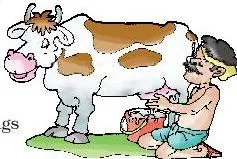
1. The dairy farm picture — the model report. This is the picture beside the report on Uncle Lal’s farm in the Find Out and Write a Report activity. It shows the farm the report describes — cows, grass and the evening barn.
That is proof of what makes the report work: it keeps to one subject (the farm) and tells things in order, from the visit to the milking to selling milk in the city.
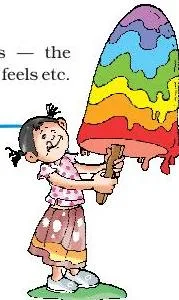
2. The dream ice cream — the Fun Time drawing task. Fun Time asks you to draw and colour your own dream ice cream, then describe it with interesting describing words — the colours, the flavours, the size, how it looks, tastes and feels. The picture is a sample of that task: your description should make a reader see exactly what you drew.
3. The kulfi picture — the sequencing puzzle. Kulfi is the North Indian ice cream, and this picture belongs to Fun Time’s ordering task.
The correct order runs: the kulfiwala takes the kulfi mould out of the pitcher, scoops the kulfi out on a plate, arranges some falooda around it, and then pours sweet syrup over it and serves it. The syrup waits until the end, after everything is already on the plate.
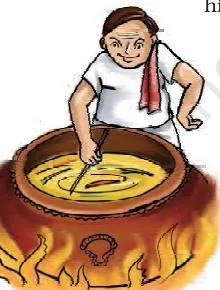
4. The avial picture — the story’s proof. This is the dish the cook invented: it began as a basket of vegetable scraps and ended as a dish in a traditional Kerala feast. When the story says “lo and behold!”, this is what the guests saw on their plates.

5. The home-after-school picture — sequence words. This activity follows the avial recipe task and keeps the same skill: putting actions in order.
From the list — pack the school bag, put away the school bag, have lunch, read a story book, chat with mummy, sleep for a while, wash up, do the homework, watch TV, go out to play, change out of the school uniform — choose five things you really do.
Then write them with the sequence words: First, I… Then, I… Next, I… After that, I… Finally, I…
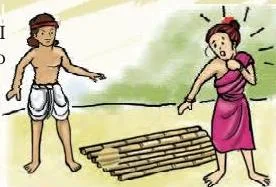
6. Bamboo Curry frame 7 — the joke’s turning point. By this frame the bridegroom has carried his in-laws’ bamboo door home and asked his wife to cook it.
When she says a door cannot make curry, he answers, “Come, I’ll help you by chopping up the bamboo” — and the reader laughs, because the whole problem is that it is a door, not bamboo shoot.
Writing a Report: From Uncle Lal’s Farm to Your Neighbourhood
A report is several sentences telling someone about something you have seen, read, heard or done — the book’s definition. The Uncle Lal picture above is its model, and the four rules are:
- Think of a good title and write it correctly.
- Keep to your subject.
- Tell things in the right order.
- Make your paper look neat.
Here is a worked sample in that shape, with invented names and prices. Follow the order: introduction, brands, flavours, best-sellers with prices, final verdict.
- Title: Ice Creams in Our Market
- Introduction: On a hot afternoon I visited the ice cream shops near our colony to find out what they sell.
- Brands: Three brands are available in our area — Snowman, Mango King and City Cream.
- Flavours: Snowman sells vanilla, chocolate and strawberry; Mango King sells mango and kesar pista; City Cream sells vanilla, butterscotch and pista.
- Best-sellers and prices: At Snowman, chocolate sells most at ₹20; at Mango King, mango at ₹25; at City Cream, vanilla at ₹15.
- Verdict: In my survey the most popular pick is City Cream’s butterscotch cup.
The class activity asks groups of four to research the real brands in your own area, with real prices. The sample above is a model of the shape your report should take, not an answer to copy.
Wonderful Waste: From Vegetable Scraps to Avial
The story’s point is simple: the Maharaja of Travancore refuses to let the cook throw away vegetable scraps, and that one order creates a dish that becomes famous all over Kerala.
- The Maharaja orders a grand dinner and enters the kitchen that afternoon to survey the dishes prepared for the feast.
- He sees a basket of vegetable scraps; the cook calls them waste and plans to throw them away.
- The Maharaja commands sternly: “You cannot waste all these bits and pieces. Find a way to use them.”
- The cook is in a fix, staring at the scraps — then an idea flashes across his mind.
- He washes and cleans the bits, cuts them into long strips and cooks them, then adds a paste of ground coconut, green chillies and garlic with salt.
- He whips in curd, pours on coconut oil, decorates with curry leaves — and “lo and behold!”, the new dish is ready. He names it avial.
Every ingredient is ordinary, and that is the wonder: chillies, vegetable scraps, coconut, curd, garlic and curry leaves. Groundnut, roasted peanuts, wood, broken bangles, pot and basket are not ingredients — the pot and basket are containers, not food.
The recipe-ordering task wants the seven steps in this order:
- Wash and clean the mix of vegetable bits.
- Cut the vegetable scraps into long strips.
- Grind some coconut, green chillies and garlic.
- Whip some curd and mix it in.
- Pour some coconut oil on top.
- Decorate with curry leaves.
- Avial is ready.
The True/False verdicts are (i) True, (ii) True, (iii) False — the cook had planned to throw the scraps away. That False is the answer most students get wrong. This story carries the unit themes of recycling waste and not wasting food.
Bamboo Curry: The Santhal Folk Tale and Its Joke
This is a folk tale told in ten pictures, and the whole joke depends on one misunderstanding. A folk tale is a story handed down from grandparents to grandchildren, often sung by mothers to babies, that tells us about the customs and culture of the place it comes from; this one comes from the Santhal people.
The misunderstanding, in short:
- A Santhal bridegroom visits his mother-in-law, who cooks a special dish for him.
- He finds it delicious and asks what it is; she points at the bamboo door.
- He takes her literally. Next morning, remembering there is no bamboo in his village, he removes the door and carries it home.
- His wife is shocked, but he offers to chop the bamboo himself. She boils it and boils it, yet it stays too hard to eat — he blames her cooking.
- That evening the in-laws visit and laugh: the curry was made from bamboo shoots, not from a bamboo door.
The humour works because the reader knows what the bridegroom does not: the delicious curry was made from tender bamboo shoots, the young part of the plant, while a door is old, hard bamboo that boiling cannot soften.
Word hunt answers: (i) mother-in-law, (ii) at, (iii) with, (iv) bamboo door, (v) from.
Sentence completions: the bridegroom left with the door because it was made of bamboo and there was no bamboo in his village; he could not eat the bamboo curry in the end because the real curry had been made from bamboo shoots. After the story, the Say Aloud box practises splitting words into syllables such as im-pa-tient and bam-boo.
Common Mistakes to Avoid in This Unit
Most marks in this unit are lost on small slips. The table names each mistake before you make it, with the rule and a quick check.
| Mistake | Correct rule | How to check your answer |
|---|---|---|
| Colouring city/cart, bowl/doll or cow/so as rhyming pairs | These three pairs do not rhyme — rhyme is a sound match, not a spelling match | Say each pair aloud; colour only when the final sounds match |
| Adding do/go to the rhyming list | Do rhymes with too; go rhymes with no — together they are the trap pair | Say “do, go” aloud: the vowel sounds are different |
| Circling price, face or rice for the zzz sound | Those keep the plain s sound; the z words are prize, maze, rise, blaze, fizz, lazy, busy, raise, rays, these | Hand on throat: z buzzes, s does not |
| Starting the kulfi order with the syrup | The syrup is poured last, after the falooda; first the kulfiwala takes the mould out of the pitcher | Ask which action must happen before all the others |
| Marking Wonderful Waste True/False (iii) as True | It is False — the cook had planned to throw the scraps away | Re-read the cook’s line: “They are waste. We will throw them away.” |
| Writing a report with no title or drifting off the subject | A report needs a correct title, one subject, and the right order | Read it aloud: does every sentence belong to the topic? |
| Reading “in a fix” as “being repaired” | It means stuck in a difficult situation, not being mended | Substitute: “The cook was stuck in a difficult situation.” |
Exam Notes: What This Unit Is Usually Tested On
At Class 5 level this unit is school-assessed, and the textbook’s own activities are the usual testing ground. Nothing below is guaranteed — it is what usually shows up in a unit test.
- Reading is Fun answers written in full sentences, not one-word labels.
- The New Words and New Phrases boxes — meaning plus an example.
- The rhyming pairs in Word Building, including the do/go trap.
- The zzz word list from Say Aloud.
- Ordering tasks: the four kulfi sentences and the seven avial steps.
- Writing a short report using the four report rules.
- Retelling the Bamboo Curry joke in your own words.
Textbook contents and the examinable syllabus are not always identical — check the current official syllabus for what your school must assess. The unit’s official themes, from the teacher pages, are recycling waste, folk tales, a multi-cultural approach to food and avoiding wastage of food.
Revision Summary
Here is the whole unit in five lines, for a quick recap:
- The poem celebrates the ice-cream man with rhymes, colours and two comparisons — the cart like a flower bed, the children like honeybees.
- New Words and the zzz sound list are the vocabulary targets; the rhyming-pair table settles Word Building.
- Wonderful Waste turns vegetable scraps into Kerala’s avial because the Maharaja refused to waste food.
- Bamboo Curry is a Santhal folk tale whose entire joke is bamboo shoots versus the bamboo door.
- The practised skills are rhyming words, describing words, sequencing and short report writing.
Related Resources
This listing is maintained for the 2026-27 academic session using the NCERT textbook information available to us. NCERT remains the authority for confirming the latest edition.
Where to go next with this unit:
- NCERT Class 5 English Marigold book page — every unit of the book in one place.
- Class 5 NCERT books hub — textbook pages for all Class 5 subjects.
- Unit 2 of Marigold — the next chapter, which opens with the poem “Teamwork”.
- Class 5 English notes — revision help built from the same Marigold book.
- Teamwork poem notes — a head start on Unit 2.
- The CBSE notes hub and Class 5 study materials hold notes for other subjects as well.
Sources and Data Verification
This page describes the NCERT Class 5 English Marigold textbook, Unit 1 — the Ice-cream Man poem, Wonderful Waste and Bamboo Curry — as published on the official NCERT site. The official chapter PDF at ncert.nic.in is the source for the text, figures and activities described here.
The full Marigold Class 5 book is on the NCERT textbook page for Marigold. This listing is maintained for the current academic session using the NCERT information available to us. NCERT settles textbooks, editions and PDFs, while CBSE settles curriculum, syllabus and examinations.
Reference: NCERT Class 5 English Marigold textbook, chapter 1, official edition on ncert.nic.in.
Frequently Asked Questions
Who wrote the poem Ice-cream Man?
Rachel Field wrote the poem “Ice-cream Man”. It opens Unit 1 of the NCERT Class 5 English Marigold textbook.
What is the Ice-cream Man’s cart compared to in the poem?
The cart is compared to a flower bed of roses and sweet peas, with the children clustering round it as thick as honeybees.
What is avial and which state does it come from?
Avial is a dish made from vegetable scraps, coconut, curd, chillies, garlic and curry leaves. It comes from Kerala, and the story Wonderful Waste tells how the Maharaja’s command created it.
Why could the bridegroom not eat the bamboo curry?
Because the curry was made from tender bamboo shoots, but the bridegroom carried home a bamboo door. Boiling the door never made it soft enough to eat.
Which words in the unit’s Say Aloud activity have the zzz sound?
Prize, maze, rise, blaze, fizz, lazy, busy, raise, rays and these. Words like price, face and rice keep the plain s sound instead.