
This is the NCERT Class 5 English Marigold Unit 7, printed as ‘Topsy-turry Land’ — the chapter with the poem about an upside-down world and a story extract from Gulliver’s Travels.
The official Topsy-turry Land Class 5 chapter PDF is right here, straight from NCERT, so you can open the exact pages your class is reading. One spelling note: the unit is headed ‘Topsy-turry Land’ in the book, while the poem inside it is ‘Topsy-turvy Land’ — both names point to the same chapter.
Download the Topsy-turvy Land Class 5 Chapter PDF
The file below is the complete Marigold Unit 7 as printed — the poem, the story extract, every exercise and the Teacher’s Page.
Download the Topsy-turvy Land Class 5 chapter PDF from NCERT to get the complete Unit 7 file — the poem, the Gulliver’s Travels extract, the grammar and writing tasks and the project — exactly as printed in the book.
If the download does not start, the same file sits in the official textbook section on ncert.nic.in, under Class 5, English, Marigold, Unit 7.
Chapter at a Glance: Inside Unit 7
The unit contains a poem, a story adapted from Gulliver’s Travels, vocabulary and comprehension work, grammar and punctuation practice, writing tasks and a project. The map below shows where each kind of work sits; the exact page, section and figure totals for the unit are listed in the chapter table on this page.
| Part of Unit 7 | What it does |
|---|---|
| Poem: ‘Topsy-turvy Land’ | Imagines an upside-down world and opens the unit. |
| New Words (poem) | Explains topsy-turvy, pleasure and grand. |
| Reading is Fun | Three comprehension questions on the poem. |
| Topsy-turvy Land / Our land | Matches five upside-down lines with everyday lines about our land. |
| Fun with sounds | Groups rhyming words such as wear, tear, stare, where. |
| Let’s Talk / Let’s Write | Jumbled sentences, similes, a home-neatness list, an imagined scene, a Puran-and-lion ordering task. |
| Story: Gulliver’s Travels | Adapted extract with its own new words, reading questions, talk and writing tasks. |
| Let’s Find Out / Creative Writing / Joke | A giants research project, a dwarf-land paragraph and a closing monster joke. |
| Teacher’s Page | Poetry, reading, conversation, writing and project suggestions for the teacher. |
Key Concepts in Unit 7
Every part of the unit works on the same few ideas. Hold on to these four and nothing in the chapter will surprise you.
- Topsy-turvy means upside down — the reverse of the normal order of things.
- The poem is an imagined game, not a description of a real place.
- The story is told by a tiny sailor among giants, so size and perspective drive everything in it.
- The comprehension questions are answered by finding sentences inside the poem and story, not from general knowledge.
What This Chapter Covers: Poem, Story, and Language Work
The unit opens with a question about a messy bedroom — the book’s way of letting every child recognise a topsy-turvy room of their own. Then the poem arrives, New Words explains topsy-turvy, pleasure and grand, and Reading is Fun asks three questions that send you back into the poem.
A comparison exercise sets the poem’s upside-down land against our land, five pairs matched one by one. Fun with sounds groups rhyming words so you hear the spelling patterns together, and the Let’s Talk exercises rearrange jumbled sentences, build as … as … similes and practise giving reasons.
Let’s Write is the biggest block: five things you do to keep home neat, an imagined topsy-turvy scene, and the jumbled story of Puran and a lion at the zoo. The same block teaches the when pattern, degrees of comparison and punctuation.
In the Puran story, a kite lifts the boy over the treetops and into the zoo. A shoe inside the lion’s cage makes everyone think the lion ate someone, until the kite brings him back and the shoe turns out to be the lion’s toy.
The unit then switches to a story — Gulliver among giants — which brings its own new words, reading questions, talk and writing tasks. It ends with the giants research task, a paragraph about waking up in the land of dwarfs, and a monster joke.
The last page is a Teacher’s Page with poetry, reading, conversation, writing and project suggestions. Students rarely read it, but it explains why each exercise exists.
The Poem ‘Topsy-turvy Land’: Every Upside-Down Detail
The poem is by H.E. Wilkinson and imagines a land where everything is the reverse of normal. It is one long list of inversions:
- People walk upon their heads.
- The sea is made of sand.
- Children go to school by night.
- The front-door step is at the back.
- You are walking when you stand.
- Hats are worn upon the feet.
- Buses sail on the sea, while pleasure boats are planned for the streets.
- People pay for what they never get.
- When you go, you are coming back.
Notice the pattern: each line takes an ordinary fact and reverses it. That is why the poem is a game, not a geography lesson.
Reading is Fun: the poem’s three answers
- Children in Topsy-turvy Land go to school by night — the poem says so directly.
- If buses travel on the sea, then the boats travel up and down the streets. Rightly, boats should sail in the sea and buses should run on land.
- The third question is the comparison exercise — its completed pairs are in the next section.
Topsy-turvy Land and Our Land Side by Side
The book places the two lands side by side so the poem’s nonsense becomes visible: each upside-down statement is paired with an everyday statement about our land.
| In Topsy-turvy Land | In our land |
|---|---|
| People walk on their heads. | People walk on their feet. |
| Children go to school by night. | Children go to school by day. |
| Hats are worn on the feet. | Hats are worn on the head. |
| Boats are planned for the streets. | Boats sail in the sea. |
| People pay for what they do not get. | People pay for what they get. |
The exercise leaves several blanks for you to fill; the pairs above are the completed version.
Fun With Sounds: Rhyming Words from the Unit
The unit collects sound-alike words so you can see and hear the spelling patterns together. Each group rhymes when you say it aloud.
- pleasure, treasure, measure — one repeated ending sound.
- wear, tear, stare, where — one rhyme, four spellings.
- planned, canned, scanned, strand — the -anned / -and sound.
- topsy-turvy, hurly-burly, curly-whirly — playful rhyming twins.
Read each group aloud twice — once to hear the rhyme, once to notice the spelling. Treat this as word work, not an exam task.
The Story: An Extract from Gulliver’s Travels
The story part of the unit is an extract adapted from Jonathan Swift’s Gulliver’s Travels. The book first explains that when a person tells the story of his own life it is called an autobiography — and that is exactly what this extract is: Gulliver, a sailor, describing himself in the land of giants.
What happens in the extract
- The ship reaches land, and the captain sends a dozen men with vessels to look for water.
- The country is barren and rocky; Gulliver sets off to explore and finds no river, spring or inhabitants.
- He turns back to find the crew rowing for the ship, chased by a huge creature in the sea — the water reaches only to its knees.
- Gulliver climbs a steep hill of barley, where the corn rises about forty feet and every fence step is six feet high.
- A giant farmer finds him; the reaper picks him up between thumb and forefinger and brings him close to his eyes, sixty feet above the ground.
- The giants sit on the ground to look at him, and the farmer carries him home to a dining table thirty feet high.
- The farmer’s wife crumbles bread for him; the cat is ten times the size of an ox; the one-year-old son grabs Gulliver and puts his head into his mouth.
- Gulliver shouts, the baby drops him, the mother catches him in her apron, and she settles him on her bed under a clean white handkerchief.
The danger in this story comes from ordinary things made huge — a giant cat, a giant table, a giant baby. That contrast is the whole point.
Reading is Fun: the story’s answers
- The captain sent the men to the land to look for water.
- The men rushed back because a giant creature walked after them in the sea.
- (i) The giant carried a reaping hook because he was going to reap the corn. (ii) They put Gulliver on the ground because they had never seen such a tiny man. (iii) Gulliver was a sailor.
- The extinct creature beginning with D is the dinosaur.
For the write-the-sentence questions, the supporting lines sit in the text: the giants sitting on the ground examining him; Gulliver trying to speak to them in several languages; the baby putting Gulliver’s head into his mouth; and the wife wrapping him in a clean white handkerchief. Find each line, then copy it exactly.
Figures in This Chapter: Seeing the Giants
The unit’s pictures make the scale believable. Without them, ‘ten times the size of an ox’ stays an abstract number; with them, you see why Gulliver is helpless.

The first picture shows the moment of panic: a huge creature striding through the sea while the crew rows for the ship. The text adds the detail the picture cannot show — the water reaches only to his knees.
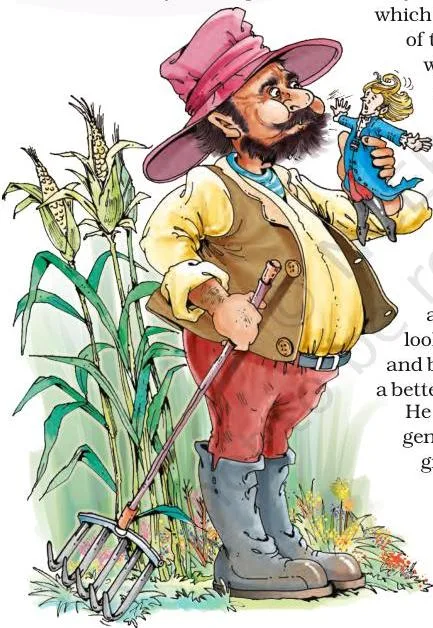
The second picture shows the giants sitting on the ground to examine the tiny man, exactly as the text describes. Gulliver is small enough to be a curiosity.
The third is the project sheet for the giants research task. It sets out the six giants you must find facts about — the giant tree, bird, land animal, water creature, reptile and aeroplane.
The fourth picture shows a child browsing an encyclopedia during library hour — the Teacher’s Page suggests exactly this as the best way to do the giants project.
New Words from Both Texts
The book gives a small glossary for each text, and the same words reappear in the exercises. Use this table while you read.
| Word | Meaning (from the book) | Where it appears |
|---|---|---|
| topsy-turvy | upside down | The poem’s very first line. |
| pleasure | feeling of enjoyment | The poem’s ‘pleasure boats’. |
| grand | big; here, great fun | The poem’s line ‘it must be grand’. |
| bellowing | very loud noise | The story’s talk exercise: a bellowing trumpet. |
| inhabitants | occupants | The giant farmer ‘in the next field’. |
| barren | land with no vegetation | The ‘barren and rocky’ country. |
| astonishment | greatly surprised | Gulliver’s ‘fear and astonishment’. |
| crumbled | broken into pieces | The wife crumbles bread for Gulliver. |
| grab | here, pick suddenly | The baby grabs Gulliver from the table. |
Grammar in Unit 7: When, Comparing, and Punctuation
The writing block teaches three practical grammar skills through exercises rather than rules alone.
The when pattern: two past actions
When joins two actions that both happened in the past. One action was already going on; the second happened in the middle of it. The book’s matching exercise pairs the two halves, and its note adds that the order of the halves can be reversed.
Original example: ‘I was reading a story when the phone rang.’ Reversed: ‘When the phone rang, I was reading a story.’ The action in the when half interrupts the was + -ing action.
Degrees of comparison: two or more
The rule: compare two things or people with -er or more; compare three or more with -est or most. The book’s examples run fast, faster, fastest and difficult, more difficult, most difficult.
Why the split matters: with two, you measure one against the other; with three or more, you pick one member out of the whole group, so the stronger ending marks that. An original example: ‘My bag is lighter than yours, but my brother’s is the lightest of all.’
The book repeats the pattern with easy and strong — so skipping is easy, jumping is easier, walking is the easiest of all.
Punctuation: six marks
The punctuation exercise practises capital letters, full stops, commas, question marks, apostrophes and exclamation marks — first inside a friendly letter, then in six sentences.
The traps are ordinary ones: days, names and places take capitals, and contractions need apostrophes. So ‘next wednesday’ becomes ‘next Wednesday’ and ‘i m’ becomes ‘I’m’. An original example: ‘next friday my cousin ravi is coming to mumbai’ becomes ‘Next Friday my cousin Ravi is coming to Mumbai.’
Similes in Let’s Talk: As … As …
A simile compares two things using as … as …, and the book’s own example is as cold as ice. The exercise gives nine fixed comparisons to complete with the words in the box: feather, tortoise, honey, snow, ox, night, rose, toast, breeze.
- as light as a feather
- as slow as a tortoise
- as sweet as honey
- as white as snow
- as strong as an ox
- as dark as night
- as red as a rose
- as warm as toast
- as gentle as a breeze
The book then drops these into sentences: hair as white as snow, feet as cold as ice (from the earlier example), the newspaper boy as slow as a tortoise, and feeling as light as a feather after exercising.
Why they work: each comparison leans on something everyone knows is extreme — a feather is famously light, snow famously white. The final part invites you to invent your own comparisons, such as as tall as a tree or as brave as a lion; any sensible answer is acceptable.
The same talk block practises giving reasons. For Gulliver’s failure to climb the fence, the book lists three reasons: every step was six feet high, a giant was coming towards him, and he ran to hide.
Common Mistakes Students Make in This Chapter
Every mistake below comes from a task in this unit. Naming the error before you make it means the exercises stop feeling like traps.
| Mistake | Correct rule | How to check your answer |
|---|---|---|
| Reading the poem as a real place. | The poem is an imagined upside-down game. | Ask: could buses really sail on the sea? If not, it is imagination. |
| Answering story questions from guesswork. | Find the supporting line in the text; the giant carried a reaping hook to reap corn, not to fight. | Re-read the paragraph before you choose. |
| Starting a jumbled sentence with the wrong word. | The word with a capital letter is the first word of the sentence. | Scan for the capital letter and start there. |
| Writing ‘the lightest of the two’. | Two things take -er: ‘the lighter of the two’. | Count the things: two → -er, three or more → -est. |
| Writing ‘the simpler problem of them all’. | ‘Of them all’ means three or more, so it takes -est: ‘the simplest problem of them all’. | See ‘of them all’ → choose -est. |
| Writing ‘badder’. | Bad is irregular: the comparative is ‘worse’, not ‘badder’. | Say it aloud — ‘badder’ is not a word. |
| Forgetting capitals and apostrophes. | ‘next Wednesday’ and ‘I’m’ need a capital and an apostrophe. | Read the sentence aloud and check every name, day and contraction. |
Exam and Classwork Notes for Unit 7
This unit is part of the NCERT Marigold book, and its exercises are typical classwork tasks at this level. After Unit 7 you should be able to:
- read the poem aloud and spot the upside-down details;
- answer the Reading is Fun questions by pointing to a line in the poem or story;
- explain the new words in your own words;
- rearrange jumbled sentences using the capital-letter clue;
- complete the as…as similes;
- join two past actions with when;
- choose -er or -est correctly; and
- punctuate a simple letter and six sentences.
One honest caution: textbook contents and the examinable syllabus are not always identical — check the current official CBSE syllabus for what is assessed in your session. This page makes no claim about marks or weightage.
Revision Summary: Unit 7 in Ten Lines
If you have five minutes, this is the unit.
- The poem imagines a land where every normal thing is reversed.
- People walk on their heads, children go to school by night, and buses sail on the sea.
- The comprehension answers come from the poem itself.
- The comparison exercise matches the poem’s upside-down lines one by one with our-land lines.
- The story takes Gulliver, a sailor, to a land of giants.
- The danger comes from everyday things made huge: a giant cat, a giant table, a giant baby.
- The grammar is the when pattern, degrees of comparison and punctuation.
- Writing tasks: a topsy-turvy scene, a paragraph about the land of dwarfs, and a giants-facts project.
- The Teacher’s Page rounds off the unit with poetry, reading, conversation, writing and project work.
- A monster joke — after the dentist pulls its tooth, the monster eats the dentist — sends the unit out on a laugh.
Creative Writing and the Giants Project
The unit does not stop at the story; it asks you to write and research. Creative Writing asks you to wake up in the land of dwarfs and begin, ‘Everything around me looked different.’ A strong paragraph works in three moves: one ordinary object turned huge or tiny, one meeting with a dwarf, and one believable way home.
For example: ‘Everything around me looked different. The breakfast plate on the table was as wide as my bed. A dwarf cyclist stopped and stared — he came up only to my ankle. At sunset I sat on a paper boat as big as a leaf, crossed the garden pond, and blinked — I was back in my own room.’
Let’s Find Out fills a different pattern: a giant tree is given (the redwood trees of California), and you add a giant bird, a giant land animal, a giant water creature, a giant reptile and a giant aeroplane. Then find interesting facts about each and share them with the class.
The two project pictures above show the route: the sheet lists the giants to research, and the library-hour picture shows a child browsing an encyclopedia — the Teacher’s Page suggests that as the best way to do the project. The exercise is about looking facts up, so let the encyclopedia do the work.
Related Resources: Class 5 English Chapters
This listing is maintained for the 2026-27 academic session using the NCERT textbook information available to us. NCERT remains the authority for confirming the latest edition.
Move on to the neighbouring units or the rest of the book from here.
- Class 5 English Marigold book — the book page, with every unit of Marigold listed.
- Class 5 hub — study material for every subject of Class 5.
- CBSE Class 5 notes — the full notes index.
- The unit before this one: What a Tank.
- The unit after this one: Nobody’s Friend.
Sources and Data Verification
This page describes the NCERT Marigold Class 5 English textbook, Unit 7, official edition on ncert.nic.in. It covers this one Marigold unit — not other Class 5 subjects or other English books.
NCERT settles textbook titles, editions and PDFs; CBSE settles the curriculum and syllabus. The listing is maintained for the current academic session using the NCERT information available to us, and it does not claim expert review or full syllabus alignment.
| What the chapter holds | Count | Where it is used |
|---|---|---|
| Printed pages | 20 | |
| Figures with NCERT captions | 3 | |
| Tables | 3 | |
| Official NCERT PDF | Download the chapter PDF | the chapter exactly as NCERT publishes it |
Reference: NCERT Class 5 English (Marigold) textbook, chapter 7, official edition on ncert.nic.in.
Topsy-turvy Land Class 5: Frequently Asked Questions
What is the poem Topsy-turvy Land about?
It imagines an upside-down land where ordinary rules are reversed: people walk on their heads, the sea is made of sand, children go to school by night, and buses sail on the sea. It is an imagined game, not a real place.
Who wrote the poem Topsy-turvy Land?
H.E. Wilkinson. The name is printed under the poem in the Marigold book.
What story comes with the poem Topsy-turvy Land in Class 5 English?
An extract adapted from Jonathan Swift’s Gulliver’s Travels, told by Gulliver, a sailor who is tiny among giants. It brings its own new words, reading questions, talk and writing tasks.
How do you compare Topsy-turvy Land with our land?
Match each upside-down statement with its everyday partner: walk on heads against walk on feet, night school against day school, hats on feet against hats on heads, buses on the sea against buses on land, boats for the streets against boats in the sea, and paying for nothing against paying for what you get.
What grammar does Unit 7 teach besides the poem and the story?
Three things: the when pattern for two past actions, degrees of comparison (-er or more for two, -est or most for three or more), and punctuation with capital letters, full stops, commas, question marks, apostrophes and exclamation marks.
Where can I download the NCERT Class 5 Marigold Topsy-turvy Land chapter PDF?
Use the download box at the top of this page — the Topsy-turvy Land Class 5 chapter PDF opens directly from NCERT’s site, filed as Marigold, English, Class 5, Unit 7.