
The Class Discussion Class 5 chapter is Unit 6 of the NCERT English Marigold textbook. It holds the poem “Class Discussion” by Gervase Phinn and the Arabian Nights story “The Talkative Barber”, together with new words, notice writing, word building and a teacher’s page. The official PDF is linked right below.
Download the Class Discussion Class 5 PDF (NCERT Marigold Chapter 6)
When you need the chapter for class reading or homework, open the Download Class Discussion Class 5 NCERT PDF — it takes you to the official NCERT file for Marigold Class 5 on ncert.nic.in, where Unit 6 appears exactly as printed. Use it for reading the poems, the story and the activities without hunting through other pages.
Chapter at a Glance: What Is Inside Unit 6
This unit holds two reading texts together with language and writing activities. The table below maps the blocks of the unit so you can jump to the part you need.
| Block of the unit | What it asks you to do |
|---|---|
| Class Discussion (poem) | Recite and discuss a poem about a girl who stays silent in class. |
| New Words (poem) | Five words explained: discussion, aired, barely, stare, plain. |
| Let’s Read | Four questions on the poem, including the reason Jane was quiet. |
| Think and Write | Describe two classmates who are very different, using the clue box. |
| Let’s Talk | What a discussion is, the qualities grid, and imagining the class discussion picture. |
| Let’s Read and Do | National Bravery Awards and a bravery story to find and narrate. |
| Write a Notice | Read Sheela’s notice, then write one for a library committee or football match. |
| The Talkative Barber (story) | The Arabian Nights tale of a Sultan and a barber who cannot stop talking. |
| New Words (story) | Seven words explained: chatterer, defect, opinion, exhausted, dessert, examine, at length. |
| Let’s Read | Five questions, including True/False statements, on the story. |
| A Lion | A short limerick by Joseph G. Francis about a lion’s haircut. |
| Let’s Talk | Four discussion questions on the Sultan and the barber. |
| Boyd’s Word Building | Opposites with un-, im-, dis-; joining words; fill in the blanks. |
| Word Fun | Write what you do at a feast, race, cricket match, cinema, fair and party. |
| Let’s Write | Describe processes such as making a salad or sending a letter, in steps. |
| Teacher’s Page | Themes, reading time, conversation time, writing time and project work. |
What This Chapter Covers: Poem, Story, and Language Work
Half of this unit is poetry and half is story. The poem “Class Discussion”, written by Gervase Phinn, shows a teacher noticing that Jane barely speaks while everyone else airs an opinion. Jane’s answer, given in a clear, low voice, is the heart of the poem.
The story “The Talkative Barber” comes from the Arabian Nights. A Sultan named Shahriar is the frame: his queen told ancient Persian and Arabic folk tales each night. Inside that frame, a barber in the city of Cashgar talks non-stop while the Sultan waits to be shaved, and the shave is never finished properly.
The unit also builds five language skills:
- New words — a box after each text explains the harder words.
- Think and Write — describe two classmates using clue words such as studious and cheerful.
- Boyd’s Word Building — make opposites with un-, im- and dis-, and join ideas with words like till and while.
- Write a Notice — a notice must answer who, when, where and what.
- Let’s Write — describe a process in clear steps with time words.
Between the poem and the story sits a short limerick, “A Lion”, by Joseph G. Francis, about a barber who weeps while his customers sleep. It keeps the barber theme light before the talkative barber appears.
Worked example: a football match notice
Sheela’s model notice in the chapter covers four points. Your own notice must do the same.
NOTICE
The Class V football team will play the final match against Green Field School on Saturday, 14 December, at 10 a.m. on the school playground. All Class V students are invited to cheer for the team. Bring your school flag.
Sports Captain, Class V
- Who: the Class V football team and the students invited to cheer.
- When: Saturday, 14 December, at 10 a.m.
- Where: the school playground.
- What: the final football match against Green Field School.
Worked example: how to make a salad
The chapter’s own model process — how a man shaves his face — uses the words then and after this to keep the order clear. Use the same pattern for any process, as in this salad example.
- First, wash the tomatoes, cucumber and onion in clean water.
- Then, chop them into small pieces and put them in a bowl.
- After this, add salt, lemon juice and a little pepper.
- Next, toss everything together lightly.
- Finally, serve the salad fresh.
Each step carries a sequence word, so a reader can follow the order without guessing.
Key Concepts: Discussion, Quiet Nature, and the Barber’s Talk
Three ideas tie the whole unit together: what a discussion is, why Jane stays quiet, and where the story’s humour comes from. Once you hold these, the comprehension questions answer themselves.
What a discussion is
The chapter defines it plainly: to discuss means to talk together or decide something. In a discussion, each person gives ideas one by one; some say why something should be done while others say how; participants ask questions and answer them; and everyone helps decide which ideas are best.
Before planning a visit to the park, for example, you would discuss the day and time, what to bring to play, who does which duty, and what to eat.
Why Jane is quiet
Jane is not afraid, not angry and not bored. The teacher asks, “is there anything the matter?”, and Jane answers in her own clear, low voice: there are many people in this world who are rather quiet. So the correct option in Let’s Read is (iv) she was quiet by nature.
The poem’s point is acceptance: a quiet classmate is a different kind of person, not a problem. The unit’s themes section calls this awareness of different personalities — talkers, quiet people and brave people.
Where the barber’s humour comes from
The joke is that the barber believes he is “very quiet and sparing with words” while he talks without stopping. He delays the shave, leaves the Sultan half-shaved to check the time, tells a story that lasts half an hour, and examines every dish of the feast. The Sultan only becomes free by giving away his food and fruit.
The True/False exercise tests these details: the barber shaved the Sultan’s head, not his beard; the Sultan did give him three gold coins; the barber refused to leave the palace; and the seven children are in the barber’s family, not the Sultan’s.
Figures in This Chapter and What They Show



The unit’s activities are built around the illustrations below. Each caption is the book’s own, and each picture is explained underneath so you can read it the way the chapter intends.
The qualities grid: Ritu and the clues
Ritu’s clue is that she is always seen with a book in hand, so her quality is studious. She fills the last column of the Let’s Talk grid. The full grid matches each child’s clue to one quality:
| Name | Clue in the chapter | Quality |
|---|---|---|
| Nirav | also called a chatterbox | talkative |
| Pranav | saved a cat from drowning in the lake | brave |
| Megha | the opposite of Nirav | quiet |
| Mithila | always teases everyone | naughty |
| Ritu | always seen with a book in hand | studious |
| Sangeeta | lends her pencil to her partner | generous |
All six qualities — brave, naughty, quiet, talkative, generous and studious — are used once, so each name matches exactly one quality.
The National Bravery Awards
This picture belongs to Let’s Read and Do. The chapter explains that the Indian Council of Child Welfare started the National Bravery Awards in 1957, and that winners ride on an elephant in the Republic Day parade.
The feast that changes the story
The Sultan only wants to explain that he is giving a feast at noon. But the barber hears the word feast and remembers his own forgotten invitation to four or five friends. From this point the Sultan is “at the mercy of the Barber”.
Fruit for dessert
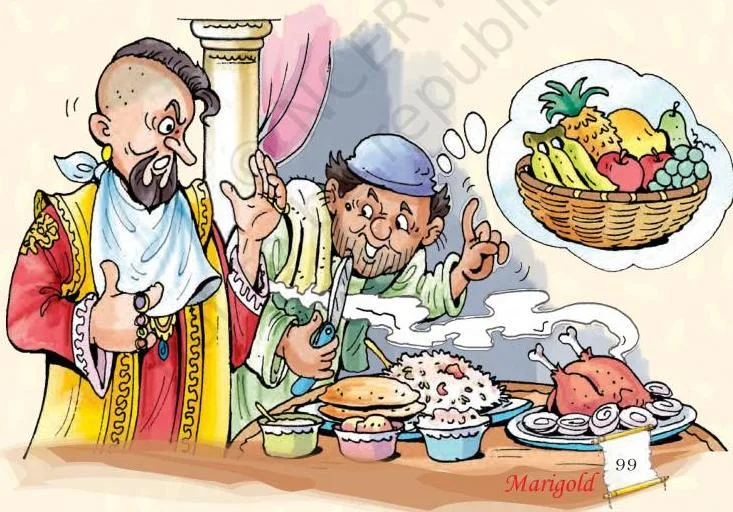
The comic climax arrives when the barber examines each dish for half an hour and announces that he also wants fruit for dessert. The Sultan, whose head is half-shaved, orders the fruits to be brought in, simply to be rid of him.
The Republic Day parade discussion
The final figure is on the Teacher’s Page. It supports the project discussion about what being brave means and the Republic Day parade, where bravery award winners ride on an elephant.
Words and Definitions to Know in This Unit
The chapter gives two New Words boxes — five from the poem and seven from the story. Learn each meaning with its example sentence.
New words from the poem
- discussion — talking together in a group on a single topic. The class held a discussion about the school trip.
- aired — made public; here, shared openly. We aired our opinions one by one.
- barely — only just. From you we barely heard a word.
- stare — look fixedly with eyes wide open. She sat and stared in silence.
- plain — here, clear. Please be plain, is anything the matter?
New words from the story
- chatterer — someone who talks a lot.
- defect — a fault.
- opinion — what a person feels about a person, thing or subject.
- exhausted — tired and fed up.
- dessert — a sweet dish served after the main meal.
- examine — to look at something very carefully.
- at length — at a stretch, without stopping.
Joining words
The chapter highlights the joining words if, or, till, where, unless, so and while, as in “Please wait with me till the bus arrives” or “My father packed my lunch while my mother combed my hair.”
Opposites with un-, im- and dis-
Boyd’s Word Building shows how a prefix flips a word to its opposite. The three models are important → unimportant, patient → impatient and pleasure → displeasure. The nine opposites you write fall into the same three groups:
| Prefix | The nine opposites |
|---|---|
| un- | unshaved, unexpected |
| im- | imperfect, impolite, impure |
| dis- | disbelieve, dissatisfy, disrespect, disobedient |
The fill-in-the-blanks box adds more: untidy, impatient, unkind, dislike, unable, disappear and impossible. Watch the tricky pairs: shaved takes un- (unshaved, not disshaved); pure takes im- (impure, not unpure); satisfy takes dis- (dissatisfy, so dissatisfied, not unsatisfied); and patient takes im- (impatient, never unpatient).
Common Mistakes in Class Discussion and The Talkative Barber
These five errors are the ones students make most often with this unit. The table pairs each mistake with the rule that fixes it and a way to check your work.
| Mistake | Correct rule | How to check your answer |
|---|---|---|
| “Jane was shy or afraid of speaking.” | The poem says she was quiet by nature; option (iv) in Let’s Read question 3. | Re-read Jane’s reply: many people in the world are rather quiet. |
| “The barber had seven brothers.” | He is the youngest of seven children, so he has six brothers. | The True/False statement about seven brothers in the Sultan’s family is False. |
| “The opposite of patient is unpatient.” | Patient takes im-, so the opposite is impatient. | Recite the models: important/unimportant, patient/impatient, pleasure/displeasure. |
| A notice leaves out a detail. | A notice must tell who, when, where and what. | Ask all four questions of your notice; if one is unanswered, add it. |
| A process jumps between steps. | Use sequence words — first, then, after this, next, finally. | Read your steps aloud; each step should carry a time word. |
How This Unit Is Taught and Assessed
The Teacher’s Page closes Unit 6 with the themes and the classroom approach. It tells you what the unit wants you to notice, beyond the two texts.
- Themes: humour, and awareness of different kinds of personalities — talkers, quiet people and brave people.
- Reading time: use a dictionary for the vocabulary exercises, and read The Arabian Nights and other witty stories such as Tenali Raman and Akbar-Birbal.
- Conversation time: talk about wit and humour and about laughing at ourselves; both talking too much and staying silent can come from shyness; group activities build self-confidence; every child has something to say.
- Writing time: the teacher guides a writing piece step by step on the blackboard before students write their own.
- Project work: discuss what being brave means — telling the truth, not hiding things, being generous — and the significance of the Republic Day parade and the Bravery Awards.
One honest note: textbook contents and the examinable syllabus are not always identical. Check the current official syllabus for what is assessed.
Revision Summary: Jane’s Answer and the Barber’s Feast
Revise the whole unit in five minutes. Hold the two characters in your head — the quiet girl and the talkative man — and the language work follows.
- The poem: the class shares opinions, but Jane says almost nothing; the teacher asks what is wrong; Jane answers that some people are quiet by nature.
- The story: the Sultan calls the barber to shave his head; the barber talks instead of working and leaves him half-shaved; the Sultan gives away his feast food and fruit just to be free of him.
- Word work: twelve new words; joining words; opposites with un-, im-, dis-.
- Writing work: a notice answers who, when, where and what; a process description uses sequence words.
- Bravery work: the National Bravery Awards began in 1957; winners get a certificate, cash prizes and free education, and ride an elephant in the Republic Day parade.
Related NCERT Resources for Class 5 English
This listing is maintained for the 2026-27 academic session using the NCERT textbook information available to us. NCERT remains the authority for confirming the latest edition.
Continue with the Class 5 English Marigold book page for every chapter of this book, or visit the Class 5 hub for other subjects. In Marigold, the previous chapter is The Lazy Frog and the next one is Topsy-Turvy Land. For study help across classes, browse the CBSE notes home.
The official NCERT textbook portal lists the current Marigold Class 5 edition alongside every other NCERT book.
Sources and Data Verification
This page describes the NCERT Class 5 English Marigold textbook, Unit 6 — the poem “Class Discussion” and the story “The Talkative Barber” — in the official edition published on ncert.nic.in. It is maintained for the current academic session using the NCERT information available to us. It covers the Marigold Class 5 book only, not other English readers.
NCERT settles the textbook, its editions and the official PDFs. CBSE settles the curriculum, syllabus and examinations. Where the two differ, the official CBSE syllabus is the authority for what is assessed.
| What the chapter holds | Count | Where it is used |
|---|---|---|
| Printed pages | 16 | |
| Figures with NCERT captions | 5 | |
| Tables | 2 | |
| Official NCERT PDF | Download the chapter PDF | the chapter exactly as NCERT publishes it |
Frequently Asked Questions about Class Discussion Class 5
Why was Jane quiet in the class discussion?
Jane was quiet by nature. The teacher asks her if anything is the matter, and she replies that there are many people in the world who are rather quiet. So the correct answer in Let’s Read question 3 is option (iv): she was quiet by nature — not afraid, not hating the noise, and not disliking the activity.
Who wrote the poem Class Discussion?
Gervase Phinn wrote the poem. His name appears under the poem in the textbook, after Jane’s reply.
What does the word discussion mean in Class 5 English?
In this chapter, discussion means talking together in a group on a single topic. The Let’s Talk section adds that in a discussion each person gives ideas one by one and everyone helps decide which ideas are best.
How many brothers did the Talkative Barber have?
The barber had six brothers. He is the youngest of his family, so there are seven children altogether — but in the barber’s family. The True/False statement about seven brothers in the Sultan’s family is false.
What is the opposite of patient — unpatient, impatient or dispatient?
The opposite is impatient. Patient takes the prefix im-, just as perfect becomes imperfect and polite becomes impolite. “Unpatient” and “dispatient” are not correct forms.
What are the National Bravery Awards in this chapter?
The National Bravery Awards honour children who show exceptional bravery. The Indian Council of Child Welfare started them in 1957. Brave children receive cash prizes, free school education and a certificate from the Prime Minister of India, and they ride on an elephant in the Republic Day parade.
Reference: NCERT Class 5 English Marigold textbook, chapter 6, official edition on ncert.nic.in.