
This page covers the Malu Bhalu class 5 chapter — Unit 10 of the NCERT English Marigold book — which pairs the poem “Malu Bhalu” with the Manipur folk tale “Who Will Be Ningthou?”.
The official chapter PDF is linked right below; afterwards, this page explains both texts, the new words and every exercise in the unit, so you can revise without hunting through the book. This page follows the NCERT Marigold edition reprinted for 2024-25.
Download the Malu Bhalu Class 5 Chapter PDF
The unit file holds everything printed under this unit number: the poem, the story, the two New Words boxes, and the exercise pages from “Reading is Fun” through “Project Work”.
Open the official Malu Bhalu class 5 chapter PDF (Marigold Unit 10) on ncert.nic.in to read the complete unit on any device, print it, or keep it open in class while you work through the exercises.
What Is Inside the Malu Bhalu Unit
The unit is built as two reading texts under one exercise trail. The first text is the poem “Malu Bhalu” by Kamla Bhasin, translated from Hindi by Sandhya Rao; the second is the Manipur folk tale “Who Will Be Ningthou?” by Indira Mukherjee.
Each text opens with a New Words box and closes with a “Reading is Fun” question set. Between the two texts sit the True or False chart with a character-sketch task, the “Let’s Talk” passage about a mango, and a pronoun rewrite exercise.
The story is followed by “Let’s Listen and Talk”, “Fun with Sound words”, the “Language Use” past-tense story, and “Project Work”.
The unit ends with a Teacher’s Page naming the unit’s themes and offering reading, conversation, writing and project ideas, followed by the Fundamental Duties from the Constitution. The table on this page lists the unit’s sections, illustrations and exercise questions under the book’s own headings.
Understanding the Poem: Malu Bhalu Learns to Swim
Malu Bhalu is a story-poem in rhyming couplets about a little polar bear who has not yet learned to swim and cannot wait for the lesson. It was written by Kamla Bhasin and translated from Hindi by Sandhya Rao.
The whole poem moves towards one moment — her first jump into the water — and the idea that doing, not advice, is what cures fear.
The poem opens high up in an icy lair, where a snow-white polar bear cub lives with her family. “Snow white, snow bright was her mane” — the first stanza gives the poem its picture of Malu, and the lines that follow tell us she is clever. She quickly learns what her parents know: catching fish, big and small.
One day Malu tells her mother she is going far out to play. She wants to see the things that lie beyond the big blue sky. Her mother asks for a little patience — summer will come — but for Malu patience is a test she refuses to sit. The next illustration shows her mood at this point.
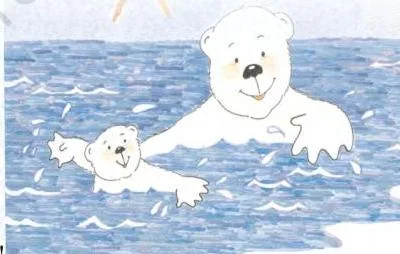
When summer arrives, Malu asks what she should do, and her words give the key line of the poem: she has never swum before. Her mother’s reply is not a lecture but an example — “Do as I do.” With no other way out, Malu grips her mother’s hand and goes into the water with a splash.
The turn comes in the final stanzas. Malu swims with all her might; whether her strokes look right or wrong stops mattering. Her mother always knew, and everyone could see: swimming came so naturally. Doubt and fear are left behind, and the poem ends by calling her fearless — not just brave, but special too.
This answers Reading is Fun, question 6: in the last two stanzas, “she” stands for Malu herself. Both stanzas describe her swimming, her fearlessness, and what everyone could see from the water’s edge.

The closing illustration sits beside the poem’s credit line, which names the poet, Kamla Bhasin, and the translator, Sandhya Rao.
Understanding the Story: Who Will Be Ningthou?
“Who Will Be Ningthou?” is a folk tale from Manipur about choosing a ruler. The book opens the story with its own question: what qualities make a good ruler? The contest in the tale supplies the answer.
In the land of Kangleipak, a Ningthou (king) and a Leima (queen) are loved dearly by their people, and they love them back. The rulers never stop thinking about their meeyam — their people — and they repeat that everybody in Kangleipak should live in peace: not only people, but birds, animals and trees.
Their three sons are Sanajaoba, Sanayaima and Sanatomba. Twelve years later a daughter is born — Sanatombi, a lovely child, soft and beautiful inside, loved by one and all.
One day the Ningthou announces that it is time to decide the Tunggi Ningthou, the future king. The ministers are shocked: in the old days the eldest son became king. But the Ningthou says times have changed, so the most worthy must be chosen. The Leima proposes a contest — a horse race to the khongnang, the banyan tree.
Whoever reaches it first becomes the future king.
Then comes the strange event: all three brothers finish together. They are expert riders — Shagol thauba nupa, “such fine horsemen” — so the rulers turn to their sons and ask each one for a different feat.
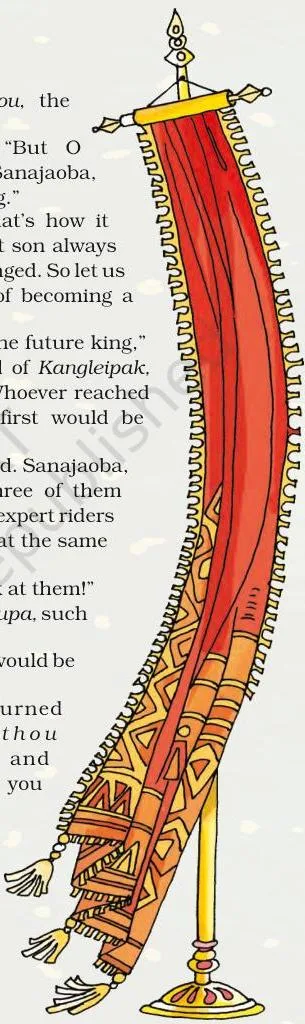
The illustration above catches that turning point: the rulers facing their three sons after the race ended in a tie.
Each son performs a feat to separate himself. Sanajaoba pierces the banyan tree with his spear and jumps his horse straight through it; the people shout Thouro! Thouro! — “Bravo! Bravo!”
Sanayaima urges his horse higher and higher until it leaps clear over the tree; the cry is Phajei! Phajei! — “Wonderful! Wonderful!” Sanatomba, the youngest, uproots the tree and carries it triumphantly to the rulers’ feet.
Still no announcement comes. The people grow restless and crane their necks — and find the king and queen watching five-year-old Sanatombi, sad and lonely, staring at the dead khongnang while birds flap worriedly around it. She whispers that the tree is dead — it was hurt by the spear.
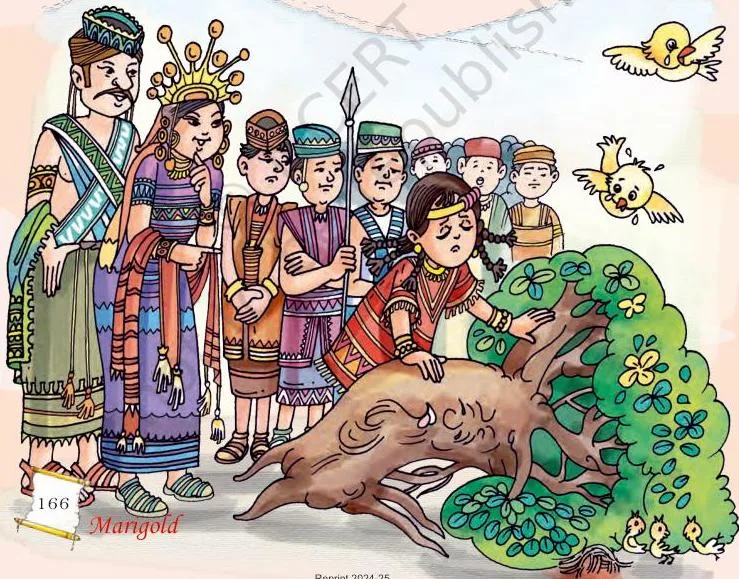
In that moment, caught in the illustration above, the Ningthou makes his choice. Sanatombi, he says, told them to look at the soul of the tree; she feels the pain of people, animals, birds and trees.
He declares her the future Leima, and the story closes with its own definition: “A Leima is one who doesn’t hurt anybody in the kingdom.”
The story is by Indira Mukherjee. Its Manipuri words — Ningthou, Leima, meeyam, khongnang, Tunggi Ningthou — are glossed in English inside the text as they appear.
Themes of the Unit: Courage, Fairness and Leadership
The Teacher’s Page at the unit’s end names three themes: girl child – gender awareness, multilingualism, and leadership qualities. The two texts together carry all three.
- Gender awareness. In the “Let’s Talk” passage, Meena brings a mango home and her grandmother gives the larger piece to Raju because he is a boy. Meena protests — she brought the mango and is the elder — and her father divides it equally. The same idea works in the story, where a five-year-old girl, not her three brothers, is chosen to rule.
- Leadership qualities. The contest’s feats decide nothing. The future Leima is chosen because she feels the pain of others. For this story, leadership means protecting the kingdom, not impressing it.
- Multilingualism. Manipuri words live inside the English story, and the Teacher’s Page suggests reading folk tales from other states and noting words from other languages.
Sanatombi’s compassion for the wounded tree links directly to the Fundamental Duties printed at the end of the unit, especially duty (g): protect and improve the natural environment and have compassion for living creatures.
New Words in the Unit Explained
Both texts carry a New Words box. The tables below re-state those boxes in the book’s own definitions and add an original sentence for each word.
From the poem:
| Word | Meaning | Example sentence |
|---|---|---|
| lair | a wild animal’s lying place | Malu came out of her icy lair to play in the snow. |
| mane | long hair on the neck of some animals | The lion’s mane was golden in the sun. |
| clasped | here: encircle, hold closely | Sanatombi clasped the little bird gently in her hands. |
| might | great strength | Malu swam with all her might to reach her mother. |
From the story:
| Word | Meaning | Example sentence |
|---|---|---|
| peace | quiet | The rulers wanted everyone in Kangleipak to live in peace. |
| worthy | deserving of | The Ningthou wanted to choose the son most worthy of becoming king. |
| contest | competition | The contest was a horse race to the banyan tree. |
| spear | a hunter’s weapon | Sanajaoba held his spear straight in front of him. |
| triumphantly | victoriously | Sanatomba carried the uprooted tree to the throne triumphantly. |
Word Building. The exercise asks for the English meanings of four Manipuri phrases. The story already supplies all four as glosses, so the task is to find them again:
- Tunggi Ningthou — future king. The phrase is explained where the Ningthou announces “the Tunggi Ningthou, the future king”.
- Thouro! Thouro! — Bravo! Bravo! The shout and its English gloss appear together at Sanajaoba’s feat.
- Phajei! Phajei! — Wonderful! Wonderful! The words follow the crowd’s reaction to Sanayaima’s leap over the tree.
- Shagol thauba nupa — such fine horsemen. The gloss sits right after the brothers finish the race together.
The Illustrations in This Unit, Explained
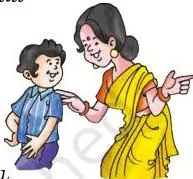

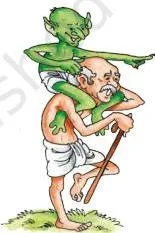
The unit’s pages carry small illustrations that support the reading. The table below gives each one its role in the unit and points to the section of this page where it is discussed in full.
| Illustration | Where it appears in the unit | Explained in |
|---|---|---|
| Malu simply could not rest. | Opening picture of the poem, beside its first stanza | Understanding the Poem section above |
| Excerpts from Malu Bhalu by Kamla Bhasin | Closing illustration of the poem, beside the credit line | Understanding the Poem section above |
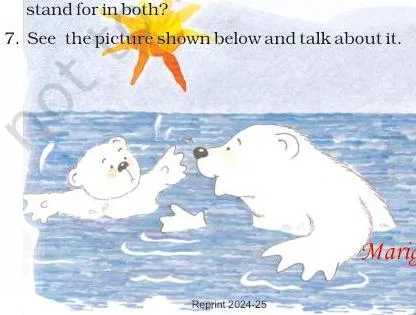
| 7. See the picture shown below and talk about it. | Picture-talk prompt for Reading is Fun, question 7 | How the Exercises Work section below |
| One day, Malu’s father told Malu that the hunters had come to trap Malu and Malu’s family. | The passage used for the pronoun rewrite | The Grammar section below |
| Now rewrite the above paragraph using words from the above table. | Instruction image for the pronoun rewrite | The Grammar section below |
| The Ningthou and Leima turned to their sons. | The contest moment in the story | Understanding the Story section above |
| The people were all attention. | The crowd watching Sanatombi and the dead tree | Understanding the Story section above |
| In a forest, there ___ (live/lives/lived) a goblin named Cruel. | The fill-in-the-blank story for Language Use | The Grammar section below |
How the Exercises Work: Comprehension and Character Sketch
The unit’s exercises run in a set order: comprehension on each text, a chart on the poem, a language task, and a project. Working through them in that order builds reading, writing and speaking skill at once.
Reading is Fun (poem): the seven questions
The poem’s set is mostly literal recall — the answer sits in a line of the poem. Question 6 asks for an inference about “she”, and question 7 is a talk, not a written answer.
- Where did the polar bear live with her family? — High up in an icy lair.
- What did Malu learn to do from her parents? — Catch fish, big and small.
- Where did Malu want to travel? — Beyond the big blue sky.
- What did Malu’s parents want her to learn? — To swim.
- Was Malu scared to swim? Did she learn it easily? — Yes, at first: “I’ve never swum before!” Once doubt and fear were left behind, swimming came naturally. So she was scared at the start, and successful as soon as she tried.
- Whom does “she” stand for in the last two stanzas? — Malu (see the poem section above).
- See the picture shown below and talk about it. — This is the speaking prompt of the unit:
Look at the picture and say what you notice: who is in it, where the scene is, and how the character feels. Use words from the poem — “snow white”, “icy lair”, “never swum before” — to support what you say.
Reading is Fun (story): the six questions
The story’s set checks whether you followed the characters and the rules of the contest. One-line answers in your own words work well here:
- Name the place in Manipur where the Ningthou and Leima ruled. — Kangleipak.
- Why did the people of Kangleipak love their king and queen? — Because the rulers always thought about their people and wanted everyone — people, birds, animals, trees — to live in peace.
- Why did the Ningthou want to choose a future king? — He believed times had changed, and the most worthy ruler should be chosen rather than the eldest son by habit.
- How did the king want to select the future king? — Through a contest: a horse race to the banyan tree, the khongnang.
- What kind of child was Sanatombi? — Lovely, soft and beautiful inside; she felt the pain of others.
- Have you ever seen an animal or a bird in pain? What did you do? — This is your own answer. One model: “Yes — I once saw a sparrow with a hurt wing. I gave it water and left it to rest. The story values exactly this: not ignoring the pain of a living creature.”
Let’s Listen and Talk: map, language and opinion
Three speaking questions follow the story. The first asks you to locate Manipur on the map of India. The second asks what language the people of Manipur speak, with three options — Assamese, Maithailon and Mizo.
The third asks who should have been made the future king — Sanajaoba (through the tree), Sanayaima (over it) or Sanatomba (uprooted it) — and why; and who was actually made queen, and why. The story’s answer to the second half is Sanatombi, because she felt the pain of others.
Use a chart: the True or False table with reasons
The chart’s first task is True or False for seven statements about Malu. The safest way to do it is to find the poem’s line before ticking any box:
| Statement | True / False | Reason from the poem |
|---|---|---|
| Malu’s hair was white. | True | “Snow white, snow bright was her mane.” |
| Malu knew how to swim. | False | She says “I’ve never swum before!” — the statement describes her before the lesson. |
| Malu was playing with the penguins. | False | The poem never mentions penguins at all. |
| Malu was good at catching fish. | True | She learnt from her parents “fish to catch, big and small.” |
| Malu was a brave bhalu. | True | “Brave mother’s brave young daughter!” and, at the end, “Fearless was Malu.” |
| Malu did not love her mother. | False | She trusts her mother, grips her hand and follows her example; the poem shows no dislike. |
| Malu’s mother was firm. | True | “Malu had to swim that day” — the mother gave her no choice. |
Character sketch of Malu Bhalu
The chart’s second column is a word bank. Choose five or six words, then support each with a line from the poem. That support is what makes the sketch a paragraph answer, not a list.
| Word chosen | Line from the poem that supports it |
|---|---|
| clever | “Malu was a clever girl.” |
| eager to learn more | she “learnt the things her parents knew,” then wanted to know what lay beyond the blue sky |
| impatient | she “simply could not rest” |
| adventurous | she wanted to see the things beyond the big blue sky |
| brave | “Brave mother’s brave young daughter!” |
| fearless | “Fearless was Malu, this she knew.” |
A model paragraph: “Malu Bhalu is a clever young cub — the poem says so outright. She is eager to learn more, moving from catching fish to wanting the world beyond the blue sky. She is impatient when told to wait for summer. And she is brave: though she has never swum, she grips her mother’s hand and jumps in.
Once in the water she is fearless, and the poem calls her not just brave, but special too.”
Project Work
The group task turns the classroom into Kangleipak: sit in groups of five, each student tells a story, and the group declares a Ningthou or Leima. The second task is to find childhood stories of famous people — scientists, religious people, freedom fighters, brave children, astronauts and artists — and share at least two of them with friends.
The Grammar in This Unit: Pronouns, Sound Words and Verbs
Three language skills sit inside the unit: replacing repeated names with pronouns, enjoying sound words, and choosing past-tense verbs correctly. Each is a small rule applied to a short text.
Pronouns: rewriting the hunters passage
Read the passage once and the problem appears fast — Malu is repeated in almost every sentence. Pronouns (I, me, she, her, they, them) stand in place of names so the writing flows. The book’s table groups them by person speaking, person spoken to, and other people or things.
Work the model sentence first: “One day, Malu’s father told Malu that the hunters had come to trap Malu and Malu’s family” becomes “One day, Malu’s father told her that the hunters had come to trap her and her family.” The possessive “Malu’s father” keeps its form; the name itself does not always turn into “she”.
The full passage, rewritten sentence by sentence:
| Original sentence | Rewritten with pronouns |
|---|---|
| Malu lived with Malu’s parents in the North Pole. | Malu lived with her parents in the North Pole. |
| Malu had great fun with Malu’s seagull friends. | Malu had great fun with her seagull friends. |
| One day, Malu’s father told Malu that the hunters had come to trap Malu and Malu’s family. | One day, Malu’s father told her that the hunters had come to trap her and her family. |
| Malu knew how to hide very well. | She knew how to hide very well. |
| Malu shut Malu’s eyes and curled up like a ball of snow. | Malu shut her eyes and curled up like a ball of snow. (or: She shut her eyes…) |
| The hunters searched for Malu and Malu’s family everywhere but in vain. | The hunters searched for her and her family everywhere but in vain. |
The second image carries the rewrite instruction itself. In sentence 5 either opening is correct — keeping the name “Malu” at the start of a sentence is natural English; what must change is the possessive “Malu’s eyes” to “her eyes”.
Fun with Sound words
Some words in the list copy a noise — Click!, Chirp! — and are true sound words. Others, like Hurrah! and Alas!, express a feeling; they are exclamations, not imitation sounds. The exercise mixes both and wants your own answer, so treat the table below as sample answers to start from:
| Word | Sample answer — what makes this sound or action | Kind |
|---|---|---|
| Click! | a camera shutter; a key turning in a lock | sound word |
| Chirp! | a small bird calling | sound word |
| Whisper! | very soft talking | sound word |
| Bravo! | a crowd cheering a performance | exclamation |
| Oh! | sudden surprise | exclamation |
| Ah! | surprise or relief | exclamation |
| Hurrah! | joy, celebrating something | exclamation |
| Alas! | sorrow, disappointment | exclamation |
| Wonderful! | praise, admiration | exclamation |
| Hi! | calling out to greet someone | exclamation |
| Ho! | calling to get someone’s attention | exclamation |
| Hop away! | a frog or rabbit leaping off | action phrase |
Language Use: the goblin story and past-tense verbs
The task has two parts: circle the action words ending in -ed and write their present forms, then choose the correct verb for a story about a goblin named Cruel. The rule on test: regular verbs form the past by adding -ed; irregular verbs change their spelling instead.
Sort the story’s verbs into the two columns:
| Regular verbs (add -ed) | Present form | Irregular verbs (change spelling) | Present form |
|---|---|---|---|
| lived | live | met | meet |
| ordered | order | leapt | leap |
| obeyed | obey | came | come |
| walked | walk | thought | think |
| moved | move | ran | run |
| noticed | notice | ||
| asked | ask | ||
| replied | reply | ||
| instructed | instruct | ||
| entered | enter |
The book’s done example, “admitted → admit”, belongs in the regular column too — it adds -ed but doubles the final consonant first. The completed story choices follow the table: lived, met, leapt, ordered, obeyed, walked, moved, noticed, asked, replied, came, instructed, entered, thought, ran.
Where Students Slip in This Unit
These are the mistakes that cost marks in this unit, named before you make them. Each row gives the fix and a way to check your own answer.
| Students often… | The correct rule | How to check your answer |
|---|---|---|
| Tick “Malu knew how to swim” as True because the poem ends with her swimming. | The statement describes the start of the poem. Before the lesson she had never swum — her own words: “I’ve never swum before!” | Ask what Malu knew at the beginning. The statement is about the start, so it is False. |
| Answer question 6 with “Malu’s mother”. | In both last stanzas “she” is Malu — the one who swims, leaves fear behind, and is called fearless. | Re-read the two stanzas: every sentence is about swimming and fearlessness — Malu’s, not her mother’s. |
| Replace every “Malu” with “she” in the rewrite, even in possessives. | “Malu’s father” keeps the possessive; later references to Malu become “her”. | For each sentence ask: is “Malu” the possessor (Malu’s …) or the person talked about (→ she / her)? |
| Call every past-tense verb regular. | Only verbs that add -ed are regular. Verbs that change spelling (met, ran, thought, came, leapt) are irregular. | Add -ed to the present form in your head. A real word (lived, walked) means regular; otherwise the verb is irregular. |
| Count Hurrah! and Alas! as sound words. | They are exclamations of feeling, not imitations of noise. | Does the word copy a sound or express an emotion? Click! copies a sound; Alas! expresses sorrow. |
| Write the character sketch as a word list. | A sketch is a paragraph: every chosen word needs a line from the poem as evidence. | For each word you choose, write the line that proves it. No line, no word. |
How to Prepare This Unit for Class
This unit builds all four language skills, not a pile of facts. Reading — the two texts and the mango passage. Writing — the character sketch and short paragraphs. Speaking — the picture talk, “Let’s Talk” and “Let’s Listen and Talk”. Listening — following the class discussion and answering the questions read aloud.
Here is a way to revise the unit in under an hour:
- Read the poem once for the story, once for the sound of the rhymes.
- Re-read the story, underlining the four Manipuri glosses (they answer Word Building) and the reasons the Ningthou gives for choosing Sanatombi (they answer the discussion).
- Do the True or False chart aloud, giving the poem’s line for each answer.
- Practise the pronoun rewrite and the verb choices by writing them, then check against the tables above.
- Write one short paragraph. The Teacher’s Page gives the order: a brief introduction, a topic sentence, supporting points, a proper ending.
The Teacher’s Page also suggests wider work: read folk tales from other states and note words from other languages; discuss which of our actions harm the environment; put up a display board on famous personalities from the Project Work.
Remember that textbook contents and the examinable syllabus are not always identical — check the current official syllabus.
The Unit in a Nutshell
Quick recap of the unit in a few lines:
- Poem (Malu Bhalu): a snow-white polar bear cub in an icy lair learns her parents’ skills, wishes to see beyond the big blue sky, and — after admitting she has never swum — learns by doing. Doubt and fear are left behind; she is not just brave, but special.
- Story (Who Will Be Ningthou?): in Kangleipak, a contest among three skilled sons ends in a tie. The future Leima is chosen for empathy, not for a feat — five-year-old Sanatombi feels the pain of the wounded banyan tree. “A Leima is one who doesn’t hurt anybody in the kingdom.”
- Language: pronouns replace repeated names; sound words imitate noise while exclamations express feeling; regular verbs take -ed, irregular verbs change spelling.
- Themes: girl child – gender awareness; multilingualism; leadership qualities.
- Closing values: the Fundamental Duties, especially duty (g) — protect the natural environment and have compassion for living creatures, the very quality Sanatombi shows.
Related Chapters and Resources
This listing is maintained for the 2026-27 academic session using the NCERT textbook information available to us. NCERT remains the authority for confirming the latest edition.
To reach every unit of this book — the ones before and after “Malu Bhalu” — open the Class 5 English Marigold book page; the Class 5 hub holds the other subjects of the class, and the CBSE notes home gathers revision material for every grade. Related English notes on this site include the Vocation poem.
For the complete book — not just this unit — the full Marigold Class 5 reader is published free on the official NCERT website.
Sources and Data Verification
- The material on this page describes the NCERT Marigold Class 5 textbook, Unit 10 (“Malu Bhalu”), current rationalised edition, published on ncert.nic.in.
- This page covers that single unit of the Marigold Class 5 book — it does not cover the whole CBSE English scheme.
- The listing is maintained for the current academic session using the NCERT information available to us.
- NCERT settles textbooks, editions and official PDFs; CBSE settles the curriculum, syllabus and examinations. The official PDF of this unit is linked in the download section above.
| What the chapter holds | Count | Where it is used |
|---|---|---|
| Printed pages | 18 | |
| Figures with NCERT captions | 8 | |
| Tables | 3 | |
| Official NCERT PDF | Download the chapter PDF | the chapter exactly as NCERT publishes it |
Frequently Asked Questions
What is the Malu Bhalu chapter about in Class 5 Marigold?
Unit 10 of Marigold pairs the poem “Malu Bhalu” — a polar bear cub learning to swim — with the Manipur folk tale “Who Will Be Ningthou?”, in which a little girl is chosen as future Leima because she feels the pain of others. The unit also practises pronouns, sound words and past-tense verbs.
Is Malu Bhalu a poem or a story?
Malu Bhalu is a poem — a story in rhyming couplets, translated from Hindi by Sandhya Rao from the original by Kamla Bhasin. The story in the same unit is “Who Will Be Ningthou?” by Indira Mukherjee.
Who wrote Malu Bhalu and Who Will Be Ningthou?
“Malu Bhalu” was written by Kamla Bhasin and translated into English by Sandhya Rao. “Who Will Be Ningthou?” was written by Indira Mukherjee.
Who does ‘she’ stand for in the last two stanzas of the poem Malu Bhalu?
‘She’ stands for Malu. The last two stanzas describe her swimming, leaving doubt and fear behind, and being called fearless — not her mother.
What are the new words to learn in the Malu Bhalu unit?
From the poem: lair, mane, clasped and might. From the story: peace, worthy, contest, spear and triumphantly. Both New Words boxes are explained with example sentences in the “New Words” section of this page.
Where can I download the official Malu Bhalu class 5 chapter PDF?
From the NCERT website — the official Malu Bhalu class 5 chapter PDF (Marigold Unit 10) is linked at the top of this page and lives at ncert.nic.in. It is free and contains the whole unit.
Reference: NCERT Class 5 English (Marigold) textbook, chapter 10, official edition on ncert.nic.in.
Explore Class 5 English Books
- Previous: Vocation
Related chapters: