
Nobody’s Friend Class 5 is Unit 8 of the NCERT English Marigold textbook — the official chapter for the current academic session. It pairs Enid Blyton’s poem Nobody’s Friend with her adapted story The Little Bully, then wraps both in reading, speaking, word-building and writing exercises. The official NCERT chapter PDF is right below.
Get the NCERT Class 5 English Nobody’s Friend chapter PDF — the Marigold chapter 8 file (eeen108) — from the NCERT textbooks portal, so you can read the poem, the story and every exercise in the exact book format.
The chapter’s first page carries the code 9526CH08; if you see that code, you have the right file.
What This Unit Contains at a Glance
This is a two-text unit — a poem followed by a story — wrapped in reading, speaking, word-building and writing exercises. The table below gives the unit’s size. Page references on this page follow the chapter PDF’s own pages (p. 1 is the poem’s first page), not the printed book’s page numbers.
One naming detail: Marigold prints this as Unit 8, while the PDF file calls it chapter 8. Both names point to the same file, so whichever label you searched with, you have the right unit.
| Sections | Figures | PDF pages |
|---|---|---|
| 21 | 8 | 18 |
The unit’s exercises are short activity blocks attached to each text rather than one numbered question set, so the contents table below doubles as the exercise list.
What This Unit Covers: Poem, Story, and the Exercises Between
This Marigold unit follows the book’s usual pattern: a poem paired with a story, both circling one idea. Unit 8’s idea is friendship — the poem shows the habit of sharing, and the story shows what happens to a child who refuses to care how others feel.
| Section in the unit | What it asks you to do |
|---|---|
| Read and Enjoy | The poem Nobody’s Friend — three stanzas to read aloud (NCERT, p. 1). |
| Reading is Fun | Four comprehension questions on the poem (NCERT, p. 3). |
| Let’s Talk | Speaking practice: sharing what you love, describing your best friend, one glass of water for a thirsty group, playing cricket alone with a bat (NCERT, p. 3). |
| Words Word Building | More -less words; the opposites of lend and nobody (NCERT, p. 3). |
| What are no Words | Six words that mean “no”, used in sentences you underline (NCERT, p. 4). |
| Say Aloud | Word groups such as nobody / everybody / somebody; rhyming words for train and friend (NCERT, p. 5). |
| Let’s Write | Aesop’s lion-and-mouse fable, the meaning of a friend in need is a friend indeed, and a short paragraph on how you can be a good friend (NCERT, p. 5). |
| The Little Bully | The story half: Hari the pinching boy at the seaside (NCERT, p. 6). |
| New Words | Six story words with meanings (NCERT, p. 10). |
| Reading is Fun | Three questions on the story, including ticking the actions that make a friendly person (NCERT, p. 10). |
| Vocabulary | An opposites crossword; black and blue; shan’t; full forms of contractions; more -ly adverbs (NCERT, p. 11). |
| Fun with Sounds | P and F word pairs; rhyme completion for bruise, carriage and prawn (NCERT, p. 13). |
| Let’s Practise some Writing | Writing about the creatures’ lesson; articles a, an, the; animals with hard covers; the turtle and tortoise; picture description with is/are + -ing; will-sentences (NCERT, p. 14). |
| Let’s be creative and Talk | A group story: suppose you went deep-sea diving (NCERT, p. 17). |
| Teacher’s Page | The unit’s themes and goals for parents and teachers (NCERT, p. 18). |
The unit runs in this order in the book, so you can find any activity by opening the chapter and looking for its section name.
The Poem ‘Nobody’s Friend’: Sharing Is What Makes a Friend
The poem opens the unit with its lesson: sharing is what makes a friend. Enid Blyton wrote three stanzas that work as a set of contrasts (NCERT, p. 1).
| Stanza | What the child does | The repeated line |
|---|---|---|
| First — the girl | keeps her sweets, won’t lend her book, won’t let anyone play with her doll | “She’s nobody’s friend!” |
| Second — the boy | eats every bit of his toffee, won’t lend his tricycle, never lets anyone play with his train | “He’s nobody’s friend!” |
| Third — the speaker | promises sweets, a ball, books and games, and offers half an apple and half a cake | “I’m your friend!” |
“Nobody’s friend” means “friend of nobody” — the apostrophe shows belonging, not the short form here. The refrain repeats in the first two stanzas and flips in the third: the speaker is a friend because a friend shares (NCERT, p. 1).
The four Reading is Fun questions (NCERT, p. 3) follow the same contrast, so the answers sit in the table above:
- What the girl will not share: sweets, her book and her doll.
- Did the boy share his toffee and tricycle? No — he ate all the toffee and did not lend the tricycle.
- Why are the two children nobody’s friends? Because they share nothing, so nobody calls them a friend.
- What does the last child want to share? Sweets, a ball, books and games, and half an apple and half a cake.
The Story ‘The Little Bully’: Hari Learns What Pinching Feels Like
The story half of Unit 8 follows a boy who loves pinching until the seaside creatures give him a taste of his own medicine. The credit printed under the story is Enid Blyton (Adapted) (NCERT, p. 6).
The story turns on a few moments:
- Hari is small but strong. His favourite tricks are pinching — he can raise a bruise in half a second — and pricking people with a pin.
- The other children hate him. Pinching him back does not work, and they will not tell the teacher because that would be telling tales.
- The class goes to the seaside for a whole day. On the train nobody sits next to Hari; on the sands nobody takes his hand.
- Angry, he sits alone by a rocky pool with a good lunch — boiled eggs, jam sandwiches, bread and butter, a ginger cake and a chocolate bar — and plans to eat it all himself.
- A monster crab walks out of the pool on eyes set on short stalks and nips his hand with its pincers. A sandy lobster pinches him harder, and shrimps, prawns and more crabs prick him until he is black and blue.
- The creatures say they were told he was a champion pincher and would love the fun. His lunch rolls into the pool and they feast on it.
- Hari runs, realising the creatures “only did to me what I keep doing to the other children”, and decides he will not pinch or prick any more (NCERT, pp. 6–10).
Why this story sits after the poem: the poem shows the positive side of sharing; the story shows the harm of selfishness and force. Hari understands other children’s feelings only when the crabs and lobsters make him feel them. That is the empathy lesson the whole unit is built on.
The story’s Reading is Fun questions check the obvious points: the children hated Hari because he always pinched them, and the line “nobody took Hari’s hand” shows he had no friends (NCERT, p. 10).
The same exercise lists actions and asks you to tick the friendly ones — respecting others, being helpful, helping classmates and protecting a weaker person are the friendly actions.
The Language Work Hiding Inside the Exercises
The unit does not separate “grammar” from “reading” — the exercises teach language through the poem and the story. Everything below is a skill the unit practises, with one fresh example of your own in the last column.
| Skill | What Unit 8 practises | One fresh example |
|---|---|---|
| -less words | Words ending in -less, like friendless and homeless (NCERT, p. 3) | fearless, careless |
| Opposites | The opposite of lend and the opposite of nobody, with clue letters | lend ↔ borrow; nobody ↔ somebody |
| No-words | Six words that mean “no”, underlined in sentences (NCERT, p. 4) | nobody, no, nowhere, no one, none, nothing |
| Word groups and rhymes | Reading groups like share, care, stare; adding rhymes for train and friend (NCERT, p. 5) | train → rain, pain; friend → bend, send |
| P and F sounds | Pairs such as pleased / pinched and fat / fruit, said aloud (NCERT, p. 13) | palm and farm; pair and fare |
| -ly adverbs of manner | Quietly and loudly tell how an action is done; add more -ly words and use them in sentences (NCERT, p. 11) | softly, brightly |
| Contractions | Full forms of won’t, weren’t, wouldn’t, couldn’t, and the meaning of shan’t (NCERT, p. 11) | shan’t = shall not; won’t = will not |
| Articles | A and an for any person or thing; the for a particular one; an before vowel sounds (NCERT, p. 14) | an owl, a book, the river |
| Hard-cover animals | Encircle animals that protect themselves with a hard cover (NCERT, p. 14) | snail, turtle, tortoise (shells); hedgehog, porcupine (quills) |
| Turtle vs tortoise | Write a few lines telling how a turtle and a tortoise differ (NCERT, p. 14) | the task is the comparing — look for differences to write |
| Picture description | Describe a scene using is/are plus -ing (NCERT, p. 14) | The baby is kicking; the boys are running |
| will-sentences | Imagine what children will do in the playground tomorrow (NCERT, p. 14) | We will play badminton after school |
| Paragraph and group story | Write a paragraph on one topic; build a story in a group (NCERT, pp. 5, 17) | how you can be a good friend; the deep-sea diving story |
The writing exercise also links words to the world: you encircle the animals that protect themselves with a hard cover, then paste or draw one animal and write five lines about it (NCERT, p. 14).
The picture space above is where the drawn or pasted animal goes; the five lines that follow it are your short piece of writing about the animal you chose.
Reading the Unit’s Illustrations
The figures below are the book’s own illustrations, and each one supports a specific moment or activity. The book prints no separate captions, so each caption here is the exercise line the picture sits beside, and the walkthrough tells you what to notice.
The class sets off for the seaside picnic
This picture sits at the moment the story’s trouble begins (NCERT, p. 6).
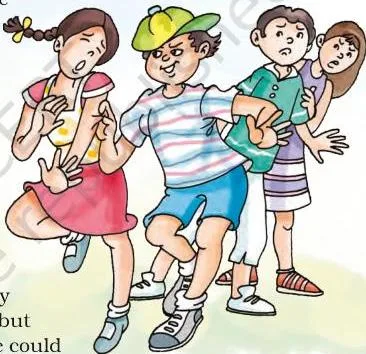
Notice the excitement of a picnic nearly every child shares. The next pages of the story carry the catch — nobody wants to sit next to Hari. This cheerful image sets up the contrast with his lonely day.
Nobody took Hari’s hand on the sands
The next illustration is the story’s own sentence in picture form (NCERT, p. 7).
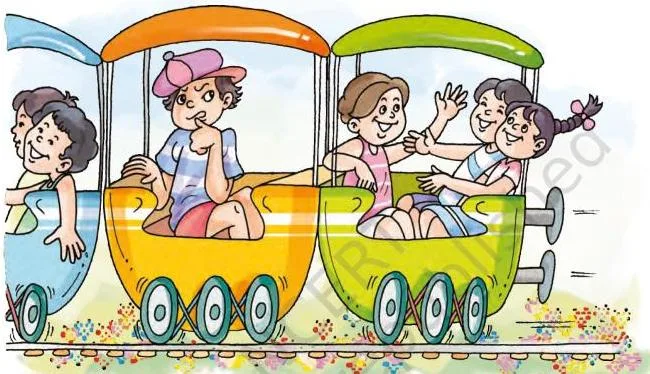
Children race hand in hand down to the sands — the picture of friendship — while the text adds, “nobody took Hari’s hand.” Reading the image with the line shows why friendship cannot be forced: Hari’s pinching has pushed everyone away.
Eating a small child’s tiffin: an unfriendly action
This small picture illustrates one of the actions in the story’s Reading is Fun exercise (NCERT, p. 10).
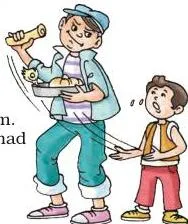
The exercise asks you to tick the actions that make a friendly person — respecting others, being helpful, helping classmates, protecting the weak. Taking someone else’s lunch is the opposite: an unfriendly action you would leave unticked.
The good-friend writing prompt
This illustration belongs to the Let’s Write exercise (NCERT, p. 5).
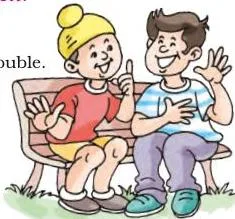
The picture is the prompt for your paragraph. Write after the Aesop fable in the same exercise, so you can build your answer from its idea: being there for a friend in trouble.
The turtle and tortoise comparison
The picture appears beside the question about the difference between a turtle and a tortoise (NCERT, p. 14).
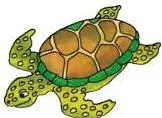
Both animals carry a hard shell — that is why both appear in the hard-cover list a few lines above. Use the picture to notice what they share, then write a few lines on what is different.
The shipwreck deep-sea story
This is the prompt for Let’s be creative and Talk (NCERT, p. 17).
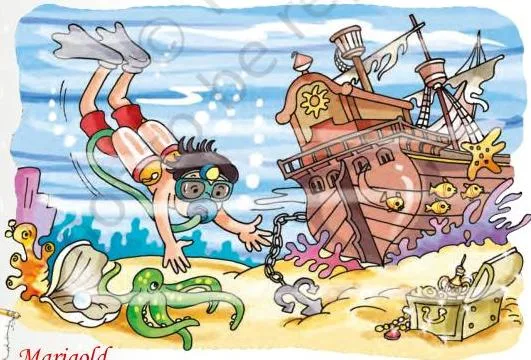
Work in groups of four: collect all the words the picture brings to mind, build them into a paragraph, and share your story with other groups. The shipwreck gives the tale a setting; the exercise turns a picture into sentences you can say aloud.
New Words and Their Meanings
The story introduces words a Class 5 reader may not meet every day, and the unit turns them into a mini-vocabulary lesson (NCERT, p. 10).
| Word | Plain meaning |
|---|---|
| bruise | a dark mark on the skin where a blow or a hard pinch landed |
| horrid | very unpleasant; terrible |
| hoarse | rough and deep, describing a voice that sounds sore |
| pincer | a gripping claw or tool, like the crab’s |
| stalk | the main stem that holds something up — the crab’s eyes sat on stalks |
| nipped | pinched or squeezed sharply |
The unit then groups words by meaning. The no-words (NCERT, p. 4) are six words that all mean “no”:
- nobody — no person at all
- no — not any
- nowhere — in no place
- no one — not a single person
- none — not any of a group
- nothing — not a single thing
The vocabulary practice also covers contractions — short forms where the apostrophe stands for missing letters (NCERT, p. 11): shan’t = shall not, won’t = will not, weren’t = were not, wouldn’t = would not, couldn’t = could not.
Two idioms stay with you from this unit. Black and blue means covered in bruises, from the line where the creatures pinch Hari till he is black and blue (NCERT, p. 11).
A friend in need is a friend indeed means a true friend stands by you in trouble; the Aesop fable in Let’s Write — the mouse freeing the lion from ropes — teaches it (NCERT, p. 5).
Mistakes Students Make in This Unit
Six small traps in this unit cost students marks and understanding. Each correction below is the one the book’s own exercises point to.
| Mistake | Correct rule | How to check your answer |
|---|---|---|
| Writing take as the opposite of lend | The opposite is borrow — the clue letters b______w point to it | Check the hint letters: borrow fits b…w; take does not |
| Writing “will not” for shan’t | Shan’t = shall not; won’t = will not — two different contractions | Swap it into the story line “I shan’t pinch”: “I shall not pinch” sounds right |
| Writing “a unpopular boy” or “a empty bottle” | An comes before a vowel sound, so an unpopular boy and an empty bottle | Say the next word aloud — “unpopular” begins with a vowel sound, so use an |
| Writing “No one of the two boys came” | The book’s sentence is “None of the two boys came” — none means “not any of a group” | When the sentence uses “of the two”, the word is none, not no one |
| Reading the heading “no words” as “know words” | No-words are words that mean “no” — the section calls never “at no time” | Check each listed word: nobody, no, nowhere, no one, none, nothing all carry the meaning “no” |
| Mixing the two apostrophe jobs in the refrain | “Nobody’s friend” = friend of nobody (possession); “She’s” = she is (short form) | Try the swaps in the line: “friend of nobody” and “she is” both work |
How to Practise Unit 8 for Class 5 English
This unit builds five skills — reading aloud, comprehension, speaking, word work, and writing — so practice should touch each one.
- Read the poem aloud and notice the refrain that repeats, stanza after stanza, until it flips to “I’m your friend!” in the last one.
- Retell The Little Bully in your own words in a few lines — the writing exercise asks exactly that (NCERT, p. 14).
- Answer the four Reading is Fun questions on each text, aloud or in writing (NCERT, pp. 3, 10).
- Practise the grammar points with fresh examples: the six no-words, -ly adverbs of manner, articles, contractions and opposites.
- Try the picture description with is/are + -ing, then the will-sentences about tomorrow in the playground (NCERT, p. 14).
- Write the short paragraph on how you can be a good friend (NCERT, p. 5).
For quick help, the Class 5 English notes collect the Marigold unit material, the Class 5 hub links the year’s pages, and the main CBSE Notes index is a good starting point.
The Teacher’s Page states the unit’s goals plainly — problems of growing up, the evils of bullying, friendship, and familiarity with the animal world (NCERT, p. 18).
It also suggests reading more Enid Blyton and Aesop’s Fables, discussing why rules matter, and a project on collections, where children talk about what they like to collect and find out about famous collectors (NCERT, p. 18).

The project research shown above turns the unit’s ideas into homework families can join in with.
One necessary reminder: textbook contents and the examinable syllabus are not always identical, so check the current official CBSE syllabus for what is examinable this session.
Unit 8 Recap: What to Remember
If you remember nothing else from the unit, remember this:
- The poem’s lesson: sharing builds friendship; the girl and the boy who keep everything to themselves are “nobody’s friend”.
- The story’s lesson: Hari learns empathy only after the crabs and lobsters pinch and prick him — treat others the way you want to be treated.
- The six no-words: nobody, no, nowhere, no one, none, nothing.
- Quietly and loudly are -ly adverbs of manner; the exercise builds more.
- Shan’t means shall not; won’t means will not.
- An comes before vowel sounds: an unpopular boy, an empty bottle.
- Black and blue means bruised.
- A friend in need is a friend indeed — from the Aesop fable in the unit.
Other Marigold Class 5 Chapters
Move on to another unit from here without a fresh search:
- NCERT Class 5 English Marigold book page — open any unit of this book
- Class 5 NCERT books — the Class 5 subject pages
- The previous Marigold unit (chapter 7)
- The next Marigold unit (chapter 9)
- Unit-specific notes for the unit before this one and the unit after this one
Sources and Attribution
This listing is maintained for the 2026-27 academic session using the NCERT textbook information available to us. NCERT remains the authority for confirming the latest edition.
This page describes Unit 8 (chapter 8) of the NCERT Class 5 English Marigold textbook. NCERT publishes the textbook, its editions and its official PDFs; CBSE sets the curriculum and syllabus for school examinations. The figures shown are the book’s own illustrations.
| What the chapter holds | Count | Where it is used |
|---|---|---|
| Printed pages | 18 | |
| Figures with NCERT captions | 7 | |
| Tables | 10 | |
| Official NCERT PDF | Download the chapter PDF | the chapter exactly as NCERT publishes it |
Reference: NCERT Class 5 English Marigold textbook, chapter 8, official edition on ncert.nic.in.
Questions About Nobody’s Friend Class 5
Who wrote the poem Nobody’s Friend and the story The Little Bully?
Enid Blyton wrote both. The poem is credited to Enid Blyton, and the story is credited “Enid Blyton (Adapted)” (NCERT, p. 6).
Why is the child in the poem called ‘nobody’s friend’?
“Nobody’s friend” means “friend of nobody” — the apostrophe shows possession. The girl and the boy share nothing at all, so nobody considers them a friend (NCERT, p. 1).
What is the moral of The Little Bully story?
Hari realises how his pinching feels only after the crabs and lobsters do the same to him: “They only did to me what I keep doing to the other children.” The moral is to treat others the way you want to be treated (NCERT, p. 10).
What does shan’t mean in The Little Bully?
Shan’t means “shall not”. The unit checks it separately from won’t, which means “will not” (NCERT, p. 11).
What are the no words in this unit?
The six no-words are nobody, no, nowhere, no one, none and nothing, and the unit also counts never (“at no time”) (NCERT, p. 4).
Is The Little Bully a separate chapter in Class 5 English?
No. The Little Bully is the story half of the same Unit 8, printed after the poem, with the language exercises between and after it (NCERT, p. 6).