
This page gives you the My Shadow Class 5 chapter — Unit 3 (Chapter 3) of the NCERT Class 5 English book Marigold.
The unit pairs Robert Louis Stevenson’s poem “My Shadow” with the story “Robinson Crusoe Discovers a Footprint” and opens on textbook page 41. The official NCERT PDF is right below; the rest of the page is a plain guide to what the unit teaches.
My Shadow Class 5 PDF Download
The official NCERT file for this unit — My Shadow Class 5 English Marigold Chapter 3 PDF — is hosted on the NCERT website, so you get the exact Marigold pages 41 to 57 in one file, ready to read on a phone, a tablet or a printout.
Chapter at a Glance
The unit has two texts — a poem and a story — plus the exercises that follow each one. The table below maps each part of the unit to its pages in the book.
| Part of the unit | Pages in the book |
|---|---|
| Poem “My Shadow” — Read and Enjoy | 41-42 |
| New Words (poem) | 43 |
| Let’s Read and Let’s Talk | 44 |
| Fun Time and Working Together | 45 |
| Let’s Write (poem) | 46-47 |
| Story “Robinson Crusoe Discovers a Footprint” | 48-51 |
| New Words and Let’s Read (story) | 52 |
| Let’s Write (story) | 53-54 |
| Fun Time (story) | 55 |
| Let’s Work in Pairs and Teacher’s Page | 56-57 |
What This Unit Contains and Why the Two Texts Belong Together
The unit deliberately pairs a funny poem about a shadow with a suspense story about a footprint. The Teacher’s Page (page 57) names the theme that joins them: investigating the unknown, suspense and a sense of curiosity, and overcoming fears by scientific analysis.
The poem shows a small child giving his shadow a child’s explanation — he treats it as a person and decides it is simply lazy. The story shows the opposite way to face something frightening: Robinson Crusoe stops guessing and examines the evidence.
Around the two texts, the unit practises these skills:
- Comprehension questions on both texts (Let’s Read, pages 44 and 52);
- Choosing relative pronouns — who, whose, whom, which, that (page 46);
- Joining ideas with and, but, or, so, because (pages 53-54);
- Creative writing — describing a dog and writing a story about strange footprints (pages 47 and 54);
- A torch experiment that shows how shadows work (Fun Time, page 45).
Key Concepts in the Poem and the Story
This section walks through what the poem says, what the story says, and the science of shadows that the unit quietly teaches. Every point below stays close to the book’s own pages.
The Poem: A Child Talking to His Shadow
The chapter opens with a riddle: whenever there is light, someone follows you — have you ever wondered who it is (page 41)? The poem’s speaker is a small child who treats his shadow like a companion who follows him, copies him and sleeps in late.
Three details carry the poem:
- The shadow goes in and out with him and is “very, very like” him “from the heels up to the head” (page 41);
- When the child jumps into bed, he sees the shadow jump before him (page 42);
- The shadow sometimes “shoots up taller like an India-rubber ball” and sometimes grows so little that “there’s none of him at all” (page 42).
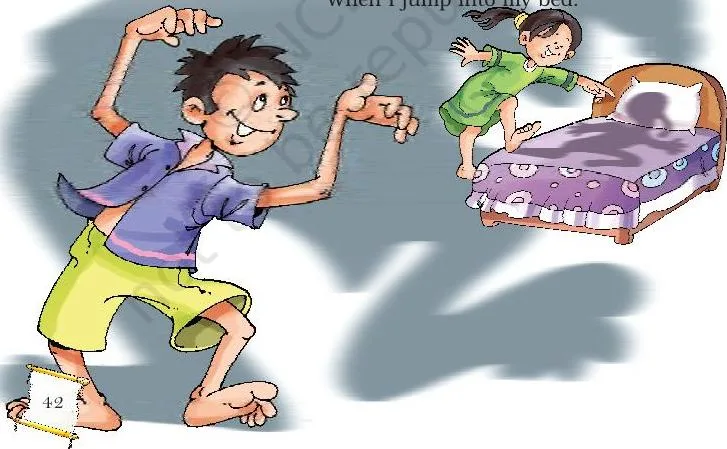
The picture on page 42 shows the moment the first stanza describes — the child mid-jump and the shadow already on the bed, landing before him. Use it to feel what the child believes: the shadow is a playmate who has raced him to bed.
The key teaching point comes in the last stanza: the child wakes “before the sun I was up” and finds his shadow “had stayed at home … fast asleep in bed”.
A shadow forms only when your body blocks light, and before sunrise there is no sunlight to block — so no shadow forms. The child mistakes a fact of light for laziness.
The Story: Robinson Crusoe and the Single Footprint
Robinson Crusoe’s ship has been destroyed by the sea, and he has lived alone on the island for many years, longing for company. One day, going towards his boat, he finds a single human footprint in the sand (page 48). What he does next is the whole story:
- Search, not proof. He listens, looks around, walks up and down the shore, and finds no second print — only “the print of a foot — toes, heel, every part of a foot” (pages 48-49).
- Fear on the way home. He looks behind him every two or three steps, “mistaking every bush and tree to be a man” (page 50).
- A sleepless night. He thinks the print could belong to one of the savages of the mainland who had wandered out to sea, and that the man may have seen his boat and will return with others to kill and eat him (pages 50-51).
- Prayer and comfort. He lies fearful for many days, prays for protection, is comforted, and begins to go out again (page 51).
- Measuring the evidence. After two or three days of seeing nothing he grows bolder, returns to the print, and measures it against his own foot (page 51).
- The conclusion. The print is not his — it is larger than his own foot, and he had not visited that shore for a long time. “The island was inhabited!” (page 51).
Crusoe stops being afraid only after this measuring step. That is the lesson the Teacher’s Page spells out: overcoming fears by scientific analysis — examine the evidence, then conclude (page 57).
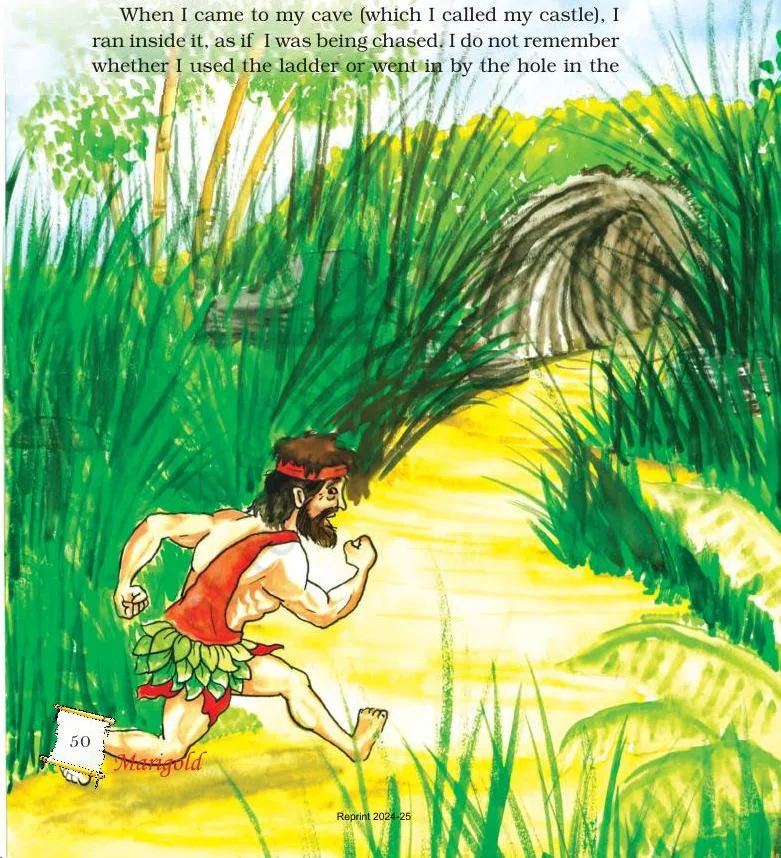
The picture on page 50 catches the fear at its worst: Crusoe runs into his cave “as if I was being chased, faster than any animal could run”. Notice his private names — the cave is his “castle” and the hole in the rock is his “door” — small signs of how long this island has been his only home.
Shadows Through the Day: the Science the Poem Hides
The poem never explains a shadow; the exercises do. Let’s Read (page 44) asks when your shadow is the tallest — morning, afternoon or night — and the answer comes from where the sun is.
The answer is morning: the sun is low in the sky in the early morning, so it throws a long, stretched shadow. Evening works the same way. At noon the sun is overhead and your shadow is shortest, gathered almost under you.
The Teacher’s Page (page 57) says to watch the shadows of trees and the school building outdoors through the day, and to notice that there is no shadow on a cloudy day — because the sun’s light is hidden.
The Fun Time torch experiment (page 45) shows the same rule on a small scale: shine a torch behind your hand, see the shadow on the wall, then move the torch a little away from your hand.
Moving the torch away makes the shadow smaller; bringing it close to your hand makes the shadow bigger. The torch is doing what the sun does — the closer the light, the more your hand blocks it, and the larger the shadow.
Grammar in This Unit
The written exercises in this unit train two joining-word skills: relative pronouns and conjunctions. Both have a simple choosing rule, explained below with fresh example sentences.
Relative Pronouns: who, whose, whom, which, that
A relative pronoun connects a person or thing to more information about it. Decide first whether the word refers to a person, a thing or belonging, and the choice almost makes itself.
| Word | Use it for | Example |
|---|---|---|
| who | people — the one doing the action | The girl who lives next door is my friend. |
| whom | people — the one receiving the action | The man whom we helped thanked us. |
| whose | belonging — asking or telling whose it is | That is the boy whose pencil I borrowed. |
| which | things and animals | I lost the book which you gave me. |
| that | things, animals and sometimes people | The cake that she baked was delicious. |
The exercise on page 46 gives seven blanks, each with three options such as who/whose/which. Apply the table: people get who or whom; things and animals get which or that; belonging gets whose. All five words appear among the options, so the person/thing/belonging rule covers every blank.
Joining Words: and, but, or, so, because
Joining words (conjunctions) show how two ideas are connected. The pair students swap most is because and so, so that comes first:
- because gives the reason: “I ran because I was frightened.”
- so gives the result: “I was frightened, so I ran.”
- and adds one idea to another: “She sings and dances.”
- but shows a contrast: “It was cold but sunny.”
- or offers a choice: “Tea or coffee?”
Notice that because and so both connect a cause and a result — they just flip the order. That is why both sentences above are correct. The story exercises let you practise: fill in the blanks with and, but, because or so (page 53), then join sentence pairs from Column A and Column B using or, and, so, but or because (page 54).
New Words and Their Meanings
The unit carries two short word lists — one for the poem (page 43) and one for the story (page 52). The meanings below are the book’s, in slightly plainer words.
From the poem (page 43)
| Word | Meaning |
|---|---|
| India-rubber ball | a ball that can bounce very high |
| buttercup | a yellow flower |
| arrant | bad |
| arrant sleepyhead | completely inattentive |
From the story (page 52)
| Word | Meaning |
|---|---|
| savages | wild people living in a primitive state |
| mainland | a large continuous extent of land |
| wandered | went from place to place without a definite route |
| bolder | more confident |
| inhabited | occupied, lived in |
The Unit’s Illustrations, Explained
The unit carries four captioned pictures, and each is tied to a task. Two appear above with their texts — the boy jumping into bed (page 42) with the poem, and Crusoe running into his cave (page 50) with the story. Here are the other two.
This picture is the prompt for the second writing task in Let’s Write (page 47). The book gives five guiding questions — what the dog is called, why she is called that, what colour she is, whether she is friendly, and what she likes to eat — and the picture of Mithoo and Shadow helps you answer them in a few lines.
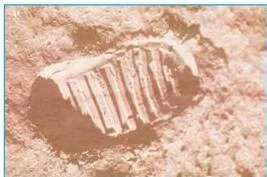
The Fun Time puzzle on page 55 shows a footprint and asks whose it is. The hint printed beside it says this is the footprint of the first man on the moon — and that man is Neil Armstrong. The book leaves his name blank for you to fill in.
Common Mistakes in This Chapter
This unit hides a few traps. Each row below names the mistake, the rule that fixes it, and a way to check your work.
| Mistake | Correct rule | How to check your answer |
|---|---|---|
| Treating the shadow as a separate person | The poem is the child’s misunderstanding, not a fact — a shadow always moves with the body that blocks light | Ask: does a shadow need light? Before sunrise there is no light, so no shadow forms — the child only thinks his shadow was lazy |
| Mixing whose and who’s | Whose shows belonging; who’s is short for who is | Read the sentence with “who is” in place of the word — if it fits, use who’s; if not, use whose |
| Using who or whom for things | Who and whom are for people only; which and that are for things and animals | Identify what the word points to — a person gets who/whom/whose, a thing or animal gets which/that |
| Swapping because and so | Because gives the reason; so gives the result | Find the cause and the result — the word in front of the cause is because, the word in front of the result is so |
| Copying Crusoe’s first mistake — panicking before checking | Check the evidence before you conclude | Crusoe’s footprint was not his because it was larger than his own foot and sat on a shore he had not visited — measure, then decide |
How to Practise This Unit
After this unit you should be able to do six things. Treat them as a checklist:
- Read the poem aloud with expression — the book itself says, “Act out the poem as you read it slowly” (page 47).
- Answer who the shadow looks like and when your shadow is the tallest (page 44).
- Choose who, whose, whom, which and that correctly in a sentence (page 46).
- Join two ideas with and, but, or, so and because (pages 53-54).
- Write a short description of a dog, using the guiding questions on page 47.
- Write a short story about strange footprints, using the prompts on page 54.
Also remember that textbook contents and the examinable syllabus are not always identical — check the current official syllabus before your exams.
What to Remember from This Unit
Here is the whole unit in eight bullets:
- The poem’s speaker is a small child who talks to his shadow as if it were a person (page 41).
- The shadow goes in and out with him, looks exactly like him “from the heels up to the head”, and jumps before him into bed (pages 41-42).
- The shadow shoots up tall “like an India-rubber ball” and sometimes shrinks until “there’s none of him at all” (page 42).
- One morning before sunrise there is no shadow, and the child calls it lazy — a shadow needs light, and before sunrise there is no sunlight (page 42).
- The poem is by Robert Louis Stevenson (page 42).
- The story’s sequence: discover the footprint, search the shore, fear on the way home, a sleepless night, prayer, measure the print against his own foot, and conclude “The island was inhabited!” (pages 48-51).
- The print was not Crusoe’s: it was larger than his own foot and lay on a shore he had not visited for a long time (page 51).
- The unit’s themes (Teacher’s Page, page 57): investigating the unknown, suspense and curiosity, and overcoming fears by scientific analysis.
Related Resources
This listing is maintained for the 2026-27 academic session using the NCERT textbook information available to us. NCERT remains the authority for confirming the latest edition.
If you are revising the whole book, the pages below take you through the rest of the Class 5 English Marigold chapters.
- Open the Class 5 English Marigold notes for every chapter of this book explained in one place.
- Visit the Class 5 study material hub to reach the other Class 5 subjects on this site.
- Go back to Chapter 2 of the Class 5 English book for the unit that comes just before this one.
- Move ahead to Chapter 4, Crying, the next unit in the book.
- Browse the CBSE notes home page for material at other class levels.
Sources and Data Verification
- The content on this page describes the NCERT Class 5 English Marigold textbook, Unit 3 — the poem “My Shadow” and the story “Robinson Crusoe Discovers a Footprint”, pages 41-57 of the current NCERT edition.
- This page covers this one chapter only, not the whole book.
- The listing is maintained for the current academic session using the NCERT publication, available on the official NCERT textbooks portal.
- NCERT settles textbooks, editions and PDFs; CBSE settles curriculum, syllabus and examinations.
| What the chapter holds | Count | Where it is used |
|---|---|---|
| Printed pages | 16 | |
| Figures with NCERT captions | 3 | |
| Tables | 2 | |
| Official NCERT PDF | Download the chapter PDF | the chapter exactly as NCERT publishes it |
My Shadow Class 5: Frequently Asked Questions
Why did the shadow stay at home in the poem My Shadow?
Because a shadow needs light, and the poem happens before sunrise. There is no sunlight yet, so the child’s body cannot cast a shadow — the child mistakes this for laziness and calls his shadow “an arrant sleepyhead” (page 42).
When is your shadow the tallest — morning or afternoon?
Morning — and again in the evening. A low sun throws a long shadow; at noon the sun is overhead and your shadow is shortest, almost under you. On a cloudy day there may be no shadow at all (pages 44 and 57).
Who wrote the poem My Shadow in Class 5 English?
Robert Louis Stevenson. His name is printed at the end of the poem (page 42).
Why was Robinson Crusoe afraid when he saw the footprint?
Crusoe was alone on an island. He thought the print could belong to one of the savages of the mainland who had wandered out to sea, and he feared that if the man had seen his boat, he would return with others to kill and eat him (pages 50-51).
Whose footprint is shown in the Fun Time section of this chapter?
The footprint of Neil Armstrong, the first man on the moon. The hint beside the picture (page 55) says it is the footprint of the first man on the moon and leaves his name blank to fill in.
What is the difference between whose and who’s?
Whose shows belonging — “the girl whose bag is red”. Who’s is short for who is — “the girl who’s standing there”. If you can replace the word with “who is”, use who’s; otherwise use whose.
Reference: NCERT Class 5 English Marigold textbook, chapter 3, official edition on ncert.nic.in.