
Teamwork Class 5 is the second unit of the NCERT English Marigold textbook: the poem “Teamwork” by Jan Nigro, the story “Flying Together”, the rhyme “For Want of a Nail” and the fable “The Ant and the Dove”, with all the word work that wraps around them.
The official teamwork class 5 NCERT English Marigold chapter 2 PDF (official) is published by NCERT on its textbook portal — open it to read the unit exactly as printed, with the poems, story, pictures and exercises together.
Teamwork Class 5: what is inside the chapter
This is a contents map for the chapter file: it names everything the unit holds, so you know what to expect before you open the PDF. A table on this page lists how much the chapter holds — sections, figures and exercises — and the sections below explain each piece.
- The poem “Teamwork” by Jan Nigro, with sentence-completion, team-member naming and rhyming-word exercises.
- The traditional rhyme “For Want of a Nail”, with its question-making exercise.
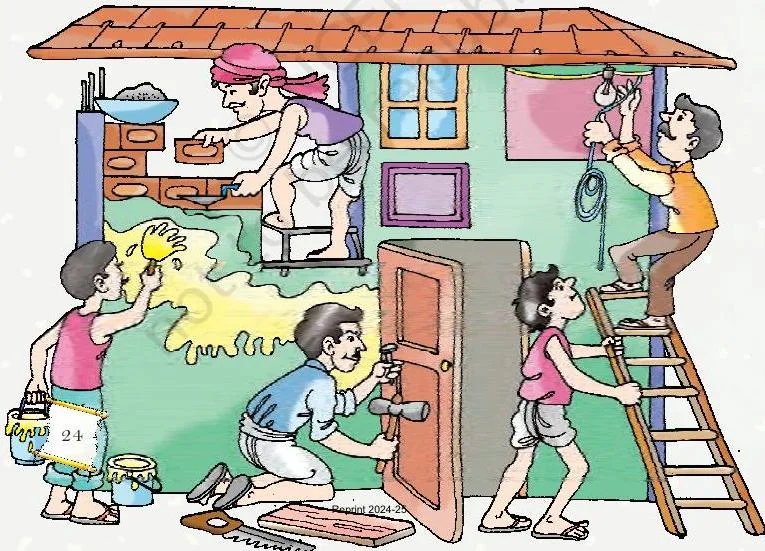
- Picture composition: a house-building scene used for one-sentence answers and a team story.
- Let’s Talk: alone-versus-group lists, family decisions and a guessing mime.
- Let’s Write: a compound-word puzzle, poem completion, contractions, prepositions and question words.
- The story “Flying Together” (adapted from the Panchatantra), with New Words and Let’s Read questions.
- The fable “The Ant and the Dove”, with its talking and writing activities.
- The clap word game for counting syllables.
- A Teacher’s Page that lists the unit’s themes and project ideas.
What this chapter covers
Think of this section as a route map for the unit: it shows where each piece sits and how the texts connect, so you can jump straight to the part you need.
- The poem opens the unit, and its exercises build comprehension, team vocabulary and rhyming.
- “For Want of a Nail” follows and practises forming questions from answers.
- Picture composition and Let’s Talk turn the teamwork theme into speaking.
- Let’s Write does the grammar: the word puzzle, poem completion and contractions.
- “Flying Together” is the main story, with New Words and the Let’s Read check.
- “The Ant and the Dove” adds a second short text with more talking and writing.
- The clap word game closes the language work with syllables.
- The Teacher’s Page explains the unit’s three themes and its projects.
The unit’s three themes — collaboration, teamwork and doing work on time — come from the Teacher’s Page, and they hold all these pieces together.
The poem ‘Teamwork’ and ‘For Want of a Nail’: meaning and exercises
This section explains what the poem means and how to do its exercises, then does the same for the short rhyme that follows it.
The message of the poem
The poem’s message in one line: a team works only when every member takes part. If nobody passes the basketball, nobody can shoot; if nobody passes the baton, the relay cannot go on.
The group is described as the parts that make up the whole, with their eyes on a common goal. When separate “you or me” voices become one “us”, individuals have turned into a single team.
The two sentence completions come straight from this idea — 1. If nobody passes the ball in a basketball game, then you can’t shoot. 2. In a relay race, if no one passes the baton, then the race can’t go on.
For “Name the team members”, list the people each activity cannot run without. Model answers — yours can differ:
- To make a film we need a director, actors, a cameraman and a light-and-sound team.
- To run a good school we need teachers, students, a principal and support staff.
- To run a restaurant we need a cook, a waiter, a manager and a cleaner.
Completing the rhyming words table
The rhyming exercise asks you to complete a table: pair each word from the poem with a word of your own that ends with the same sound. The first pair — team and beam — is done for you. A completed set:
| Word from the poem | Your own rhyming word |
|---|---|
| team | beam (done) |
| plus | bus |
| done | sun |
| hoop | loop |
| shoot | root |
| goal | hole |
| joy | toy |
‘For Want of a Nail’: the chain and the questions
The rhyme “For Want of a Nail” is one long chain reaction: a missing nail loses the shoe, the shoe loses the horse, the horse loses the rider, the rider loses the battle, and the battle loses the kingdom.
One tiny thing ignored on time grows into a huge loss — the same warning the geese in “Flying Together” ignore.
The exercise then asks you to form questions for given answers. Match the question word to the answer type: why for a reason (because…), when for a time, where for a place, what for a thing.
| The answer gives… | Use this question word | Worked example |
|---|---|---|
| a reason | why | Why was the kingdom lost? — Because the battle could not be fought. |
| a place | where | Where did the geese live? — In a tall tree. |
| a thing | what | What did the hunter spread in the tree? — He spread a net. |
In the book’s three bubbles, every answer gives a reason — the word “because” — so all three questions begin with why: Why was the kingdom lost? Why was the shoe lost? Why was the battle lost?
The exercise ends by asking you to make three more questions and answers from the poem itself. Model pairs in original words:
- Q. What happens if nobody passes the basketball? — A. Then nobody can shoot.
- Q. Why can’t the relay race go on? — A. Because nobody wants to pass the baton.
- Q. What do we share when the work is done? — A. We share the joy of what we’ve done.
The story ‘Flying Together’: plot, moral and reading check
This story belongs in a teamwork unit because it shows what happens when a group ignores good advice and then has to save itself together. The plot, in six steps:
The plot
- A flock of wild geese lives safely in a tall forest tree; one of them is a wise old bird.
- The old bird notices a small creeper at the foot of the tree and warns that it will grow thick and strong enough for a hunter to climb.
- The other geese say there is no hurry and the creeper is small — destroy it later. They never do.
- The creeper winds up the tree, a hunter climbs it, spreads a net and traps the whole flock.
- The wise bird’s plan: when the hunter returns, every goose must pretend to be dead.
- The hunter throws them down one by one; when the last one lands, all the geese get up, flap their wings and fly away together.
The moral has two halves: act on good advice before a small problem becomes a big one, and in a crisis stay calm and act as one. The geese escape only because every bird keeps to the same plan at the same moment.
The reading check
The six Let’s Read questions are answered in short, complete sentences:
- 1. Where did the geese live? — In a tall tree deep in a forest.
- 2. Why did the old bird advise destroying the creeper? — Because, once grown thick and strong, it would let a hunter climb up and kill them all.
- 3. Why did the geese cry “Help! Help!”? — They were trapped in the hunter’s net and could not get out.
- 4. What did the hunter do when he thought the geese were dead? — He threw them out of the net one by one, planning to collect them below.
- 5. Why did the geese pretend to be dead? — So the hunter would not want them, would throw them down, and they could escape.
- 6. Describe one incident when you got into trouble for not doing your work on time. — A model: I once left my homework till the morning, had to rush, made mistakes and was late. Your own experience is the real answer.
The five True/False statements test whether you read the exact words. Statement 1 is False — the tree was the home of a flock of geese, not parrots. Statement 3 is False — the hunter climbed with the help of the creeper, not a ladder.
Statements 2, 4 and 5 are True: the old bird wanted the creeper destroyed, the trapped birds wept and called themselves foolish, and the wise bird’s plan let the flock escape.
A later reference-to-context exercise asks who spoke two key lines, to whom, and when: the birds, replying that there was no hurry, and the hunter, telling himself where the geese lived.
The one idea the poem and the story share
Both pieces teach the same teamwork idea, and seeing them side by side makes it stick:
| ‘Teamwork’ (poem) | ‘Flying Together’ (story) |
|---|---|
| Form: a song-like poem | Form: a Panchatantra story |
| What goes wrong: nobody passes — no shot, no relay | What goes wrong: nobody acts on the creeper — the net catches everyone |
| The fix: everyone takes part, one common goal | The fix: everyone follows one plan at the same moment |
| Shared idea: when each member shares and acts on time, the whole group succeeds; when they do not, everyone loses. | |
The Ant and the Dove, and the clap word game
Two short pieces finish the unit: one tiny fable and one word game. This section covers both.
The Ant and the Dove
In the fable, an ant slips into a sparkling fountain and cannot swim. A friendly dove pulls off a leaf and lets it glide down to the ant, who climbs on and is saved. The dove flies away, and there the excerpt ends.
The lesson: a small act of kindness can save someone. For the talking points, the story supports two answers — the dove helped because she saw the ant drowning, and the ant must have felt huge relief and gratitude. The third question is personal: retell a time someone helped you.
A pair-work exercise gives a model for question words: if your friend says “I play games”, ask “What games do you play?”; “I play in the ground” → “Where do you play?”; “On Sunday I go shopping” — “When do you go shopping?”
The clap word game
The clap word game is a syllable-counting game. Say a word aloud and clap once for each sound beat you make — not for each letter you see. The book’s examples: one clap for “creep”, two for “cree-per”, three for “to-mo-rrow”.
Method: say the word slowly, and tap your chin lightly — every time your chin drops, that is one syllable. Apply it to the game list: geese gets one clap, creeper two, tomorrow three. Clapping follows sound, not spelling.
Themes from the Teacher’s Page: collaboration, teamwork, doing work on time
The Teacher’s Page at the end of the unit names the three ideas the whole chapter is built on, and every exercise connects to at least one of them.
Where each theme appears
| Theme | What it means | Where it appears in the unit |
|---|---|---|
| Teamwork | Everyone does their part | The poem’s basketball and relay lines; the geese pretending to be dead together |
| Collaboration | Different people joining skills on one job | The house-building picture (mason, carpenter, painter, electrician); the story itself |
| Doing work on time | Small jobs finished early, before they grow | The creeper the geese should have cut young; the story’s opening questions about homework and school bags |
Both texts plant the same ripple-effect idea: in the rhyme, a nail leads to a shoe, a horse, a rider, a battle and finally a kingdom; in the story, a creeper leads to a hunter and a net. Ignore a tiny matter and the chain runs on.
What the Teacher’s Page adds
The Teacher’s Page also frames how the unit should be used — the four headings below are its own:
- Reading time — enjoying poetry out loud; listening to poetry is like listening to music. Panchatantra tales, originally written in Sanskrit, teach wise conduct of life through animal stories.
- Conversation time — the Let’s Talk questions, so every child speaks freely on familiar situations.
- Writing time — the alone-and-group list, five ways birds and animals are like humans, and the house-building picture essay.
- Project work — a tree conservation drive and a clean-school campaign.
Figure walkthrough: the chapter’s pictures and how to use them

Each picture in the chapter belongs to an exercise. This section reads them one by one and shows how to use them for the task they go with.
This is the picture-composition scene, and the box gives the clue words: plumber, painter, mason, electrician, labourer, carpenter, gardener. To answer in one sentence: read the question, find the worker it asks about, pick the matching clue word, and answer as “The ___ is ___”.
- Who is laying the bricks? — The mason is laying the bricks.
- Who is holding the ladder? — The labourer is holding the ladder.
- Who is the man on the ladder? — The man on the ladder is the painter.
- Who is making the door? — The carpenter is making the door.
- Who is painting the walls? — The painter is painting the walls.
The same scene becomes a story prompt. Give each worker a name and show that every job is needed, for example: “Ravi the mason laid the bricks, Joseph the carpenter made the door, and Meera the painter stood on a ladder that Tom the labourer held.” Close with a line that states the teamwork idea.
This is the Let’s Talk list template. In groups of five, discuss first, then write: things I like doing alone — reading, drawing, solving a puzzle; things I like doing in a group — playing cricket, going on a picnic, acting in a skit.
This is one of the Let’s Talk situations: you are stuck in a traffic jam. In groups of five, discuss what each of you would do. The point is to practise speaking calmly about an everyday problem — give a suggestion, then hear the others.
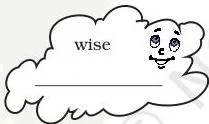
The word clouds hold words that describe someone or something in “The Ant and the Dove”. Method: read each cloud word, match it to the character it fits, write the character’s name in the blank, then use the word in a sentence of your own.
The story itself gives you the characters’ traits — the ant is tiny and cannot swim, the dove is friendly — so a cloud word that matches one of those traits names the answer. Model sentences: “The tiny ant slipped into the fountain.” “The friendly dove dropped a leaf.”
This is the writing-time picture of people building a house. The Teacher’s Page says it should come after a class discussion in two parts: who builds a house — mason, carpenter, painter, electrician, plumber, labourer — and in what order the work happens. Discuss, then write about the picture.
The project-work picture: a clean-school campaign. The caption tells you what to do — work in a group, collect litter and throw it into dustbins. It sits beside the tree conservation drive, and both projects ask the class to work together on time, the unit’s third theme.
Definitions and language work: words, contractions and grammar
This section gathers the chapter’s vocabulary and grammar exercises in one place: new words, contractions, compound words, prepositions and question words.
New words
The New Words box explains five words from “Flying Together”:
| New word | Simple meaning |
|---|---|
| geese | plural of goose; a large web-footed bird |
| creeper | a plant that needs support and grows along a wall or tree |
| winding | moving in a circular or spiral course |
| muttered | spoken in a low tone |
| flapped | moved the wings up and down |
Contractions
A contraction is a short form of two words, and the apostrophe sits exactly where letters were left out: cannot becomes can’t (the “no” disappears).
The Say Aloud box lists the pairs — we will/we’ll, cannot/can’t, we have/we’ve, you have/you’ve, there is/there’s, what have/what’ve, we are/we’re, they are/they’re.
Exercise answers: has not becomes hasn’t, have not becomes haven’t, do not becomes don’t, are not becomes aren’t; and going backwards, weren’t becomes were not, she’ll becomes she will, wasn’t becomes was not, who’s becomes who is.
Compound words and the word puzzle
In the word puzzle, notice that most of the listed words are compound words — two words joined into one: some + time, every + one, basket + ball, no + body, team + work. Baton is in the list but is not a compound; it is a single word. The grid also hides “standby” (stand + by), another compound to find.
Prepositions, question words and proverbs
For prepositions, one tip covers most blanks: into shows movement from outside to inside, while in shows that something is already inside. So the geese flew into the tree (movement), but they were caught in the net (position).
For the ant answers, build each question from the answer’s key word: the colour of the ant is black, so ask “What is the colour of the ant?”; it lives on land, so ask “Where does it live?”; it eats sugar, so ask “What does it eat?”.
The rule again: why for a reason, when for a time, where for a place, who for a person, what for a thing.
The unit closes with proverbs. “Unity is strength” and “United we stand, divided we fall” are the two that name the chapter’s theme: a group acting together is strong, and split into pieces it falls — the geese are saved only because they act as one.
Common mistakes in this chapter
These are the errors students actually make in this chapter’s exercises — check your work against each one before you submit it.
| Mistake | Correct rule | How to check your answer |
|---|---|---|
| Writing contractions without the apostrophe, or with it misplaced — “cant”, “were’nt” | The apostrophe marks where letters were removed | Say the full two words, remove the letters, put the apostrophe exactly in that gap |
| Treating “geese” as singular | Geese is the plural of goose | One goose, many geese |
| Marking “baton” as a compound word in the puzzle | Baton is a single word; compounds join two words (basket + ball) | Split the word: can you find two real words inside it? |
| Clapping syllables by spelling instead of sound | Clap once per sound beat, not per letter | Say the word slowly; cree-per has two beats, not seven letters |
| Mismatching question words | Why for a reason, when for a time, where for a place | Look at the keyword in the answer (because → why) |
| Confusing “into” with “in” | Into shows movement, in shows position | Is something moving, or already there? |
| True/False traps in the story | The tree was home of geese, not parrots; the hunter used the creeper, not a ladder | Re-read the exact sentence instead of answering from memory |
What this unit prepares you for
This unit builds the everyday English skills that carry into all your English work. Stated as the chapter itself practises them, without any exam promise:
- Reading comprehension — recalling story details and judging True/False statements carefully.
- Question formation — matching question words to the answer type.
- Vocabulary — new words and compound-word building.
- Grammar — contractions and prepositions.
- Writing — poems, stories and lists.
- Speaking and listening — group discussion, mime and the clap game.
The Teacher’s Page frames the unit for recitation, conversation and project work rather than written drills alone. Textbook contents and the examinable syllabus are not always identical — check the current official syllabus.
For the next stage of English practice, follow the same book in the Class 5 English notes.
The whole chapter in five points
The entire chapter in five points, for last-minute revision:
- The poem “Teamwork” says every member must take part — passing, sharing, one common goal.
- “For Want of a Nail” shows a tiny loss growing into a lost kingdom.
- “Flying Together” teaches acting on advice before the creeper grows, and staying united in a crisis.
- “The Ant and the Dove” shows a small act of kindness saving someone.
- The unit’s language work — compound words, contractions, prepositions, question words and syllable clapping — wraps around both texts.
Related resources
This listing is maintained for the 2026-27 academic session using the NCERT textbook information available to us. NCERT remains the authority for confirming the latest edition.
Next, move to the rest of the book: the Class 5 English Marigold book page and the Class 5 NCERT books hub hold this class’s resources, and the CBSE notes home reaches the other subjects.
The neighbouring units are Class 5 English Marigold Chapter 1 and Class 5 English Marigold Chapter 3, and their companion notes pages are Papa’s Spectacles and My Shadow.
Sources and data verification
This page describes “Teamwork”, Unit 2 of the NCERT Class 5 English textbook Marigold. NCERT publishes the official edition on its website, ncert.nic.in, and NCERT is the authority for the textbook’s contents, editions and PDFs.
CBSE sets the syllabus and examinations. This page describes what the NCERT textbook contains, not the full CBSE scheme, and the listing is maintained for the current academic session.
| What the chapter holds | Count | Where it is used |
|---|---|---|
| Printed pages | 22 | |
| Figures with NCERT captions | 7 | |
| Tables | 5 | |
| Official NCERT PDF | Download the chapter PDF | the chapter exactly as NCERT publishes it |
Reference: NCERT Class 5 English textbook (Marigold), chapter 2, official edition on ncert.nic.in.
FAQ: Teamwork Class 5 questions answered
What is the poem ‘Teamwork’ about?
It is about what makes a team work: every member must take part. Nobody passing means nobody can shoot; nobody passing the baton means the relay cannot go on. Separate people become one team — a single “us” — with their eyes on a common goal.
What is the moral of the story ‘Flying Together’?
Act on good advice while the problem is still small, and in a crisis stay calm and act as one. The geese ignored the old bird’s warning about the creeper; when the net trapped them, only a single plan followed by all of them together set them free.
What are the new words in the Teamwork chapter and what do they mean?
The New Words box gives five: geese (plural of goose, a large web-footed bird), creeper (a plant that climbs along a wall or tree), winding (moving in a circular or spiral course), muttered (spoken in a low tone) and flapped (moved the wings up and down).
How does the clap word game work?
Say a word aloud and clap once for each syllable — each sound beat — you actually make. The book’s examples: “creep” gets one clap, “cree-per” two, “to-mo-rrow” three. Count sounds, not letters: “geese” is one clap even though it has five letters.
What is a contraction? Which contractions appear in this chapter?
A contraction is a short form of two words, and the apostrophe shows where letters were left out. The chapter lists we’ll, can’t, we’ve, you’ve, there’s, what’ve, we’re and they’re, and the exercise adds hasn’t, haven’t, don’t and aren’t.
Where can I download the official Teamwork Class 5 PDF?
NCERT publishes the official Class 5 Marigold textbook on its portal at ncert.nic.in/textbook.php — use the link at the top of this page, which opens the full book including Unit 2 “Teamwork”.