
The Life Around Us Class 2 chapter is Chapter 8 of the NCERT English book Mridang — a short, activity-based unit, seven printed pages in the official PDF, built around the poem ‘A Show of Clouds’.
The official PDF of the chapter is right here, and below it is a plain-language guide to every activity in the unit, written for parents and teachers as much as for the child.
Download the Life Around Us Class 2 PDF
You can download the official Life Around Us Class 2 PDF here — it is the chapter file (bemr108.pdf) exactly as printed on ncert.nic.in, with the book’s own layout and drawings. The file is the chapter as printed, with nothing added and nothing removed.
Chapter 8 at a glance
This is an activity-based poem unit rather than a content-heavy chapter. It opens with the poem ‘A Show of Clouds’ and then moves through a speaking activity (Say aloud), teacher-led sentence-frame questions, a Let us write block, a Let us draw prompt, a Picture time dot-joining page and a Let us listen sound activity.
The table below lists how many sections, figures and questions the chapter holds. The chapter’s pictures are unlabelled activity drawings, so this guide teaches from the activity instructions themselves rather than from the drawings.
| What the chapter holds | Count | Where it is used |
|---|---|---|
| Printed pages | 7 | |
| Figures with NCERT captions | 4 | |
| Official NCERT PDF | Download the chapter PDF | the chapter exactly as NCERT publishes it |
What Life Around Us is about: the poem A Show of Clouds
The whole chapter hangs on this poem, so it helps to know what happens in it before reading it with the child.
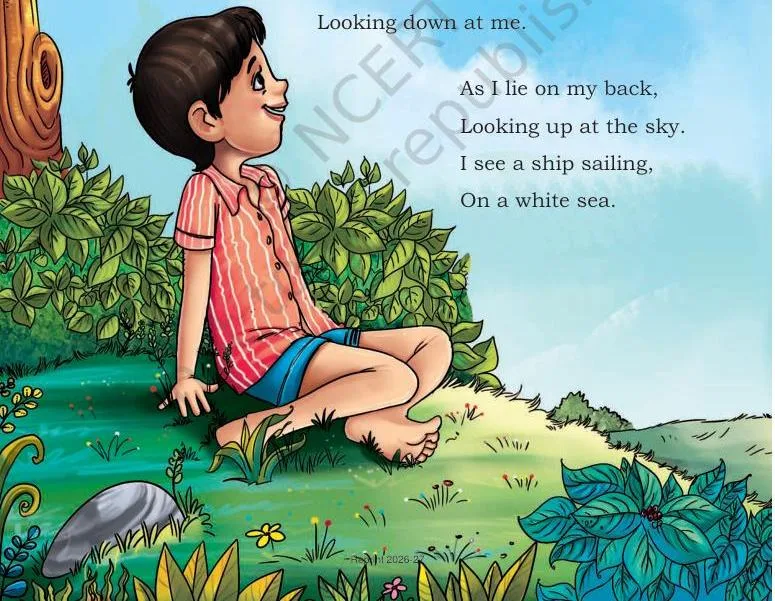
A child lies on the back looking up at the sky and sees a big white bear looking down. Then the same sky becomes a white sea, and the child sees a ship sailing on it. The poem ends with the child’s delight: it is fun to see whatever they want to see.
The teaching point is that a cloud is not fixed — the same shape can become a bear to one child and a ship to another. Observation, what is actually in the sky, and imagination, what the child makes of it, work together, and the chapter never marks the imagination wrong.
The poem’s repeated word ‘back’ also does quiet homework for the rest of the chapter: it is the anchor for the ‘ck’ sound activity on the final page. The poem fills the opening pages of the chapter, before the numbered activities begin.
Speaking practice: cloud colours and the teacher’s questions
Two oral activities come right after the poem. Both are meant to be spoken out loud, and both carry teacher notes that tell adults exactly how much to accept.
Say aloud: cloud watching and the colour list
The Say aloud activity (NCERT, p. 56) sends the child outside to sit in an open space and watch the clouds go by, and asks them to tell the class the next day what they saw. A second question gives a list and asks the child to tick the colours clouds can be: white, grey, red, green, black and blue.
NCERT’s note beside it says to let children speak, encourage them to use English, and accept answers given in only one word or a phrase.
The teacher’s three sentence frames
The teacher-led questions (NCERT, p. 57) run three sentence frames: ‘When I look up, I see ___’, ‘When I look down, I see ___’ and ‘When I close my eyes, I see ___’. The note says every answer, real or imaginary, is acceptable, and that regular practice of these frames is the goal.
Running the frames at home
At home, the same drill works with anything the child says. If the child answers just ‘grass’, the adult models the full frame: ‘When I look down, I see green grass.’
If the child answers ‘a red balloon’, the adult models ‘When I close my eyes, I see a red balloon.’ The child’s word is the seed; the adult’s sentence shows the shape to grow into.
Let us write and Let us draw: what page 58 asks for
The Let us write block (NCERT, p. 58) holds the only written questions in the chapter — three of them, and they are the only answers the child physically writes.
- The first question checks recall of the poem: which animals did the child see in the clouds? The answer the poem supports is a bear — the ship in the second stanza is a thing, not an animal.
- The second asks the child to write any three things seen in the sky during the day. This is open observation — clouds, the sun, a kite, anything reasonable works.
- The third asks what the child sees in the sky at night and leaves blank lines for the answer — stars, the moon, a moving aeroplane light are all fine.
Let us draw
The Let us draw heading appears right after the writing block, and the book prints no instruction under it. Treat it as a drawing prompt that follows the writing — what to draw is left to the child or the adult running the lesson.
Picture time: joining the dots in alphabetical order
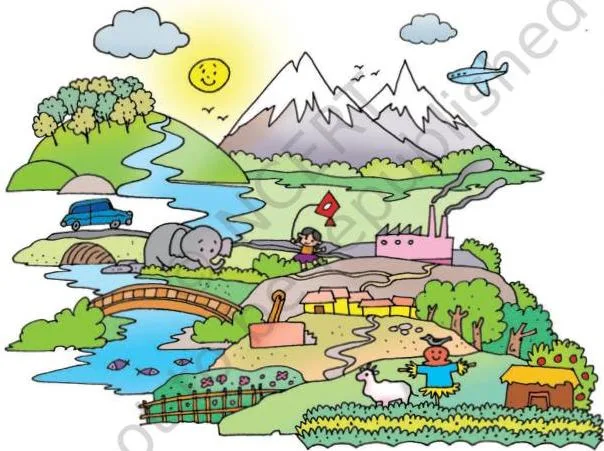
Picture time (NCERT, p. 59) is the chapter’s one visual activity, and the instruction itself is the teaching: ‘Join the dots in alphabetical order and colour the picture.’
Joining the dots trains the A-to-Z sequence — the child moves from A to B to C in order, and the finished picture is the feedback. If the order is right, the shape appears; if it is not, the lines cross. The colouring is the reward, not the test.
The picture is not labelled in the book, so this guide describes the task rather than the drawing. What matters is the alphabetical order, not the subject of the picture.
Listening for the ‘ck’ sound: words and sounds of the chapter
The chapter does not ask children to memorise word meanings. It closes with a listening task, and the skill it builds matters more than the vocabulary.
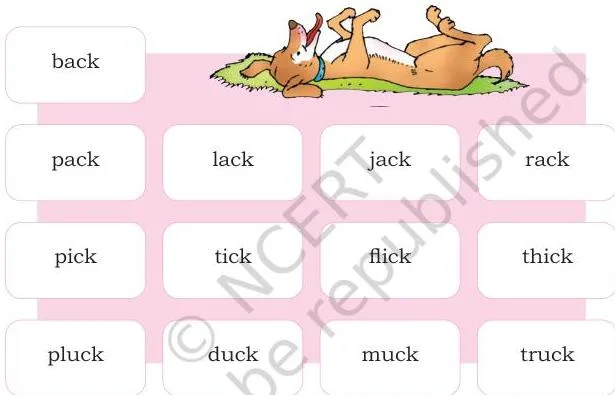
The Let us listen block (NCERT, p. 60) starts from the poem’s word ‘back’. The teacher says a short set of words aloud, and the child’s job is to notice the sound they share — ‘ck’, heard at the end of each word.
The note to the teacher says children should repeat the words one by one, noticing the ‘ck’ sound, and that they need not know the meanings of these words.
The reason is simple: hearing a final sound blend is a pre-reading skill. The child is learning to pull a word apart into sounds before they are ready to attach meaning to every new word; meaning can come later.
At home, use ‘back’ as the anchor and hunt together for more words that end in the same ‘ck’ sound — words the child finds themselves stick better than any printed list.
Mistakes to avoid: what the teacher notes flag
NCERT’s own notes flag three mistakes adults make with this chapter. All three have the same shape: the adult expecting too much, too early.
| Mistake | What the note actually says | How to check yourself |
|---|---|---|
| Marking ‘the cloud is red’ as wrong | Accept the answer. The child may be thinking of clouds at sunset — ask them to explain. | Say ‘What made you think of red?’ and listen, instead of correcting. |
| Demanding full sentences immediately | One-word and phrase answers are acceptable; full sentences come with regular practice. | The child says ‘bear’ — accept it, then model ‘I see a bear in the clouds.’ |
| Making children learn what the ‘ck’ words mean | Meanings are not needed at this stage; repeating the words and hearing the shared sound is the target. | If the child can hear ‘ck’ in ‘back’, the task is done, whether or not they can explain the word. |
The broader rule from the page 57 note covers all three: every answer, real or imaginary, is acceptable. The chapter wants the child to speak and observe — not to be right on the first try.
What the child should be able to do after this chapter
Here is the chapter in outcomes rather than activities. If the child can do these, the chapter has done its job:
- join in reciting, or listening to, the poem ‘A Show of Clouds’;
- describe an outdoor cloud-watching session in the child’s own words;
- tick the cloud colours from the given list;
- answer all three sentence frames — look up, look down, close my eyes — in full sentences;
- write three things seen in the day sky and things seen in the night sky;
- join the dots in alphabetical order;
- hear the ‘ck’ sound in a spoken word.
Class 2 English is not a board-exam subject, so this list is about readiness, not marks. Every skill above is something the chapter’s own activities require.
Life Around Us Class 2: the chapter in one look
A quick scan of the whole unit, in the order the chapter itself runs:
- the poem A Show of Clouds — a child’s imaginary seeing turns clouds into a bear and a ship;
- Say aloud — outdoor cloud watching, then a cloud-colour tick list;
- the three sentence frames — look up, look down, close my eyes;
- Let us write (p. 58) — the bear question, three day-sky things, night-sky things, then a Let us draw prompt;
- Picture time (p. 59) — dots joined in alphabetical order;
- Let us listen (p. 60) — the ‘ck’ sound anchored on ‘back’.
Related NCERT Class 2 English chapters
Life Around Us is one of the poem-and-activity units in Mridang. From here you can open the Mridang Class 2 English book page, browse the Class 2 study hub, or go back to the notes home page. The previous chapter and the next chapter in this book are also on the site.
Every edition and chapter PDF of Mridang is published on the NCERT textbook portal, so that is the place to check for any newer printing of the book.
Sources and data verification
This listing is maintained for the 2026-27 academic session using the NCERT textbook information available to us. NCERT remains the authority for confirming the latest edition.
The chapter described on this page is Chapter 8, ‘Life Around Us’, of the NCERT Class 2 English textbook Mridang, as published on ncert.nic.in. This page covers that chapter only — other chapters, books and classes have their own pages.
This page is maintained for the current academic session against NCERT’s published PDFs. NCERT settles textbook editions and PDFs; CBSE settles curriculum, syllabus and examinations. Textbook contents and the examinable syllabus are not always identical, so check the current official syllabus where it matters.
Reference: NCERT Class 2 English Mridang textbook, chapter 8, official edition on ncert.nic.in.
Life Around Us Class 2: common questions
What is the poem in Life Around Us Class 2 about?
The poem ‘A Show of Clouds’ is about a child who lies on the back, looks up at the sky, and sees a big white bear looking down, then a ship sailing on a white sea — the white sea is the sky full of clouds.
The child’s delight is that they can see whatever they want to see, so the poem celebrates imagination as much as observation.
What do children do in the picture time activity of Life Around Us Class 2?
They join the dots in alphabetical order and colour the picture (NCERT, p. 59). Following the A-to-Z sequence correctly makes the picture come out right, so the activity is really a check on knowing alphabetical order; the colouring is the reward.
Is a red cloud answer wrong in this chapter?
No. NCERT’s note to the teacher says a child who says ‘the cloud is red’ may be thinking of clouds at sunset, and asks the adult to get the child to explain. Any real or imaginary answer is acceptable.
Do children need to know the meanings of the words in the Let us listen activity?
No. The note on page 60 says children need not know the meaning of these words. The task is to repeat the words and notice the ‘ck’ sound they share — hearing a sound blend is the pre-reading skill being practised.
What colours can clouds be according to Mridang Chapter 8?
The chapter asks children to tick the colours clouds can be from a list of six: white, grey, red, green, black and blue. Red is deliberately not marked wrong — the sunset explanation is in the teacher’s note.
How should a parent run the look up, look down, close my eyes activity at home?
Say the three frames one at a time and let the child finish them: ‘When I look up, I see ___’, ‘When I look down, I see ___’, ‘When I close my eyes, I see ___.’
Accept any answer, real or imaginary, then model the full sentence after the child speaks — child says ‘grass’, parent says ‘When I look down, I see green grass’ — and repeat the drill often, because regular practice is what the note says builds full sentences.
Explore Class 2 English Books
Related chapters: