
The Crow Class 2 chapter is a poem in the NCERT English book Mridang — the book’s tenth chapter. This page carries the official NCERT Class 2 English Mridang Chapter 10 The Crow PDF, with a plain-language account of the poem and its activities below it.
The chapter runs across eight printed pages, marked Mridang 68 to 75. Around the poem sit sight words, new words, and speaking, writing, drawing and listening activities, so the download comes first and the explanation follows.
Download The Crow Class 2 PDF (NCERT Mridang Chapter 10)
The official file lives on NCERT’s own portal, ncert.nic.in, so you never need to rely on a photocopy or a third-party website.
When you want the poem and every activity page exactly as printed, open the NCERT Class 2 English Mridang Chapter 10 The Crow PDF from the NCERT textbook portal — this is NCERT’s own file for the current edition.
The Crow chapter at a glance
The chapter is an 8-page unit built around a poem, with speaking, writing, drawing and listening activities arranged around it. The table below lists what the file contains.
| What the chapter holds | Count | Where it is used |
|---|---|---|
| Printed pages | 8 | |
| Figures with NCERT captions | 3 | |
| Tables | 2 | |
| Official NCERT PDF | Download the chapter PDF | the chapter exactly as NCERT publishes it |
What is inside The Crow chapter
This is the order in which the pieces appear in the book, so you can find each activity without hunting through the PDF.
- The poem — “The Crow”, recited first, on the opening page of the unit (printed page 68).
- Sight words box — the words the child should recognise at a glance (printed page 69).
- New words box — nine words from the poem, with room to learn their meanings (printed page 70).
- Let us speak — two questions about the birds the child sees around the house or school (printed page 70).
- Let us write — name the birds shown in the picture box (printed page 71).
- Let us draw — draw your favourite bird in the box and write its name (printed page 72).
- Let us listen — clap the syllables of five words as the teacher says them (printed page 73).
- Let us write (second) — a rhyming-words table (printed page 74) and a sentence-building table (printed page 75).
- Four “Note to the teacher” boxes sit beside the activities with guidance for the adult helping the child.
The poem: what happens in The Crow Class 2
The poem is a little story in rhyme, so it helps to know the order of events before reading it aloud. This is the sequence the child should be able to retell.
- A black crow decides he wants to be beautiful.
- He wishes for colourful feathers of his own.
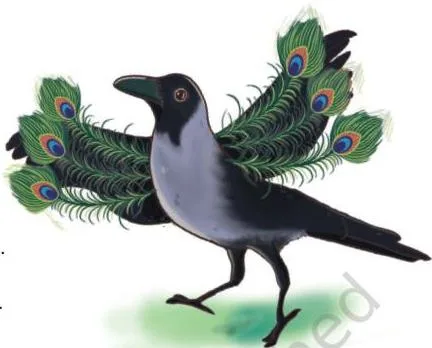
- He finds one peacock feather and sticks it into his tail.
- He finds more feathers, puts them into his wings, then places one on his head.
- He dances and announces that he is now beautiful.
- The other crows laugh at him and call him a fool.
- They tell him he is beautiful in black, and that they love him for what he is.
The poem ends there, with the other crows’ answer. Everything that follows in the chapter — the speaking, writing and drawing tasks — grows out of this last moment.
What The Crow poem teaches about beauty
The message of the chapter is self acceptance, and it is worth saying plainly because the poem can be misread. The decorated crow is laughed at — and then told he was beautiful all along, because the other crows love him for what he is.
The feathers were never the point. The poem is not saying borrowed decoration is wrong; it is saying the crow never needed it. He was already beautiful in black, and that is where the love comes from.
The note to the teacher on the printed page marked 70 pushes the same idea further. It says India has many skin tones, and that it is not the fair or dark complexion that matters — real beauty lies in good qualities.
It also asks the adult to discuss the uniqueness of different animals and birds, and to have each child say one good quality of a friend.
Sight words in The Crow
Sight words are words a child should recognise the instant they see them, without sounding out the letters. Recognising them on sight is what makes reading feel fast and smooth.
The sight words in this chapter are:
- once
- as
- how
- to
- one
- be
- now
- at
- all
- it
A simple practice that works: make flash cards of the words, or hunt for the words inside the poem itself. Each time the child spots one, they say it aloud; after two or three readings the word stops needing to be sounded out.
New words and what they mean
The new-words box collects the words from the poem that a Class 2 reader is most likely to meet for the first time. The nine new words, with simple meanings matched to how the poem uses them, are below.
| Word | Simple meaning | How the poem uses it |
|---|---|---|
| colourful | having many colours | the crow wants colourful feathers |
| feather | one of the light, soft coverings that grow on a bird’s body | he finds a peacock feather and sticks it in his tail |
| wings | the parts a bird flaps to fly | he sticks feathers into his wings |
| picked | took something up, lifted it | he picks up all the feathers he finds |
| fool | someone who does something silly | the other crows call him a fool |
| love | to care for someone very much | the crows love the crow just as he is |
| beautiful | very pleasing to look at | the crow wants to be beautiful |
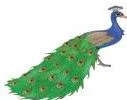
| peacock | a large bird with bright, showy tail feathers | the feather he finds comes from a peacock |
| another | one more, a different one | after the first feather, he finds another |
Rhyming words: grow–crow and the bird-name puzzle
This writing activity reads the words in Column A and completes each row of Column B with a bird name that rhymes. The hint is printed in the book: the words in Column B should be the names of birds.
Rhyme means the last sound matches, not the spelling. So grow and crow rhyme, and so do block and peacock, even though peacock is a much longer word.
| Column A | Column B (completed) |
|---|---|
| grow | crow |
| carrot | parrot |
| pen | hen |
| arrow | sparrow |
| block | peacock |
One row is done in the book: grow becomes crow. For the next row the hint is “arrot”, and the child adds the missing first letter — p + arrot = parrot, and a parrot is a bird. The table appears on the printed page marked 74.
Clap the syllables: the Let us listen activity
This listening activity helps the child pronounce long words by breaking them into syllables — the beats inside a word. The teacher says each word slowly, and the child claps once for every beat.
The activity splits peacock, feather, beautiful, colourful and another into syllables exactly like this:
| Word | Syllables | Claps |
|---|---|---|
| peacock | pea · cock | 2 |
| feather | fea · ther | 2 |
| beautiful | beau · ti · ful | 3 |
| colourful | co · lour · ful | 3 |
| another | a · no · ther | 3 |
Clapping forces the child to slow down and hear every part of the word, which is why long words become easy to say after this exercise. The note to the teacher on the printed page marked 73 suggests practising regularly, each time with a new set of words.
Build sentences: the word-box activity
The word-box table turns word order into a game. The child picks one word from each column, in order, and the words form a complete sentence.
| Starter | Who | Action | To | Place |
|---|---|---|---|---|
| Today | I | will go | to a | village |
| we | school | |||
| Rajni | park | |||
| She | farm | |||
| Harish | theatre |
Two example sentences built from the boxes: Today I will go to a village. and Today Rajni will go to a park. Many combinations are valid — Today She will go to a farm, Today Harish will go to a theatre — and that is the point: any sensible choice is correct.
The table appears on the printed page marked 75.
The picture activities: naming birds and drawing your favourite
Two activities are built around the book’s illustrations, and this page does not try to copy those pictures — the child should work with the open book in front of them.
Let us write (printed page 71) shows a box of birds with blank lines. The child identifies each bird and writes its name on the line. The note to the teacher says to help children identify the birds and provide the English words for them.
Let us draw (printed page 72) asks the child to draw their favourite bird in the box and write its name in the blank that begins “My favourite bird is ____”. The note to the teacher suggests grass and trees in the background.
The book deliberately does not label the birds — identifying them is the task, so the names come from the child’s own knowledge.
Common mistakes to watch for in The Crow
Three small mistakes tend to catch children in this chapter. Naming them before they happen is the fastest way to avoid them.
| Mistake | Correct rule | How to check your answer |
|---|---|---|
| Clapping beautiful as two beats (beau-tiful) | Beautiful has three syllables: beau · ti · ful | Say the word slowly with a hand under the chin — the chin drops once per syllable, so it drops three times |
| Writing “arrow” in the rhyme table and stopping | Column B must be a bird name, so the hint arrow becomes sparrow | Read the completed word aloud — arrow is not a bird, sparrow is |
| Reading the poem as “colourful feathers make you beautiful” | The message is the opposite: the crow is loved for what he is, and real beauty lies in good qualities | Ask the child what the other crows said — they love him in black |
For teachers: the discussion questions are the lesson, not a warm-up. A child who skips them and memorises the poem has missed the point of the chapter.
For parents and teachers: the notes to the teacher in this chapter
The chapter prints four “Note to the teacher” boxes that tell the adult what each activity is really for. Here they are in one place, in plain language.
- After Let us speak (printed page 70) — discuss India’s many skin tones and that real beauty lies in good qualities, talk about the crow’s own qualities, consider the uniqueness of different animals and birds, and ask each child to say one good quality of a friend.
- After Let us write (printed page 71) — help the child identify the birds in the picture and provide the English words they need.
- After Let us draw (printed page 72) — encourage the child to add grass and trees to the background of the drawing.
- After Let us listen (printed page 73) — help the child break any word into syllables to pronounce it easily, clap each beat, and practise regularly with a new set of words each time.
How The Crow chapter is used in class
This is a poem chapter, so there are no exam claims to make here — the activities themselves show what the chapter builds toward. In most Class 2 settings, assessment is observation- and activity-based rather than written-exam based, and this chapter is shaped exactly for that.
The chapter’s own tasks point to its goals:
- Reciting the poem aloud builds reading fluency and confidence.
- Reading the sight words on sight builds instant word recognition.
- Completing the rhyme table builds awareness of word sounds.
- Clapping syllables builds clear pronunciation of long words.
- Building sentences from the word boxes builds basic word order.
One caveat applies to every NCERT chapter: textbook contents and the examinable syllabus are not always identical — check the current official syllabus.
The Crow: what to remember
Five things carry the whole chapter, in our words:
- The story: a crow decorates himself with peacock feathers so he can be beautiful, and the other crows laugh at him.
- The message: self acceptance — the crow is loved for what he is, and real beauty lies in good qualities, not in borrowed feathers or complexion.
- The sight words: once, as, how, to, one, be, now, at, all, it.
- The rhyme pairs: grow–crow, carrot–parrot, pen–hen, arrow–sparrow, block–peacock.
- The syllable splits: pea-cock, fea-ther, beau-ti-ful, co-lour-ful, a-no-ther.
Related NCERT resources for Class 2 English
This listing is maintained for the 2026-27 academic session using the NCERT textbook information available to us. NCERT remains the authority for confirming the latest edition.
To keep moving through the book, open the NCERT Class 2 English Mridang book page, which lists every chapter in order, or jump to the Class 2 hub for the other subjects covered at this level.
For quick help with the other early chapters, the Class 2 English study notes include My Name and The Smart Monkey, and the Class 2 notes page collects the rest. If you arrived here from a search, the main notes index maps the whole site.
Sources and data verification
This page describes Chapter 10, “The Crow”, in the official NCERT edition of the Class 2 English book Mridang. It covers that single chapter only, and not the other English books or readers some schools use at Class 2.
The page is maintained for the current academic session using the NCERT information available to us. NCERT settles textbooks, editions and PDFs; CBSE settles the curriculum, syllabus and examinations.
Reference: NCERT Class 2 English Mridang textbook, chapter 10, official edition on ncert.nic.in.
Frequently asked questions about The Crow Class 2
What is the message of The Crow poem in Class 2?
The message is self acceptance. The crow dresses himself in peacock feathers and expects to look beautiful, but the other crows laugh and tell him he is beautiful in black and they love him for what he is. The teacher note adds that real beauty lies in good qualities, not in complexion or borrowed decoration.
Which sight words are taught in The Crow chapter of Mridang?
The sight words are once, as, how, to, one, be, now, at, all and it. A sight word is one a child recognises instantly without sounding it out; flash cards, or finding the words inside the poem, are good practice.
What are the answers to the rhyming words exercise in The Crow?
Grow rhymes with crow, carrot with parrot, pen with hen, arrow with sparrow and block with peacock. The completed words in Column B are all bird names.
How many syllables does beautiful have?
Beautiful has three syllables: beau-ti-ful. The child claps once for each beat, so beautiful gets three claps — two claps is the mistake to watch for.
Is The Crow a poem or a story in the Class 2 English book?
The Crow is a poem. It tells a short story in rhyme — a crow who decorates himself with peacock feathers — but the chapter presents it as a poem to recite, followed by activities.
What does the note to the teacher say about skin colour in The Crow chapter?
The note on the printed page marked 70 says India has many skin tones, that it is not the fair or dark complexion that matters, and that real beauty lies in good qualities. It also asks the adult to discuss the uniqueness of different animals and birds, and to have each child say one good quality of a friend.
Explore Class 2 English Books
Related chapters: