
The Smart Monkey Class 2 chapter is the 11th chapter of the NCERT Class 2 English textbook Mridang, and the official PDF is right on this page. The printed chapter runs to 8 pages and tells one short story — two girls, a monkey and a dustbin — with word work and five activities built around it.
Keep reading for the story in plain words, the sight words and new words, and what each activity expects of your child.
Download the Smart Monkey Class 2 chapter PDF
This is the official NCERT file, published on ncert.nic.in — the one to keep at home.
Download The Smart Monkey Class 2 chapter PDF (NCERT Mridang) from the official NCERT textbook portal to read the complete story, sight words, new words and all five activities exactly as printed in the book.
It is the story of Anju, Farida and a monkey who knows where rubbish belongs, and the full chapter file is 8 pages long.
The Smart Monkey chapter at a glance
This section is a map of the PDF: a table of what the chapter holds, then the activity blocks named in plain words.
| What the chapter holds | Count | Where it is used |
|---|---|---|
| Printed pages | 8 | |
| Figures with NCERT captions | 4 | |
| Tables | 1 | |
| Activities | 1 | |
| Official NCERT PDF | Download the chapter PDF | the chapter exactly as NCERT publishes it |
In use, the chapter reads as one short story followed by word work and five activity blocks:
- Let us speak — discussion questions about littering and the school dustbin.
- Let us draw — drawing three things used to clean the house.
- Let us listen — clapping the syllables in words from the story.
- Let us write — true or false sentences, fill-in-the-blanks and a short clean-home list.
- Project Work — telling the class about a real trip to a nearby shop.
Let us speak appears twice: once near the start as a conversation warm-up, and again at the end when the child writes sentences from pictures. Several Note to the teacher boxes sit inside the chapter, telling the adult what to practise.
What The Smart Monkey chapter covers
This is the story in plain words, so you know what your child is reading before you open the book together.
The story opens with a trip to the market. Anju buys a bag, Farida buys a water bottle, and together they buy a packet of groundnuts and a bottle of juice. Tired from their shopping, they rest on a bench under a tree — while, above them on a branch, a monkey watches.
The girls take out their food and begin to eat. The monkey peels a banana and eats it, and when the girls toss their used packet and empty bottle to the ground, he climbs down the tree carrying his peel. A dustbin stands nearby, and into it goes the banana peel.
Anju and Farida feel ashamed. They pick up the packet and the empty bottle and put them in the dustbin too — the monkey, not the people, is the one who remembered where rubbish belongs.
The lesson is simple enough to say aloud: waste belongs in the dustbin. The Let us write activities at the end of the chapter are the recall check — they ask the child what the girls bought, where they sat and who threw what, straight from the story just read.
The key ideas this chapter teaches
This chapter does more than tell a story. It builds five small skills, and each one has its own block in the book.
- Sight words — nine short words the child should recognise at a glance: then, down, on, and, with, in, them, under, nearby.
- New words — seven words from the story worth knowing by name: shopping, groundnuts, branch, peel, dustbin, threw, empty.
- Syllable clapping (Let us listen) — the teacher says a word slowly and the child claps once per syllable.
- Picture sentences (the second Let us speak) — read the word under each picture and write a sentence about it, following the printed example, “There is a clock in the classroom.”
- Clean habits — the story, the talk and the writing all point one way: litter goes in the dustbin.
Syllable clapping is a listening game, not a writing task. The book lists eight story words in syllables: mar-ket, mon-key, pack-et, dust-bin, class-room, An-ju, ba-na-na, Fa-ri-da. After the teacher’s words, the child claps their own name — one clap for a short name, two or three for a longer one — and counts the claps.
Sight words and new words: a home practice table
Simple meanings for all sixteen words, each tied to a phrase from the chapter, so the words are met in context rather than memorised in a bare list.
| Sight word | What it means | Where it appears |
|---|---|---|
| then | at that moment, next | “Just then,” the monkey climbs down |
| down | from higher to lower | “climbed down the tree” |
| on | resting above something | “on the branch” |
| and | a word that joins things | “Anju and Farida” |
| with | carrying, or together with | “with the banana peel” |
| in | inside | “a clock in the classroom” |
| them | the things already named | “threw them into the dustbin” |
| under | below | “under a tree to rest” |
| nearby | close by | “a dustbin nearby” |
| New word | What it means | Where it appears |
|---|---|---|
| shopping | buying things at shops | the girls’ trip to the market |
| groundnuts | peanuts, the snack they bought | “a packet of groundnuts” |
| branch | the part of a tree that holds leaves | the monkey sat “on the branch” |
| peel | the skin of a banana | “the banana peel into the dustbin” |
| dustbin | the container for rubbish | “a dustbin nearby” |
| threw | past tense of throw | “threw the packet down” |
| empty | with nothing left inside | “the empty bottle” |
A teacher note in the chapter asks the adult to let children know that groundnuts are also called peanuts — teach both names, and the child will recognise either word. Sight words are the priority: a child should read them instantly, without sounding out. New words can first be spoken aloud and used in a sentence.
Using the pictures in the chapter
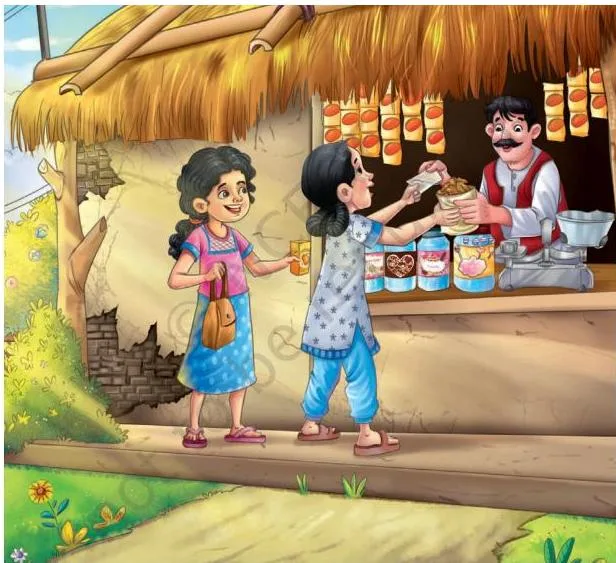
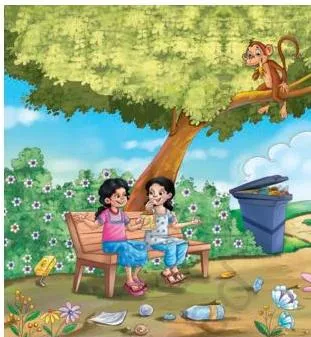

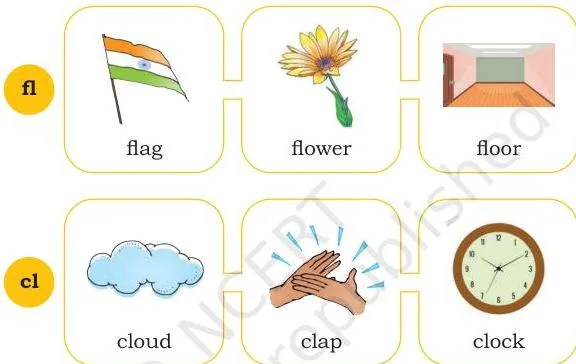
The pictures for this chapter live inside the printed book, and several activities send the child back to them, so the best way to use them is a picture walk with the book open.
- Before reading, turn through the pages and name what the pictures show: the market, the bench, the tree, the monkey, the dustbin.
- While reading, point to each thing the words name as it appears — the packet, the bottle, the branch, the peel.
- Let us draw asks for three things used to clean the house. There is no right drawing; the point is to look around the home and choose.
- The second Let us speak asks the child to read the word under each picture, then write a sentence about it, using “There is a clock in the classroom” as the pattern.
These pictures carry part of the lesson, not just decoration: the market scene sets up the story, and the dustbin appears where the action turns. Pointing at them while reading connects the words on the page to their meaning.
Mistakes young readers make with this chapter
Name the confusion before the child meets it, and homework time goes much faster.
| Mistake | What is correct | How to check |
|---|---|---|
| Swapping look-alike sight words: then and them, on and in, under and nearby. | Each word has its own sentence in the story; read slowly and look at the whole word, not the first letter. | Ask the child to find each sight word in the story and read the sentence it sits in. |
| Marking true or false from memory instead of from the story. | Sentence 1 is wrong — the girls went to the market, not to school. Sentence 3 is wrong — a monkey, not a bird, sat on the branch. | Read each statement back against the story and tick only what the story actually says. |
| Confusing who threw what. | The monkey threw the banana peel into the dustbin; Farida and Anju threw down the packet and the bottle. | Ask the two questions separately: “Who threw the peel?” and “Who threw the packet?” |
All three corrections share the same fix: go back to the story and read the exact sentence aloud.
What your child should be able to do after this chapter
There is no board assessment for Class 2, so treat this list as a friendly classroom check rather than a test.
- Read the nine sight words without stopping to sound them out.
- Clap the syllables in two- and three-syllable words such as market and banana.
- Judge the five true or false sentences from the story, not from memory.
- Complete the four fill-in-the-blank sentences from the story.
- Say whether their school has a dustbin and where it is.
- Speak a few sentences about a real shopping trip with family.
Each activity and the skill it builds
| Activity | What it asks | Skill it builds |
|---|---|---|
| Let us speak (first) | Talk about littering and the school dustbin | Speaking |
| Let us draw | Draw three things used to clean the house | Drawing and observing |
| Let us listen | Clap syllables in story words, then in your own name | Listening for syllables |
| Let us write | Tick true or false, finish sentences, list clean habits | Writing story recall |
| Project Work | Share a real shopping trip with the class | Speaking about real shopping trips |
Fill-in-the-blank answers, checked against the story
| Fill-in sentence | Answer from the story |
|---|---|
| Farida and Anju sat on ______ under the tree to rest. | a bench |
| There was a monkey sitting ______ of the tree. | on a branch |
| The two girls had a ______ and a bottle of juice. | packet of groundnuts |
| The monkey threw the ______ into ______. | banana peel, the dustbin |
What the Note to the teacher boxes ask for
The three Note to the teacher boxes in this chapter tell the adult what the classroom should practise, and they are worth knowing at home too:
- Groundnuts are also called peanuts — teach both names.
- Children may begin speaking in a mix of mother tongue and English, then move to speaking completely in English.
- Blends need regular practice — letter sounds that run together, like cl in clock or br in branch, should be said correctly and exercised daily.
The Smart Monkey chapter in one page
Read this aloud the night before, or use it to see what your child remembers.
Anju and Farida go shopping and stop to rest on a bench under a tree. While they eat groundnuts and drink juice, they drop the used packet and the empty bottle on the ground.
A monkey on the branch above eats a banana, climbs down and puts his peel in the nearby dustbin. The girls watch, feel ashamed, and throw their own rubbish in the dustbin too.
Sight words: then, down, on, and, with, in, them, under, nearby. New words: shopping, groundnuts, branch, peel, dustbin, threw, empty.
The lesson in one sentence: our rubbish belongs in the dustbin — and in this story, the monkey is the one who remembered it.
Related NCERT Class 2 resources
This listing is maintained for the 2026-27 academic session using the NCERT textbook information available to us. NCERT remains the authority for confirming the latest edition.
If this chapter works for your child, the rest of the Mridang book follows the same rhythm of story, words and activities.
- The previous chapter in the Mridang Class 2 English book
- The next chapter in the Mridang Class 2 English book
- The NCERT Class 2 English (Mridang) book page
- The Class 2 hub for NCERT subjects
- The CBSE notes index
Sources and data verification
This page describes Chapter 11 of the NCERT Class 2 English textbook Mridang, in the edition NCERT currently publishes. It covers this one chapter only — not other Mridang chapters and not other Class 2 books. It is maintained for the current academic session from the NCERT edition available to us.
NCERT publishes the textbook, decides its editions and provides the official PDFs. CBSE settles the curriculum, syllabus and examinations. Textbook contents and the examinable syllabus are not always identical, so check the current official CBSE syllabus for session-specific lists.
Reference: NCERT Class 2 English (Mridang) textbook, chapter 11, official edition on ncert.nic.in.
The Smart Monkey Class 2: common questions
Short answers to what parents ask most about this chapter.
Where can I download the Smart Monkey Class 2 chapter PDF?
From the official NCERT textbook portal at ncert.nic.in — the download link at the top of this page takes you straight there. The file is the complete 8-page chapter from Mridang, exactly as published.
What is the story The Smart Monkey about?
Two girls, Anju and Farida, drop their rubbish while resting under a tree. A monkey puts his banana peel in the dustbin, the girls feel ashamed, and they pick up their own litter. It is a story about not littering.
Which sight words and new words are in The Smart Monkey chapter?
Nine sight words — then, down, on, and, with, in, them, under, nearby — and seven new words: shopping, groundnuts, branch, peel, dustbin, threw, empty.
What is the moral of The Smart Monkey?
Waste belongs in the dustbin. The discussion questions, the true or false exercise and the fill-in sentences all circle back to that single point.
How is The Smart Monkey chapter taught in the classroom?
As a read-aloud story followed by five activity blocks: talking about littering, drawing cleaning tools, clapping syllables, writing story recall sentences and sharing a real shopping trip. The teacher notes ask for patience with mixed-language speaking and daily practice of blends.
Explore Class 2 English Books
Related chapters: