
Picture Reading Class 2 — chapter 2 of the NCERT English textbook Mridang — is built around one short story, OUT! OUT!, and the word and writing activities that come with it. The official NCERT chapter PDF is right below.
This page retells the story, explains the sight words, the picture-word rows and the ‘e’ sound, and gives the answers the book leaves blank. It follows the NCERT edition of Mridang published for the current academic session.
Download the Picture Reading Class 2 PDF
This is the official chapter file as NCERT publishes it — the part of Mridang that holds the opening picture questions, the story OUT! OUT!, and every word and writing activity around it.
Get the chapter straight from the source: Picture Reading Class 2 NCERT English Mridang Chapter PDF on the NCERT e-textbook portal.
What is inside Mridang Chapter 2, Picture Reading
This is a picture-led chapter built around one short story. Every activity feeds off the same reading text, so a child who understands OUT! OUT! can work through the rest of the chapter alone.
In the order the book presents them, the parts are:
- The opening picture page — where the title “Picture Reading” comes from; children observe a scene and answer questions such as what they see and how many children are playing.
- The story OUT! OUT! — the reading text, about Jeet and Babli losing a ball and making a new one from things at home.
- Sight words and new words — eight common words to recognise at a glance and six story words to learn.
- Let us speak — questions about games the child plays, plus a five-sentence sequencing task from the story.
- The three picture-word rows — grouped pictures for the ‘e’ sound, showing when to use a and when to use an.
- Let us write — writing the children’s names, the ball-making items, five opposites, and joining sentences with and.
- Let us do — two speaking activities: acting out the story in pairs and interviewing grandparents about childhood games.
The chapter-at-a-glance table below gives the printed size of the chapter — pages, sections and activities — while the list above explains what those parts actually do.
| What the chapter holds | Count | Where it is used |
|---|---|---|
| Printed pages | 10 | |
| Figures with NCERT captions | 5 | |
| Tables | 1 | |
| Activities | 1 | |
| Official NCERT PDF | Download the chapter PDF | the chapter exactly as NCERT publishes it |
What this chapter teaches: a story, a game and a homemade ball
This is the reading heart of the chapter. The story OUT! OUT! is short enough to read aloud in a minute, and every exercise after it refers back to the same events.
In order, here is what happens in the story:
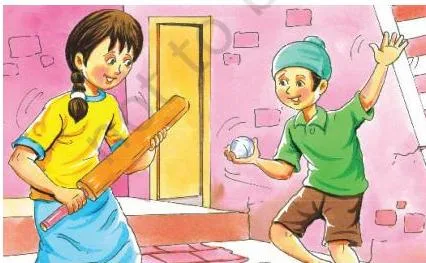
- It is a holiday. Jeet and Babli are playing — they skip the rope and play hide and seek.
- They decide to play ‘bat and ball’. Jeet gets ready and throws the ball; Babli hits it.
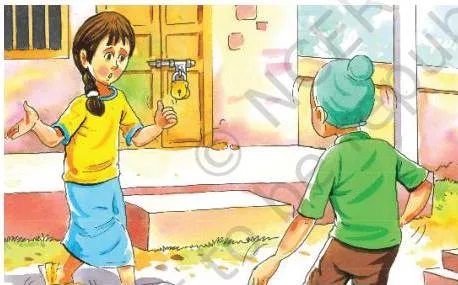
- The ball lands in Mohit’s garden. His house is locked, so they cannot find the ball, and the game stops.
- Babli knows how to make a ball. They get a few rags, paper and wool; Babli also brings a piece of string.
- She rolls the rags, paper and wool into a ball and ties it with string. The game starts again.
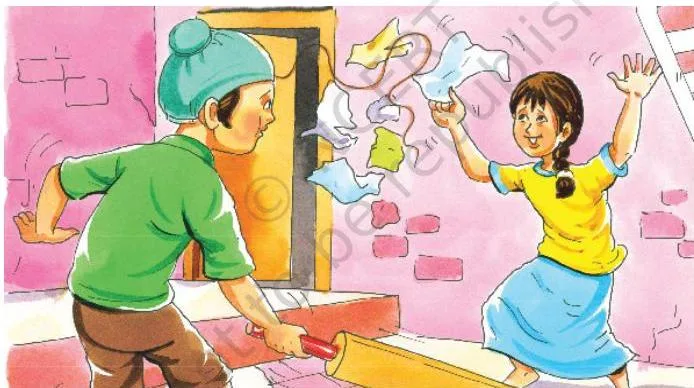
- This time Babli throws and Jeet hits — hard. The ball bursts open and scatters in the air.
- Babli jumps, catches a piece of rag, and shouts “OUT! OUT!”
Order matters because Let us speak prints the five events in a shuffled list and asks the child to number them 1 to 5. In correct order they are: Jeet got ready to throw, Jeet threw, Babli hit, the ball went into Mohit’s garden, and they lost the ball — so the retelling above doubles as the answer key.
The story also opens with a picture-question page, where children observe a scene and answer questions about what they see. That is where the chapter’s title, Picture Reading, comes from.
Key ideas in Chapter 2: sight words, new words and the ‘e’ sound
This chapter builds three small skills: recognising common words at a glance, learning new words from the story, and noticing the short ‘e’ sound. Each skill is introduced through the story and practised on its own page.
Sight words: read at a glance
Sight words are common words a reader should recognise instantly, without sounding them out letter by letter. Reading flows only when the reader does not stop at every word, and these eight words appear again and again in almost any English text.
The chapter’s eight sight words are This, a, how, also, they, after, and, of. A useful practice tip: hunt for them inside the story OUT! OUT! and underline each one as you find it — and and a will turn up many times, which is exactly the point.
New words from the story
The new words are the six interesting words a child meets while reading OUT! OUT!. Knowing them before reading keeps the story smooth:
- skipped — moved with little jumps, as over a skipping rope;
- threw — sent the ball through the air with a hand;
- courtyard — an open space in front of or between houses;
- gathered — collected things together;
- brought — carried or fetched something to a place;
- picked — chose or took hold of something.
Three more words from the ball-making part of the story are worth knowing: rags (old pieces of cloth), wool (soft sheep’s thread) and string (thin cord for tying). These are the materials named in the writing task.
The short ‘e’ sound and ‘a’ or ‘an’
The picture-word page teaches the vowel sound ‘e’ as in ‘pen’. The book’s note to the teacher says the aim is to introduce young learners to this sound and to help them notice that ‘an’ occurs before the words beginning with ‘e’.
Row 1 holds the words that begin with the ‘e’ sound — an egg, an engine, an elephant. Rows 2 and 3 carry the ‘e’ sound in the middle: a pen, a pencil, a bell, then a kettle, a hen, a well. The full pattern is worked through in the next section.
Opposites and joining with ‘and’
Let us write asks for two small grammar jobs. First, opposites: the book’s table shows one worked pair, up–down, and leaves five pairs blank for the child to finish. The completed answers are in the common-mistakes section below.
Second, joining with and: when two sentences share the same ending, the two subjects are joined with and and the shared part is written once. The book’s model joins ‘Suresh went to school’ and ‘Gopal went to school’ as ‘Suresh and Gopal went to school’.
Try a fresh pair: ‘Riya likes to paint’ and ‘Aman likes to paint’ become ‘Riya and Aman like to paint’.
Reading the pictures: the three word-picture groups
In your copy of the chapter you will see three rows of pictures, each with a word underneath it. The job is to look at the picture, say the label aloud, and notice where the ‘e’ sound sits in the word.
Here is what each row teaches:
| Row | Words under the pictures | Where the ‘e’ sound sits | Use |
|---|---|---|---|
| 1 | egg, engine, elephant | at the start of the word | an egg, an engine, an elephant |
| 2 | pen, pencil, bell | in the middle of the word | a pen, a pencil, a bell |
| 3 | kettle, hen, well | in the middle of the word | a kettle, a hen, a well |
Read every label aloud and listen for the ‘e’ sound — it is the first sound in egg, engine and elephant, and the middle sound in pen, pencil, bell, kettle, hen and well. The rule behind the table is simple: ‘an’ goes before the words that begin with ‘e’, and the rest keep a.
Why does the rule exist? Saying ‘a egg’ forces the mouth to jump straight from one vowel sound to another, so English slides an extra ‘n’ in between — an egg — to make the two sounds easier to say. That is why ‘an’ belongs with egg, engine and elephant, but not with pen or hen.
Words in OUT! OUT!, explained simply
The six new words above came from the story, but the story also uses a few everyday words a Class 2 reader may still be learning. Knowing them keeps reading smooth and helps with the writing task that follows.
| Word | What it means in the story |
|---|---|
| bat | the stick Jeet and Babli use to hit the ball |
| ball | the round object they throw and hit |
| hide and seek | a game where one child counts with eyes closed while the others hide |
| rope | the cord the children skip with (“skipped the rope”) |
| garden | the outdoor space around Mohit’s house where the ball lands |
| rag | a piece of old cloth; Babli catches one and shouts “OUT! OUT!” |
| scattered | flew apart in all directions when the ball burst |
One guiding note: Let us write asks for the names of the children in the story and the items used to make the ball. The words to reuse are Jeet and Babli, and rags, paper, wool and string — all sitting in the word lists above.
Common mistakes in Picture Reading Chapter 2 and how to fix them
Four slips trip children up in this chapter, and all four are easy to check against the book. Each row below names the mistake, the correct rule, and a way to check the answer.
| Mistake | Correct rule | How to check your answer |
|---|---|---|
| Writing “a egg” or “a elephant” | ‘an’ goes before words that begin with the ‘e’ sound: an egg, an engine, an elephant | Say the word aloud — does the first sound come from the letter e? Then write ‘an’ |
| Wrong opposites | The pairs are in–out, open–closed, fat–thin, hot–cold, small–big | Read each pair aloud; the two words must mean the opposite of each other |
| Repeating the shared part when joining with ‘and’ | Join the two subjects with ‘and’ and write the shared ending once | ‘Riya and Aman like to paint’ — the shared words appear only once |
| Numbering the story sentences from memory | Reread the story in its printed order and number as you go | Correct order: Jeet got ready, Jeet threw, Babli hit, ball into Mohit’s garden, they lost the ball |
The opposites the book leaves blank are out, closed, thin, cold and big, matched to in, open, fat, hot and small — with the book’s worked example, up–down, already done.
The joining mistake is worth one extra look. In the book’s model, the part that repeats — ‘went to school’ — is written once, after the joined names. A correct answer keeps the shared part once and puts and only between the two subjects.
What a child should be able to do after this chapter
Class 2 is assessed informally by the school, not by a board exam, and the goal at this age is comfort with reading and speaking. Textbook contents and the examinable syllabus are not always identical — check the current official syllabus for what the school will assess.
After finishing Chapter 2, a child working at the expected level can:
- recognise the eight sight words — This, a, how, also, they, after, and, of — inside the story;
- read the six new words — skipped, threw, courtyard, gathered, brought, picked;
- say which words share the ‘e’ sound, and where the sound sits;
- use ‘an’ before words that begin with ‘e’: an egg, an engine, an elephant;
- complete the five opposites: in–out, open–closed, fat–thin, hot–cold, small–big;
- join two sentences with ‘and’, writing the shared part once;
- number the five story events in the correct order;
- talk about games and toys made from things at home, using words like bat, ball, rags and string.
Picture Reading Class 2: key points to remember
The chapter does not print its own summary, so this recap is drawn from the chapter’s actual parts — a one-screen revision the night before.
- The chapter is called Picture Reading and centres on the story OUT! OUT!
- It is a holiday; Jeet and Babli play many games, including skipping and hide and seek.
- They play bat and ball — Jeet throws, Babli hits, the ball lands in Mohit’s locked garden, and the game stops.
- Babli makes a new ball from rags, paper, wool and string, tied with string.
- Jeet hits the new ball hard; it bursts open and scatters; Babli shouts “OUT! OUT!”
- Eight sight words: This, a, how, also, they, after, and, of.
- Six new words: skipped, threw, courtyard, gathered, brought, picked.
- ‘an’ comes before words that start with ‘e’ — an egg, an engine, an elephant.
- Five opposites: out, closed, thin, cold, big; sentences join with ‘and’ once.
- Let us do: enact the story in pairs and ask grandparents about a childhood game.
Let us do: enacting the story and asking grandparents about games
The chapter’s last page turns the story into two speaking activities. Neither has a right answer — the point is talking about games.
Activity A: enact OUT! OUT! with a partner
Let us do asks each pair to act out the story of Babli and Jeet. Without a script, a pair prepares this way: decide who plays Babli and who plays Jeet, then choose the actions to show — skipping the rope, getting ready to throw, hitting the ball, catching the rag as the ball bursts.
Reuse the story’s own words for the dialogues — “OUT! OUT!” and the game words ball, bat, string, rag. The book’s note to the teacher lets children use their home language while acting, and encourages English as much as possible.
Activity B: ask grandparents about a childhood game
The second activity is a small interview: ask a grandparent or parent about a game they played as children, then speak about it in class the next day. These sample questions are enough to start:
- Which game did you play most when you were small?
- What things did you need to play it?
- How many children joined in?
- Where did you play — inside or outside?
- Can you teach me how to play it?
For reporting back, one tip carries the answer: name the game, say what was needed to play it, and tell one thing that made it fun.
The teacher’s note lets children use mother-tongue terms for the game, and points out the chapter’s real purpose — showing how things around us, including waste material, can be turned into something useful and fun.
The book’s own example of this is an old bicycle tyre used as a wheel and chased with a stick — a toy made entirely from things at home.
Other Class 2 English chapters and official sources
This listing is maintained for the 2026-27 academic session using the NCERT textbook information available to us. NCERT remains the authority for confirming the latest edition.
This page covers only Chapter 2 of Mridang. The Class 2 English Mridang book page lists the chapters of this book, the Class 2 hub gathers the year’s subject pages together, and the CBSE notes home page sorts the notes by class.
You can also open the related Class 2 English notes pages — Fun with Friends and It is Fun — from the same section of the site.
The official chapter PDFs are published by NCERT on its NCERT e-textbook portal — the authoritative source for the current edition of the book.
Reference: NCERT Class 2 English textbook, chapter 2 (Picture Reading), official edition on ncert.nic.in.
Sources and data verification
Source. The chapter described on this page is Picture Reading, chapter 2 of the NCERT Class 2 English textbook Mridang, as published on ncert.nic.in.
Scope. This page covers that one chapter — not the whole book, and not other subjects.
Session. The facts on this page follow the NCERT edition currently published on ncert.nic.in, for the academic session named in the introduction above.
Authorities. NCERT settles the textbook, its editions and the official PDFs. CBSE settles the curriculum, syllabus and examinations.
Picture Reading Class 2: common questions
What is the story in Picture Reading, Class 2 English Chapter 2?
The chapter tells the story OUT! OUT!. On a holiday, Jeet and Babli play many games and then bat and ball: Jeet throws, Babli hits, and the ball lands in Mohit’s locked garden, so they lose it.
Babli makes a new ball from rags, paper, wool and string. Jeet hits it hard, the ball bursts open, and Babli shouts “OUT! OUT!”.
Which words are the sight words in Mridang Class 2 Chapter 2?
The eight sight words are This, a, how, also, they, after, and, of. Sight words are common words a child should recognise at a glance so reading stays smooth. A good practice is to hunt for these words inside the story and underline them as they appear.
Which words in Chapter 2 teach the ‘e’ sound, and why do some of them use ‘an’?
The ‘e’ sound starts the words egg, engine and elephant, and sits in the middle of pen, pencil, bell, kettle, hen and well. The words that begin with ‘e’ take an — an egg, an engine, an elephant — because ‘an’ makes two vowel sounds next to each other easier to say. The rest take a: a pen, a kettle, a hen.
How can I help my child practise Picture Reading class 2 at home?
Read the story aloud together, then number the five events of Let us speak in order. Say each picture label aloud and listen for the ‘e’ sound, and finish the opposites and the ‘and’ sentences together. The Let us do activities are the most fun: act out the story in pairs, and ask a grandparent about a childhood game.
Where can I get the official NCERT Class 2 English Mridang Chapter 2 PDF?
The official chapter file is published by NCERT on its e-textbook portal at ncert.nic.in — use the Picture Reading Class 2 NCERT English Mridang Chapter PDF link at the top of this page. That portal is the authoritative source for the textbook.
Explore Class 2 English Books
Related chapters: