
Let us read Class 2 is the thirteenth chapter of the NCERT English Mridang book, and the official PDF of the chapter is right below. This page tells you what the chapter contains and how the activities work.
It is a picture-led reading and speaking unit: twelve children from different states introduce themselves, and around their introductions the chapter practises polite phrases, letter sounds, writing, a play and four festival cards. Use the link in the next section to open the chapter file, then read on for what is inside it.
Download the Let us read Class 2 chapter PDF
The official chapter file is published on the NCERT textbook portal at ncert.nic.in. Open the NCERT Class 2 English Mridang Chapter 13 Let us read PDF to see the full chapter exactly as printed — the twelve introductions, the charkha play, the fruit-to-tree matching, the festival cards and the project work.
The link goes to the official NCERT source, the same file schools use. The chapter is the thirteenth in the current NCERT MRIDANG English textbook for Class 2.
Chapter at a glance
The table below lists what the chapter file holds — its sections, illustrations, activities and questions — as they appear in the NCERT edition.
| What the chapter holds | Count | Where it is used |
|---|---|---|
| Printed pages | 20 | |
| Figures with NCERT captions | 5 | |
| Official NCERT PDF | Download the chapter PDF | the chapter exactly as NCERT publishes it |
What the Let us read Class 2 chapter contains
This is a reading and speaking chapter, not a grammar lesson. Its blocks move from speaking to drawing to writing, and every activity returns to one idea: Indian children are different from each other, yet all are Indians.
We are all Indians: twelve children introduce themselves
The chapter opens with twelve children. Each one says their name, where they come from, the language they speak and one thing they enjoy — then turns a question back to the reader.
| Child | State | Language | What they mention | Question they ask |
|---|---|---|---|---|
| Meenakshi | Tamil Nadu | Tamil | Favourite festival: Pongal | What is your name? |
| Ramu | Gujarat | Gujarati | Likes to dance the Garba; is seven years old | How old are you? |
| Gulabo | Rajasthan | Not stated | Colourful clothes, puppet shows, travels by camel | How do you travel? |
| Badal | Bengal | Bengali | Painting and music; studies at Santiniketan | Where do you study? |
| Vibha | Maharashtra | Marathi | Visited Ellora and Ajanta caves | Have you travelled anywhere? |
| Surinder | Punjab | Punjabi | Neighbour Mallika likes to do Bhangra | Which dance do you like? |
| Neerja | Uttar Pradesh | Not stated | Has seen the Taj Mahal | Have you seen any monument? |
| Nonglik | Manipur | Manipuri | — | What language do you speak? |
| Kamala | Karnataka | Kannada | Plays the Mridang | Do you play any musical instrument? |
| Bharti | Andhra Pradesh | Telugu | Summer holidays in Kashmir with Salma and Suresh | Where do you go for your holidays? |
| Two sisters | Odisha | Odia | Decorate their walls and floors | Do you have a sister or a brother? |
| Unni | Kerala | Malayalam | Favourite tree: the coconut tree | Which tree do you like? |
Two children name their region but not their language: the chapter does not tell us what Gulabo of Rajasthan or Neerja of Uttar Pradesh speak, so a child can guess or ask at home. The introductions end with the refrain of the chapter: “But we are all Indians. Each of us is unique.”
The unit closes its word work with a New words box: festival, puppet, travel, painting, neighbour and fingerprints. Every word appears in the introductions except fingerprints, which lives in the box only.
Let us speak: polite words and partner questions
The first speaking block asks what a child would say in five everyday situations — entering the classroom, visiting the washroom, borrowing a book, hurting someone by mistake, and thanking a friend who shares a pencil.
Then children work in pairs and ask each other four questions: which language you speak, whether you can speak more than one, your favourite dish, and your favourite tree.
The book’s note to the teacher says something worth knowing: if a child answers in the mother tongue, accept it, then help them give the response in English. Children should discover that they can speak more than one language, even if only a few words.
Let us draw and sound work: the br and fr words
Children draw one thing they like most at home — a small step between speaking and writing. Then comes sound work with six words: bread, bridge, brown, frock, frame and frog. The book’s sample sentence uses a bright sunny day, bread and a bridge.
The note to the teacher here suggests inviting a local folk musician to sing or play for the children, so the sound work connects to real music in the classroom.
Let us write: discussion, jumbled letters and joining with ‘but’
Three discussion questions open this block: what we call the people who live in India, the name of the festival of colours, and a child’s own favourite festival with a reason. Then come four jumbled words whose answers are languages: INHDI becomes HINDI, GNIELHS becomes ENGLISH, RUUD becomes URDU, and ELUTGU becomes TELUGU.
Finally, the book gives three sentence pairs to join with ‘but’ — the pattern and the solved answers are explained in the ideas section below.
Something New: the charkha play
The play follows seven children — Anshika, Zoya, Rohan, Tejas, Bhavya, Pamyo and Simran — who find an unfamiliar object on the teacher’s table. They guess aloud: it looks like a bicycle with one wheel, it has no handle, no pedals, it is made of wood, and there is a thread wound on it.
The teacher explains that the object was very dear to Mahatma Gandhi. It is called the charkha, or spinning wheel, and Gandhiji used it to spin thread.
The children also recall that Mahatma Gandhi is the Father of the Nation, led the Indian freedom movement, and gave the message of non-violence and peaceful existence.
Gandhiji wanted to promote local handicrafts and used the charkha as a symbol of self-reliance and independence. A guest will join the class to show how to spin the charkha, and all the children clap with joy.
Match the fruits, then the festival cards
A matching activity pairs fruits with the trees they grow on: banana with the banana tree, coconut with the coconut tree, apple with the apple tree, mango with the mango tree, and grapes with the grapevine.
Four festival cards follow — Phool Dei, Sharad Poornima, Aadi Perukku and Pang Lhabsol — each named in the comparison table in the ideas section. The cards end with a question for the child: does any festival they know respect the sun? A note to the teacher suggests talking about Vanmahotsav and any local festival that focuses on the conservation of trees.
Project work: a folk song
The chapter’s final block is a project: learn a folk song and present it in class. The book gives a four-point presentation format — your name; the village or state your family belongs to; your mother tongue; and the main idea of the song.
How to do it, step by step:
- Ask your parents, grandparents or relatives about a folk song or local song they used to sing in their village.
- Ask them when they used to sing it — at a festival, at harvest time, or at bedtime.
- Learn the song in your mother tongue and practise singing it.
- Fill in the four points: your name, the village or state, your mother tongue, and the main idea of the song.
- Present it in class — say the four points, then sing the song.
The ideas this chapter teaches
Behind the activities sits one clear aim: build a Class 2 child’s speaking, reading and writing through the theme of Indian diversity. Each idea below is the skill one activity is really teaching.
We are all Indians, each of us unique
The chapter’s message appears on the page that closes the introductions: “But we are all Indians. Each of us is unique.” The children come from twelve states, speak different languages and enjoy different festivals — yet they belong to one nation. That single idea holds the whole chapter together.
A self-introduction pattern a child can reuse
Every introduction follows the same frame, and a child can use it to speak about themselves: say your name, say where you come from, say the language you speak, add one thing you like or do, then ask the listener a question back.
The questions the children ask form the last step of the pattern. The chapter uses twelve of them, and they turn a speech into a conversation:
- What is your name?
- How old are you?
- How do you travel?
- Where do you study?
- Have you travelled anywhere?
- Which dance do you like?
- Have you seen any monument?
- What language do you speak?
- Do you play any musical instrument?
- Where do you go for your holidays?
- Do you have a sister or a brother?
- Which tree do you like?
Talking politely: five situations, simple phrases
The chapter asks what to say in five situations but does not print the answers, so the exact words are the child’s choice. These are the kinds of phrases that fit:
| Situation in the chapter | A phrase that fits |
|---|---|
| You want to enter the classroom | “May I come in, please?” |
| You want to visit the washroom | “May I go to the washroom, please?” |
| You want to borrow a book from your friend | “May I please borrow your book?” |
| You hurt someone by mistake | “I am sorry — I did not mean to.” |
| A friend gives you a pencil you needed | “Thank you very much.” |
Notice that an apology and a thank-you need no long sentence — just the right words, said sincerely.
Joining ideas with ‘but’
The word ‘but’ joins two ideas where the second goes against the first. The pattern is simple: Sentence 1 + but + Sentence 2. The chapter’s own example is about mangoes and apples; here is a new one: “My sister is small but she is very brave.”
Three more new pairs to practise:
- The puppy is tiny but it runs fast.
- Rani is young but she sings very well.
- The bus was crowded but we reached on time.
The three pairs in the child’s book join the same way — milk with tea, grandfather with strong, going out with too tired. The solved sentences are: “I like milk but I don’t like tea. My grandfather is old but he is strong. I wanted to go out but I was too tired.”
Why ‘but’ and not ‘and’? Because the second half contradicts the first: liking milk does not fit with disliking tea, so the two ideas stand against each other.
The br and fr sounds: say the blend, not the letters
The six words bread, bridge, brown, frock, frame and frog begin with a blend — two letters spoken together as one sound. A child who sounds out b-r-e-a-d letter by letter will not hear the word.
A simple drill: first say the whole blend, brr or frr, not b, r. Then add the rest of the word, brr-ead, frr-ock. Then say it fast until it becomes bread or frock. Practise all six words, then build a sentence from them, as the book’s sample does with a bright sunny day, bread and a bridge.
Reading a play: the brackets are instructions
A play looks different from a story. In the charkha play, parentheses hold stage directions such as “(pointing at the object)” — these tell how a line is said or done, and they are not read aloud. Only the words outside the brackets are spoken.
The play is also where the history lesson sits. The charkha was dear to Mahatma Gandhi; he used it to spin thread and made it a symbol of self-reliance, independence and local handicrafts, in keeping with his message of non-violence and peaceful existence.
Festivals follow seasons, rivers and mountains
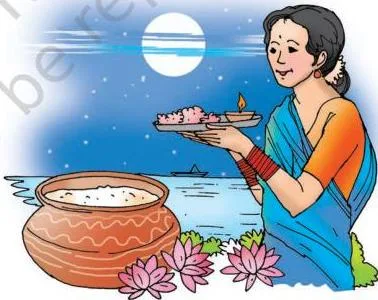
The four festival cards teach one idea: Indian festivals are tied to nature. Flowers open the spring, the full moon of Ashvin ends the monsoon, the river Cauvery is honoured in the Tamil month of Aadi, and the mountain Kanchenjunga is worshipped in Sikkim.
| Festival | Region the chapter names | When | What people do |
|---|---|---|---|
| Phool Dei | Not named in the chapter | Beginning of Spring | Children collect flowers, offer them to elders or leave them on doorsteps; elders give rice and jaggery. |
| Sharad Poornima | Not named in the chapter | Full moon night in Ashvin (September–October) | Marks the end of the monsoon; the weather is pleasant. |
| Aadi Perukku | Tamil (a Tamil monsoon festival) | Aadi month (July–August) | People worship the river Cauvery; farmers pray for a good harvest. |
| Pang Lhabsol | Sikkim | August or September | Mt Kanchenjunga is worshipped as a protector; people dance and celebrate. |
The cards close with a question: “The sun is the source of energy on the earth. Do you know any festival that respects the sun?” — a good prompt for a family discussion.
Why the pictures matter in this chapter
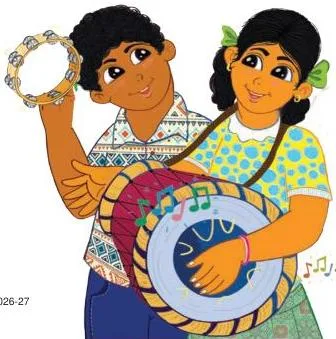
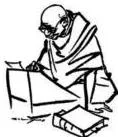
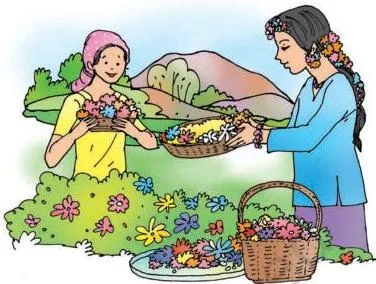
This chapter is built around its pictures, yet the illustrations carry no printed captions of their own — they work with the words around them. Two activities cannot be done properly without looking at the page.
First, the fruit-to-tree matching: the fruit names and tree names are listed apart, and a child must look at the pictures to see how they pair. Second, the charkha play: the text says the children go round the table and look at the object from all sides, and the pictures carry that classroom scene.
So open the PDF to see them. Parents should treat the pictures as part of the task, not decoration — the questions near them expect the child to look, point and compare.
New words this chapter introduces
The chapter prints a boxed list of six new words. This table gives each a simple meaning, then adds the words the charkha play and the festival cards introduce.
| Word | What it means |
|---|---|
| festival | A special day when people celebrate together |
| puppet | A toy figure that is made to move, often with strings or hands |
| travel | To go from one place to another |
| painting | A picture made with colours, or the act of making one |
| neighbour | A person who lives near your home |
| fingerprints | The marks your fingers leave on things you touch |
| charkha | A spinning wheel used to make thread from cotton |
| spinning wheel | The machine the charkha is — it spins fibre into thread |
| thread | Thin cord spun from cotton and used for weaving cloth |
| local handicrafts | Things made by hand by local people |
| self-reliance | Depending on yourself instead of on others |
| monsoon | The rainy season |
| harvest | The gathering of ripe crops |
| worship | To show deep respect to something held holy |
| protector | Someone or something that keeps people safe |
One honest note: fingerprints appears in the box but not in the chapter’s reading lines, so a child should practise reading and spelling it without a story context to lean on.
Mistakes Class 2 readers make here — and how to avoid them
Most slips in this chapter come from two features: it asks for each child’s own answer, and it introduces a connector word that behaves differently from ‘and’. Each row below names the slip, why it happens, and a quick check.
| Mistake | Why it happens | How to check your answer |
|---|---|---|
| Child thinks their answer is wrong because a classmate’s is different | The chapter asks for each child’s own true answer | The book’s own note says answers are different, yet all are correct — compare and accept both |
| Child answers in the mother tongue and stops | The child answers in the language they think in | The teacher note says accept it, then help the child give the response in English |
| Joining with ‘and’ instead of ‘but’ | ‘and’ is the joining word children already know | ‘but’ joins ideas where the second goes against the first — if the second half contradicts the first, use ‘but’ |
| Jumbled letters: fixing only the first and last letters | The child sees the word’s shape, not its order | Write the word, then cross off each letter as you place it — INHDI needs H-I-N-D-I to become HINDI |
| One-word answers where the book expects a sentence | Discussion questions look easy to answer briefly | The question asks which festival and why — answer in a full sentence: “My favourite festival is Holi because I love colours.” |
How this chapter is checked in Class 2
There is no CBSE board exam at Class 2 — schools check these skills in class and through the book’s own tasks, usually by listening to children read, speak and present. The activities a teacher is likely to watch for are all in the chapter:
- Speaking about oneself — name, place and language — and asking a question back.
- Using polite phrases for the five situations in Let us speak.
- Reading the charkha play aloud, with the stage directions understood.
- Joining sentences with ‘but’ in Let us write.
- Completing the jumbled-letter task and answering the discussion questions.
- Presenting the folk song in the four-point format and singing it.
One caution: textbook contents and the examinable syllabus are not always identical. For the current Class 2 curriculum, check the official syllabus on cbse.gov.in.
Recap: what a child should be able to do after this chapter
Working through the chapter once, a child should be able to do all of these:
- Introduce themselves with name, place and language.
- Ask a partner a simple question back.
- Use a polite phrase for each of the five classroom situations.
- Read the br and fr words — bread, bridge, brown, frock, frame, frog — and build a sentence from them.
- Write the four language names from the jumbled letters: HINDI, ENGLISH, URDU, TELUGU.
- Join two ideas with ‘but’.
- Read the charkha play aloud and say who Mahatma Gandhi was and what the charkha stood for.
- Match banana, coconut, apple, mango and grapes to their trees.
- Name the four festivals with their region and season.
- Collect and present a folk song using the four-point format.
The chapter’s whole message fits in one line: we are all Indians, and each of us is unique.
Related NCERT resources for Class 2
This listing is maintained for the 2026-27 academic session using the NCERT textbook information available to us. NCERT remains the authority for confirming the latest edition.
Let us read sits in the later half of the Class 2 Mridang book, after the chapters that build early reading. For the full set of chapters, see the Class 2 English page, or start from the Class 2 hub and the CBSE notes home. A related Class 2 English chapter page is Little Drops of Water.
Sources and data verification
This page describes Chapter 13, ‘Let us read’, of the NCERT Mridang Class 2 English textbook, official edition published on ncert.nic.in. It covers that chapter only, of that book — not the older Class 2 English books such as the earlier Marigold or Raindrops series, and not any other subject.
The listing is maintained for the current academic session using the NCERT information available to us. NCERT settles textbooks, editions and PDFs; CBSE settles curriculum, syllabus and examinations.
Reference: NCERT Class 2 English Mridang textbook, chapter 13, official edition on ncert.nic.in.
Quick questions about Let us read Class 2
What is the Let us read Class 2 chapter in Mridang about?
It is a reading and speaking chapter about India’s diversity. Twelve children from different states introduce themselves in their own languages, and the chapter ends with the message that we are all Indians, each of us unique.
Around that idea it practises polite phrases, the br and fr sounds, writing with ‘but’, the charkha play, four festival cards and a folk-song project.
Where can I download the official NCERT Class 2 English Mridang PDF for this chapter?
From the NCERT textbook portal at ncert.nic.in — the download link in the first section of this page points there. It is the official source of the current Mridang edition, the same file schools use.
Why is the charkha taught in a Class 2 English chapter?
The charkha appears in the play ‘Something New’, where seven children find an unfamiliar object and ask about it. The teacher explains that Mahatma Gandhi used the charkha to spin thread, and that he made it a symbol of self-reliance and local handicrafts. The play turns a piece of history into a reading-aloud lesson.
Which festivals does the chapter talk about and where are they celebrated?
Phool Dei welcomes spring with flowers. Sharad Poornima is the full-moon night in Ashvin, marking the end of the monsoon. Aadi Perukku is a Tamil festival in the Aadi month, when the river Cauvery is worshipped.
Pang Lhabsol is a Sikkim festival in August or September, when Mt Kanchenjunga is honoured as a protector. The chapter also asks whether the child knows a festival that respects the sun.
How should my child do the folk song project work in this chapter?
Ask a parent, grandparent or relative about a folk song from their village and when it used to be sung. Learn it in your mother tongue, fill in the four-point format — name, village or state, mother tongue, main idea — then sing it for the class.
Is Mridang the current NCERT English book for Class 2?
Yes. This page follows the NCERT Mridang Class 2 English textbook, published on the official NCERT portal. The earlier Class 2 English series — Marigold and Raindrops — are older books, not the current one.
Explore Class 2 English Books
Related chapters: