
Fun with Friends Class 2 is the opening chapter of NCERT’s Mridang, the English textbook for Class 2. It is built around a short poem, My Bicycle, followed by word lists and activity blocks that practise listening, speaking, reading and writing. The official PDF of the chapter is directly below.
Open the NCERT Class 2 English Mridang Chapter 1 Fun with Friends PDF to read the chapter exactly as it is printed in the official Mridang textbook — the poem, the two word lists, and every activity from Let us listen to the final Let us write page.
The file is the official NCERT edition published on ncert.nic.in, so it matches the book a child reads in class.
Below the file, this page walks through each part of the chapter in plain words: what the poem says, which words a child must know, how the vowel sound “a” works, and how to run each activity at home or in class.
Download the NCERT Fun with Friends Class 2 PDF
Everything on this page follows the same order as the chapter file: the poem first, then the word lists, then the five skill blocks. Keep the PDF open while you work through the sections below, and the activity names will line up with the blocks in the child’s book.
Fun with Friends Class 2: chapter at a glance
This is not one long reading lesson but five short skill blocks built around a single poem. The chapter opens with My Bicycle and two word lists, then moves through sharing, listening, speaking, writing and thinking activities.
| What the chapter holds | Count | Where it is used |
|---|---|---|
| Printed pages | 7 | |
| Figures with NCERT captions | 4 | |
| Official NCERT PDF | Download the chapter PDF | the chapter exactly as NCERT publishes it |
The file is built from these blocks, in the order the book prints them:
- My Bicycle — the opening poem, recited aloud.
- Sight words and New words — two printed word lists under the poem.
- A. Share with the class — six oral questions about bicycles.
- Let us listen — identifying recorded bell sounds.
- Let us speak — reading the words printed below pictures.
- Let us write — two blocks: labelling a bicycle, then comprehension tasks on the poem.
- Let us think — the magic bicycle drawing and conversation.
What Fun with Friends Class 2 covers
This table is a one-glance map for a parent or teacher. Each row names an activity block and what the child actually does in it.
| Activity block | What the child does |
|---|---|
| My Bicycle | Recites the poem aloud with the class. |
| Sight words and New words | Learns the five sight words and six new words printed under the poem. |
| A. Share with the class | Answers six oral questions, such as whether they have seen a bicycle, what colour it was, and who rides it. |
| Let us listen | Identifies recorded bell sounds, including the school bell, bicycle bell and temple bell. |
| Let us speak | Reads the words printed below pictures and notices when an is used instead of a. |
| Let us write | Labels the parts of a bicycle; then completes sentences about the poem and ticks statements true or false. |
| Let us think | Draws a magic bicycle and talks about what they would do with it. |
What the poem My Bicycle teaches
The opening poem, My Bicycle, is a child describing the bicycle they own and ride. It has four short stanzas, and each one carries a small idea a child can find and repeat in their own words.
- The colours: the bicycle is red, the seat is blue, and the tyres and pedals are black.
- The bell: the sound “Trin… trin… trin…” makes friends move aside.
- The ride: sometimes fast, sometimes slow, but always on track — the bicycle stays on its path.
- The helmet: the child wears a little helmet, needs only air in the tyres to keep moving, and rides happily everywhere.
The line most children remember is “Trin… trin… trin… goes the bell” — it is the poem’s sound effect, and the Let us listen activity later turns it into a game with recorded bells.
Words this chapter asks a child to know
The poem page prints two word lists. A sight word is a very common word that a beginning reader learns to recognise as a whole, instead of sounding it out letter by letter.
The five sight words are I, and, is, in, my — small words a child will meet in almost every sentence of early reading.
Each new word gets a simple meaning, plus the line of the poem where it appears:
| New word | Simple meaning | Where it appears in the poem |
|---|---|---|
| pedal | the flat part you push with your foot | “I pedal and I ride” |
| aside | to one side | “Makes my friends move aside” |
| sometimes | not always | “Sometimes fast, sometimes slow” |
| track | the route the bicycle follows | “always on track” |
| helmet | a head guard | “my little helmet” |
| everywhere | in all places | “go happily everywhere” |
The vowel sound “a” and when to use “an”
This is the chapter’s main grammar moment, taught through pictures and word rows rather than as a printed rule. The Let us speak page shows three rows, each with pictures and the words printed below them.
| Row | Words under the pictures | The pattern it shows |
|---|---|---|
| 1 | an ant, an axe, an apple | an is used before vowel sounds |
| 2 | a rat, a cat, a mat | a is used before consonant sounds |
| 3 | a pan, a man, a cap | a is used before consonant sounds |
The pattern: an comes before words that begin with a vowel sound, and a comes before words that begin with a consonant sound. The teacher note for the page says the activity introduces the vowel sound “a” as in pan.
Why the n is there: it acts as a bridge between two vowel sounds. “An apple” flows easily; “a apple” does not. The same test works on fresh pairs — a dog but an egg.
Parts of a bicycle: the labelling task
The first Let us write activity turns the poem’s bicycle into a drawing that the child labels. A help box beside the drawing names seven parts: seat, pedal, wheel, bell, handle, carrier, brake.
| Part | What it does |
|---|---|
| seat | where the rider sits; blue in the poem |
| pedal | the flat part pushed with the foot to ride |
| wheel | the round part that rolls; its tyre is black |
| bell | makes the “trin… trin… trin” sound |
| handle | what the rider holds to steer |
| carrier | the rack that carries things on the bicycle |
| brake | slows or stops the bicycle |
The drawing itself stays in the child’s book. Before writing each name, have the child say the word aloud, then match it to the box — the task is about matching the picture to the word, not about spelling perfectly.
How the pictures and word tables carry the lesson
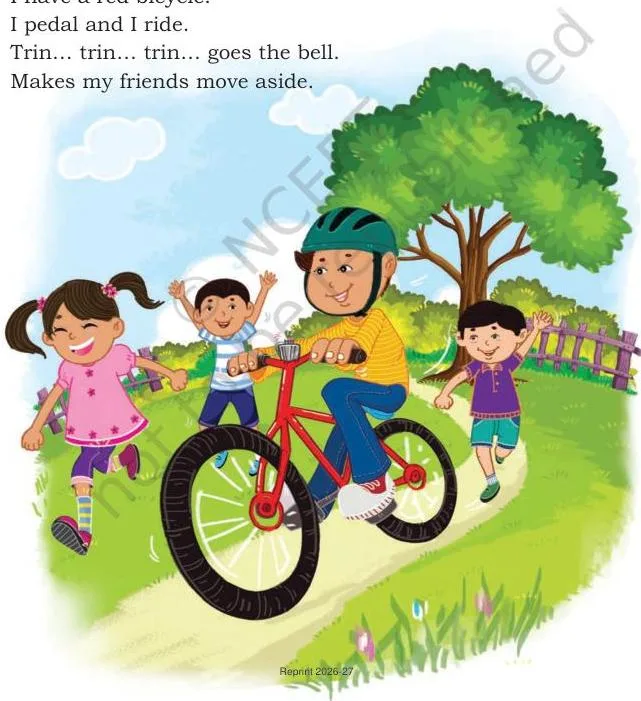
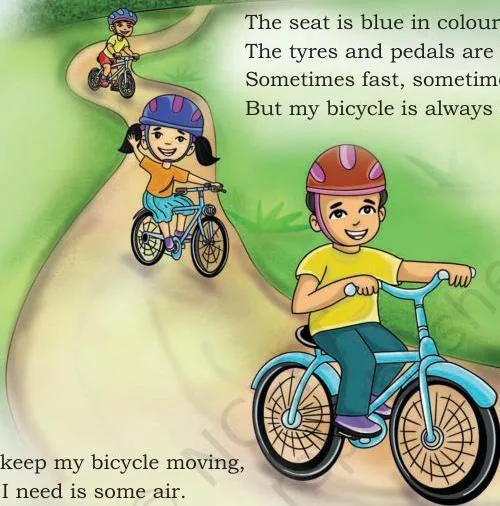
This chapter is picture-led: most activities ask a child to look at a picture, then read the printed word beside or below it. Two picture moments carry the lesson.
The Let us speak picture rows
Three rows of pictures with words underneath. The child reads the word below each picture and, across the rows, notices when the word begins with a or an. The teacher note says children should notice that an appears before words beginning with a vowel.
The Let us write labelling drawing
A bicycle drawing with blank boxes and a help box. The child matches each printed part name to the right empty box on the drawing.
A good habit for both tasks: look at the picture first and say what it shows, then read the word under it. The picture carries the meaning, the word carries the spelling, and pairing them is how a young reader starts to recognise whole words.
Listening, speaking and the magic bicycle
This chapter is as much about talking as about reading. Three of its blocks are oral, and all three are simple to run at home.
Let us listen: identifying bell sounds
The teacher plays sounds recorded on a mobile and children identify them. The teacher note suggests three: the school bell, the bicycle bell and the temple bell. At home, any bell sound on a phone works — play it, pause, and ask the child what made it.
Let us speak: reading words below pictures
Children read the word rows under the pictures. This is the same a/an material as the grammar section above, now practised aloud.
Let us think: the magic bicycle
The child imagines having a magic bicycle, draws it in the box, and then talks about it. The teacher note suggests three follow-up prompts, and any of them can start the conversation at home:
- Where would you go?
- What would you do there?
- What would you see there?
The places may be imaginary or real, and there are no right or wrong answers — the goal is for the child to speak in sentences.
Common mistakes in this chapter and how to fix them
The mistakes below are typical of early reading, not signs of failure. Each one is corrected by a line of the poem or a row of the word table.
| Mistake | Correct rule | How to check your answer |
|---|---|---|
| Writing “a ant” instead of “an ant” | an is used before words that begin with a vowel sound; a before words that begin with a consonant sound | Say both aloud — “an ant” flows, “a ant” does not. The Let us speak table keeps an ant, an axe and an apple in one row so the pattern is seen together. |
| Answering the true or false task from memory | Each statement is settled by one specific line of My Bicycle | Read the poem again and find the line each statement refers to before ticking. |
| Not knowing what a tricycle or a wheelchair is | A tricycle has three wheels; a wheelchair helps senior citizens, the injured and the disabled move. The chapter’s point is that wheels aid movement | Look at the picture of a tricycle the teacher keeps ready; talk about who uses a wheelchair and why. |
The five true or false answers, tied to the poem
Exercise B of the second Let us write block asks for five true or false ticks. Each answer below is decided by one line of My Bicycle, so a child can check their own work against the poem.
| Statement | Answer | The poem line that decides it |
|---|---|---|
| The child has a blue bicycle. | False | “I have a red bicycle” — the seat is blue, not the bicycle itself. |
| The bell goes trin… trin… trin. | True | “Trin… trin… trin… goes the bell.” |
| The child’s bicycle is always fast. | False | “Sometimes fast, sometimes slow” — so not always fast. |
| The child needs some water to keep the bicycle moving. | False | “All I need is some air” — air, not water. |
| The child puts on a little helmet while riding. | True | “I put on my little helmet.” |
What to practise before any assessment
This chapter is a skills starter, not an exam unit — treat it as a checklist. A child who has worked through the chapter should be able to do six things:
- Recite My Bicycle aloud, including the “trin… trin… trin” bell.
- Recognise the five sight words instantly: I, and, is, in, my.
- Read the six new words: pedal, aside, sometimes, track, helmet, everywhere.
- Use an before vowel-sound words (an ant, an axe, an apple) and a before consonant-sound words.
- Label the seven bicycle parts: seat, pedal, wheel, bell, handle, carrier, brake.
- Complete the sentences and tick the true or false statements from the poem.
The chapter opener also carries a safety conversation: the teacher note asks children to describe a bicycle they have seen and to talk about safety measures such as wearing a helmet and putting on a seat belt.
That is the chapter’s real-world takeaway — the poem’s rider wears a little helmet, and the discussion connects it to seat belts and other safety habits.
Quick recap: the learning blocks of Fun with Friends
The chapter has no printed summary block, so this recap maps it by its own activity names. In one minute:
- Poem — My Bicycle: a red bicycle, a blue seat, black tyres and pedals, a “trin… trin… trin” bell, and a little helmet.
- Words — five sight words (I, and, is, in, my) and six new words (pedal, aside, sometimes, track, helmet, everywhere).
- Listening — identify recorded bell sounds such as the school bell, bicycle bell and temple bell.
- Speaking — read the words under the pictures and notice a before consonant sounds and an before vowel sounds; talk about a magic bicycle.
- Writing — label the seven bicycle parts and answer the poem’s comprehension tasks.
Related chapters and resources
This listing is maintained for the 2026-27 academic session using the NCERT textbook information available to us. NCERT remains the authority for confirming the latest edition.
Fun with Friends is the opening chapter of Mridang, so there is no previous chapter to link back to. For what comes next, use the NCERT Class 2 English book page to move to the following chapters of the same book.
The NCERT Class 2 books hub lists the other subjects of Class 2 alongside English, and the CBSE notes home page is the single starting point for every class and subject on this site.
The picture-first approach of this chapter is the same skill early readers need next: see Class 2 English picture reading for more practice of reading words from pictures.
All chapter files, including this one, are published by NCERT on the official NCERT textbook portal — the authoritative source for NCERT textbook PDFs.
Sources and data verification
The facts on this page describe Chapter 1 (Fun with Friends) of the NCERT Class 2 English textbook Mridang, as published on ncert.nic.in, and maintained against the official NCERT edition currently available there. The page covers this single chapter only — not the other chapters of Mridang, and not other Class 2 subjects.
- NCERT settles textbook editions and the official PDFs. CBSE settles curriculum and syllabus.
- Textbook contents and the examinable syllabus are not always identical — check the current official syllabus.
- This page names activities by their book titles (Let us listen, Let us speak, Let us write) rather than printed page numbers, because the chapter is organised around its activity blocks.
Reference: NCERT Class 2 English Mridang textbook, chapter 1, official edition on ncert.nic.in.
Frequently asked questions about Fun with Friends Class 2
Where can I find the Fun with Friends Class 2 PDF?
The official link is at the top of this page — it opens the NCERT textbook portal, where the Class 2 Mridang chapter PDFs are published. Fun with Friends is Chapter 1, so it is the first chapter in the Class 2 English book listing.
What is the poem in Fun with Friends Class 2 about?
The poem, My Bicycle, is a child describing a red bicycle with a blue seat and black tyres and pedals. The bell goes “Trin… trin… trin…” and makes friends move aside; the child rides sometimes fast, sometimes slow, always on track, and wears a little helmet.
What are the sight words and new words in this chapter?
The five sight words are I, and, is, in, my. The six new words are pedal, aside, sometimes, track, helmet, everywhere. Both lists are printed under the poem inside the chapter.
Why does the chapter use an before ant, axe and apple?
Because those words begin with a vowel sound, and an is the form used before vowel sounds. Words that begin with a consonant sound take a — as in a rat, a cat, a mat, a pan, a man and a cap.
Which bicycle parts does the chapter ask children to label?
Seven parts: seat, pedal, wheel, bell, handle, carrier and brake. The names appear in the help box beside the bicycle drawing, and the child writes the matching name in each blank box.
How should I help my child with the magic bicycle activity?
Use the three prompts from the teacher’s note — where would you go, what would you do there, and what would you see there — and let the child draw before speaking. There are no right or wrong answers, and the places may be imaginary or real.
Explore Class 2 English Books
Related chapters: