
This is My Town Class 2 is the seventh chapter of the NCERT English Mridang textbook — a short poem called “This is My Town” with word, listening and drawing activities that run across six printed pages, Mridang pages 48 to 53.
The official NCERT chapter PDF is right below, followed by a plain-language walk through what the chapter asks a Class 2 child to do, page by page.
Download the Official This is My Town Class 2 PDF
The file on this page is the official chapter from the current NCERT edition — the same six printed pages students carry in their Mridang book.
Open the NCERT Class 2 English Mridang Chapter 7 This is My Town PDF when you want to read the poem, sight words and activities in their original layout, or to print a clean copy for practice at home.
Chapter at a Glance: What Is Inside This is My Town
Before any activity starts, it helps to know what kind of chapter this is. This is My Town is activity-led, not question-led: the poem introduces a set of place words, and each page builds one small skill with them.
| What the chapter holds | Count | Where it is used |
|---|---|---|
| Printed pages | 6 | |
| Figures with NCERT captions | 3 | |
| Tables | 2 | |
| Activities | 1 | |
| Official NCERT PDF | Download the chapter PDF | the chapter exactly as NCERT publishes it |
The chapter moves in a steady order. It opens with the poem (Mridang p. 48) and its five sight words — in, this, that, there, my — then lists six new words: train, town, street, house, flower, basket (p. 49).
After that come the activities: picture talk, word building, writing the home address, a listening game, re-reading the poem to count letters, a drawing task, and the sh-sound speaking and writing tasks. There is no long exercise list — the whole chapter works through short “Let us…” tasks, each finishable in one sitting.
What This Chapter Covers, Section by Section
The pages follow one skill at a time, so a parent can see what each page is for before opening the book. The page numbers below are the printed Mridang page numbers.
- Page 48 — the poem. “This is My Town” names places from the town down to a basket of flowers, then repeats the chain in reverse.
- Pages 48–49 — sight words and new words. Five sight words and six new words are listed for reading practice.
- Page 49 — Let us speak (picture talk). Three questions: what do you see in the picture, what is the name of your town/city, and what is the name of your street. This trains speaking about your own place.
- Page 49 — Let us write (word building). Letter sets such as e-b-d, m-o-r-o and w-o-t-n are rearranged into words — bed, room, town — and each word is then used in a sentence.
- Page 50 — your home address. A six-row table from Name/House No. down to Country teaches the child to say exactly where they live.
- Page 50 — Let us listen. Five rows of word pairs — fan/fin, wall/well, house/mouse, lane/line, skin/swim. The teacher says one word per row and the child encircles the word heard.
- Page 51 — Read the poem again. Count the e’s, count the u’s, then say which letter appears more. This trains careful observation.
- Page 52 — Let us draw. An unfinished picture is completed from the child’s own imagination.
- Page 53 — the sh sound. Point to shirt, shell and shoe as the teacher says them, then write sh in blanks to finish shining, shorts, shirt, shawl and shoes.
Key Ideas in This is My Town Class 2
A Class 2 reader is not just memorising a poem. The chapter builds four habits that appear in every later English lesson: vocabulary of places, instant word recognition, a new sound, and the habit of hearing small differences between words.
The poem’s nesting pattern: town down to flowers and back up
The poem works like boxes inside boxes. It moves from the town to the street, then the house, the room, the bed, the basket, and finally the flowers (Mridang p. 48).
The second half then turns around and comes back, starting with flowers in a basket, moving up to the basket on the bed, the bed in the room, and so on until the street is back inside the town.
That nesting order is what makes the words easy to recall: learn the chain in one direction and the poem itself hands you the reverse. The repeated “There are…” / “There is…” pattern also gives early readers a rhythm to hold on to.
Sight words: read them at a glance
A sight word is a word you recognise instantly, as a whole, without sounding it out letter by letter. The five sight words here — in, this, that, there, my (Mridang p. 48) — are among the most common words in English, and most of them cannot be reliably “sounded out” anyway. Practise them by pointing and reading fast, not by spelling.
The sh sound: one sound, two letters
sh is a digraph — two letters that make one new sound. The chapter introduces it with three words to point at, shirt, shell, shoe (Mridang p. 53), and then asks the child to write sh into five sentences: shining, shorts, shirt, shawl, shoes.
Listening rows: hearing one-sound differences
The listening game on Mridang p. 50 is not about knowing harder words — it is about hearing. Each row has two words that differ by exactly one sound: fan/fin, wall/well, house/mouse, lane/line, skin/swim. House and mouse rhyme, so the change is at the start of the word; lane and line change the vowel in the middle.
The teacher says one word from each row and the child encircles what they hear, which trains the ear for reading later.
The Pictures and What to Do with Them
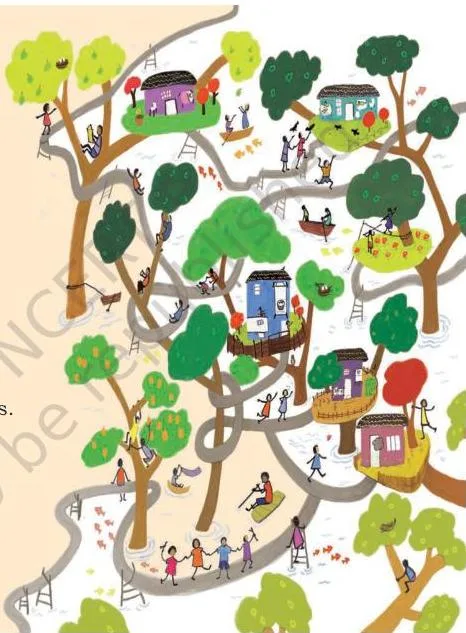

The two pictures in this chapter are working pictures — each one belongs to an activity, and neither has a “right” answer to memorise.
The first picture accompanies the poem and feeds the Let us speak task on Mridang p. 49: “What do you see in the picture?” The child looks, names what they notice, and then connects the scene to their own life through two more questions — the name of their town or city and the name of their street.
The second picture ends the chapter with Let us draw (Mridang p. 52): the child looks at an unfinished picture and adds whatever they think is needed to complete it. The teacher note beside it says to encourage children to draw objects and living beings according to their imagination — so there is no correct picture, only a complete one.
Word Meanings and Sight Words in This Chapter
Two kinds of words appear here, and a Class 2 child treats them differently. Sight words are read by recognition; new words are built from letters. Knowing which is which stops a child from trying to “sound out” words that do not sound out.
Sight words
A sight word is a common word meant to be read as a whole shape. The chapter lists five of them on Mridang p. 48.
| Sight word | What it does in the poem |
|---|---|
| in | Sits inside “in my town” — the place where something is |
| this | Points to something near the speaker |
| that | Points to something farther away |
| there | “There are” tells what exists in a place |
| my | Shows the speaker owns it — “my town”, “my street” |
New words
These are the place and object words the poem is built on (Mridang p. 49), each with a one-clause meaning.
| New word | Simple meaning |
|---|---|
| train | A line of coaches that runs on railway tracks |
| town | A place with houses, streets and shops where people live |
| street | A road in a town with houses on both sides |
| house | A building where a family lives |
| flower | The coloured part of a plant |
| basket | A container for carrying things such as flowers |
The sh words
The chapter practises seven sh words: shirt, shell, shoe for the pointing game and shining, shorts, shirt, shawl, shoes for the fill-in-the-blanks (Mridang p. 53). Read each one aloud so the child hears the sh at the start before writing it.
Common Mistakes Students Make in This Chapter
This chapter’s mistakes are small, and each one belongs to a specific activity. Name them before the child makes them and the page goes smoothly.
| Mistake | Correct rule | How to check your answer |
|---|---|---|
| Skipping the rarer letter when counting e’s and u’s in the poem (p. 51) | Count one letter at a time across the whole poem: finish every e, write the number, then start again for the u’s. | Make a small tick above each e, then above each u, so no letter is counted twice. |
| Confusing the listening pairs — fan/fin, wall/well, house/mouse, lane/line, skin/swim (p. 50) | Each pair differs by one sound; say both aloud and name what changed before circling anything. | The teacher says only one word per row; listen again before marking if unsure. |
| Writing s instead of sh — “ining” for shining, “orts” for shorts (p. 53) | sh is two letters that make one sound; without the h the sound changes completely. | Read the finished sentence aloud — every blank should hold exactly sh and the sentence should sound right. |
| Leaving blanks in the address table because the street, area or state is not known yet (p. 50) | The activity teaches the full home address; it does not test it. | Ask at home until the child can say the address from house number to country without help. |
| Mixing up the sight words this and that | this is for something near; that is for something farther away. | Point to a near object and a far object while reading the two words aloud. |
The letter-count answers are not stated on this page — counting them is the exercise itself, so a child should do it in their own book.
Self Check: What This Chapter Expects You to Do
This is a readiness check, built from the chapter’s own “Let us…” tasks. If a child can do these things after finishing, the chapter has done its job.
- Read the poem aloud, keeping the order of places right — town, street, house, room, bed, basket, flowers.
- Recognise the five sight words — in, this, that, there, my — the moment they appear.
- Build words from mixed letters and use at least one in a sentence of the child’s own.
- Say and write a full home address, from house number to country.
- Hear the difference between fan and fin, wall and well, house and mouse, lane and line, skin and swim.
- Write shirt, shell, shoe, shining, shorts, shawl and shoes with the sh kept intact.
- Count the e’s and u’s in the poem without missing or double-counting any letter.
One honest note: textbook contents and the examinable syllabus are not always identical, so check the current official syllabus for what is assessed this year.
Revision Summary: The Chapter in One Minute
The poem is itself the best revision aid, because it teaches its own memory trick. The places nest like boxes — flowers sit in the basket, the basket rests on the bed, the bed is in the room, the room is in the house, the house is on the street, and the street is in the town.
Learn the chain forward and you can walk it backward, rebuilding every line of the poem. Here is what each activity is really training:
| Activity | Skill it builds |
|---|---|
| Picture talk (p. 49) | Speaking about your own town and street |
| Word building (p. 49) | Forming words from letters and using them in a sentence |
| Address table (p. 50) | Knowing exactly where you live |
| Listening rows (p. 50) | Hearing one-sound differences between words |
| Letter counting (p. 51) | Careful observation of print |
| Drawing (p. 52) | Imagination, and finishing a task |
| sh words (p. 53) | The sh digraph: one sound made by two letters |
The sounds practised are the short vowels in fan/fin and wall/well, plus the new sh sound — the two things the listening task and the writing task are built on.
Why This Chapter Is Built Around Activities
The teacher notes printed in the chapter explain the purpose of each task — and they are worth reading, because they show the chapter is training habits, not just finishing pages.
- The listening game (p. 50) is tied to the diversity of languages and cultures of India — the point is to celebrate how differently things can be said, not just to test words.
- The note beside it asks the teacher to help children find out the name of their street — so the address task carries real-world homework behind it.
- The letter-counting task (p. 51) builds observation skill, not arithmetic.
- The drawing task (p. 52) encourages children to draw objects and living beings according to their imagination.
- The sh speaking task (p. 53) asks the teacher to bring the actual objects — shirt, shell, shoe — into the classroom so the word and the thing connect.
Related Resources
This listing is maintained for the 2026-27 academic session using the NCERT textbook information available to us. NCERT remains the authority for confirming the latest edition.
This chapter is part of the NCERT Class 2 English Mridang book page, where the book’s chapters are listed. For the full set of Class 2 subjects, see the Class 2 hub, and the CBSE notes library is the starting point for the whole site.
Two companion chapters in the same book are Between Home and School and Life Around Us.
The official file is the NCERT Mridang Chapter 7 PDF on ncert.nic.in, and the NCERT portal carries the full current textbook list.
Sources and Data Verification
This page describes the NCERT Class 2 English Mridang textbook, Chapter 7, “This is My Town”. It covers this one chapter of this one book — not other Class 2 English readers or other subjects — and it is maintained for the current NCERT edition available from ncert.nic.in.
NCERT settles textbook content, editions and official PDFs; CBSE settles the curriculum and examinations. The activity names, word lists and teacher notes above all come from the chapter as printed in the textbook.
Reference: NCERT Class 2 English Mridang textbook, chapter 7, official edition on ncert.nic.in.
Frequently Asked Questions
What is the poem This is My Town about?
The poem names the places a child moves through — the town, the street, the house, the room, the bed, and a basket of flowers — and then repeats the chain in reverse, from the flowers back up to the town. That nesting order is what makes the place words easy to recall.
Which words does a Class 2 child learn in This is My Town?
The chapter teaches five sight words — in, this, that, there, my — six new words — train, town, street, house, flower, basket — and the sh digraph with shirt, shell, shoe, shining, shorts, shawl and shoes.
What does the listening activity with fan and fin teach?
It trains sound discrimination: hearing the one sound that makes two words different. The rows are fan/fin, wall/well, house/mouse, lane/line and skin/swim; the teacher says one word from each row and the child encircles the word they hear.
How can I help my child with the sh sound words?
Say the words aloud and let the child hear the sh at the start before writing. The usual mistake is dropping the h — writing “ining” for shining — so check that every blank is filled with sh, two letters, before moving on.
Why does the chapter ask my child to write their home address?
Knowing your full address — house number, street, area, town, state, country — is a real-life skill, and the teacher note asks teachers to help children find out their street name. The table teaches the address; it does not test it, so a blank row is a signal to practise at home.
Where can I find the official This is My Town Class 2 chapter?
The official file is the NCERT Class 2 English Mridang Chapter 7 This is My Town PDF hosted at ncert.nic.in, linked in the download section at the top of this page. It is the same chapter that appears in the printed Mridang textbook.
Explore Class 2 English Books
Related chapters: