
This page carries the official PDF of Between Home and School Class 2 — Chapter 6 of the NCERT English reader Mridang — and a plain-language map of everything inside it.
The chapter opens with Ravi’s walk to school, then moves into new words, phonics, speaking, drawing, writing and a craft task. Grab the PDF below, or read on for what each part of the chapter asks.
Download the official Between Home and School Class 2 PDF
The NCERT Class 2 English Mridang Chapter 6 Between Home and School PDF is published on the official NCERT textbook portal, where the whole Mridang book is available to open or download, so you can keep this chapter on any device.
Chapter at a glance: what is inside this chapter
| What the chapter holds | Count | Where it is used |
|---|---|---|
| Printed pages | 6 | |
| Figures with NCERT captions | 2 | |
| Tables | 1 | |
| Activities | 1 | |
| Official NCERT PDF | Download the chapter PDF | the chapter exactly as NCERT publishes it |
This is a short, activity-led chapter in the Class 2 Mridang book. It moves from Ravi’s walk to school into speaking, phonics, drawing, writing and craft tasks — every part is meant to be read aloud or done with a pencil, not studied silently.
What this chapter covers, section by section
The chapter has six parts, and this table shows what each part asks. Read it once to see the whole lesson before opening the chapter.
| Section | What it asks |
|---|---|
| Between Home and School (opening passage) | Introduces Ravi, who walks to school with a friend through paddy fields, a mango grove and the main road. The fun on the way: jumping over canals, climbing trees, swinging from branches and watching garden lizards — yet they reach school on time. |
| New words | Nine words from the passage to read and understand: school, paddy, fields, grove, route, canals, branches, lizards and bicycle. |
| Let us speak | Three speaking tasks: say when you leave home and when school starts, tell classmates about the fun on your way, and point to the object — chart, chalk or chair — when the teacher reads its name. |
| Let us draw | Draw the route from your home to your school in the box. |
| Let us write (two parts) | First: fill ‘ch’ into five blanks and read the sentences aloud. Second: circle the things Ravi sees, answer two questions and unscramble four words from the lesson. |
| Let us do | Make five sentences with gate, road, tree, lunch and lizard, then cut out a vehicle picture, paste it on a class sheet and write its name underneath. |
New words in Between Home and School, with simple meanings
The chapter lists nine new words. They all come from Ravi’s own story, so each meaning below stays close to how the word is used there.
| Word | What it means |
|---|---|
| school | the place where you go to study; Ravi studies in Class 2 here |
| paddy | rice growing in the field, before it is cut and taken away |
| fields | open land where farmers grow crops |
| grove | a small group of trees; Ravi passes a mango grove |
| route | the way you go from one place to another; Ravi takes the shortest route |
| canals | water channels dug through the fields; Ravi jumps over them |
| branches | the arms of a tree; Ravi swings from them |
| lizards | small reptiles with long bodies and tails; Ravi watches garden lizards |
| bicycle | a two-wheeled vehicle you pedal; Ravi walks, so he does not ride one |
Ravi goes on foot, so bicycle is a word to know but not part of his journey — it appears only in the New words list.
The ‘ch’ sound: lunch, chips, teacher, chart, chair
The ch sound is one sound written with two letters. The Let us write activity asks children to add those two letters themselves, and to read the sentences aloud afterwards.
The same sound appears at the start, in the middle or at the end of a word:
- at the start: chips, chart, chair
- in the middle: teacher
- at the end: lunch
Say each word aloud and listen for the ch sound instead of the sh sound — lunch ends in ‘ch’ while brush ends in ‘sh’. The pointing game adds chalk to the same family.
Here is a fresh sentence to read together: My teacher keeps a chart of ch words on the wall beside her chair.
Picture-based activities: point, circle, draw and paste
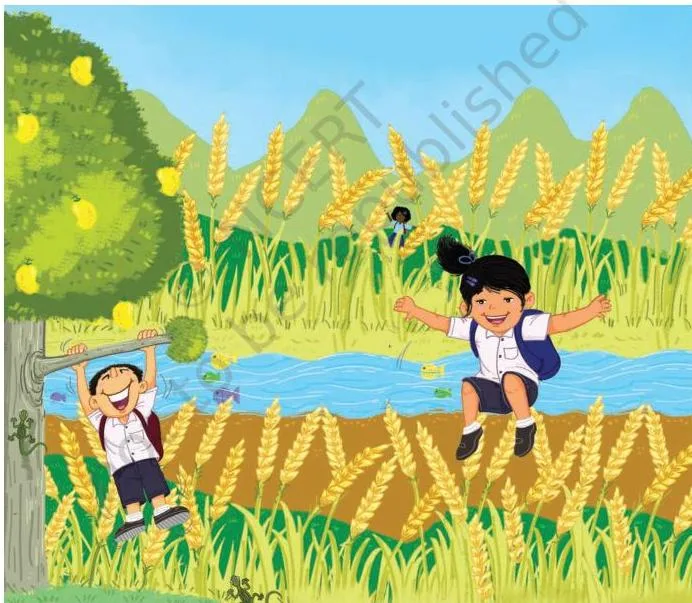
The pictures in this chapter are activity prompts, not diagrams to study. Four visual tasks use them: point, circle, draw and paste.
- Point — the teacher reads a word and the child points to the object that matches: chart, chalk or chair.
- Circle — circle the printed words that name things Ravi sees on the way; the list mixes story words with distractors.
- Draw — draw the route from home to school in the box, the way Ravi describes his own.
- Paste — cut out a vehicle picture from an old magazine, newspaper or poster, bring it to class, and paste it on a large sheet with the vehicle’s name written underneath.
What Ravi sees on the way to school (and what he does not)
The circle activity lists twelve options, but only six come from the story. This table keeps the answer checkable against Ravi’s own words.
| On Ravi’s route | Not on Ravi’s route |
|---|---|
|
|
Ravi and his friend go on foot, so no bicycle belongs in the circled list either — the story never puts one on the route.
Jumbled letters: how to unscramble them
The hint says every answer is a word from the lesson, which turns the task into a hunt rather than a guess. A simple method works every time:
- Say the letters aloud, one by one.
- Look for a word from the New words list or the story.
- Check that every letter is used once — if one is left over or repeated, try again.
The lesson’s answers are home, canal, paddy and mango:
| Jumbled letters | Word |
|---|---|
| a o h m e | home |
| b a n c a l | canal |
| c d a p y d | paddy |
| d o n m g a | mango |
| l o h c s o | school (fresh practice) |
| t u e r o | route (fresh practice) |
The first four rows are the lesson’s own words; the last two are fresh practice using the same method.
Common mistakes in this chapter and how to fix them
Three mistakes are common in this chapter. Each one is named here with its correction, so the child can check before moving on.
| Mistake | Correct rule | How to check your answer |
|---|---|---|
| Circling familiar distractors such as park, bank, water park, cars or train | Circle only what the story actually names | Re-read Ravi’s words; the six correct answers are canals, mango grove, paddy fields, lizards, main road and trees |
| Writing ‘sh’ instead of ‘ch’ in lunch and teacher | ‘ch’ is one sound written with two letters | Say the word aloud and listen: lunch and teacher carry ‘ch’, not ‘sh’ |
| Answering a sentence task with one word, such as ‘tree’ | Write a full sentence with a subject and a verb | Ask: does my answer say who did what? ‘I climb a tree on the way’ is a sentence; ‘tree’ is not |
What a teacher checks in this chapter
This is a classroom chapter, not a test chapter. A teacher checks how each activity is done rather than marking an exam, and these are the tasks looked for.
- reads the five ch words aloud with the correct sound
- speaks in full sentences when telling classmates about the fun on the way
- circles only the six story words in the picture activity
- writes answers to the two questions as complete sentences
- draws a recognisable route from home to school in the box
- makes five sentences using gate, road, tree, lunch and lizard
- brings a labelled vehicle picture for the class chart
A note in the book itself asks teachers to bring real objects — chart, chalk and chair — for the pointing game, and to collect one vehicle picture from each child for a display chart.
How parents and teachers can use this chapter
The same activities work as home practice or classroom games. Use the chapter the way it is built: short, spoken and hands-on.
At home with a parent:
- ask the child what time they leave home and what time school starts — the first speaking question
- retell Ravi’s route together, then compare it with the child’s own way to school
- draw the home-to-school route in the box and describe it aloud
- make the five sentences with gate, road, tree, lunch and lizard
In the classroom:
- run the point-to-object game with real objects — chart, chalk and chair
- build the class vehicle chart: collect one picture per child, paste them on a large sheet and write the vehicle’s name under each
What to remember from Between Home and School
For the night before class, keep these points ready.
- Ravi walks to school with a friend; they go on foot.
- The route passes paddy fields, a mango grove and the main road.
- Fun on the way: jumping over canals, climbing trees, swinging from branches, watching garden lizards.
- The nine new words are school, paddy, fields, grove, route, canals, branches, lizards and bicycle.
- The five ch words are lunch, chips, teacher, chart and chair.
- Circle answers: canals, mango grove, paddy fields, lizards, main road and trees.
Through all of it, Ravi and his friend still reach school on time.
Related chapters and NCERT resources
This listing is maintained for the 2026-27 academic session using the NCERT textbook information available to us. NCERT remains the authority for confirming the latest edition.
This chapter belongs to a whole book and a whole year of English work. The links below lead to both.
The chapter sits inside the Class 2 English Mridang book page, which lists every chapter in order, and the Class 2 section of this site gathers all Class 2 subjects together.
For revision, the Class 2 English notes pages mirror the same Mridang chapters, and the Class 2 hub links everything a Class 2 reader needs. The chapters around this one — Going Places and This Is My Town — each have a notes page here, and the whole library is organised by class in the CBSE notes pages.
Sources and data verification
This page is built from the book itself, so the trail back to the source is short.
- The chapter described here is Chapter 6, ‘Between Home and School’, of NCERT’s English textbook Mridang for Class 2, as published on ncert.nic.in.
- This page covers this one chapter; the Class 2 English book page lists the rest of the book.
- NCERT is the authority for textbooks, editions and PDFs; CBSE is the authority for curriculum, syllabus and examinations.
- This listing is maintained for the current academic session using NCERT’s published material.
- Textbook contents and the examinable syllabus are not always identical — check the current official syllabus.
Reference: NCERT Class 2 English Mridang textbook, chapter 6, official edition on ncert.nic.in.
FAQ: Between Home and School Class 2 questions
What is the Between Home and School Class 2 chapter about?
It is Chapter 6 of the NCERT English book Mridang. Ravi, a Class 2 boy, walks to school with a friend through paddy fields, a mango grove and the main road. They jump canals, climb trees, swing from branches and watch garden lizards, yet reach school on time.
The rest of the chapter practises new words, the ch sound, speaking, drawing and writing.
Which things does Ravi see on his way to school?
Six, from the circle list: canals, mango grove, paddy fields, lizards, main road and trees. Bank, hospital, water park, park, cars and train are the distractors — familiar things that are not in the story.
What are the new words in this chapter?
Nine: school, paddy, fields, grove, route, canals, branches, lizards and bicycle. A simple meaning for each is in the New words table above.
How do children practise the ch sound in this chapter?
They fill ‘ch’ into five blanks to make lunch, chips, teacher, chart and chair, then read the sentences aloud. The tip is to listen for the ch sound instead of the sh sound.
How can I download the official NCERT Class 2 English Mridang Chapter 6 PDF?
Use the download link at the top of this page — it leads to the official NCERT textbook portal, where the chapter PDF is hosted on ncert.nic.in.
What does the Let us draw activity ask the child to do?
Draw the route from your home to your school in the box, the way Ravi describes his own route. A simple line with landmarks — a gate, a field, a road — is enough.
Explore Class 2 English Books
Related chapters: