
It is Fun Class 2 is the poem chapter in the NCERT Mridang English book — nine pages in which a child imagines acting like six animals, leaping like a lamb, climbing like a cat, hopping like a frog.
The official chapter PDF is on this page. Below it, you will find what every section of the chapter does, the words it teaches, and the activities a Class 2 child actually works through.
The official NCERT chapter PDF for It is Fun Class 2 is below — the publisher’s own file, free to open, print or save for reading aloud with the child.
What is inside the It is Fun chapter
| What the chapter holds | Count | Where it is used |
|---|---|---|
| Printed pages | 9 | |
| Figures with NCERT captions | 6 | |
| Official NCERT PDF | Download the chapter PDF | the chapter exactly as NCERT publishes it |
The table above lists how much the chapter holds, counted from the official file. This page explains what each part teaches.
The chapter itself flows in one clear order:
- Let us recite — the poem, read aloud with rhythm.
- Sight words — seven words to recognise at a glance.
- New words — six words to learn.
- Let us speak A and B — identify animal sounds, then answer “if you were a cat…”.
- Note to the teacher — how to run the speaking game.
- Let us speak C — say the action words and make sentences with them.
- Let us write — finish sentences and answer questions on the poem.
- Picture Reading — talk about a picture, then write about it.
- Match the animals to their actions.
- Look at the pictures — read three rows of short-i words.
- Song of I — clap and sing to learn the word I.
- Rangoli — draw in three steps and colour.
What It is Fun teaches, section by section
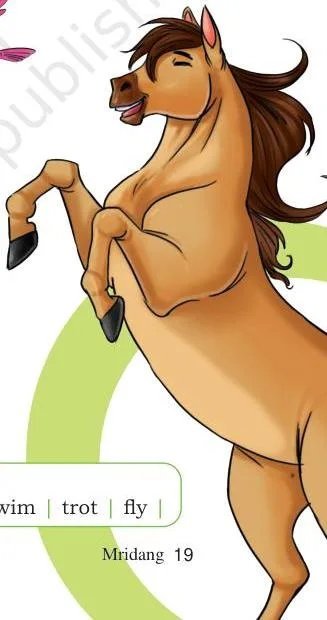
The poem is one long piece of make-believe: a child pretends to be six animals and act like each one — a lamb leaps, a cat climbs, a frog hops, a fish swims, a horse trots and a bird flies. The chapter then moves deliberately from reciting, to speaking, to writing.
Here is each part, what it asks, and the skill it builds.
| Part | What it asks | Skill it builds |
|---|---|---|
| Let us recite | Read the poem aloud, line by line | Poem rhythm, reading fluency |
| Sight words | Look at this, that, like, to, them, all, none as whole words | Instant word recognition |
| New words | Learn fun, climb, leap, swim, trot, fly | Vocabulary |
| Let us speak A and B | Guess animal sounds from a mobile; answer “If you were a cat, what would you do?” | Listening and speaking |
| Let us speak C | Say the action words; build sentences such as “Monkeys climb trees.” | Oral sentence building |
| Let us write | Finish “I can ___ like a ___”; name two swimmers and two tree-dwellers; answer two questions on the poem | Writing with a frame |
| Picture Reading and Let us think | Talk about what you see in the picture; then write a few sentences about it | Observation to written language |
| Match the animals | Join each animal to its action | Action-word meaning |
| Look at the pictures | Read three rows of picture words | The short i sound; a versus an |
| Song of I | Clap and sing to learn the word I | Pronoun awareness |
| Rangoli | Follow steps 1 to 3 to draw, then colour | Following instructions |
Short fragments like “leap like a lamb” and “I can act just like them all” carry the poem’s idea. The full verse stays in the chapter and is best read aloud while the child acts out each animal.
Key concepts: action words, sight words and the short i sound
This chapter is not testing comprehension. It builds early literacy: movement vocabulary, instant word recognition and one vowel sound.
Action words are meant to be acted out
The poem’s verbs — climb, leap, hop, swim, trot, fly — are all things a child can do with their body, and acting is how young children anchor meaning. Say “show me a trot” and the word has been taught better than a definition ever could.
Sight words are read as whole shapes
The seven sight words — this, that, like, to, them, all, none — are common little words that do not sound out neatly. Children learn to recognise them at a glance, as whole shapes rather than letter by letter.
The short i sound and the a/an rule
Three picture rows all share the short i sound: an inch, an inkpot, an igloo; a pin, a list, a fish; a bin, a ring, a ship. The first row also models an before a vowel sound, which is how the chapter slides a versus an into the same activity.
The picture activities in It is Fun
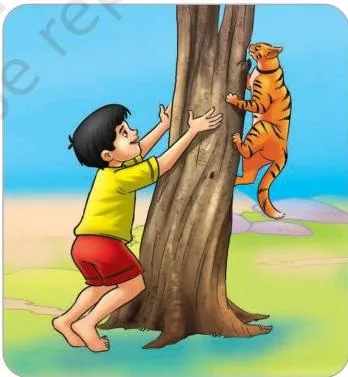

This is where a Class 2 child actually works. The pictures are part of the printed chapter, so open the book and look at them together during each activity.
- Picture Reading, then Let us think — the book asks “What do you see in the picture?” and then “Write a few sentences about the picture.” Talk first, write after; that order is the lesson.
- Match the animals to their actions — five fixed pairs: the horse trots, the lamb leaps, the snake crawls, the squirrel runs, the monkey swings. Matching fixes each action word’s meaning.
- Look at the pictures — read the words under the pictures, three rows, all short i. Row 1 starts with an, rows 2 and 3 with a, so children see an inch next to a pin and learn the vowel sound rule by contrast.
- Rangoli, after Let us draw — follow steps 1 to 3 to draw a rangoli, then colour it — a task a child can repeat at home with crayons.
New words and sight words to know
The book lists the chapter’s words but expects the adult to explain them. Here is what each new word means, in words a seven-year-old follows.
| New word | Child-friendly meaning |
|---|---|
| fun | Enjoyment — anything that makes you laugh or smile |
| climb | Move upward using hands and feet, the way a cat goes up a tree |
| leap | Jump high off the ground |
| swim | Move through water using your body |
| trot | Move at a steady jogging pace, the way a horse does |
| fly | Move through the air on wings |
A sight word is a common word children learn to read as a whole shape instead of sounding it out letter by letter. The chapter’s sight words are this, that, like, to, them, all and none.
The matching activity extends the same vocabulary with five more action words: trots, leaps, crawls, runs and swings — crawls means moving low on the belly like a snake, and swings means moving by holding and pulling, the way a monkey moves through trees.
Where young readers stumble in It is Fun
The chapter’s two “Note to the teacher” blocks carry two clear messages: the letter I stands for oneself, and every child should get a speaking turn. They also point at exactly where children slip, so the fixes below are built from them.
| Mistake | Correct rule | How to check your answer |
|---|---|---|
| Writing the child’s own name where the word I goes | I is a word that means the speaker — the song says “You use I and not your name” | Sing the song while pointing at yourself, then say “I am ___” aloud |
| Confusing capital I with small i | Capital I is the word; small i is only a letter inside words like fish | Ask: “Is this the word I, or the letter inside fish?” |
| Saying “a inch” instead of “an inch” | Words beginning with a vowel sound take an: an inch, an inkpot, an igloo | Read row 1 aloud and listen for the an sound |
| Mixing up animal actions | Fix the pairs: a snake crawls, a horse trots, a lamb leaps | Say each pair aloud until the match is instant |
| Sounding out sight words letter by letter | Sight words are read as whole shapes | Flash a card; the child should say the word at once |
None of these are exam questions — they are everyday slips the chapter itself anticipates, and each one has a simple fix at home.
How teachers use It is Fun in Class 2
Class 2 has no board exam, so this chapter is assessed through classroom participation and oral work. The “exam” here is whether the child can recite, answer and write the frames.
- The teacher plays animal sounds on a mobile — a frog croaking, a hen cackling, a duck quacking, a sheep bleating — and children guess the animal.
- The “If you were a cat, what would you do?” conversation gives every child a speaking turn.
- Children say the action words aloud and build sentences with them.
- Children finish “I can ___ like a ___.”
- They match animals to their actions.
- They read the short-i word rows.
- They sing the Song of I with three claps.
- They draw and colour a rangoli in steps.
Textbook contents and the examinable syllabus are not always identical — check the current official syllabus for what the school assesses.
It is Fun at a glance: what to remember
The chapter prints no summary of its own, so this one-minute recap is built from the chapter’s own material only.
- The poem’s idea: a child acts like six animals and ends with “I can act just like them all”.
- The six new words: fun, climb, leap, swim, trot, fly.
- The seven sight words: this, that, like, to, them, all, none.
- The short i rows and the a/an rule: an inch, an inkpot, an igloo; a pin, a list, a fish; a bin, a ring, a ship.
- The animal-action pairs: horse trots, lamb leaps, snake crawls, squirrel runs, monkey swings.
- I as a word: “You use I and not your name.”
Related NCERT resources for Class 2 English
This listing is maintained for the 2026-27 academic session using the NCERT textbook information available to us. NCERT remains the authority for confirming the latest edition.
Use the links below to move around the Class 2 English book and its chapters.
- Class 2 English (Mridang) book page — the full book index
- Chapter 2, Picture Reading — the previous Mridang chapter
- Chapter 4, Seeing without Seeing — the next Mridang chapter
- Class 2 NCERT books hub — every Class 2 book on this site
- CBSE notes home — the complete notes index
The full book, including this chapter, can be opened and downloaded free on the official NCERT textbook portal — the publisher’s own e-book site.
Sources and data verification
The chapter described on this page is Chapter 3, “It is Fun”, from the NCERT Class 2 English textbook Mridang, official edition on ncert.nic.in.
This page covers this single chapter only — not the whole book, and not the CBSE syllabus.
The NCERT information on this page is maintained for the current academic session.
NCERT settles textbooks, editions and official PDFs. CBSE settles curriculum, syllabus and examinations.
Reference: NCERT Class 2 English (Mridang) textbook, chapter 3, official edition on ncert.nic.in.
Frequently asked questions about It is Fun Class 2
What is the poem It is Fun about?
The poem is make-believe: the child pretends to be six animals and act like each one — leap like a lamb, climb like a cat, hop like a frog, swim like a fish, trot like a horse, fly like a bird — and ends with “I can act just like them all”.
Which new words and sight words are in the It is Fun chapter?
The new words are fun, climb, leap, swim, trot and fly. The sight words are this, that, like, to, them, all and none, and they are meant to be read as whole shapes, not sounded out letter by letter.
How does the It is Fun chapter teach the short i sound and the words a and an?
Three picture rows all share the short i sound: an inch, an inkpot, an igloo; a pin, a list, a fish; a bin, a ring, a ship. Row 1 begins with vowel-sound words, so it uses an; rows 2 and 3 use a. Reading the rows aloud teaches the vowel rule by ear.
What does the Song of I teach children?
It teaches that I, written with a capital letter, is a real word that means the speaker — “You use I and not your name”. Children sing it with three claps and point at themselves.
What activities come with the It is Fun chapter?
Guessing animal sounds, answering “if you were a cat” questions aloud, building sentences with action words, finishing “I can ___ like a ___”, matching animals to actions, reading short-i word rows, singing the Song of I, talking and writing about a picture, and drawing and colouring a rangoli in three steps.
Where can I download the official Class 2 English Mridang textbook?
From the official NCERT textbook portal at ncert.nic.in — the same publisher site this chapter’s PDF comes from. The e-book is free to open and download.
Explore Class 2 English Books
Related chapters: