
Looking for Grouping and Sharing Class 2? This page carries Chapter 8 of the NCERT Class 2 Joyful Mathematics textbook, and the official PDF is right here. It is maintained for the current academic session, and everything below is described from the book itself.
Download the official Grouping and Sharing Class 2 PDF
This is the official NCERT file, hosted on ncert.nic.in — open it in a new tab to read, download or print the whole chapter: Grouping and Sharing Class 2 PDF.
Chapter at a glance
The table below shows what the chapter holds — its sections, activities and tables — so you can see its size at a glance.
| What the chapter holds | Count | Where it is used |
|---|---|---|
| Printed pages | 15 | |
| Figures with NCERT captions | 9 | |
| Tables | 10 | |
| Activities | 3 | |
| Official NCERT PDF | Download the chapter PDF | the chapter exactly as NCERT publishes it |
Grouping and Sharing turns repeated addition into multiplication facts, then moves from equal sharing to making groups. The chapter flows through five big ideas:
- counting wheels and other objects in groups
- completing the tables of 2, 3, 5 and 10
- building new tables by adding known tables
- sharing things equally among people
- finding how many groups fit into a total
What Grouping and Sharing actually teaches
The chapter is an activity book, not a page of rules, so the quickest way to know what is inside is to follow the activities in order.
| Activity in the chapter | What it teaches |
|---|---|
| Opening street scene | Ramya counts 7 cars with 4 wheels each and writes: 7 times 4 is 28. |
| Let us Do | Four bicycles, two wheels each: \(2 + 2 + 2 + 2 = 8\), written \(4 \times 2 = 8\). The × sign appears here for the first time. |
| Let us do it for cars | Fill-in work that ends with the sentence “7 fours are 28.” |
| Let us Do (butterflies, octopuses, soldiers) | The same idea with new objects: 3 twos are 6, 2 eights are 16, 4 tens are 40. |
| Complete the Table and Match the Following | Matching repeated addition, “times” language and the multiplication fact — for example 4 × 3 = 12 stars and 5 × 3 = 15 fingers. |
| Complete the Table of 2, 3, 5, 10 | Completing the first four tables; the dot rows show every fact as a picture the child can count. |
| How Many? | Observing that 4 groups of 3 and 3 groups of 4 both make 12, then word problems with bindis, buttons, pencils and cars. |
| Making Multiplication Table | Building the tables of 4, 6, 7 and 8 by adding two tables the child already knows. |
| Project Work | Arranging 24 real objects in different arrays and recording each multiplication fact. |
| Let us Share | Sharing gulab jamuns equally, drawing 12 bindis on 2 ice-cream cones and dividing laddoos equally on 3 plates. |
| How Many Groups? | 20 beads make 4 bracelets of 5 beads each — this is finding how many groups. |
| Let us Make | Short problems: strings of 7 from 21 beads, 9-flower bracelets from 54 flowers, roses in vases, candles in boxes, buttons on shirts and bananas among monkeys. |
Key ideas: repeated addition, groups and the times sign
This chapter builds one big idea: multiplication is a fast way to add equal groups. The book never starts with a multiplication fact — it starts with wheels.
Four bicycles stand in the street. Each bicycle has 2 wheels, so counting the wheels means adding 2 four times:
\[ 2 + 2 + 2 + 2 = 8 \]
The book says this in three ways that all mean the same thing: “4 times 2 is 8”, “4 groups of 2 give 8”, and \(4 \times 2 = 8\). The word “times” and the sign × both mean groups of. So “7 fours are 28” means seven groups of four, which is how the opening street scene counts 7 cars with 4 wheels each.
Here is a worked example with new numbers — six toy cars, each with four wheels:
- Step 1: Count the groups — there are six toy cars.
- Step 2: Each car has 4 wheels, so add 4 six times.
\[ 4 + 4 + 4 + 4 + 4 + 4 = 24 \]
Step 3: Six groups of 4 is written with the times sign.
\[ 6 \times 4 = 24 \]
Final answer: six cars have 24 wheels; \(6 \times 4 = 24\).
The How Many? section then shows why the picture matters. Ram makes 4 bouquets of 3 flowers — that is \(4 \times 3\). Gopal makes 3 bouquets of 4 flowers — that is \(3 \times 4\). Both use 12 flowers, so the totals match, but the arrangements are different. The book asks the child to discuss this, then test it with gulab jamuns and flowers.
How the chapter builds the tables of 4, 6, 7 and 8
The clever part comes in Making Multiplication Table: a child does not have to memorise every table, because a new table can be built by adding two known tables.
| Known tables | Add the same position in each row | New table |
|---|---|---|
| Table of 2 + Table of 2 | \(2+2=4,\ 4+4=8,\ 6+6=12,\ \ldots,\ 20+20=40\) | Table of 4 |
| Table of 3 + Table of 3 | \(3+3=6,\ 6+6=12,\ \ldots,\ 30+30=60\) | Table of 6 |
| Table of 3 + Table of 4 | \(3+4=7,\ 6+8=14,\ 9+12=21,\ \ldots,\ 30+40=70\) | Table of 7 |
| Table of 2 + Table of 6 | \(2+6=8,\ 4+12=16,\ 6+18=24,\ \ldots,\ 20+60=80\) | Table of 8 |
This works because the tables line up position by position. To make the table of 4, Rudra in the book adds the table of 2 to itself: 2 and 2 make 4, 4 and 4 make 8, and so on up to 20 and 20 making 40.
Take one position of the table of 7 and the reason is visible:
- Step 1: Want 7 × 5, so look at the fifth position of the tables of 3 and 4.
- Step 2: \(3 \times 5 = 15\) and \(4 \times 5 = 20\).
- Step 3: Add them: \(15 + 20 = 35\).
\[ 7 \times 5 = 35 \]
Reading the dot pictures in the table activities

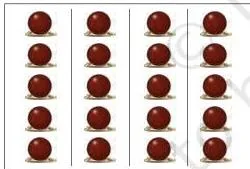

The tables of 2 and 3 are taught with rows of dots, so a child can count the fact before memorising it. The dots turn a symbol like \(3 \times 3\) into something the eye can check.
- Table of 2: each row shows two dot groups. “2 threes are 6” appears as three dots beside three dots (●●● ●●●) — the child counts three and three, and sees six.
- Table of 3: each row shows three dot groups. “3 threes are 9” appears as three groups of three dots (●●● ●●● ●●●) — three threes, counted as nine.
- Table of 10: the rows of ten dots let the child count in tens, which makes “10 ones are 10, 10 twos are 20” feel like counting objects, not reciting a list.
The order in the book is always the same: look at the dots, say the words (“2 threes are 6”), then write the fact \(2 \times 3 = 6\). The picture, the words and the symbol all describe the same groups.
Key words explained: groups, times and equal sharing
This chapter introduces four words that all describe the same two actions — putting things into equal groups, and splitting things equally.
| Word | What it means in this chapter | Example from the book |
|---|---|---|
| Group | A set of equal-sized things counted together | 7 groups of 4 wheels in the opening street scene |
| Times (×) | Shorthand for adding the same number again and again | \(4 \times 2 = 8\) for four bicycles |
| Equal sharing | Splitting a total so everyone gets the same amount | 24 bananas among 3 monkeys — each monkey gets 8 |
| How many groups | The size of each group is fixed; count how many groups fit | 21 beads in strings of 7 — that makes 3 strings |
Hands-on activities worth doing at home
This chapter is designed to be done with real objects, not just pencil and paper. Five minutes with household things teaches more than a filled page.
- Project Work, with 24 objects: collect 24 buttons, bottle caps or pebbles. Start with the book’s own example, 3 groups of 4 → \(3 \times 4\), then try 4 groups of 6, 6 groups of 4, 2 groups of 12 and 8 groups of 3, recording the fact each arrangement shows.
- Make the craft pair: draw 12 bindis equally on 2 ice-cream cones (6 and 6), and divide laddoos equally among 3 plates.
- Say it aloud: the book’s activities expect spoken answers, so say the full sentence with the child — “4 groups of 5 is 20” — instead of only writing \(4 \times 5 = 20\).
Common mistakes children make in Grouping and Sharing
Most errors in this chapter are language errors, not counting errors. The child can count perfectly but writes the fact the wrong way round, or uses the wrong question.
| Common mistake | Correct rule | How to check |
|---|---|---|
| Writing “4 × 3” for “3 groups of 4” | The first number tells how many groups. 3 groups of 4 is written \(3 \times 4\). | Read the fact aloud: “three groups of four” — the number of groups comes first. |
| Treating 4 × 3 and 3 × 4 as the same story | The totals match (12) but the arrangements differ. | Ask the child to draw both: 4 bouquets of 3 flowers and 3 bouquets of 4 flowers. |
| Losing count while adding wheels one by one | Add in groups instead of one at a time. | For three cars, count groups of 4: 4, 8, 12. |
| Confusing equal sharing with making groups | Sharing asks “how many in each group?”; grouping asks “how many groups?” | For 24 bananas among 3 monkeys ask “how many each?”; for 21 beads in strings of 7 ask “how many strings?” |
| Reading × as + because both signs look small | The × sign means “times” — repeated addition, not ordinary plus. | Say the whole fact aloud: “four times two is eight,” not “four plus two.” |
What a Class 2 child should be able to do after this chapter
This is a foundation chapter, so the aim is spoken reasoning with objects, not reciting memorised tables. The checkpoints below come straight from the activities themselves.
- Say “7 fours are 28” when shown 7 cars with 4 wheels.
- Match \(9 + 9 + 9\) to \(3 \times 9\).
- Complete the tables of 2, 3, 5 and 10.
- Build the table of 4 by doubling the table of 2.
- See that 4 groups of 3 and 3 groups of 4 give the same total.
- Share 24 bananas equally among 3 monkeys — 8 each.
- Find how many groups of 5 make 20, as with 20 beads in bracelets of 5.
Textbook contents and the examinable syllabus are not always identical — check the current official syllabus for what is assessable.
One-page recap: from wheels to equal sharing
The whole chapter moves in one direction: groups first, then faster counting, then fair sharing.
| Idea | One example from the chapter |
|---|---|
| Repeated addition counts equal groups | \(2 + 2 + 2 + 2 = 8\) for four bicycles |
| “Times” and × mean “groups of” | 4 groups of 2 = \(4 \times 2 = 8\) |
| Complete the first tables by counting | Tables of 2, 3, 5 and 10 |
| Build a new table by adding two known tables | Table of 4 = table of 2 + table of 2 |
| The same total can come from different groups | \(4 \times 3 = 12\) and \(3 \times 4 = 12\) |
| Equal sharing: how many in each group? | 27 candles, 3 boxes → 9 in each box |
| Making groups: how many groups fit? | 21 beads, 7 per string → 3 strings |
Related resources for Class 2 Mathematics
This listing is maintained for the 2026-27 academic session using the NCERT textbook information available to us. NCERT remains the authority for confirming the latest edition.
Ready to move on? Open the Class 2 Mathematics book page to see the whole textbook, or the Class 2 hub for every subject. The CBSE notes home page covers all classes.
In Joyful Mathematics, go back to the previous chapter, Let us Read, or move ahead to the next chapter, Seasons.
Sources and data verification
This page describes the NCERT Class 2 Joyful Mathematics textbook — Chapter 8, Grouping and Sharing — as published on ncert.nic.in, maintained for the current academic session. It covers the single NCERT Class 2 Mathematics textbook only, and it is a book description, not a CBSE syllabus listing.
NCERT is the authority for textbook editions and official PDFs; CBSE is the authority for curriculum, syllabus and examinations.
Frequently asked questions about Grouping and Sharing Class 2
What does “7 fours are 28” mean in Grouping and Sharing?
It means seven groups of four. In the opening scene there are 7 cars and each car has 4 wheels, so the total is 4 added seven times: \(4 + 4 + 4 + 4 + 4 + 4 + 4 = 28\), written \(7 \times 4 = 28\). The phrase “7 fours” is the book’s way of saying “seven groups of four.”
Why does the chapter compare 4 groups of 3 with 3 groups of 4?
To show that the total can be the same while the arrangement is different. Ram’s 4 bouquets of 3 flowers use \(4 \times 3 = 12\); Gopal’s 3 bouquets of 4 flowers use \(3 \times 4 = 12\). Both make 12 flowers, but the child should be able to draw both pictures. The book asks the child to discuss this observation.
How can my child build the table of 4 from the table of 2?
Write the table of 2 and add it to itself, position by position: \(2+2=4,\ 4+4=8,\ 6+6=12\), and so on until \(20+20=40\). The same method builds the table of 6 from two tables of 3, the table of 7 from the tables of 3 and 4, and the table of 8 from the tables of 2 and 6.
What is the difference between sharing and grouping in this chapter?
Sharing asks “how many in each group?” when the number of groups is fixed — 24 bananas among 3 monkeys means each monkey gets 8. Grouping asks “how many groups?” when the group size is fixed — 21 beads in strings of 7 makes 3 strings. The child has to spot which question the problem is asking.
Where can I download the official Grouping and Sharing Class 2 PDF?
The official PDF is the Grouping and Sharing Class 2 PDF at the top of this page — an NCERT file hosted on ncert.nic.in, ready to read, download or print.
Reference: NCERT Class 2 Mathematics textbook, chapter 8, official edition on ncert.nic.in.
Explore Class 2 Mathematics Books
Related chapters: